Numbing Creams vs Pills for PE: Which Works Better?
Both delay ejaculation, but they work in completely different ways — one numbs the glans on demand in minutes, the other resets a brain reflex over weeks. Here is how I choose between a cream and a pill in clinic.

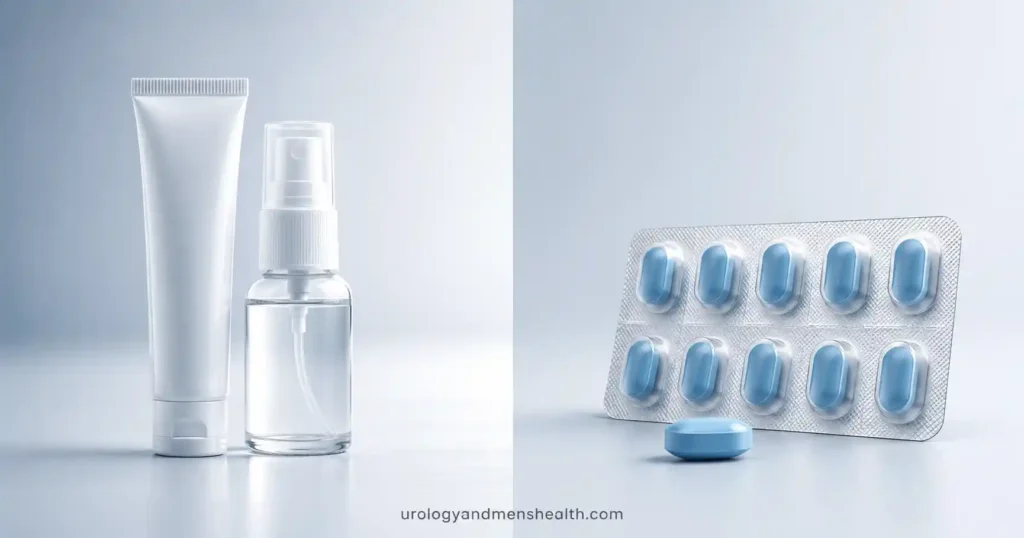
If you are weighing numbing creams vs pills for PE, you have already landed on the two first-line drug treatments urologists actually use — and they could not be more different. One works on the surface of the penis in minutes. The other changes a reflex in your brain over days to weeks. Both are backed as first-line options by the 2020 AUA/SMSNA guideline[1], so this is not a “real” treatment versus a gimmick. It is a question of matching the mechanism to your situation. I see men who spent months on a daily antidepressant they did not need, and others who wrote off a numbing spray after one clumsy attempt. Most of that comes down to not understanding how each option behaves. Below I walk through how each one works, what the evidence shows, and how I decide which to start. For the wider picture of causes and options, see our sexual health hub.
Key Takeaways
- Both topical anesthetics and oral SSRIs are first-line for premature ejaculation under the 2020 AUA/SMSNA guideline — neither is second-best.
- Numbing sprays act in about 5 minutes on demand; a metered lidocaine-prilocaine spray raised average ejaculation time from under 1 minute to roughly 3 to 4 minutes in trials.
- Dapoxetine is the only pill designed specifically for on-demand PE, but it is not FDA-approved in the US; daily paroxetine is stronger but takes 1 to 2 weeks and is off-label.
- The main downside of creams is numbness that can transfer to a partner; the main downside of pills is systemic effects like nausea and lower libido.
In This Guide:
[SECTION B — paste after the TOC block]
How numbing creams and pills for PE actually work
The two treatments attack the problem from opposite ends of the nervous system. Understanding that difference is what tells you which one fits.
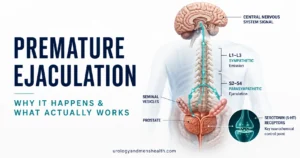
Numbing creams and sprays work locally. The glans, the head of the penis, is dense with sensory nerve endings. A topical anesthetic like lidocaine sits on that surface and dampens the signal traveling up to the spinal cord. Less sensation means the ejaculatory reflex takes longer to trigger. Think of it as turning down the volume on a single microphone rather than rewiring the sound system.
Pills work centrally. SSRIs and related drugs raise serotonin activity in the brain and spinal cord, and higher serotonin slows the ejaculatory reflex at its control center. Nothing is numbed. The timing of the whole reflex is shifted. That is why a pill can feel more “natural” during sex but also carries body-wide side effects a cream never will.
Not sure how severe your PE is? Score it with the PEDT self-assessment →Numbing creams and sprays: what the evidence shows
The topical options fall into three groups. Combination creams such as an EMLA-style lidocaine 2.5% plus prilocaine 2.5% cream, applied to the glans and left for 20 to 30 minutes. Metered sprays such as the lidocaine-prilocaine spray (lidocaine 150 mg/mL and prilocaine 50 mg/mL) that absorb in about 5 minutes. And single-agent lidocaine sprays sold over the counter in some markets, which absorb faster and transfer less.
The evidence for a well-used lidocaine spray for premature ejaculation is genuinely good. In phase III trials, a metered lidocaine-prilocaine spray raised average intravaginal ejaculation time from under 1 minute to roughly 3 to 4 minutes — about a sixfold increase — without dulling the sensation of orgasm itself[2]. That is why the AUA/SMSNA guideline lists topical anesthetics as a first-line pharmacotherapy, on the same tier as pills[1].
How you use it decides whether it works. Apply a small amount to the glans only, wait the full absorption time, then wipe off any excess before sex. The three failure modes I see are the same every time: using too much, spreading it onto the shaft, and not allowing enough time.
Downsides to plan around
Topical anesthetics are effective, but they carry practical drawbacks:
- Partner transfer — lidocaine on the glans can numb a partner’s tissue. Wipe off excess or use a condom.
- Over-numbing — too much can soften your own erection by dulling the sensation that maintains it.
- Skin reactions — occasional local irritation; stop if it develops.
- Keep it off the urethral opening and out of the mouth.
ED that is not responding to the usual pills? Download Dr. Khalid’s ED & Sexual Function Action Plan.
Enter your email below to receive Dr. Khalid’s complete ED & Sexual Function Action Plan as a free, printable PDF.
Pills for PE: dapoxetine, daily SSRIs, and tramadol
Dapoxetine is the only SSRI built specifically for premature ejaculation. It is short-acting, taken on demand 1 to 3 hours before sex at 30 mg or 60 mg, and it clears the body quickly. Phase III trials show it lengthens ejaculation time and improves control and satisfaction[4]. The catch for American readers: dapoxetine is licensed in many countries but is not FDA-approved in the US, which is why no PE-specific pill is sold there[1].
That leaves daily off-label SSRIs as the workhorse pill option: paroxetine, sertraline, fluoxetine, or citalopram taken every day. These are stronger than on-demand dosing but slower to start. Paroxetine is the most effective of the group — one meta-analysis found it increased ejaculation time roughly 8.8-fold over baseline[3]. The trade-off is patience: a daily SSRI usually needs 1 to 2 weeks before the effect is reliable. The full breakdown of dapoxetine and daily SSRIs covers dosing and how to taper them.
Tramadol works on demand and can delay ejaculation, but I keep it in reserve because of its dependence potential and serotonin-syndrome risk when mixed with SSRIs. Clomipramine, an older tricyclic, is effective on demand but has a heavier side-effect load. Neither is a starting point for most men.
The side effects that make men stop pills are predictable: nausea, headache, dizziness, lower libido, and delayed orgasm. Dapoxetine in particular carries a warning for dizziness and fainting on standing. SSRIs should never be combined with MAOIs or other serotonergic drugs without supervision.
In My Practice
A man in his early thirties told me a numbing spray “did nothing except make sex worse.” When I asked how he used it, he had emptied a large dose over the whole shaft, waited two minutes, and skipped the condom — so he had numbed himself soft, numbed his partner, and still had wet product on the surface at penetration. We restarted with three metered sprays to the glans only, five minutes to absorb, and excess wiped off. It worked the first night.
Most “the numbing cream failed” stories are dose and technique problems, not drug failures — get the method right before you abandon the treatment.
Numbing creams vs pills for PE: how I choose
When a man asks which is better, I do not have a single answer — I have six questions. Here is how the two options actually compare on the things that matter in real life.
- Speed: Creams and sprays win — about 5 minutes for a spray, 20 to 30 for a cream. On-demand dapoxetine needs 1 to 3 hours; a daily SSRI needs 1 to 2 weeks of build-up.
- Dosing pattern: Topicals and dapoxetine are used only when you need them. Daily SSRIs commit you to a pill every day, sex or no sex.
- Strength: A daily SSRI, especially paroxetine, tends to produce the largest delay. Topicals and on-demand dosing sit a step below but are enough for most men.
- Side effects: Creams stay local — numbness is the whole risk. Pills act body-wide: nausea, low libido, dizziness.
- Partner impact: Only creams transfer. Pills do not touch your partner at all.
- Access and cost: In the US there is no licensed PE pill, so it is a topical or an off-label SSRI prescription. In countries where dapoxetine is sold, cost often pushes men toward cheaper daily paroxetine.
My rough rule: if you want something on demand and want to avoid a systemic drug, start topical. If you have sex often enough that a pre-sex ritual is annoying, or a spray under-delivers, a daily SSRE is the better fit. And if your PE comes packaged with erectile difficulty, treating the erection first with a PDE5 inhibitor — sometimes alongside a topical — can resolve both. Combination therapy, such as a daily SSRI plus an on-demand topical, is a recognized next step when one alone is not enough. For the broader map of what drives PE and every treatment tier, our complete guide to premature ejaculation causes and treatment lays it out.
One pattern deserves special mention. If your PE started suddenly after years of normal control — acquired PE — the timing is often a symptom, not the disease. Chronic pelvic pain and prostate inflammation can present with rushed or uncomfortable ejaculation, and in those men a cream or pill is treating the wrong target. If that sounds like you, read how prostatitis presents in younger men before committing to a delay product.
Red Flags: When PE Needs a Workup, Not Just a Product
See a urologist rather than self-treating if any of these apply:
- Sudden, new-onset PE after years of normal control — this warrants a cause hunt (thyroid, prostate, new ED).
- PE with erectile difficulty — the erection problem is usually treated first.
- Pain with ejaculation, in the pelvis, or in the testicles.
- You are taking an MAOI or another serotonergic medication — do not add an SSRI or tramadol without medical clearance.
Frequently Asked Questions
Do numbing creams or pills work faster for PE?
When men ask me whether numbing creams vs pills for PE is faster, the creams win on speed. A lidocaine-prilocaine spray works in about 5 minutes and an EMLA-style cream in 20 to 30 minutes, both used on demand. Dapoxetine as a pill needs 1 to 3 hours, and a daily SSRI takes 1 to 2 weeks before it delays ejaculation reliably. If you need something for tonight, gauge your baseline severity first, then reach for a topical.
Can numbing cream transfer to my partner?
Yes, and it is the most common complaint I hear. Lidocaine on the glans can rub off and numb a partner’s tissue, reducing their sensation. You cut that risk sharply by applying only to the glans, waiting the full absorption time, wiping off any excess before sex, or using a condom. Faster-absorbing sprays transfer less than thick creams. Our main PE treatment guide covers application technique in more detail.
Is dapoxetine available in the US?
No. Dapoxetine is the only drug designed specifically for on-demand PE and is licensed in many countries, but it is not FDA-approved in the United States. American men are usually prescribed a daily off-label SSRI such as sertraline or paroxetine instead, or use a topical anesthetic. The SSRI and dapoxetine breakdown explains the off-label options.
Can I use a numbing spray and an SSRI together?
Often yes — combination therapy is a recognized step when one option alone is not enough. A daily SSRI plus an on-demand topical anesthetic can add their effects. What you must not do is combine an SSRI with tramadol or another serotonergic drug without supervision, because of serotonin-syndrome risk. Discuss any combination with a urologist first; our sexual health hub outlines when combinations make sense.
What if my PE started suddenly after years of normal control?
Sudden, new PE — called acquired PE — behaves differently from lifelong PE and deserves a look at the cause before you pick a cream or pill. Thyroid problems, new erectile dysfunction, and pelvic conditions can all trigger it. Chronic prostatitis in particular can present with rushed or painful ejaculation, as covered in our guide to prostatitis in younger men. Treating the driver often fixes the timing.
References
- Shindel AW, Althof SE, Carrier S, et al. Disorders of Ejaculation: An AUA/SMSNA Guideline. J Urol. 2022;207(3):504-512. AUA
- Prilocaine/lidocaine spray for premature ejaculation: a dose- and time-finding study for clinical practice use. Int J Impot Res. 2022. PubMed
- Paroxetine in the treatment of premature ejaculation: a systematic review and meta-analysis. BMC Urol. 2019;19(1):2. PubMed
- McMahon CG. Efficacy of Dapoxetine in the Treatment of Premature Ejaculation. Clin Med Insights Reprod Health. 2011;5:25-39. PubMed
Dr. Muhammad Khalid
MBBS · FCPS (Urology) · MCPS (General Surgery) · CHPE · CRSM · IMC #539472
Specialist urologist with 11+ years of clinical experience across tertiary teaching hospitals. Trained at Lady Reading Hospital and Khyber Teaching Hospital, Peshawar. Author or co-author of five peer-reviewed international publications, including in Cureus and the World Journal of Surgery. Procedural expertise: URS, PCNL, RIRS, TURP, TURBT, and major open urological surgery. Full profile →
This article is for educational purposes only and does not constitute medical advice. Always consult your physician or urologist for diagnosis and treatment decisions specific to your condition.