Creatine and Your Kidneys: Safe or Not? The Evidence
A lifter walks in panicked because a routine blood test flagged "reduced kidney function." Almost always it's creatine raising creatinine — not the kidney. Here's how I tell them apart.

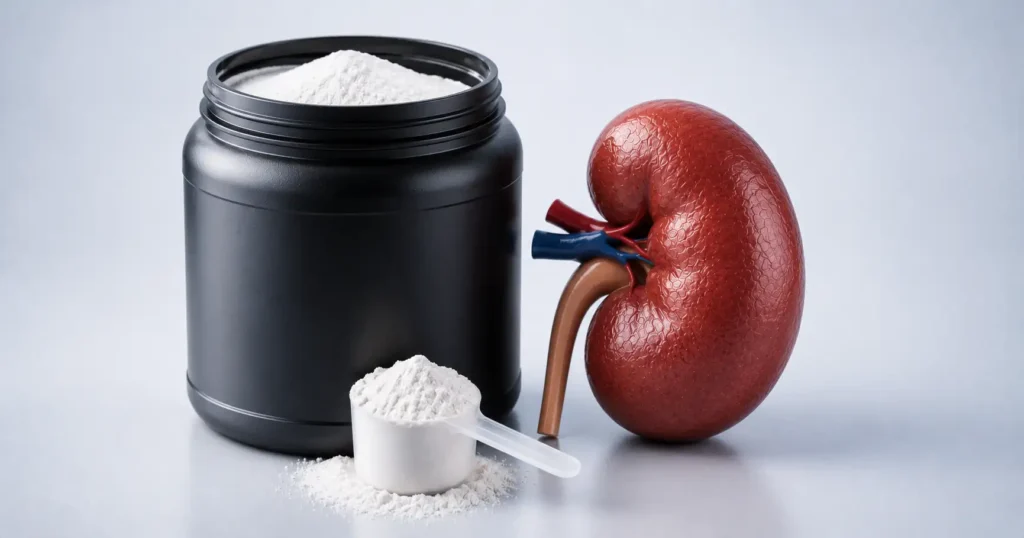
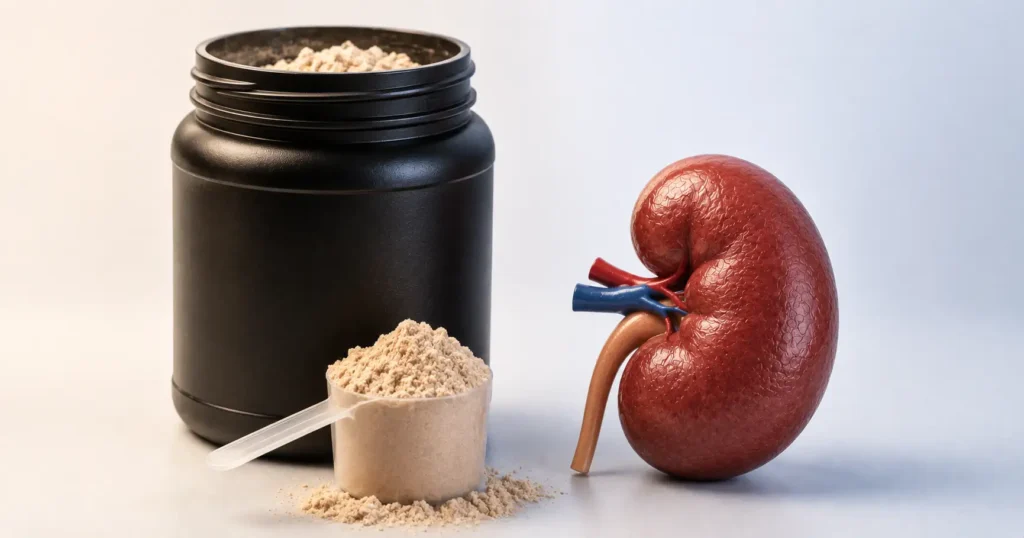
The link between creatine and kidney function is one of the most misunderstood topics I deal with in clinic. A man walks in pale, holding a blood test that says his kidney function looks reduced, already convinced his supplement has damaged him. Almost every time, the kidney is completely fine. What changed is the number on the page, not the organ behind it. Creatine raises a blood marker called creatinine, and creatinine is exactly what most labs use to estimate how well your kidneys filter. So the test reads worse even though nothing has gone wrong inside you. This article explains why that happens, what the research actually shows about creatine and your kidneys, and the small group of men who genuinely should check with a doctor first. For the wider picture of how your kidneys work and what protects them, see our Kidney Stones Hub. Let’s separate the myth from the mechanism.
Key Takeaways
- Creatine raises creatinine, the blood marker most labs use to estimate kidney filtration — so a routine test can look worse even when your kidneys are working normally.
- In healthy adults, creatine doses up to 30 g a day for as long as 5 years have not been shown to lower measured kidney filtration (GFR).
- A 2025 review of 21 studies found a small rise in serum creatinine but no meaningful change in GFR — a number effect, not an organ effect.
- Men with existing kidney disease, a single kidney, or who regularly take anti-inflammatory painkillers should get individual clearance before starting.
Why People Think Creatine Wrecks Your Kidneys
The fear has a specific origin. In 1998, a case report in The Lancet described a young man whose kidney markers worsened while he was taking creatine [4]. It was a single patient who already had a kidney condition, but the headline travelled faster than the detail. Through two decades of gym conversations, “creatine hurt one guy’s kidneys” hardened into “creatine hurts your kidneys.”
The naming overlap makes it worse. Creatine and creatinine sound almost identical and are chemically related, so when a lab flags high creatinine, it is easy to assume the creatine tub on your shelf is the culprit. In reality, creatine is a natural compound. Your liver and kidneys make some of it, you eat more of it in red meat and fish, and your muscles store it as rapid-access fuel. Supplementing simply tops up a tank your body already uses every day.
Creatine and Kidney Function: Why the Blood Test Misleads You
Here is the mechanism that explains almost every scare. Creatine stored in muscle breaks down on its own into creatinine at a steady rate of roughly 2% of your total body store per day [2]. The more creatine you keep in the tank, the more creatinine your body produces as a normal byproduct. That creatinine ends up in your blood, which is where the lab measures it.
Most labs do not measure your kidney filtration directly. They take your serum creatinine and feed it into a formula to produce an estimated GFR (eGFR) — a calculated stand-in for how well your kidneys clear waste. Higher creatinine going into the formula means a lower eGFR coming out, so the report says “reduced kidney function.” But the actual filtration, the true GFR, has not moved. You have simply put more creatinine into a calculation that assumes all of it came from struggling kidneys.
This is why I tell patients two things. First, you can see exactly how serum creatinine drives that estimate with our CKD Stage Calculator — watch the eGFR shift as the creatinine input changes. Second, there is a cleaner test: a cystatin C-based estimate of kidney function does not respond to creatine supplements, so it cuts straight past the artifact. If a result will actually guide a decision, that is the test to ask for.
What the Research Actually Shows
Creatine is one of the most heavily studied supplements in existence, which means we are not guessing here. The International Society of Sports Nutrition reviewed the full literature and concluded that short- and long-term supplementation — up to 30 g per day for five years — is safe and well tolerated in healthy people, from children to the elderly [1].
The most recent evidence is just as reassuring. A 2025 systematic review and meta-analysis in BMC Nephrology pooled 21 studies and found that creatine produced only a small, transient rise in serum creatinine and no significant change in GFR [3]. In plain terms: the marker nudges up, the filtration stays the same. A separate 2023 review of controlled trials reached the same verdict — the idea of creatine-induced kidney failure simply is not supported by well-designed human studies, though the authors were honest that people with pre-existing kidney disease still need more research [2].
In My Practice
A 34-year-old who had been lifting for years came in genuinely frightened. His doctor had repeated a blood test twice and told him his kidney function was slipping. Nobody had asked about the 5 grams of creatine he had taken every morning for three years. We rechecked him with a cystatin C-based estimate, which does not react to creatine, and his kidney function was completely normal.
Most “abnormal” kidney results in healthy creatine users are a measurement artifact, not disease — and the right second test is what proves it.
High blood pressure and worried about your kidneys? Download Dr. Khalid’s Blood Pressure & Kidney Protection Guide.
Enter your email below to receive Dr. Khalid’s complete Blood Pressure & Kidney Protection Guide as a free, printable PDF.
Who Actually Needs to Be Careful
A clean bill of health for healthy people is not the same as a free pass for everyone. The honest position is that a few groups should slow down and get individual advice first.
If you already have reduced kidney function or established chronic kidney disease, the safety data thins out quickly — most studies were done in healthy people, so this is exactly where I want a doctor in the loop. It helps to understand how chronic kidney disease is staged before adding anything that shifts your creatinine. The same caution applies if you have a single kidney or a transplant.
The genuine risk is rarely creatine on its own — it is creatine combined with other stressors. Regular anti-inflammatory painkillers (ibuprofen, naproxen, diclofenac) reduce blood flow through the kidney. Stack those with heavy training, poor hydration, and a very high protein intake, and you are loading several stressors at once. If you are already pushing protein supplements hard, it is worth reading on whether protein powder is hard on the kidneys, because high animal protein also pushes up your kidney stone risk independently of creatine.
Talk to a Doctor Before Starting If…
Creatine is safe for most healthy men, but check first if any of these apply to you:
- You have known chronic kidney disease or a single functioning kidney
- You take NSAID painkillers (ibuprofen, naproxen, diclofenac) regularly
- You have had unexplained protein or blood in your urine
- You are on medications that affect the kidneys, such as certain blood pressure drugs or diuretics
And see a doctor promptly if you develop one-sided flank pain, a sharp drop in how much you urinate, or new swelling in your legs — those point to a real kidney problem, not a lab artifact.
How to Use Creatine Without the Kidney Worry
If you are healthy and want the benefits without the anxiety, the approach is simple. A steady 3-5 grams a day of creatine monohydrate is all most people need. A loading phase (around 20 g a day split into four doses for 5-7 days) only fills your stores faster — it is optional, not safer or stronger.
Hydration matters because creatine pulls water into muscle, so drink to thirst and a little beyond, especially when you train in heat. Most importantly, tell your doctor you take creatine before any kidney blood test. If the result is going to guide a real decision, either stop creatine for two to four weeks before testing or ask for a cystatin C-based estimate that ignores the supplement entirely.
On product choice, stick with plain creatine monohydrate from a third-party-tested brand. The exotic “kidney-friendly” or “advanced” forms cost more and have not earned it. That is the same evidence test I apply to everything men ask me about — the same way I weigh the evidence behind common supplements before recommending them. If a creatine product’s main selling point is its packaging, it is selling you the packaging.
Frequently Asked Questions
Does creatine damage your kidneys?
In healthy people, no. Studies tracking creatine and kidney function — including doses up to 30 g a day for five years — show no drop in true kidney filtration. Creatine raises serum creatinine because it converts to creatinine, which makes a calculated eGFR estimate look lower without the kidney itself being harmed.
Why did my creatinine go up and my eGFR drop after starting creatine?
Because creatine breaks down into creatinine at about 2% of your body store per day, so more creatine means more creatinine in your blood. Labs feed that creatinine into the eGFR formula, so the number drops even though filtration is unchanged. A cystatin C test, or a recheck after a break, usually confirms your kidneys are fine — the same artifact people worry about when reading about chronic kidney disease stages.
Can I take creatine if I have one kidney or kidney disease?
This is where caution is warranted. Most safety data comes from healthy people, so if you have reduced function, a single kidney, or a transplant, get individual clearance from your doctor first. The same applies if you stack creatine with high-dose protein — it is worth understanding whether protein powder strains the kidneys before combining the two.
Should I stop creatine before a kidney blood test?
If the result will guide a medical decision, yes — stopping for two to four weeks removes the creatinine bump and gives a cleaner reading. At minimum, tell your doctor you take creatine so an elevated creatinine is not misread as kidney disease. You can also request a cystatin C estimate, which the supplement does not affect. For the bigger picture of kidney health, see our Kidney Stones Hub.
Is creatine loading harder on the kidneys than a maintenance dose?
Loading (about 20 g a day for a week) raises serum creatinine more sharply in the short term, but research has not linked it to any drop in actual filtration in healthy people. It is not “harder on the kidneys” — it just inflates the marker faster. Most people can skip loading entirely and take a steady 3-5 g a day, which I weigh the same way I weigh other supplement claims.
References
- Kreider RB, Kalman DS, Antonio J, et al. International Society of Sports Nutrition position stand: safety and efficacy of creatine supplementation in exercise, sport, and medicine. J Int Soc Sports Nutr. 2017;14:18. PubMed
- Longobardi I, Gualano B, Seguro AC, Roschel H. Is It Time for a Requiem for Creatine Supplementation-Induced Kidney Failure? A Narrative Review. Nutrients. 2023;15(6):1466. PubMed Central
- Naeini EK, Eskandari M, Mortazavi M, et al. Effect of creatine supplementation on kidney function: a systematic review and meta-analysis. BMC Nephrol. 2025;26(1):622. PubMed
- Pritchard NR, Kalra PA. Renal dysfunction accompanying oral creatine supplements. Lancet. 1998;351(9111):1252-1253. PubMed
Dr. Muhammad Khalid
MBBS · FCPS (Urology) · MCPS (General Surgery) · CHPE · CRSM · IMC #539472
Specialist urologist with 11+ years of clinical experience across tertiary teaching hospitals. Trained at Lady Reading Hospital and Khyber Teaching Hospital, Peshawar. Author or co-author of five peer-reviewed international publications, including in Cureus and the World Journal of Surgery. Procedural expertise: URS, PCNL, RIRS, TURP, TURBT, and major open urological surgery. Full profile →
This article is for educational purposes only and does not constitute medical advice. Always consult your physician or urologist for diagnosis and treatment decisions specific to your condition.