TURP vs HoLEP vs Aquablation vs UroLift: How to Choose
Most men comparing TURP vs HoLEP vs Aquablation vs UroLift start with the efficacy data. Your prostate size and whether you still care about ejaculating decide two or three of these before efficacy ever enters the room.

TURP vs HoLEP vs Aquablation vs UroLift is the comparison most men bring into my clinic, usually printed off or half-remembered from a friend’s experience. It is the right shortlist and almost always the wrong opening question. Before any of these is genuinely on or off the table, two facts settle most of the decision: how large your prostate is, and whether preserving ejaculation matters more to you than never needing a second operation. Those two answers eliminate two or three of the four options inside a minute of consultation time. What follows is how I work through it in practice — the prostate size ranges each procedure was actually tested in, the five-year repeat-procedure numbers from the trials rather than the brochures, and the sexual trade-offs that get mentioned quickly and understood badly. For the wider picture of when surgery becomes the right move at all, see the Prostate Health Hub.
Key Takeaways
- Prostate volume is a gate, not a preference: UroLift and Rezum were trialled at 30-80 mL, Aquablation up to 150 mL, and HoLEP has no upper size limit.
- Five-year repeat-procedure rates differ by roughly threefold between the minimally invasive options — 4.4% after Rezum versus 13.6% after UroLift.
- UroLift durability depends on how many implants your surgeon places: four or fewer predicted early retreatment, and each extra implant cut surgical retreatment odds by about 41%.
- A Cochrane network meta-analysis found minimally invasive treatments give similar or worse symptom relief than TURP at short-term follow-up, on low-certainty evidence — the trade is side effects, not superiority.
TURP vs HoLEP vs Aquablation vs UroLift: What Each One Actually Removes
The four procedures are not four versions of the same operation. They sit on a spectrum of how much prostate tissue leaves your body, and almost every difference in outcome follows from that one variable.
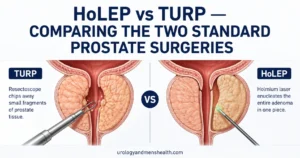
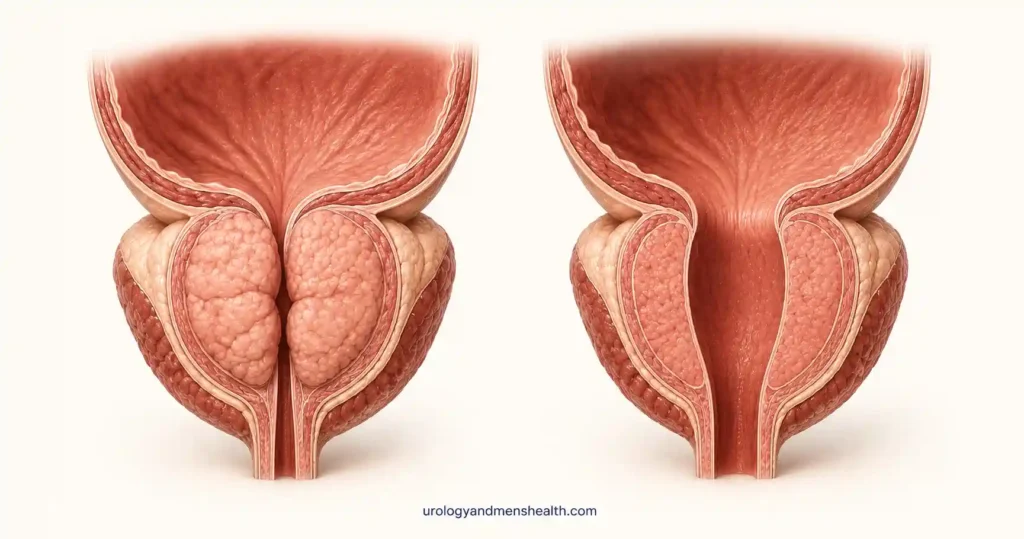
TURP chips obstructing tissue away from the inside of the prostatic urethra with an electrified loop, a few grams at a time. It has been the reference standard since the 1970s, which is why every newer procedure is measured against it rather than against each other. HoLEP takes a different approach entirely — a holmium laser peels the whole obstructing lobes off the surgical capsule, in the same plane a surgeon’s finger would find during open prostatectomy, and the tissue is then morcellated and suctioned out. The distinction matters: resection removes what the surgeon can reach, enucleation removes what is anatomically there.
Aquablation uses a high-velocity waterjet, mapped on real-time ultrasound and delivered by a robotic arm, to cut a channel through the tissue without heat. Because no energy is applied, the structures around the verumontanum can be spared deliberately rather than by feel. UroLift removes nothing at all. Permanent implants are fired through the lateral lobes to pin them open, mechanically widening the channel while leaving the gland in place. Rezum, which belongs in this conversation even though it rarely makes the four-way lists, injects steam into the tissue; the treated tissue then dies and is reabsorbed over the following three months.
That last group — UroLift and Rezum — is what urologists mean by minimally invasive surgical therapy, or MIST. The practical differences between UroLift and Rezum are worth reading separately, because they are frequently presented to patients as interchangeable and they are not.
Prostate Size Decides More of This Than You Think
Every one of these procedures was tested in a defined prostate volume range, and those ranges are narrower than the marketing suggests.
The randomised UroLift trial enrolled men with prostates between 30 and 80 mL and treated the lateral lobes only [6]. The Rezum trial used the same 30-80 mL window, though it permitted middle lobe treatment at the surgeon’s discretion [7]. Aquablation was tested first in 30-80 mL glands and then, in the WATER II trial, in prostates of 80-150 mL with a mean volume of 107 mL [4]. HoLEP has no ceiling — the original randomised comparison against TURP enrolled prostates from 40 up to 200 mL [2].
So if your prostate measures 110 mL, two of the four options in your title question were never studied at your size. That is not a technicality. It is the single most common reason I have to redirect a consultation that arrived with a decision already made.
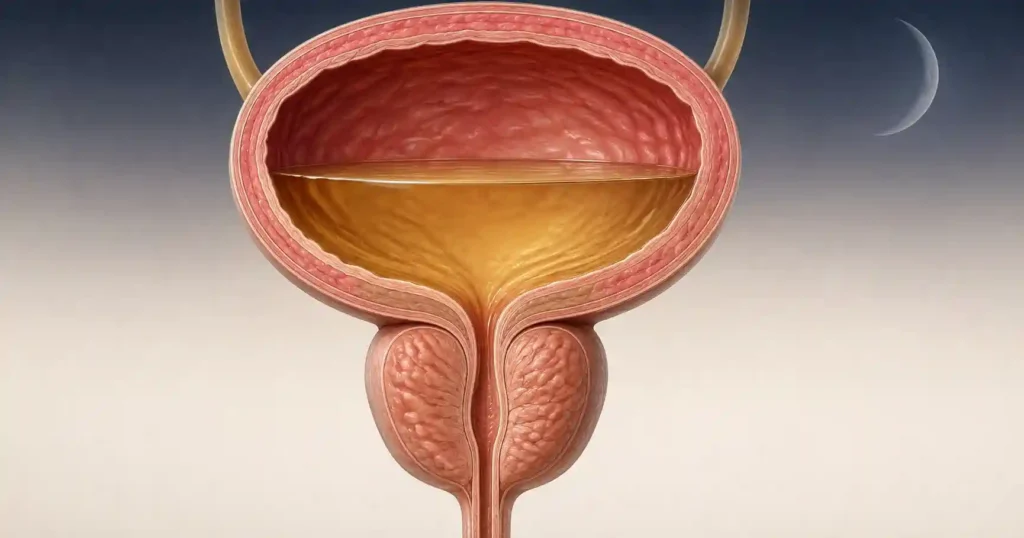
The second anatomical gate is the median lobe — a third lobe that grows upward into the bladder like a plug rather than outward. UroLift was designed to hold lateral lobes apart and does poorly against an obstructing intravesical median lobe. Rezum can treat one. Aquablation and HoLEP handle it routinely. If you do not know your prostate volume and lobe configuration, you are not yet in a position to compare anything; run your ultrasound dimensions through the prostate volume calculator and bring the number to your appointment.
In My Practice
The consultation that stays with me is a 58-year-old accountant who arrived having already settled on UroLift, because a colleague at his firm had it and was back at work in two days. His transrectal ultrasound showed a 96 mL prostate with a large median lobe sitting in the bladder base like a cork. I turned the screen round and showed him. He had spent three weeks comparing a procedure he was not anatomically eligible for against three he had already dismissed.
Volume and lobe anatomy are gatekeepers, not tiebreakers — measure first, then compare.
The Decision Matrix: Matching the Procedure to the Man
Here is the comparison in the form I actually use, with the numbers taken from the trials rather than from device literature.
| Procedure | Prostate size studied | Repeat procedure by 5 yr | Ejaculation preserved | Typical catheter time |
|---|---|---|---|---|
| TURP | 40-200 mL (RCT arm) | 18%* | Rarely | 1-3 days |
| HoLEP | 40-200 mL, no upper limit | 0%* | Rarely | 1-2 days |
| Aquablation | 30-150 mL | 3-5% | Often | 1-2 days |
| UroLift (PUL) | 30-80 mL, lateral lobes | 13.6% | Usually | 0-1 days |
| Rezum (WVTT) | 30-80 mL, median lobe OK | 4.4% | Usually | 3-7 days |
Read that Rezum row again. The procedure sold hardest on being minimally invasive is the one most likely to send you home with a catheter for a week, because the treated tissue swells before it shrinks. Men are rarely told this at the point of choosing, and it is the complaint I hear most often afterwards.
If you want to work through your own combination of volume, symptoms and priorities before your appointment, the BPH procedure selector walks the same branching logic the 2026 AUA guideline uses [1].
The BPH Surgery Consultation Checklist: What to Measure and What to Ask Before You Consent
Enter your email below to receive Dr. Khalid’s complete BPH & Enlarged Prostate Guide as a free, printable PDF.
Retreatment Rates: The Number Nobody Quotes You
Symptom score improvement is what gets quoted in the consultation room. Retreatment is what determines whether you go through this once or twice.
At five years, the randomised UroLift trial reported 13.6% surgical retreatment — roughly one man in seven needed a further operation [6]. The Rezum trial reported 4.4% over the same period [7]. Aquablation reported 95% and 97% freedom from surgical retreatment at five years in the 30-80 mL and 80-150 mL cohorts respectively, with 99% and 94% of men off BPH medication entirely [5]. That last figure is the one I find most useful: staying off tamsulosin is a more honest measure of success than a symptom score taken on a good day.
Enucleation sits at the durable end. In the seven-year randomised follow-up, no assessable HoLEP patient required reoperation for recurrent BPH, against three of seventeen in the TURP arm [2]. The sample was small enough that I would not build a policy on it alone, but a Korean multicentre analysis across six hospitals found the same direction of effect — lower reoperation, lower transfusion, and less long-term dependence on alpha-blockers and 5-alpha reductase inhibitors after HoLEP than after TURP [1]. If you are weighing those two specifically, the head-to-head evidence on HoLEP against TURP covers it properly.
The UroLift number deserves a caveat that works in the patient’s favour. A 2026 pooled analysis of 331 men across five controlled studies found durability was largely a technique variable: placing four or fewer implants was associated with higher surgical retreatment within the first year, and every additional implant reduced the odds of surgical retreatment by a further 41.2% [8]. Higher baseline symptom scores also predicted retreatment out to five years. So the honest version of the 13.6% figure is that it is an average across surgeons who placed different numbers of implants, and the man who asks his surgeon how many implants are planned is asking a question with a real answer behind it.
One finding runs against the whole minimally invasive story, and it belongs here. A Cochrane network meta-analysis of 27 trials and 3,017 men concluded that minimally invasive treatments produce similar or worse urinary symptom outcomes than TURP at short-term follow-up, with the overall certainty of evidence rated low to very low [9]. The reduction in major adverse events was real and substantial. The improvement in urination was not. That is the trade you are making, stated plainly.
Ejaculation, Erections, and What You Are Actually Trading
Retrograde ejaculation is the most under-discussed outcome in this entire decision, and the one men are most upset about later.
The mechanism is simple. During ejaculation the bladder neck clamps shut so semen is forced forward down the urethra. TURP and HoLEP both widen the bladder neck deliberately — that is how they relieve obstruction — and the muscle can no longer close. Semen takes the path of least resistance backwards into the bladder. The orgasm sensation is generally preserved; the visible ejaculate is not. It comes out cloudy in the next urination. It is not dangerous, and it is not reversible, but it does end natural fertility. If that is relevant to you, read what retrograde ejaculation after prostate surgery actually involves before you consent to anything.
The newer procedures were designed around this problem. In the five-year WATER trial data for 50-80 mL prostates, new-onset ejaculatory dysfunction was 21.9 percentage points lower after Aquablation than after TURP, alongside a greater symptom score improvement of 14.1 points versus 10.8 [3]. Across five years of UroLift follow-up there was no de novo sustained erectile or ejaculatory dysfunction reported [6], and the Rezum trial reported no device- or procedure-related sexual dysfunction and no sustained new erectile dysfunction over the same period [7].
Worth setting against the medications you may currently be on. When Rezum patients were compared against the drug arms of the MTOPS trial over five years, men on finasteride and on combination therapy showed significant deterioration in desire, erectile function and ejaculatory function, while the men who had a single steam procedure reported improved sexual satisfaction across the five years [7]. If you have been told your options are surgery or staying on tablets, that comparison is not as one-sided as it sounds.
When This Stops Being an Elective Comparison
Some findings take the timeline out of your hands. Speak to a urologist within days, not months, if any of these apply:
- You cannot pass urine at all, or you are passing only small volumes with a painfully full bladder — this is acute retention and needs a catheter the same day.
- Your creatinine or eGFR has worsened and your urologist has attributed it to bladder outlet obstruction.
- You have had two or more urinary tract infections in six months, or stones have formed in your bladder.
- You are passing visible blood in the urine repeatedly, particularly with clots.
- You are emptying incompletely enough that you leak overflow urine at night.
In these situations the question changes from which procedure you prefer to which procedure can be done soonest and most definitively.
What to Ask Your Urologist Before You Consent
Bring these five questions to the appointment. They are the ones that change the answer.
- What is my measured prostate volume, and do I have a median lobe? Ask for the number in mL from ultrasound or MRI, not an impression from digital examination. This alone rules two options in or out.
- How many of this procedure do you personally do a year? HoLEP in particular has a steep learning curve, and enucleation outcomes track operator volume more than any other variable in this list.
- If you are proposing UroLift, how many implants do you expect to place? Four or fewer was associated with higher retreatment in the pooled five-study analysis [8]. This is a fair and answerable question.
- What is your own retreatment rate, and over what follow-up period? Trial numbers are a floor, not a promise. A unit that audits its own outcomes will have this.
- How long will I have a catheter, and will I go home with it? Confirm this specifically for Rezum, where the answer is often longer than men expect.
If TURP is what is being offered and you want to know exactly what the admission involves, the TURP procedure explained step by step covers the day itself. For the newer waterjet option, the detail on how Aquablation compares to conventional resection goes further into the trial evidence than this page does.
Frequently Asked Questions
Can UroLift work on a 100 mL prostate?
It was not trialled there. The randomised UroLift study enrolled men with prostates of 30 to 80 mL and treated lateral lobes only. Above that volume, and particularly with an intravesical median lobe, the implants have too much tissue to hold apart. At 100 mL the realistic options are Aquablation, HoLEP or open or robotic simple prostatectomy. Confirm your volume using the prostate volume calculator first.
Does HoLEP always cause retrograde ejaculation?
Not always, but expect it. Enucleation widens the bladder neck by design, so the muscle can no longer close during ejaculation and semen passes backwards into the bladder. The sensation of orgasm is usually unchanged. Ejaculation-preserving modifications exist but are not standard and trade some symptom relief. Read what retrograde ejaculation involves before consenting if fertility matters to you.
How do TURP vs HoLEP vs Aquablation vs UroLift compare on five-year retreatment?
UroLift reported 13.6% surgical retreatment at five years, Rezum 4.4%, and Aquablation 3 to 5% across both size cohorts. HoLEP and TURP have the longest randomised follow-up at 7.6 years, where no HoLEP patient and three of seventeen TURP patients required reoperation, though those samples are small. Enucleation is the most durable; UroLift the least, and heavily dependent on implant count.
Is Aquablation actually robotic surgery?
Partly. A surgeon maps the treatment area on live ultrasound and sets the boundaries; a robotic arm then delivers the waterjet along that plan. The tissue removal is automated, the decision-making is not. No heat is used, which is why structures near the verumontanum can be spared deliberately. The detailed Aquablation comparison covers how the mapping step works.
Why did my urologist offer only one of these four options?
Usually availability rather than dogma. Aquablation and HoLEP require specific equipment and a surgeon trained on it, and many units offer neither. If only one option was presented and your prostate volume would allow others, ask directly whether the limitation is anatomical or logistical. If it is logistical, a second opinion at a higher-volume centre is reasonable — start with the BPH procedure selector to see what should be on your list.
References
- Goueli R, Badlani GH, Welliver C, et al. Management of Lower Urinary Tract Symptoms Attributed to Benign Prostatic Hyperplasia: AUA Guideline (2026) Part III: Procedural/Surgical Management. J Urol. 2026;216(2):161-170. doi:10.1097/JU.0000000000005099. AUA
- Gilling PJ, Wilson LC, King CJ, et al. Long-term results of a randomized trial comparing holmium laser enucleation of the prostate and transurethral resection of the prostate: results at 7 years. BJU Int. 2012;109(3):408-411. doi:10.1111/j.1464-410X.2011.10359.x. PubMed
- Oumedjbeur K, Corsi NJ, Bouhadana D, et al. Aquablation versus TURP: 5-year outcomes of the WATER randomized clinical trial for prostate volumes 50-80 mL. Can J Urol. 2023;30(5):11650-11658. PubMed
- Bhojani N, Bidair M, Kramolowsky E, et al. Aquablation therapy in large prostates (80-150 mL) for lower urinary tract symptoms due to benign prostatic hyperplasia: final WATER II 5-year clinical trial results. J Urol. 2023;210(1):143-153. doi:10.1097/JU.0000000000003483. PubMed
- Berjaoui MB, Nguyen DD, Almousa S, et al. WATER versus WATER II 5-year update: comparing Aquablation therapy for benign prostatic hyperplasia in 30-80 cm3 and 80-150 cm3 prostates. BJUI Compass. 2024;5(11):1023-1033. doi:10.1002/bco2.430. PubMed
- Roehrborn CG, Barkin J, Gange SN, et al. Five year results of the prospective randomized controlled prostatic urethral L.I.F.T. study. Can J Urol. 2017;24(3):8802-8813. PubMed
- McVary KT, Gittelman MC, Goldberg KA, et al. Final 5-year outcomes of the multicenter randomized sham-controlled trial of a water vapor thermal therapy for treatment of moderate to severe lower urinary tract symptoms secondary to benign prostatic hyperplasia. J Urol. 2021;206(3):715-724. doi:10.1097/JU.0000000000001778. PubMed
- Eure G, Ashley M, Rukstalis DB, et al. Predictors of durability of the prostatic urethral lift (PUL) for benign prostatic hyperplasia. Prostate Cancer Prostatic Dis. 2026. doi:10.1038/s41391-026-01101-y. PubMed
- Franco JVA, Jung JH, Imamura M, et al. Minimally invasive treatments for benign prostatic hyperplasia: a Cochrane network meta-analysis. BJU Int. 2021;130(2):142-156. doi:10.1111/bju.15653. PubMed
Dr. Muhammad Khalid
MBBS · FCPS (Urology) · MCPS (General Surgery) · CHPE · CRSM · IMC #539472
Specialist urologist with 11+ years of clinical experience across tertiary teaching hospitals. Trained at Lady Reading Hospital and Khyber Teaching Hospital, Peshawar. Author or co-author of five peer-reviewed international publications, including in Cureus and the World Journal of Surgery. Procedural expertise: URS, PCNL, RIRS, TURP, TURBT, and major open urological surgery. Full profile →
This article is for educational purposes only and does not constitute medical advice. Always consult your physician or urologist for diagnosis and treatment decisions specific to your condition.