ESWL vs URSL vs PCNL: How Urologists Actually Decide
Choosing between ESWL vs URSL vs PCNL is not a ranking exercise. It is a matching exercise — stone size, density, and position against three very different mechanical solutions. Here is the framework I use in clinic.

ESWL vs URSL vs PCNL is not a ranking question, though almost every patient asks it that way. Men come into my clinic having read that one of these operations is “the best,” and they want to know why they are not being offered it. The honest answer is that all three are excellent operations aimed at different problems. A shockwave machine, a laser fiber threaded up the ureter, and a tract drilled through the flank are three mechanically distinct solutions, and the stone in front of you decides which one is appropriate. Size, density, position inside the kidney, your body habitus, and how the kidney drains all shift the calculation. What follows is the framework I actually use, the trial evidence behind it, and the questions worth asking before you agree to anything. For the wider picture on preparation and recovery across urological procedures, see our Urological Surgery and Recovery hub.
Key Takeaways
- Shockwave lithotripsy fragments stones from outside the body with no incision, but stone density above 1,000 Hounsfield units and a long skin-to-stone distance both predict failure.
- In the PUrE randomized trial, ureteroscopy cleared twice as many small lower pole stones as shockwave therapy (72% vs 36%) — yet patients reported no difference in quality of life over the following 12 weeks.
- For lower pole stones of 10-25 mm, PCNL cleared 71% versus 48% for ureteroscopy, with far fewer follow-up procedures (6% vs 23%).
- The 2026 AUA surgical stone guideline added mini-PCNL as an option from roughly 10 mm upward, where it may be preferred over ureteroscopy for its higher single-session clearance.
- The right question is not “which operation is best” but “how many procedures am I willing to accept to become stone-free”.
ESWL vs URSL vs PCNL: What Each Procedure Actually Does
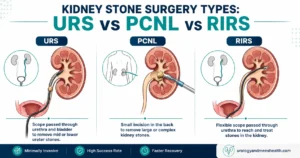
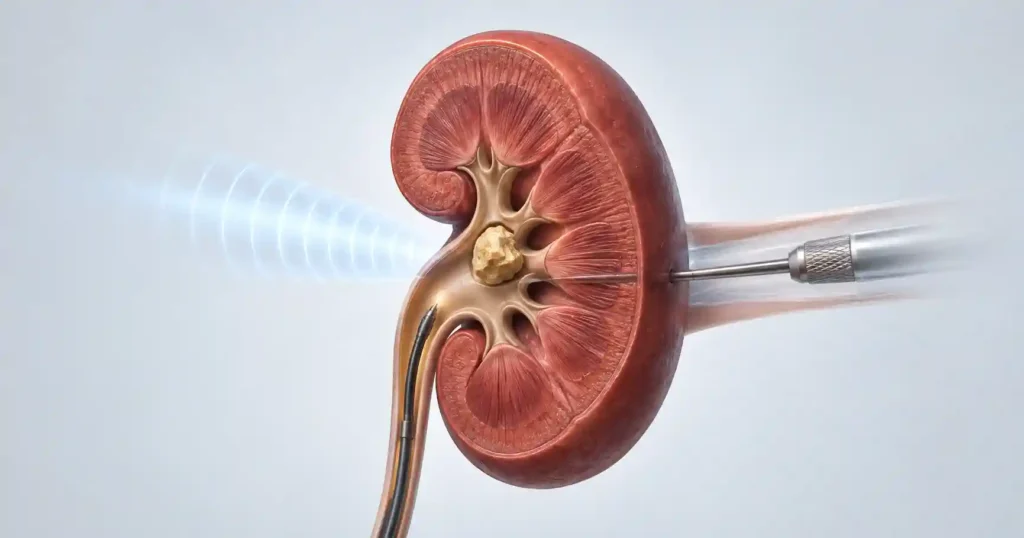
ESWL (extracorporeal shockwave lithotripsy) focuses acoustic energy from outside your body onto the stone. Nothing enters you. Around 2,000 to 4,000 shocks are delivered in a session, and the stone cracks along internal fault lines. You then pass the fragments yourself over the following days to weeks. Think of it as controlled fatigue failure — repeated pressure pulses opening microscopic cracks until the structure gives way. The catch is that the fragments still have to travel out through your ureter, so the operation only ends when your body finishes the job. Candidacy is narrower than most people expect, and I have written separately on who is genuinely a good shockwave candidate.
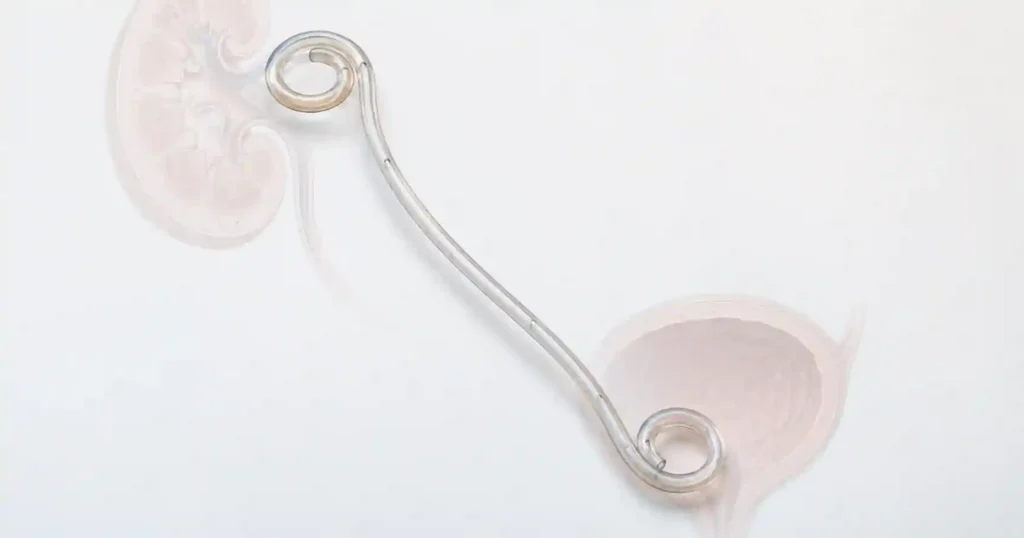
URSL (ureteroscopic lithotripsy) means passing a scope up through the urethra, bladder and ureter to reach the stone directly, then breaking it with a holmium or thulium laser. When the scope has to bend up into the kidney itself, we call it RIRS — retrograde intrarenal surgery. The advantage is that I am looking at your stone and I can see it disappear. Fragments are either dusted small enough to wash out or basketed and removed under direct vision. The trade-off is instrumentation of the ureter, which is why a stent often follows. The technique itself is covered in detail in our guide to flexible ureteroscopy and RIRS.
PCNL (percutaneous nephrolithotomy) creates a working channel through your flank directly into the kidney, usually about 5 to 10 mm wide (roughly 1/5 to 2/5 inch). Through that tract I can use larger instruments, suction fragments out actively, and clear a stone burden that would take three ureteroscopies to touch. It is the most invasive of the three and the only one that routinely involves an overnight stay. It is also the only one that reliably clears staghorn and large-volume disease in a single sitting. Our step-by-step account of PCNL surgery walks through what the day itself involves.
The Three Variables That Decide the Operation
Size. This is the first filter and the least controversial one. Below about 10 mm (roughly 2/5 inch), all three modalities are technically feasible and the argument is about convenience and clearance. Between 10 and 20 mm, shockwave therapy starts losing badly, and the real contest becomes ureteroscopy versus PCNL. Above 20 mm (about 3/4 inch), PCNL is the default because the volume of fragment simply cannot be evacuated retrograde in one session. Our kidney stone size chart sets out where the thresholds sit for observation versus intervention.
Density. This is the variable patients almost never hear about, and it is the one that most often explains why shockwave therapy was not offered. Stone hardness is measured on your CT scan in Hounsfield units. A systematic review of 28 studies covering 4,206 patients found that a mean density below 750 HU is associated with shockwave success, while values above 1,000 HU are strongly associated with failure [6]. Overall shockwave success across those studies averaged 66.5% — a number that surprises people who assume the non-invasive option is also the reliable one. Cystine and brushite stones are notoriously shockwave-resistant regardless of what the number says.
Location and body habitus. A stone sitting in the lower pole of the kidney has gravity working against it — fragments have to climb out of a dependent pouch. Skin-to-stone distance matters too, because shockwave energy attenuates through tissue. One risk-stratification study combined both factors and found shockwave success of 91% in patients with stones under 900 HU and a skin-to-stone distance under 9 cm (about 3.5 inches), falling stepwise to 41% in those with both a denser stone and a longer distance [7]. That is not a marginal difference. That is a different operation.
Work through your own stone size, density and location with the Kidney Stone Surgery Selector →What the Randomized Trials Actually Found
Most comparisons of these procedures come from single-center series with wildly different definitions of “stone-free.” The PUrE program changed that. It ran two parallel randomized trials in UK hospitals, and both reported in 2025.
PUrE RCT 1 randomized 461 patients with lower pole stones of 10 mm or less to flexible ureteroscopy or shockwave lithotripsy [3]. Complete stone clearance was 72% with ureteroscopy versus 36% with shockwave therapy — exactly double. Only 9.1% of ureteroscopy patients needed another treatment, compared with 27% after shockwave. And yet the primary outcome, health status measured weekly for 12 weeks, showed no significant difference between the groups. Shockwave therapy was also decisively more cost-effective.
I want to sit on that result for a moment, because it is the single most useful finding in this field and it is routinely misreported. Ureteroscopy cleared twice as many stones. Patients could not feel the difference. That does not make the stone-free rate meaningless — residual fragments seed future stones and future colic, and 12 weeks is too short a window to capture that. But it does mean that anyone telling you the higher-clearance operation is automatically the better patient experience is arguing past the evidence.
PUrE RCT 2 took the larger stones: 159 patients with lower pole stones of 10-25 mm randomized to ureteroscopy or PCNL [4]. PCNL cleared 71% versus 48%, and needed additional treatment in 6% of cases versus 23%. Health status was marginally better with PCNL, and PCNL was also cheaper. Here the more invasive operation won on almost every axis, which tells you the size threshold is real.
Real-world data lands in the same place with worse numbers. A Michigan surgical collaborative reviewed 3,645 procedures for lower pole stones across 35 practices and found stone-free rates of 56% for ureteroscopy versus 39% for shockwave therapy in stones of 1 cm or less — both well below the figures quoted in expert-center series [5]. Notably, shockwave therapy was still chosen for 62.7% of those cases.
Facing stone surgery? Get the recovery guide covering stents, pain control, and what to expect week by week.
Enter your email below to receive Dr. Khalid’s complete Urology Surgery Recovery Guide as a free, printable PDF.
The 2026 AUA Framework: Matching Procedure to Stone
The American Urological Association replaced its long-standing 2016 stone surgery guideline with a three-part series published in 2026, drawing on literature through 2025 [1]. Two changes matter for this decision.
First, mini-PCNL entered the algorithm as a distinct option, particularly for stones between 10 and 30 mm. For stones of 10-20 mm, the guideline indicates mini-PCNL may be offered in preference to ureteroscopy on the strength of higher stone-free rates, while acknowledging that ureteroscopy retains advantages at certain locations [2]. This is a meaningful shift. The old mental model was “small stone equals scope, big stone equals tract,” with a grey zone in between. Miniaturized percutaneous access has pulled the tract option downward into that grey zone.
Second, the guideline now advises that additional asymptomatic non-obstructing stones of 6 mm or less should be offered treatment during a ureteroscopy or PCNL already being performed, on the basis that clearing them reduces future stone events [2]. If you have three small stones scattered through the kidney and one causing trouble, this is the reason your surgeon may propose dealing with all of them. It is a legitimate change in practice, not upselling.
The guideline also clarified shockwave sequencing: a repeat session may be considered after an incomplete response, but after a failed retreatment the recommendation is to move to ureteroscopy rather than persist [2]. Two failed shockwave sessions is the point at which the modality itself, not the technique, is the problem. Our Tier-1 overview of URS, PCNL and RIRS as stone surgeries sets these procedures side by side in more general terms.
In My Practice
The conversation I have most often is with a man in his forties carrying a 14 mm lower pole stone who has already had one shockwave session elsewhere and been told to come back for another. He arrives frustrated, assuming the machine was faulty or the operator inexperienced. When I pull up his CT, the stone reads over 1,100 Hounsfield units and his skin-to-stone distance is 12 cm. Nothing went wrong. The stone was never going to fragment.
If your first shockwave session produced no visible fragmentation at all, ask for the Hounsfield value from your CT report before agreeing to a second session — that single number often ends the discussion.
Ureteral Stones Are a Different Decision
Everything above concerns stones inside the kidney. Once a stone has moved into the ureter, the calculus shifts, because the ureter is a narrow muscular tube and position along it changes what is reachable.
Distal ureteral stones — those in the lower third, near the bladder — are the strongest case for ureteroscopy. A semirigid scope reaches them easily and the stone has nowhere to escape to. A meta-analysis of comparative studies found pooled stone-free rates of 84% for ureteroscopy versus 60% for shockwave therapy, with mean overall costs of $2,801 versus $3,627 [8].
Proximal ureteral stones are more contested. Shockwave therapy works reasonably well there because the stone sits close to the kidney and fragments have a short journey. Ureteroscopy carries the specific hazard of retropulsion — the stone being pushed backward into the kidney during treatment, converting a straightforward case into a RIRS. Evidence here genuinely splits, and a well-run shockwave service with an early second-session protocol can match ureteroscopy for these stones with fewer ureteric injuries.
PCNL for ureteral stones is reserved for large, impacted proximal stones where retrograde access has already failed or is predicted to fail. It is not a first-line ureteral operation.
When This Decision Becomes Urgent
The comparison in this article assumes an elective, planned procedure. Some presentations override it entirely and need emergency drainage first — a stent or nephrostomy — before any stone treatment is discussed. Go to the emergency room the same day if you have:
- Fever above 38°C (100.4°F) with flank pain — an infected, obstructed kidney can progress to sepsis within hours
- Flank pain in a solitary kidney, a transplanted kidney, or with known chronic kidney disease
- Passing little or no urine over 12 hours alongside stone symptoms
- Vomiting severe enough that you cannot keep fluids or pain medication down
- Pain that is unmanageable despite full-dose oral analgesia
What You Are Trading: Recovery, Risk and Repeat Procedures
Stone-free rate is one axis. It is not the axis most patients are actually optimizing for, and a good consultation makes the other trades explicit.
Anesthesia and time off. Shockwave therapy is often done under sedation and you go home the same morning, frequently back at work the next day. Ureteroscopy is a general anesthetic day case, with most men back to desk work within two to four days. PCNL usually means one to two nights in hospital and one to two weeks before comfortable return to physical work.
The stent question. This is the complaint I hear more than any other, and it is asymmetric across the three procedures. Shockwave therapy frequently requires no stent. Ureteroscopy usually does. Stent symptoms — urgency, flank pain on voiding, blood in the urine — are the dominant reason men describe ureteroscopy as worse than they expected, even when the surgery itself went perfectly. If you are weighing modalities and you already know you tolerate discomfort poorly, this belongs in the conversation.
The complication profile differs in kind, not just degree. Shockwave therapy risks steinstrasse, a column of fragments obstructing the ureter, and perirenal hematoma. Ureteroscopy risks ureteral injury and, rarely, stricture. PCNL carries the highest bleeding risk — the 2026 AUA guideline addresses this directly, permitting continuation of low-dose aspirin in selected patients and raising tranexamic acid as an option to reduce bleeding [2]. Pleural injury is a specific concern with upper pole access.
Ask about the retreatment number, not just the success number. Two operations that both end with you stone-free are not equivalent if one required three visits. In PUrE RCT 1, 27% of shockwave patients needed further treatment against 9.1% after ureteroscopy [3]. Ask your urologist directly: what proportion of patients like me need a second procedure? If the answer is vague, ask for the unit’s own audit figures.
Compare recovery times, anesthesia and complication profiles across urological procedures →Frequently Asked Questions
Is ESWL still worth doing if my stone is over 1,000 Hounsfield units?
Usually not as a first choice. A systematic review of 4,206 patients found that densities above 1,000 HU are strongly associated with shockwave failure, while values under 750 HU predict success. If your CT reports a value above 1,000, ask specifically why shockwave therapy is being proposed over ureteroscopy. Our guide to shockwave candidacy sets out the full list of factors that argue against it.
Why did my urologist recommend PCNL for a 15 mm stone instead of ureteroscopy?
Because at that size the tract wins on clearance. In PUrE RCT 2, PCNL cleared 71% of lower pole stones of 10-25 mm against 48% for ureteroscopy, and only 6% of PCNL patients needed further treatment versus 23%. The 2026 AUA guideline also introduced mini-PCNL as an option from around 10 mm upward for this reason. Our account of what PCNL surgery involves explains the tract itself.
Does the choice between ESWL vs URSL vs PCNL change whether I need a stent?
Substantially. Shockwave lithotripsy often requires no stent at all. Ureteroscopy usually does, because the ureter has been instrumented and needs to drain while it settles. PCNL varies by technique and whether a nephrostomy tube is left. If stent symptoms concern you, raise it before the operation is booked, not after. Our guide to flexible ureteroscopy covers what stenting after RIRS typically involves.
If shockwave lithotripsy fails once, should I repeat it or switch to ureteroscopy?
One repeat session is reasonable after a partial response. The 2026 AUA guidance is that after a failed retreatment, the move should be to ureteroscopy rather than a third attempt. If the first session produced no fragmentation whatsoever, ask for the stone density value before agreeing to a second — a hard stone will not become softer. The stone surgery selector tool walks through this branch point.
Why is ESWL still used so often when ureteroscopy clears twice as many stones?
Because clearance is not the only outcome that counts. PUrE RCT 1 found no difference in patient-reported health status over 12 weeks despite ureteroscopy doubling the stone-free rate, and shockwave therapy was clearly more cost-effective. It also avoids general anesthesia and usually avoids a stent. Our overview of the stone surgery types compares where each option genuinely earns its place.
References
- Pearle MS, Matlaga BR, Antonelli JA, et al. Surgical Management of Kidney and Ureteral Stones: AUA Guideline (2026). Part II. J Urol. 2026;215(2):124-131. PubMed
- American Urological Association. Surgical Management of Kidney and Ureteral Stones Guideline (2026), Parts I-III. AUA Guidelines. 2026. AUA
- Wiseman O, Smith D, Starr K, et al. The PUrE randomised controlled trial 1: flexible ureterorenoscopy and extracorporeal shockwave lithotripsy for lower pole stones of 10 mm or less. Eur Urol. 2025. PubMed
- Smith D, Wiseman O, Starr K, et al. PUrE Randomised Controlled Trial 2: flexible ureterorenoscopy and percutaneous nephrolithotomy for lower-pole stones of 10-25 mm. Eur Urol Focus. 2025. PubMed
- Michigan Urological Surgery Improvement Collaborative. Ureteroscopy vs shock wave lithotripsy for lower pole renal stones: treatment variation and outcomes in a surgical collaborative. J Urol. 2025. PubMed
- Garg M, Johnson H, Lee SM, et al. Role of Hounsfield unit in predicting outcomes of shock wave lithotripsy for renal calculi: a systematic review. Curr Urol Rep. 2023;24(4):173-185. PubMed
- Perks AE, Schuler TD, Lee J, et al. Stone attenuation and skin-to-stone distance on computed tomography predicts for stone fragmentation by shock wave lithotripsy. Urology. 2008;72(4):765-769. PubMed
- Geraghty RM, Jones P, Herrmann TRW, Aboumarzouk O, Somani BK. Ureteroscopy is more cost effective than shock wave lithotripsy for stone treatment: systematic review and meta-analysis. World J Urol. 2018;36(11):1783-1793. PubMed
Dr. Muhammad Khalid
MBBS · FCPS (Urology) · MCPS (General Surgery) · CHPE · CRSM · IMC #539472
Specialist urologist with 11+ years of clinical experience across tertiary teaching hospitals. Trained at Lady Reading Hospital and Khyber Teaching Hospital, Peshawar. Author or co-author of five peer-reviewed international publications, including in Cureus and the World Journal of Surgery. Procedural expertise: URS, PCNL, RIRS, TURP, TURBT, and major open urological surgery. Full profile →
This article is for educational purposes only and does not constitute medical advice. Always consult your physician or urologist for diagnosis and treatment decisions specific to your condition.