UroLift and Rezum: MIST Options for Enlarged Prostate
Both UroLift and Rezum open up an enlarged prostate without cutting tissue or wrecking ejaculation — but they work in completely different ways. Here's how I decide which one fits which man.

UroLift and Rezum are the two minimally invasive procedures I turn to most for an enlarged prostate when a man wants real symptom relief but isn’t ready for — or doesn’t want — a full resective operation like TURP. For years, the script men were handed was simple and frustrating: take pills indefinitely, or have surgery that often ends normal ejaculation. These two treatments sit in the gap that script ignored. Neither cuts away prostate tissue the way TURP does, both can be done as a day case under local anesthesia or light sedation, and both are designed to protect sexual function. But they work in genuinely different ways, suit different prostates, and have different recoveries. If you’ve been offered one of them, or you’re weighing them against medication or surgery, this is how I explain the real differences in clinic. For the wider picture on enlarged-prostate treatment, see our Prostate Health Hub.
Key Takeaways
- UroLift uses tiny permanent implants to hold the prostate’s side lobes open; Rezum uses steam to shrink the tissue — neither cuts or removes the prostate.
- UroLift usually gives relief within days and often needs no catheter; Rezum’s relief builds over two to four weeks and usually needs a catheter for a few days.
- Both preserve ejaculation in the large majority of men, which is the main reason men choose them over TURP or staying on medication.
- Rezum can treat a median (middle) lobe and a wider range of prostate sizes; classic UroLift was designed for side-lobe obstruction.
How UroLift and Rezum Actually Work
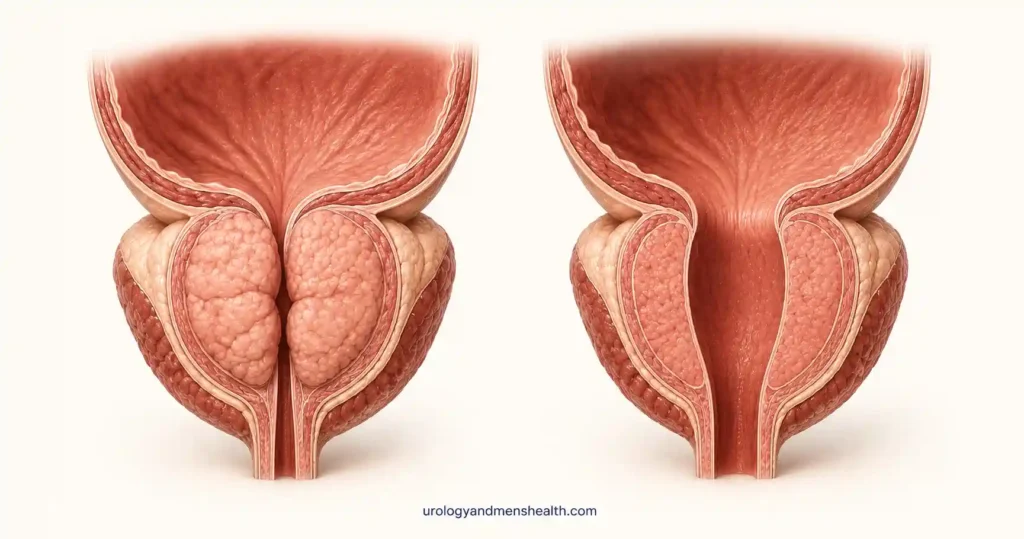
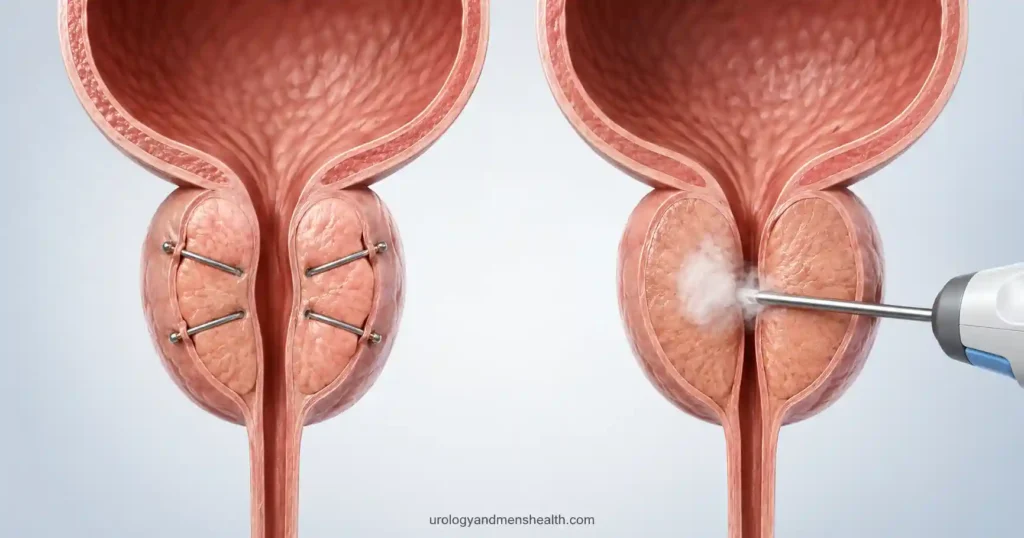
UroLift — known clinically as a prostatic urethral lift — doesn’t remove or heat any tissue. Instead, the urologist places small permanent implants that pull the obstructing side lobes of the prostate apart, like tie-backs holding a curtain open, so the urethra (the tube urine flows through) is no longer squeezed shut. The channel is opened mechanically. Because nothing is cut or burned, the improvement in flow tends to be immediate.[1]
Rezum works on almost the opposite principle: it removes tissue, just slowly and from the inside. The device injects a few seconds of sterile steam — water vapor — directly into the obstructing prostate tissue. That heat destroys the treated cells, and over the following weeks your body gradually reabsorbs them, so the gland shrinks and the urethra opens. Because this healing takes time, Rezum’s benefit builds over two to four weeks rather than appearing overnight.[1]
That single difference — implants that hold tissue aside versus steam that shrinks tissue away — drives almost everything else that follows: how fast you improve, whether you need a catheter, and which prostate shapes each one can treat.
UroLift vs Rezum: My Side-by-Side Comparison
When a man asks me to just tell him which is better, my honest answer is that “better” depends on his prostate and his priorities. Here is how the two differ on the points that actually change the decision:
- Speed of relief: UroLift usually improves flow within days; Rezum’s improvement develops over two to four weeks as the treated tissue clears.
- Catheter: After UroLift, many men go home with no catheter or only overnight. After Rezum, a catheter for roughly three to seven days is normal, because the prostate swells before it shrinks.
- Tissue handled: UroLift leaves all your prostate tissue in place and simply holds it open. Rezum actually reduces prostate volume over time.
- Median (middle) lobe: Rezum can treat a middle lobe that bulges into the bladder. Classic UroLift was designed for side-lobe obstruction, though its use has since widened.
- Durability: Both have solid five-year data with low retreatment rates, but TURP still outlasts both for the largest, most obstructed glands.[4][5]
- Sexual function: Both preserve ejaculation in the large majority of men — the single biggest reason men pick them over TURP or staying on pills.
If you’re also weighing newer resective options, it’s worth seeing how these tissue-sparing treatments stack up against something like Aquablation, which uses a water jet to remove prostate tissue — a different trade-off between recovery and how much obstruction it can clear.
Weak stream and night-time trips wearing you down? Download Dr. Khalid’s BPH & Enlarged Prostate Guide.
Enter your email below to receive Dr. Khalid’s complete BPH & Enlarged Prostate Guide as a free, printable PDF.
Who Each Procedure Is Right For
The first thing I check is prostate size and shape, because that often makes the decision for us. UroLift performs best in prostates that aren’t enormous — broadly under about 80 mL (around 80 grams) — with obstruction coming mainly from the two side lobes. Rezum handles a wider range of sizes and, importantly, can treat a median lobe: the middle portion that can act like a ball-valve at the bladder neck. You can get a rough sense of where your own gland sits with our prostate volume calculator.
The second thing I ask about is what the man values most. If preserving ejaculation is his top priority — and for many men in their 50s and 60s it is — both procedures deliver, but UroLift has the longest track record there. Men on blood thinners also tend to tolerate these procedures more easily than major surgery, and both avoid a general anaesthetic in most cases.
Neither is the right answer for everyone. A very large gland, a prostate that has already tipped you into complete urinary retention, bladder stones, or kidney back-pressure usually points toward a more definitive operation instead. A structured BPH procedure selector can help you frame the conversation, but your prostate size, your symptoms, and your scans settle it with your urologist.
In My Practice
A 58-year-old came to me furious — not at his prostate, but at his pills. Tamsulosin had thinned his ejaculate to almost nothing and left him lightheaded every time he stood up, and he’d been told the next step was a TURP, which he’d read could end ejaculation for good. His gland was moderately enlarged with no middle lobe. He had a UroLift, was off the medication within a week, and kept ejaculation intact.
The man who is most relieved by a minimally invasive procedure is usually the one who was never told an option existed between lifelong pills and resective surgery.
Recovery: Catheters, Timelines, and Symptom Relief
UroLift recovery is usually the gentler of the two. Most men have some burning when passing urine, a feeling of urgency, and maybe a little blood in the urine for a few days up to a couple of weeks. Many are back to normal activity within a day or two. Because nothing was ablated, there’s no sloughing phase to wait through.
Rezum asks for more patience. For the first one to three weeks, urinary symptoms can actually feel worse before they get better — more urgency, frequency, and discomfort — while the treated tissue dies off and clears. This is expected, not a complication, but I make sure every patient knows it in advance so they don’t panic and assume the procedure failed. The catheter period bridges that swollen phase.
Both procedures are built to preserve antegrade (forward) ejaculation, which is exactly what TURP and some BPH medications can take away. If you want to understand what changes when ejaculation does go backward after prostate surgery, our guide on retrograde ejaculation and why it happens explains it plainly.
When to Get Urgent Help
After either procedure, a few symptoms are not “part of recovery” and need same-day medical attention:
- You cannot pass any urine at all and your bladder feels painfully full — this is acute retention and needs an emergency room.
- Fever, chills, or worsening pain, which can signal infection.
- Heavy bleeding or clots that block your stream rather than the light pink urine that’s expected early on.
- Pain that your prescribed medication isn’t controlling.
Where MIST Fits Between Pills and TURP
I find it helps to picture BPH treatment as a ladder. The bottom rungs are lifestyle changes and medications such as tamsulosin or finasteride. The top rung is resective surgery — TURP, HoLEP, or newer options. UroLift and Rezum sit deliberately in the middle: stronger and more lasting than pills, but less invasive than an operation that removes the core of the gland.
The men who benefit most are usually those whose medications have stopped working or caused side effects they won’t accept, who have moderate symptoms, and who place a high value on keeping their sexual function — but who aren’t yet in a situation that demands surgery. For the full case on when an operation becomes the right move, see our guide on when an enlarged prostate needs surgery.
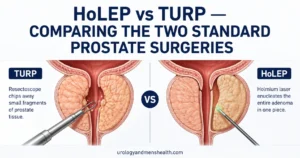
When the gland is very large, when retention or kidney impact is already in play, or when long-term durability matters more than a fast recovery, resective surgery still wins. If you’re choosing between the bigger operations themselves, our comparison of HoLEP versus TURP walks through that decision.
Frequently Asked Questions
Is UroLift or Rezum better for an enlarged prostate?
There’s no universal winner. UroLift opens the prostate mechanically with implants, gives faster relief, and often needs no catheter, which suits side-lobe obstruction in a moderately sized gland. Rezum shrinks tissue with steam and can treat a median lobe or a larger prostate. Your scan and your priorities decide it — start with our Prostate Health Hub.
Will I still be able to ejaculate normally after UroLift or Rezum?
Yes, in the large majority of men. Both UroLift and Rezum are specifically designed to preserve antegrade (forward) ejaculation, which is what makes them so appealing compared with TURP, where retrograde ejaculation is common. A temporary dip can happen while Rezum heals. To understand what retrograde ejaculation actually means, read our guide on ejaculation changes after prostate surgery.
How long after Rezum before I see improvement?
Plan for two to four weeks. Rezum destroys tissue that your body then reabsorbs, so the benefit builds gradually rather than appearing immediately. In the first one to three weeks, symptoms can briefly feel worse while the prostate swells and the treated tissue clears — this is expected. UroLift, by contrast, usually improves flow within days. More on the wider treatment picture is in our enlarged-prostate treatment guide.
Can UroLift or Rezum be redone, or will I still need TURP later?
Both can be repeated, and neither closes the door on TURP later if you need it. Five-year data show low retreatment rates for both UroLift and Rezum, but a minority of men do go on to need further treatment as the prostate keeps growing. If durability is your main concern, compare the resective options in our HoLEP versus TURP guide.
Does insurance cover UroLift and Rezum?
In the United States, both UroLift and Rezum are FDA-cleared and are commonly covered by Medicare and most private insurers when you meet the clinical criteria, though plans vary. Always confirm prior-authorization requirements with your insurer and surgeon before booking. Coverage and product naming differ outside the US.
References
- American Urological Association. Management of Benign Prostatic Hyperplasia (BPH) Guideline. 2024 amendment. AUA
- European Association of Urology. Management of Non-neurogenic Male LUTS Guideline. 2025. EAU
- National Institute of Diabetes and Digestive and Kidney Diseases. Prostate Enlargement (Benign Prostatic Hyperplasia). NIDDK
- Roehrborn CG, et al. The prostatic urethral lift for lower urinary tract symptoms due to BPH: the L.I.F.T. Study and 5-year outcomes. J Urol. 2013; and follow-up. PubMed
- McVary KT, et al. Final 5-year outcomes of the randomized sham-controlled trial of water vapor thermal therapy (Rezum II) for LUTS secondary to BPH. J Urol. 2021. PubMed
Dr. Muhammad Khalid
MBBS · FCPS (Urology) · MCPS (General Surgery) · CHPE · CRSM · IMC #539472
Specialist urologist with 11+ years of clinical experience across tertiary teaching hospitals. Trained at Lady Reading Hospital and Khyber Teaching Hospital, Peshawar. Author or co-author of five peer-reviewed international publications, including in Cureus and the World Journal of Surgery. Procedural expertise: URS, PCNL, RIRS, TURP, TURBT, and major open urological surgery. Full profile →
This article is for educational purposes only and does not constitute medical advice. Always consult your physician or urologist for diagnosis and treatment decisions specific to your condition.