Urinalysis Results Explained: What Each Line on Your Urine Test Means
Most abnormal urine tests I see are not emergencies, and a few are. Here is how I read each line of the report, and which combinations change what happens next.

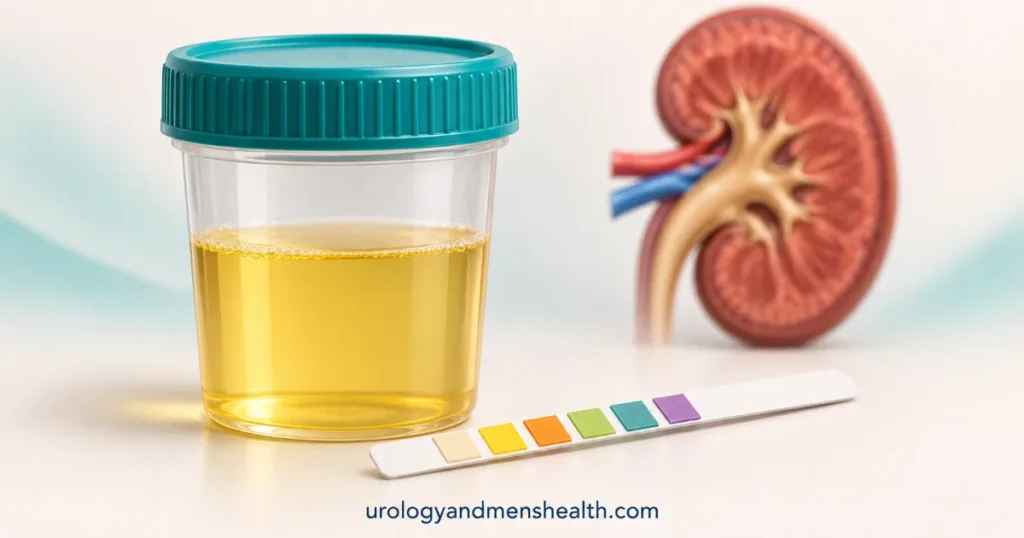
Your urinalysis results arrive as a column of words and numbers: specific gravity, pH, protein, ketones, leukocytes, nitrites, red cells, epithelial cells. Most men who send me a screenshot of that report want one answer: is anything here worth worrying about? A urinalysis is really three tests in one. The physical check looks at color and clarity. The dipstick is a strip of chemical pads that change color when they meet sugar, protein, blood or the by-products of bacteria. The microscopy looks at the spun-down sediment for cells, crystals and casts. Each line answers a different question, and a single abnormal line rarely tells the whole story. This guide goes line by line through what each result means, which combinations matter, and what to ask for next. For blood in the urine and the wider kidney picture, start at our Kidney Health hub.
Key Takeaways
- A dipstick positive for blood is not a diagnosis: the AUA/SUFU guideline defines microhematuria as 3 or more red blood cells per high-power field on microscopy, and says a dipstick alone should not be used to define it.
- A positive nitrite strongly suggests a bacterial infection, but a negative nitrite does not rule one out, because bacteria need about 4 hours in the bladder to produce it.
- Glucose appears in urine when blood sugar rises above roughly 180 to 200 mg/dL (10 to 11 mmol/L); glucose in your urine is a reason to check your blood sugar, not your kidneys.
- Lots of squamous epithelial cells usually mean the sample picked up skin contamination, so an abnormal result with heavy contamination often needs a repeat clean-catch sample.
Urinalysis Results Explained: The Dipstick Line by Line
The values below come from the American Academy of Family Physicians’ 2022 review of office urinalysis [1]. Laboratories set their own reference ranges, so always read your result against the range printed on your report.
| Dipstick result | What is usual | What an abnormal result points to |
|---|---|---|
| Specific gravity | Around 1.010 suggests normal hydration | Above 1.020: dehydration or sugar in urine; below 1.003: very dilute urine |
| pH | 4.5 to 8, most often 5.5 to 6.5 | Alkaline urine with infection can suggest urea-splitting bacteria; acid urine favors uric acid stones |
| Protein | Negative or trace | 1+ or more suggests kidney filter injury and needs a quantitative test |
| Glucose | Negative | Blood sugar above about 180 to 200 mg/dL |
| Ketones | Negative | Fasting, ketogenic diet, vomiting, or diabetic ketoacidosis |
| Blood | Negative | Needs microscopy to confirm real red cells |
| Leukocyte esterase | Negative | White cells in urine: infection or inflammation |
| Nitrite | Negative | Bacteria that convert nitrate to nitrite, usually infection |
Two lines are worth understanding mechanically. Specific gravity measures how concentrated your urine is compared with water; it mostly tells me how much you drank before the test, and it changes how I read everything else. A very concentrated sample makes trace protein look worse; a very dilute one can hide it. pH measures acidity. It swings with diet and time of day, and on its own is rarely a diagnosis, but it matters for stone formers and when infection is present.
Leukocytes and Nitrites: Reading the Infection Signals
Leukocyte esterase is an enzyme released by white blood cells. A positive result means white cells are in the urine, which happens with infection but also with inflammation from a stone, a recent catheter, or a sexually transmitted infection of the urethra. Nitrite is produced when certain bacteria, mostly the gut-type bacteria that cause most urinary infections, convert nitrate in urine into nitrite. The 2022 review notes that bacteria need about four hours in the bladder to make nitrite, and that some, such as Enterococcus, do not make it at all [1].
That gives three practical patterns:
- Leukocytes positive, nitrite positive: infection is very likely. In a man, a urine culture should be sent before antibiotics start.
- Leukocytes positive, nitrite negative: infection is still possible, especially if you passed urine frequently before the test. Inflammation, stones and urethral infections also fit this pattern.
- Both negative with no symptoms: infection is unlikely.
A urinary infection in a man is never routine, because the male urinary tract is long and well defended. Our guide to UTIs in men and when to worry explains why, and if a urethral infection is possible, our UTI versus STI symptom checker helps separate the two.
Blood and Protein in the Urine Test
The blood pad reacts to the iron-containing part of red cells, but it also reacts to muscle breakdown products and some contaminants. That is why the American Urological Association and the Society of Urodynamics (AUA/SUFU) guideline says clinicians should not define microhematuria by a positive dipstick alone; a positive dipstick should prompt microscopy, and microhematuria is defined as 3 or more red blood cells per high-power field on a properly collected sample [2]. Once confirmed, the guideline sorts people into risk groups by age, smoking history and the number of red cells; men in the lowest-risk group are usually offered a repeat urinalysis within six months rather than immediate cystoscopy. Our guide to blood in urine in men covers the causes and the workup.
Protein is different. A protein result of 1+ or more suggests the kidney’s filters are leaking, and the next step is a quantitative test, usually a spot urine albumin-to-creatinine ratio, rather than another dipstick [1]. Fever, heavy exercise and dehydration can all cause temporary protein, so a single result needs repeating. Our page on protein in urine explains when it matters, and if your blood test shows a raised creatinine as well, read our guide to high creatinine.
In My Practice
A 47-year-old man was sent to me after a routine medical showed “blood 2+” on a dipstick, and he had spent a week convinced he had bladder cancer. He had run a half-marathon the day before the test. Microscopy on a repeat sample a week later, with no running beforehand, showed one red cell per high-power field. No further tests were needed.
A positive dipstick is a question, not an answer; microscopy on a properly timed sample answers it.
Glucose, Ketones and the Microscopy Report
Glucose spills into urine when blood sugar exceeds what the kidney can reabsorb, roughly 180 to 200 mg/dL (10 to 11 mmol/L) [1]. Glucose in urine is a reason to check a fasting blood glucose or HbA1c with your primary care doctor within a week or two. Some diabetes tablets, the SGLT2 inhibitors, cause glucose in the urine deliberately, so tell whoever reads your result if you take one.
Ketones appear when the body burns fat for fuel instead of sugar: after fasting, on a ketogenic diet, during vomiting illness, and in diabetic ketoacidosis. Ketones on a low-carbohydrate diet with normal blood sugar are expected. Ketones together with high glucose, thirst and vomiting are an emergency.
The microscopy section counts what the dipstick only hints at. More than five white cells per high-power field is consistent with infection in a man with symptoms. More than five large squamous epithelial cells per field suggests the sample picked up skin cells from the foreskin or urethral opening, which makes the whole sample less reliable [1]. Crystals form in many normal urines as they cool and only matter in fresh samples from stone formers. Casts, tiny cylinders molded in the kidney’s tubules, carry more weight: red cell casts point toward the kidney’s filters rather than the bladder.
Urine color tells its own story before any test is run; our urine color decoder and guide to what urine color means cover it.
Get Seen the Same Day If
A urine result needs urgent attention, not a routine follow-up, when it comes with:
- Fever, shivering or pain in the side or back together with leukocytes or nitrites
- Ketones and glucose together with thirst, vomiting, or drowsiness
- Visible blood with clots, or inability to pass urine
Confused by your urine test? Get the urologist's guide to what each result means and the next test to ask for
Enter your email below to receive Dr. Khalid’s complete 7-Day Kidney Stone Prevention Meal Plan as a free, printable PDF.
Frequently Asked Questions About Urinalysis Results
What do leukocytes in urine mean if nitrites are negative?
White cells without nitrite can still mean infection, especially if you urinated often before the test, because bacteria need about four hours in the bladder to make nitrite. It can also reflect inflammation from a stone or a urethral infection. In a man, ask for a urine culture. Our guide to UTIs in men explains what comes next.
Is blood on a urinalysis dipstick always a concern?
Not on its own. The AUA/SUFU guideline says microhematuria should not be diagnosed from a dipstick alone; it needs microscopy showing 3 or more red cells per high-power field. Exercise, contamination and muscle breakdown can all trigger the pad. If microscopy confirms red cells, read our guide to blood in urine in men.
Why are there ketones in my urine?
Ketones appear when your body burns fat instead of sugar: after fasting, on a ketogenic diet, or during a vomiting illness. With normal blood sugar this is expected. Ketones with high glucose, thirst and vomiting suggest diabetic ketoacidosis and need emergency care the same day.
What does a high urine specific gravity mean on my urinalysis results?
Specific gravity above about 1.020 usually means concentrated urine from not drinking enough before the test, though sugar in the urine can also raise it. Concentrated urine can exaggerate trace protein or blood, so a repeat sample after normal drinking often clears things up. If protein persists, see our page on protein in urine.
What do squamous epithelial cells on a urine test mean?
More than five large squamous cells per high-power field suggest the sample was contaminated by skin cells near the urethral opening. That makes other results less reliable. Ask for a repeat clean-catch midstream sample: retract the foreskin, clean the tip, pass the first part of the stream into the toilet and collect the middle part.
References
- Hitzeman N, Greer D, Carpio E. Office-based urinalysis: a comprehensive review. Am Fam Physician. 2022;106(1):27-35. AAFP
- Barocas DA, Boorjian SA, Alvarez RD, et al. Microhematuria: AUA/SUFU guideline (2020, amended 2025). American Urological Association. AUA
- Simerville JA, Maxted WC, Pahira JJ. Urinalysis: a comprehensive review. Am Fam Physician. 2005;71(6):1153-62. PubMed
Dr. Muhammad Khalid
MBBS · FCPS (Urology) · MCPS (General Surgery) · CHPE · CRSM · IMC #539472
Specialist urologist with 11+ years of clinical experience across tertiary teaching hospitals. Trained at Lady Reading Hospital and Khyber Teaching Hospital, Peshawar. Author or co-author of five peer-reviewed international publications, including in Cureus and the World Journal of Surgery. Procedural expertise: URS, PCNL, RIRS, TURP, TURBT, and major open urological surgery. Full profile →
This article is for educational purposes only and does not constitute medical advice. Always consult your physician or urologist for diagnosis and treatment decisions specific to your condition.