Lifting and the Gym After TURP: A Week-by-Week Return
Most men feel ready for the gym long before their prostate is. Here is the exercise ladder I give my patients, and why the second week, not the first, is when to be most careful.
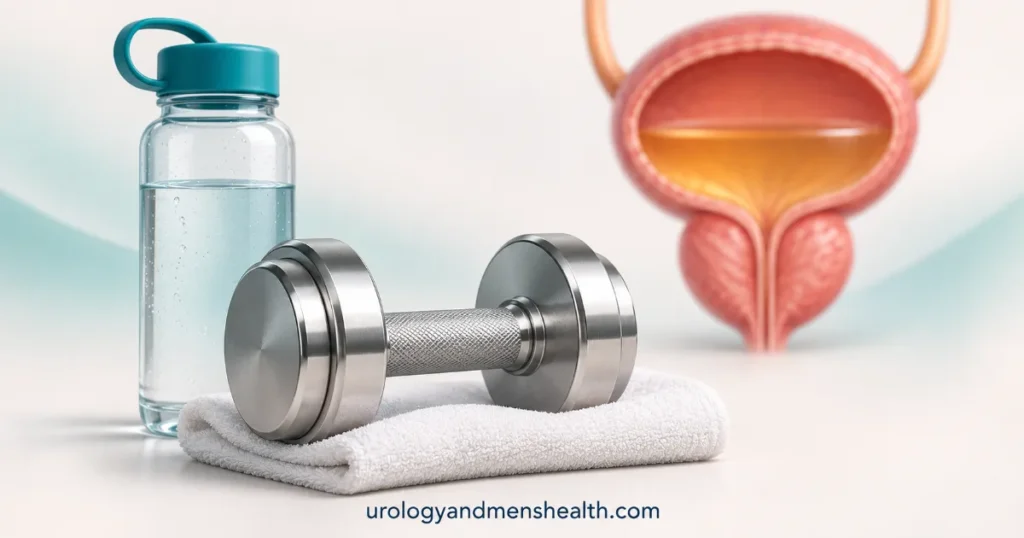
Lifting after TURP is the question I am asked most at the two-week check, usually by a man who feels fine and wants his gym back. The honest answer is that how you feel and how the inside of your prostate has healed are on two different clocks. After a transurethral resection of the prostate (TURP), the channel through your prostate is a raw surface, like a graze on the inside. It is covered by a scab while the lining grows back. Heavy straining raises the pressure in your belly and can knock that scab off early, and that is when men end up back in the emergency room with clots. This guide gives you an exercise ladder, week by week and activity by activity, so you know what you can do this week rather than waiting for a vague “recovery” to end. For the full post-operative timeline, read our TURP recovery timeline week by week, and for every surgery guide on the site, see our Urological Surgery & Recovery hub.
Key Takeaways
- The NHS advises avoiding heavy lifting and intense exercise for about 6 weeks after TURP; walking can start the day you get home.
- About 1 in 5 men has some bleeding 10 to 14 days after discharge, when the healing scab separates, so weeks 2 to 3 are the time to hold back hardest.
- Heavy squats, deadlifts and any lift that makes you hold your breath come last, not first, because breath-holding spikes pressure on the healing prostate.
- Cycling is a separate problem: the saddle presses directly under the prostate, so I keep men off bikes for 6 weeks even if they are lifting.
Why Lifting After TURP Can Cause Bleeding
During a TURP, the surgeon trims away the overgrown prostate tissue from the inside, leaving a hollowed-out channel called the prostatic fossa. Small blood vessels in that surface are sealed with heat at the end of the operation, and a scab, called an eschar, forms over them. Over the following weeks, new lining grows underneath and the scab comes away in pieces.
The British Association of Urological Surgeons (BAUS) tells patients that about one man in five (20%) gets some bleeding 10 to 14 days after getting home, as those scabs separate [1]. Most of that bleeding is mild and settles with extra fluids. What turns it into a problem is pressure.
When you lift something heavy, you instinctively take a breath and lock it in, called the Valsalva manoeuvre. That clamps your belly muscles and drives the pressure inside your abdomen and pelvis sharply upward. Picture squeezing a water balloon that has a fresh patch on it. A loose scab under that pressure lifts off before the lining beneath is ready, and a small vessel opens. That is the mechanism behind almost every lifting-related bleed I see.
Exercise After TURP: The Week-by-Week Ladder
There are no randomized trials telling us the exact week each exercise becomes safe. What follows is surgeon consensus, anchored to the published patient guidance: the NHS advises against heavy lifting and intense exercise for about 6 weeks, with normal activities usually back at 2 to 4 weeks [2]. Your own surgeon’s instructions override this ladder, especially if your operation was large or you bled more than usual.
| Time since surgery | What is usually fine | What to hold off |
|---|---|---|
| Week 1 | Short walks, several times a day, building up gently | Any lifting heavier than a full kettle, any gym work |
| Weeks 2 to 3 | Longer walks on flat ground, light housework | Weights, golf, gardening that involves digging, carrying shopping bags |
| Weeks 4 to 6 | Brisk walking, swimming once cleared, light machine weights without breath-holding | Free weights, heavy compound lifts, running, cycling |
| After 6 weeks | Gradual return to free weights, running and sport, starting at about half your old load | Maximal lifts until you have had 2 weeks of clear urine with normal training |
The 5 kg (about 11 lb) rule I give most men for the first month is a practical line rather than a scientific one: it covers a bag of shopping or a small child’s car seat and rules out anything that makes you brace. If you catch yourself holding your breath to lift it, it is too heavy for now.
Returning to the Gym: Free Weights, Squats and Deadlifts
Not all lifting loads the prostate equally. What matters is how hard the movement makes you brace your core. I rank gym exercises in roughly this order of risk, from lowest to highest:
- Seated upper-body machines (chest press, lat pulldown, seated row) at light weight: low core bracing, easy to keep breathing.
- Dumbbell work seated or standing at light to moderate weight: more bracing, but controllable.
- Leg press and lunges: heavier load through the pelvis; start low.
- Overhead pressing, squats and deadlifts: these demand a full Valsalva brace and come last.
When you return after 6 weeks, start at about half your previous working weights for the first two weeks and breathe out through the effort of each rep instead of locking your breath. Check your urine after the first few sessions. Pink-tinged urine that clears within a day after drinking more is a signal to drop back a step for a week; red urine or clots are a reason to stop and call your surgeon’s team.
Your pelvic floor also needs attention. Some men leak a little urine when they strain in the first months after TURP. Pelvic floor training helps, and our 12-week Kegel protocol for men can be started once your catheter is out.
In My Practice
A 61-year-old builder came back on day 12 with clots and bright red urine. He had felt so well that he spent a Saturday moving paving slabs. We washed the clots out through a catheter and he went home two days later, but he lost a week of work he would otherwise have had. When I asked about it, he said nobody had told him that the second week is the risky one.
The scab separates around days 10 to 14, so that is when to be most careful, not least.
Cycling After TURP Is a Different Problem
Cycling is not a lifting problem; it is a pressure-point problem. A bike saddle presses directly on the perineum, the area between the scrotum and the anus, which sits right under the prostate. That is mechanical pressure on the healing surface, repeated with every pedal stroke, even on an easy ride.
I keep men off bicycles, exercise bikes and spin classes for 6 weeks. When you go back, use a saddle with a cut-out or a split nose, keep the first rides short and flat, and stand on the pedals for a few seconds every few minutes to take the weight off. Rowing machines load the area in a similar way and follow the same timeline.
Does HoLEP or Laser Surgery Change the Timeline?
Laser procedures such as HoLEP (holmium laser enucleation of the prostate) and bipolar TURP tend to seal vessels well and many men bleed less in the first days. But they still leave a raw internal surface that has to re-line, so I give the same lifting and cycling advice after all of them. If you are still choosing between operations, our comparison of HoLEP versus TURP covers the recovery differences that do matter.
Stop and Get Help If
Stop exercising and contact your surgeon’s team or go to the ER the same day if you have:
- Blood clots in your urine, or urine that stays red after you drink extra water for a few hours
- Difficulty passing urine or being unable to pass urine at all
- Fever, shivering or burning that keeps getting worse
- Pain low in your belly that builds rather than settles
Being unable to pass urine after prostate surgery has its own causes and treatment; our guide to urinary retention after surgery explains what happens next. To map your own return to activity day by day, use our post-op recovery planner.
Recovering from prostate surgery? Get the week-by-week recovery guide, including when to call your surgeon
Enter your email below to receive Dr. Khalid’s complete Urology Surgery Recovery Guide as a free, printable PDF.
Frequently Asked Questions About Lifting After TURP
How long after TURP can I lift weights at the gym?
Most men can return to light machine weights at 4 to 6 weeks and to free weights after 6 weeks, starting at about half their old load. The NHS advises against heavy lifting and intense exercise for about 6 weeks. Squats, deadlifts and overhead presses come last because they require breath-holding. Our TURP recovery timeline shows the wider picture.
Why did I start bleeding again two weeks after TURP?
Around days 10 to 14 the scab covering the healing prostate separates, and BAUS reports that about 1 in 5 men see some bleeding then. Drink extra water and rest; most settles within a day. Lifting or straining during this window makes it worse. Clots or difficulty passing urine need same-day review, as covered in our retention guide.
Can I go back to the gym 8 weeks after a TURP operation?
Usually yes, provided your urine has been clear for at least two weeks and your surgeon has no specific concerns. Rebuild over two to three weeks rather than going straight back to your old weights, and breathe out through each lift. If pink urine appears after a session, drop back for a week. Plan the steps with our recovery planner.
When can I ride a bike after prostate surgery?
I advise waiting 6 weeks before cycling or using an exercise bike, because the saddle presses directly under the healing prostate. Start with short, flat rides on a cut-out saddle and stand on the pedals regularly. Pelvic floor strength helps with any leakage during exercise; see our Kegel exercises for men.
Is the lifting advice different after HoLEP compared with TURP?
Laser operations often bleed less in the first few days, but they still leave a healing surface inside the prostate, so I give the same lifting and cycling timeline after both. Follow your own surgeon’s instructions if they differ. Our HoLEP versus TURP comparison covers where recovery genuinely differs.
References
Dr. Muhammad Khalid
MBBS · FCPS (Urology) · MCPS (General Surgery) · CHPE · CRSM · IMC #539472
Specialist urologist with 11+ years of clinical experience across tertiary teaching hospitals. Trained at Lady Reading Hospital and Khyber Teaching Hospital, Peshawar. Author or co-author of five peer-reviewed international publications, including in Cureus and the World Journal of Surgery. Procedural expertise: URS, PCNL, RIRS, TURP, TURBT, and major open urological surgery. Full profile →
This article is for educational purposes only and does not constitute medical advice. Always consult your physician or urologist for diagnosis and treatment decisions specific to your condition.