Bladder Training for Overactive Bladder: Men’s Protocol
Most men with urgency are handed a tablet and no plan. Bladder training for overactive bladder carries the AUA's strongest recommendation — here is the 12-week protocol I actually give men in clinic.

Bladder training for overactive bladder is the one treatment men consistently underestimate — and it is the only one the American Urological Association backs with its strongest possible language. The 2024 AUA/SUFU overactive bladder guideline states that clinicians should offer bladder training to all patients with OAB, as a Strong Recommendation on Grade A evidence [1]. Most men who reach my clinic are already on a tablet. They were told to take it, told nothing about what to do with their bladder, and within a year most of them have quietly stopped taking it anyway [4]. Retraining a bladder is unglamorous work: a diary, a clock, and eight to twelve weeks of deliberate practice. But in the only randomized trial run specifically in men, behavioral treatment matched extended-release oxybutynin on voiding frequency and beat it on nocturia [2]. This is the protocol I actually hand out — and the part most articles skip, which is what has to be ruled out first. For the wider picture, see our Men’s Wellness Hub.
Key Takeaways
- The 2024 AUA/SUFU guideline makes bladder training a Strong Recommendation (Grade A) for every patient with OAB — it is a first-line treatment, not a fallback for when drugs fail.
- Extend your voiding interval by 15 minutes only after you have held the current interval on 5 of the last 7 days. Jumping ahead is the single most common reason men abandon the program.
- Running to the bathroom makes urgency worse. Standing still and performing 5 to 6 quick pelvic floor contractions lets the bladder contraction pass — that reflex is the entire basis of urge suppression.
- In men, urgency can come from bladder outlet obstruction or from producing too much urine. A post-void residual scan and a 3-day bladder diary belong before any retraining schedule.
What Bladder Training for Overactive Bladder Actually Does
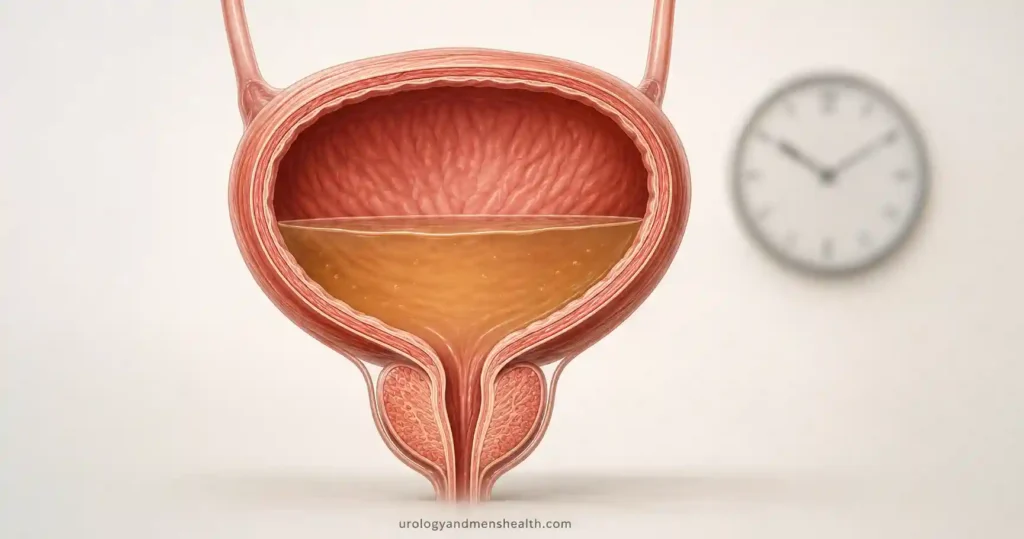
Overactive bladder is a symptom diagnosis: urinary urgency, usually with frequency and waking at night to pass urine, with or without leakage, in the absence of infection or another obvious cause. The mechanical problem is that your detrusor — the smooth muscle wall of the bladder — begins contracting at low filling volumes instead of waiting until the bladder is genuinely full.
Think of it as a smoke alarm that has started going off at burnt toast. The alarm is not broken. Its threshold has drifted down, and every time you respond immediately by rushing to the bathroom, you confirm to the system that the alarm was correct. Over months, the functional capacity of your bladder shrinks to match the shortened interval you have taught it.
Bladder training works on both halves of that loop. Scheduled voiding with progressively longer intervals rebuilds functional capacity. Urge suppression restores the brain’s ability to inhibit a detrusor contraction rather than obey it. You are not training yourself to suffer — you are re-teaching a reflex arc that has become badly calibrated.
What the evidence actually says — including the weak part
I am going to be straight about this, because most articles are not. The 2004 Cochrane review of bladder training for urinary incontinence found only five usable trials with 467 participants, and every one of those participants was female [3]. Confidence intervals were wide. The reviewers concluded that bladder training may be helpful and that definitive research had not been done. That is a thinner foundation than a Grade A recommendation implies at first glance.
What makes the case for men is a separate trial. The MOTIVE trial randomized 143 men aged 42 to 88 who still had urgency and more than eight voids a day despite four weeks of alpha-blocker therapy. Eight weeks of behavioral treatment — pelvic floor exercises, urge suppression, delayed voiding — was compared against individually titrated extended-release oxybutynin. Mean daily voids fell from 11.3 to 9.1 with behavioral treatment and from 11.5 to 9.5 with the drug. The results were statistically equivalent. The behavioral group did better on nocturia, averaging 0.70 fewer episodes per night against 0.32 for the drug group [2].
So: modest effect size, real effect, no dry mouth, no constipation, no anticholinergic load. That is the honest summary. Before you begin, score your baseline symptoms so you have something to measure against in twelve weeks — our validated OAB Symptom Score takes about two minutes and gives you a number, not an impression.
Rule This Out First: Urgency in Men Is Not Always a Bladder Problem
This is where men differ from the women in whom most bladder training research was done, and it is why starting a retraining schedule without an assessment is a mistake. Three different problems present with the same complaint of needing to go urgently and often.
Storage failure is true OAB: small voided volumes, typically 100 to 150 mL (about 3 to 5 fl oz) each time, with a normal 24-hour total. Bladder training is aimed precisely at this.
Bladder outlet obstruction from an enlarged prostate produces storage symptoms indirectly — the bladder wall thickens against the resistance and becomes irritable, and residual urine left behind after each void means the next filling cycle starts from a partially full bladder. The 2026 AUA guideline on lower urinary tract symptoms attributed to BPH is explicit that these symptoms are multifactorial and involve both storage and emptying function [6]. If obstruction is the driver, no amount of clock-watching fixes it, and adding an antimuscarinic on top of a high residual volume risks tipping you into retention. Estimate where you stand with our post-void residual danger estimator, then get an actual bladder scan.
Overproduction is the one most often missed. A man voiding eight times a day at 300 mL a time is producing close to 2,400 mL (about 81 fl oz) of urine daily. That is not an overactive bladder — that is polyuria, and the cause list runs from untreated diabetes to diuretic timing to obstructive sleep apnea. If more than a third of your 24-hour output happens overnight, you have nocturnal polyuria, and bladder training will not touch it.
What to ask for, and when
Book a primary care or urology appointment within the next four weeks and ask specifically for: a urinalysis to exclude infection and blood, a bladder scan for post-void residual, a fasting glucose or HbA1c if your total output is high, and a discussion of PSA testing if prostate enlargement is suspected. Bring a completed 3-day bladder diary — it changes the consultation more than any single test. Our full workup and treatment guide for OAB in men covers what each of those results means.
Get the 3-Day Bladder Diary and 12-Week Retraining Schedule
Enter your email below to receive Dr. Khalid’s complete OAB & Incontinence Guide as a free, printable PDF.
The 12-Week Bladder Retraining Schedule
The AUA treatment algorithm allows 8 to 12 weeks for behavioral therapy to demonstrate effect, against 4 to 8 weeks for drug therapy [1]. That difference matters psychologically: men judge bladder training against the timeline of a tablet and conclude at week three that it has failed. Expect the first measurable change in your diary at three to four weeks, and judge the program at twelve.
Week 0 — find your real starting interval
For three consecutive days, record the clock time and measured volume of every void, an urgency rating from 0 to 4, any leakage, and what you drank. Use a measuring jug or measuring cup — estimates are useless here. Then find your shortest typical daytime interval. Not your best day. The interval you hit routinely.
Weeks 1 onward — hold, then extend
- Set your schedule at that baseline interval — for most men starting out, 45 minutes to 1 hour. Void by the clock during waking hours whether or not you feel an urge.
- If an urge arrives early, do not go. Use the urge suppression sequence in the next section, wait for the wave to pass, then continue to your scheduled time.
- Add 15 minutes only when you have met the current interval on 5 of the last 7 days. For most men that works out to a step up every one to two weeks.
- Target 6 to 8 voids per 24 hours, which usually means intervals of 3 to 4 hours.
- Do not apply the schedule overnight. Night-time voiding is driven by urine production, not habit, and forcing it produces nothing but broken sleep.
Fluids: the mistake almost every man makes
The instinct is to drink less. It backfires. Concentrated urine is chemically irritating to the bladder lining, so cutting fluids raises urgency even as it lowers volume — you end up going just as often, in smaller amounts, feeling worse. Aim for roughly 1.5 to 2 liters daily (about 50 to 68 fl oz, or 6 to 8 cups), weighted toward the first two-thirds of the day, with nothing significant in the three hours before bed.
Caffeine is worth a proper trial rather than vague moderation. Cut to under two cups a day for a week, then go fully off it for two weeks and compare your diary. Alcohol and carbonated drinks behave similarly. If your urgency does not budge, you have learned something real and you can stop restricting.
In My Practice
A retired teacher in his late sixties came back at six weeks convinced bladder training had failed him. He was frustrated enough to want a prescription that day. I asked to see his diary, and the problem was on the first page — he had started at a 90-minute interval when his baseline was 40 minutes. He had been failing six days out of seven for a month and a half, and reading that failure as proof the method did not work. We reset him to 45 minutes. By week ten he was holding 2.5 hours and had stopped planning his errands around toilet locations.
The starting interval has to be one you already achieve, not the one you wish you achieved — bladder training fails on ambition far more often than it fails on physiology.
Urge Suppression: The 60 Seconds That Decide Whether You Make It
Every man with urgency does the same wrong thing: he sprints. Getting up quickly raises abdominal pressure on a bladder that is already contracting, the jostling of walking fast adds mechanical stimulation, and the sight of the bathroom door triggers a learned anticipatory response. Sprinting is the reason so many men leak in the last three steps.
Urgency comes in waves. A detrusor contraction builds, peaks, and subsides — usually inside 30 to 60 seconds — whether or not you empty. The whole technique is built on outlasting the peak.
- Stop moving. Sit down if you can, stand still if you cannot. Do not head for the bathroom.
- Perform 5 to 6 quick, strong pelvic floor contractions, one to two seconds each. Contracting the pelvic floor triggers a reflex that inhibits the detrusor — this is the mechanical heart of the technique, not a distraction trick.
- Slow your breathing and drop your shoulders. Bracing the abdomen pushes down on the bladder.
- Give your brain a concrete task. Count backwards from 100 in sevens. Vague instructions to think about something else do not work; a task that demands working memory does.
- Wait for the wave to peak and fall, then walk to the bathroom at a normal pace.
Your pelvic floor is the lever — make sure you are using it
None of the above works if you cannot contract the right muscles. A correct contraction feels like a lift and squeeze around the back passage and the base of the penis, with no buttock clenching, no abdominal bracing, and no breath-holding. If you are not sure, that uncertainty is worth resolving before week one, because a badly performed squeeze does nothing to the detrusor. Work through the technique in our guide to pelvic floor training for men, then build 5 to 10 minutes daily — three sets of ten, mixing quick one-second flicks with five-second holds.
When Bladder Training Is Not Enough: What I Add Next
At twelve weeks, judge the result against your diary and a repeat symptom score, not against memory. Memory is unreliable in both directions. If you are still bothered, the next step is addition, not replacement — the 2024 AUA guideline deliberately eliminated the old concept of step therapy in favor of shared decision-making, and behavioral therapy continues underneath everything you add on top [1].
Beta-3 agonists are where I go first for most men, particularly those already on prostate medication. The COURAGE trial randomized 1,105 men aged 45 and over who had persistent OAB symptoms while on an alpha-blocker with or without a 5-alpha-reductase inhibitor. Against placebo at week 12, vibegron produced 0.74 fewer daily voids, 0.95 fewer urgency episodes, and 0.22 fewer nocturia episodes per night, with adverse event rates of 45.0% against 39.0% for placebo [5]. Read those numbers carefully: roughly one fewer void and one fewer urgency episode per day. Statistically solid, clinically modest. That gap is exactly why the behavioral work is not optional.
Antimuscarinics such as oxybutynin, solifenacin, or tolterodine remain effective, but they carry dry mouth, constipation, and a cumulative anticholinergic burden that matters increasingly with age. In men with a raised post-void residual they also raise the risk of urinary retention, which is why the bladder scan comes first.
Then there is the durability problem nobody mentions at the point of prescribing. A systematic review of 30 real-world studies found one-year persistence of just 12% to 25% for antimuscarinics and 32% to 38% for mirabegron, with median time to discontinuation under five months for most antimuscarinics [4]. Most men on OAB tablets are not on them a year later. A retraining habit does not expire the way a prescription does.
Beyond medication: percutaneous tibial nerve stimulation, intradetrusor onabotulinumtoxinA injection — which in men carries a real risk of needing intermittent self-catheterization — and sacral neuromodulation. And if the assessment pointed at obstruction, treating the prostate itself may resolve the storage symptoms entirely.
One specific caveat: if your dominant complaint is waking two or more times a night, work through why men wake at night to pass urine before assuming OAB is the answer. Nocturnal polyuria, sleep apnea, and evening diuretic timing all present as nocturia and none of them respond to a daytime voiding schedule.
Red Flags — Get Assessed Before You Start
Bladder training is safe, but urgency is a symptom, not a diagnosis. Do not start a retraining schedule if any of the following apply — book an urgent assessment instead.
- Visible blood in your urine, at any point, even once, even painless.
- Burning on passing urine, fever, or new confusion in an older man — these suggest infection, not OAB.
- Straining to start, a weak stream, dribbling at the end, or a feeling that the bladder never fully empties — these point to obstruction.
- Complete inability to pass urine with a painful lower abdomen — this is acute retention. Go to the emergency room the same day.
- New leg weakness, numbness around the groin or saddle area, or new bowel changes alongside urinary symptoms — same-day emergency assessment for possible spinal cord compression.
- Unintentional weight loss, bone pain, or night sweats occurring with new urinary symptoms.
Frequently Asked Questions
How long does bladder training for overactive bladder take to work in men?
Allow 8 to 12 weeks, which is the window the AUA algorithm gives behavioral therapy, against 4 to 8 weeks for medication. Most men see the first measurable change in their diary at three to four weeks: fewer urgency episodes before the change in voiding interval. Rescore yourself with the OAB Symptom Score at week 12 and compare against your baseline number rather than your impression.
Should I stop my overactive bladder medication while doing bladder training?
No. The 2024 AUA guideline removed the old step-therapy model, so behavioral therapy and medication run together rather than in sequence. Combination consistently outperforms either alone. If the goal is eventually to come off the tablet, complete the full 12 weeks of retraining first, then discuss a supervised taper with your urologist. Our treatment guide for OAB in men covers the sequencing.
Why does my urgency get worse when I drink less water?
Because concentrated urine irritates the bladder lining directly. Restricting fluid lowers the volume but raises the irritant load, so you still go frequently, in smaller amounts, with more urgency. Target 1.5 to 2 liters daily (about 50 to 68 fl oz), front-loaded before evening. If night-time is your main problem, read our guide on nocturia in men before restricting anything further.
Can I do bladder training if I have an enlarged prostate?
Yes, and the 2026 AUA BPH guideline treats these symptoms as multifactorial rather than purely prostatic. The condition is that your post-void residual has been measured first. If a significant volume of urine is being left behind after each void, retraining alone will underperform and adding an antimuscarinic raises retention risk. Estimate your risk with the post-void residual tool, then get a bladder scan.
What is the difference between bladder training and Kegel exercises?
Bladder training is the schedule: progressively extending the interval between voids to rebuild functional bladder capacity. Pelvic floor exercises are the muscular tool that makes the schedule survivable, because a quick contraction reflexively inhibits the detrusor mid-urge. You need both, and the squeeze has to be performed correctly to work. Technique is covered in our pelvic floor training guide for men.
References
- American Urological Association / Society of Urodynamics, Female Pelvic Medicine & Urogenital Reconstruction. The AUA/SUFU Guideline on the Diagnosis and Treatment of Idiopathic Overactive Bladder. 2024. AUA
- Burgio KL, Goode PS, Johnson TM 2nd, et al. Behavioral versus drug treatment for overactive bladder in men: the Male Overactive Bladder Treatment in Veterans (MOTIVE) Trial. J Am Geriatr Soc. 2011;59(12):2209-2216. PubMed
- Wallace SA, Roe B, Williams K, Palmer M. Bladder training for urinary incontinence in adults. Cochrane Database Syst Rev. 2004;2004(1):CD001308. Cochrane
- Yeowell G, Smith P, Nazir J, et al. Real-world persistence and adherence to oral antimuscarinics and mirabegron in patients with overactive bladder (OAB): a systematic literature review. BMJ Open. 2018;8(11):e021889. PubMed
- Staskin D, Owens-Grillo J, Thomas E, et al. Efficacy and safety of vibegron for persistent symptoms of overactive bladder in men being pharmacologically treated for benign prostatic hyperplasia: results from the phase 3 randomized controlled COURAGE trial. J Urol. 2024;212(2):256-266. PubMed
- American Urological Association. Management of Lower Urinary Tract Symptoms Attributed to Benign Prostatic Hyperplasia: AUA Guideline. 2026. AUA
Dr. Muhammad Khalid
MBBS · FCPS (Urology) · MCPS (Gen. Surgery) · CHPE · CRSM · IMC #539472
Specialist urologist with 11+ years of clinical experience across tertiary teaching hospitals. Trained at Lady Reading Hospital and Khyber Teaching Hospital, Peshawar. Author of 5 peer-reviewed international publications in Cureus, WJSA, and AJBS. Procedural expertise: URS, PCNL, RIRS, TURP, TURBT, and major open urological surgery. Full profile →
This article is for educational purposes only and does not constitute medical advice. Always consult your physician or urologist for diagnosis and treatment decisions specific to your condition.