Vascular Age vs Biological Age: What the Number Means
Two men who turn 52 the same week can have arteries a decade apart. Here is what vascular age actually measures, how it differs from biological age, and what I do when a patient's number comes back old.

Your vascular age is the age your arteries behave like, not the age printed on your license. Two men can both turn 52 next month and have circulatory systems that function like a 41-year-old’s and a 68-year-old’s. I see that gap in clinic constantly, and almost never in men who came to me about their heart. They came about erectile dysfunction, a kidney stone, a PSA question, waking four times a night. The vascular system is the one system that touches every complaint in urology, and the number that describes its condition is not the number most men think it is.
The confusion I hear most often is between vascular age and biological age. They sound interchangeable. They are not. They are built from different inputs, they answer different questions, and only one of them currently changes what a doctor does on the day you walk in. Below I separate the two, show you what each is calculated from, and tell you exactly what to do with a result that comes back older than you are. For the wider picture of how pressure drives all of this, start with the Blood Pressure Hub.
Key Takeaways
- Vascular age converts your cardiovascular risk profile into a single number of years. Biological age estimates how fast your whole body is aging, usually from DNA methylation or biomarker panels.
- The average American man carries a heart age about 7.8 years older than his chronological age, and one man in two is at least 5 years over.
- Only vascular age currently drives treatment decisions. The 2025 AHA/ACC hypertension guideline uses a PREVENT 10-year risk of 7.5% as its threshold, and vascular age is that same risk restated in years.
- The measured version of the same finding is arterial stiffness: a carotid-femoral pulse wave velocity above 10 m/s marks arteries that have already lost elasticity.
- New erectile dysfunction in a man under 60 is often the first physical sign that his vascular age is running years ahead of his real one.
What vascular age actually measures
Vascular age is a translation, not a measurement. A risk equation takes your inputs — age, sex, systolic blood pressure, cholesterol, diabetes status, smoking, body mass index, kidney function — and produces a percentage risk of a cardiovascular event. That percentage means very little to most people. So the calculator does one more step: it asks which age a man with ideal risk factors would have to be in order to carry that same risk. That age is handed back to you as your vascular age.
The CDC ran this calculation across the entire adult US population in 2015 and the result is still the most useful single statistic on the topic. Average predicted heart age for American men was 7.8 years older than their chronological age, compared with 5.4 years for women. One man in two was at least five years over [1]. That is not a fringe finding about unhealthy outliers. That is the median man.
There is also a measured version, and it is worth knowing the difference. Carotid-femoral pulse wave velocity times how fast the pressure wave from each heartbeat travels down the aorta. Young elastic arteries absorb the wave and slow it down. Stiff arteries transmit it fast. European consensus puts the threshold at 10 m/s (roughly 22 mph), above which the aorta is considered to have sustained measurable damage [4]. Coronary artery calcium scoring does something similar with imaging. Neither is routine in primary care, which is why the calculated version is the one you will actually be given.
Run your own number: the Vascular Age Calculator, built on the 2025 PREVENT equationsVascular age vs biological age: different questions, different math
Biological age is the broader claim. It attempts to estimate how fast your entire body is aging, and it is built from molecular markers rather than clinical risk factors. The most-cited methods are epigenetic clocks, which read chemical methylation tags on DNA and compare the pattern against age-matched populations. Others use telomere length, or a panel of routine bloods weighted into a single phenotypic age. These are legitimate research instruments. They are also what most consumer “biological age” kits are selling.
Here is the honest distinction. Biological age tells you something about trajectory across every organ system at once, but no guideline body anywhere currently uses it to start, stop, or change a medication. Vascular age is narrower, cruder, and organ-specific — and it is the one embedded in clinical practice. The 2025 AHA/ACC hypertension guideline replaced the old Pooled Cohort Equations with the PREVENT equations, which estimate 10- and 30-year risk of total cardiovascular disease including heart failure, incorporate kidney function through eGFR, and use no race variable [2]. A PREVENT 10-year risk of 7.5% or higher is now one of the triggers for starting blood pressure medication in a man sitting at 130/80 mmHg [3]. I unpack what else changed in that guideline in the 2025 hypertension guideline and PREVENT score.
So: your biological age is interesting. Your vascular age is actionable. If you only have money or attention for one, it is not close.
Get the Men's Cardiovascular Risk Reduction Guide — which numbers to test, what each one changes, and how fast vascular age responds
Enter your email below to receive Dr. Khalid’s complete Men’s Cardiovascular Risk Reduction Guide as a free, printable PDF.
Why a urologist is the one telling you this
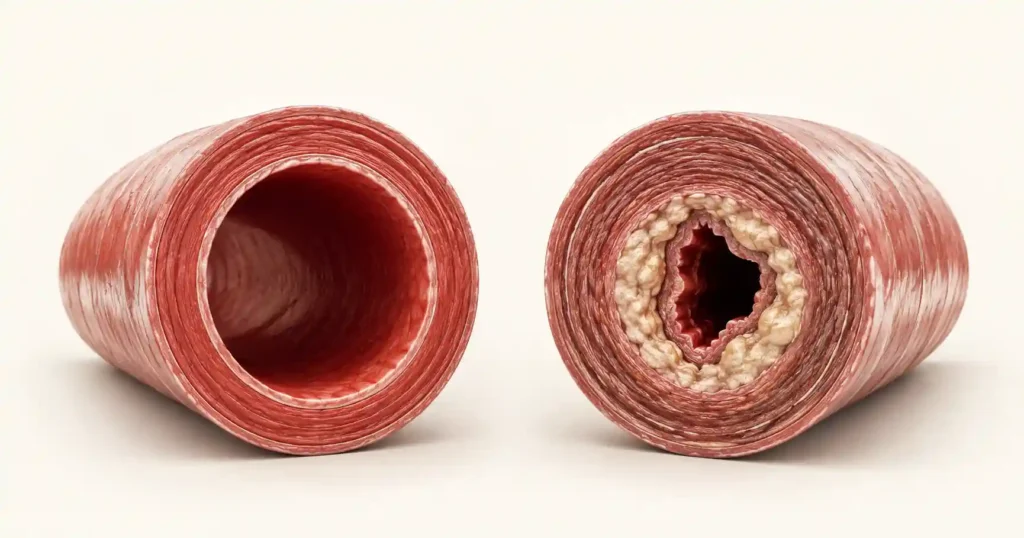
Atherosclerosis is a whole-body process, but it does not announce itself everywhere at once. It announces itself first in the smallest vessels, because a given thickness of plaque takes up a far larger share of a narrow lumen than a wide one. The penile cavernosal arteries measure roughly 1 to 2 mm (about 1/16 inch). The coronary arteries measure 3 to 4 mm (about 1/8 inch). Identical disease, very different consequences — and that asymmetry is the reason erectile function fails before angina appears. This is the artery size hypothesis, and the observed interval is not small: erectile dysfunction typically precedes clinically evident coronary disease by 2 to 5 years [5].
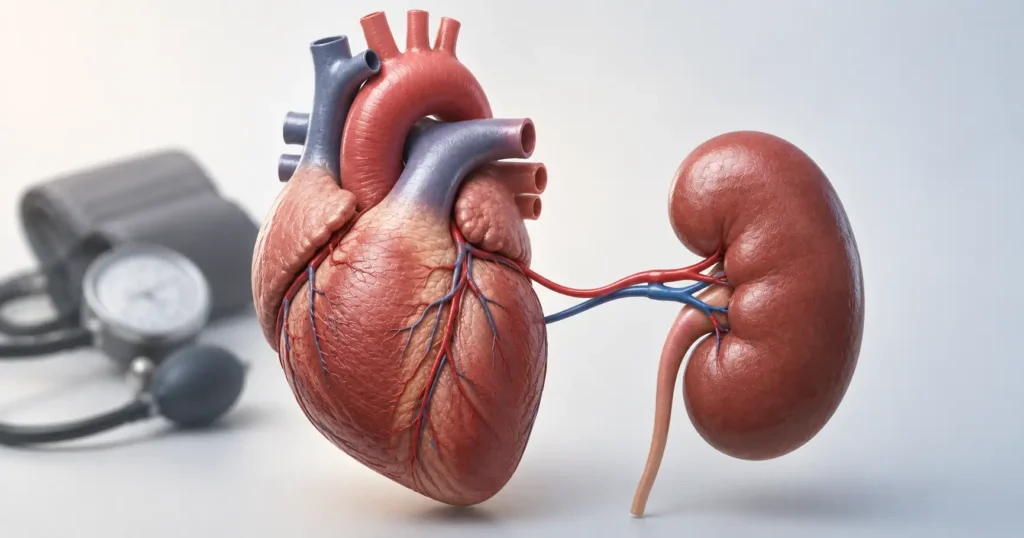
The kidney is the other end of the same story. eGFR sits in the PREVENT base model for a reason: declining filtration and stiffening arteries drive each other. High pressure damages the glomeruli; damaged kidneys handle sodium and volume worse; pressure rises further. By the time creatinine drifts up, the arteries have usually been aging fast for years. I have written the mechanism out in detail in high blood pressure and your kidneys.
In My Practice
A 46-year-old came to me last year for erectile dysfunction that had crept in over about eight months. Non-smoker, normal weight, testosterone fine, no diabetes. He was certain it was stress at work. I took his blood pressure because I take everyone’s, and it was 148/94 mmHg on two readings — a number he had never had checked as an adult. Running his profile through PREVENT put his vascular age in the late fifties. He had come to me about erections and left with a diagnosis of hypertension.
In men under 60, new erectile dysfunction is a vascular finding until proven otherwise, and the blood pressure cuff is the highest-yield thing in the room.
How to lower your vascular age, and how fast the number moves
Systolic blood pressure carries more weight in these equations than almost any other modifiable input, which makes it the first lever every time. Ask your doctor for a home blood pressure log: two readings each morning and evening for seven days, and bring the averages rather than a single clinic number. If the average sits at or above 130/80 mmHg, that is the conversation to have, and the 2025 guideline gives a 3-to-6-month lifestyle window before medication in men whose PREVENT risk is under 7.5%.
- Blood pressure. A sustained 10 mmHg drop in systolic pressure moves the calculated number by several years. Request a repeat calculation at 12 weeks, not at 12 months.
- Smoking. The single largest step-change available. Stopping removes the smoking term from the equation immediately, though the arterial wall itself takes far longer to recover.
- Glycemic control. Ask for an HbA1c if you have not had one in 12 months. Diabetes status flips a binary switch in the model — moving from diabetic to non-diabetic range is worth more than most men expect.
- Weight and activity. BMI is in the base model directly, and works indirectly through pressure and glucose. Track waist circumference monthly alongside weight; it moves first.
- Lipids and statin use. Statin use is itself a variable in PREVENT. If you have been offered one and declined, that decision is now visible in your number.
One caution about timelines, because it is where men lose faith in the exercise. The calculated vascular age responds within weeks of a genuine change in blood pressure or diabetes status, because you have changed the inputs. The measured stiffness of the aortic wall responds over months to years, and some structural change does not reverse at all. Both are real. Do not expect a pulse wave velocity reading to follow your calculator result in the same quarter.
When a Calculator Is the Wrong Tool
A vascular age result is a planning number. It is not a triage number, and it should never delay assessment of these:
- Blood pressure at or above 180/120 mmHg on repeat measurement — same-day medical assessment, not a calculator.
- Chest tightness, jaw or arm discomfort, or breathlessness brought on by exertion and relieved by rest — emergency assessment.
- Erectile dysfunction that appeared alongside calf pain when walking, which suggests peripheral arterial disease. Ask for ankle-brachial index testing within weeks.
- Sudden one-sided weakness, facial droop, or speech difficulty, even if it resolves — call emergency services immediately.
Frequently Asked Questions
Is vascular age the same thing as heart age?
In practice, yes. Heart age was the CDC’s public-facing label for the same calculation, run on the Framingham model. Vascular age is the broader term and is now more often computed from the PREVENT equations, which add kidney function, heart failure risk and a 30-year horizon. Different engine, same idea: your risk profile restated as a number of years.
Can erectile dysfunction mean my vascular age is high?
Often, yes, and it is the reason I ask about it. Penile arteries are a fraction of the width of coronary arteries, so the same plaque burden causes symptoms there years earlier. Any man under 60 with new erectile dysfunction should have blood pressure, HbA1c and lipids checked. I cover the full sentinel picture in ED and heart disease.
Are the epigenetic biological age tests sold online worth buying?
Not for clinical decisions. Epigenetic clocks are genuine research tools, but no guideline uses a biological age result to start, stop or adjust treatment, and consumer kits vary widely in method and reproducibility. If you want a number that changes what your doctor does, spend the money on a blood pressure monitor, an HbA1c and a lipid panel instead.
Does losing weight change my vascular age?
Yes, through more than one route. Body mass index is a direct input in the PREVENT base model, and weight loss usually lowers systolic pressure and improves glycemic control at the same time, so it moves three variables together. Check where you currently sit using the BMI and metabolic syndrome screener before and after.
How often should I recalculate my vascular age?
Every 12 months if nothing has changed, and 12 weeks after any deliberate intervention — starting a blood pressure medication, quitting smoking, or completing a weight loss block. Recalculating more often than that produces noise, because the inputs themselves have not moved enough to mean anything.
References
- Yang Q, Zhong Y, Ritchey M, et al. Vital Signs: Predicted Heart Age and Racial Disparities in Heart Age Among U.S. Adults at the State Level. MMWR Morb Mortal Wkly Rep. 2015;64(34):950-958. CDC
- Khan SS, Matsushita K, Sang Y, et al. Development and Validation of the American Heart Association’s PREVENT Equations. Circulation. 2024;149(6):430-449. Circulation
- 2025 AHA/ACC/Multisociety High Blood Pressure Guideline-at-a-Glance. J Am Coll Cardiol. 2025. JACC
- Van Bortel LM, Laurent S, Boutouyrie P, et al. Expert consensus document on the measurement of aortic stiffness in daily practice using carotid-femoral pulse wave velocity. J Hypertens. 2012;30(3):445-448. Journal of Hypertension
- Raheem OA, Su JJ, Wilson JR, Hsieh TC. The Association of Erectile Dysfunction and Cardiovascular Disease: A Systematic Critical Review. Am J Mens Health. 2017;11(3):552-563. PubMed Central
Dr. Muhammad Khalid
MBBS · FCPS (Urology) · MCPS (General Surgery) · CHPE · CRSM · IMC #539472
Specialist urologist with 11+ years of clinical experience across tertiary teaching hospitals. Trained at Lady Reading Hospital and Khyber Teaching Hospital, Peshawar. Author or co-author of five peer-reviewed international publications, including in Cureus and the World Journal of Surgery. Procedural expertise: URS, PCNL, RIRS, TURP, TURBT, and major open urological surgery. Full profile →
This article is for educational purposes only and does not constitute medical advice. Always consult your physician or urologist for diagnosis and treatment decisions specific to your condition.