High Creatinine Levels: When to Worry and What to Do
High creatinine levels are not a diagnosis. The number reflects muscle, medication, and hydration as much as kidney function — and in men over 60, the cause most often missed sits below the kidneys, not in them.

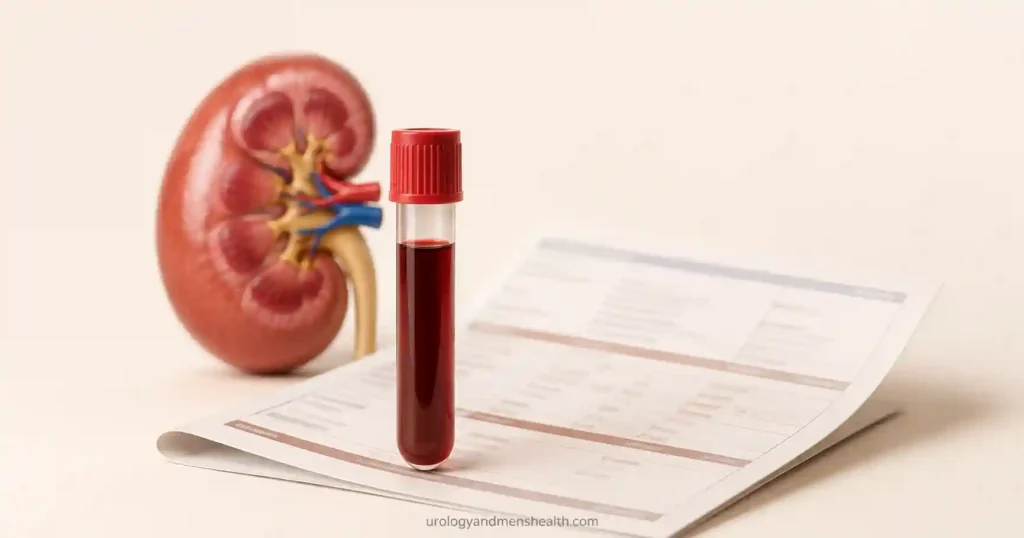
High creatinine levels are one of the most common reasons a man arrives in my clinic already convinced his kidneys are failing. Most of the time he is wrong. Occasionally he is right, in a way nobody has explained to him properly. Creatinine is not a disease marker — it is a waste product from muscle, and the amount sitting in your blood reflects three separate things at once: how much muscle you carry, what you have recently eaten or swallowed, and how well your kidneys are clearing it. One number cannot separate those three. That is why a creatinine of 1.4 mg/dL (124 µmol/L) can be entirely normal in a 34-year-old who trains hard, and quietly alarming in a 78-year-old who has been getting up five times a night to urinate. This article covers what the number actually measures, the causes that are not kidney damage, the urological cause missed most often in men, and precisely which tests to request next. For the wider picture, see our Blood Pressure & Kidney Health Hub.
Key Takeaways
- Creatinine tracks muscle mass as closely as it tracks kidney function — a heavily muscled man can sit above his lab’s reference range with completely healthy kidneys.
- eGFR, not the raw creatinine number, is what stages kidney function; it is calculated from your creatinine plus your age and sex.
- Trimethoprim, cimetidine and creatine supplements all raise creatinine without damaging a single nephron, and the level falls back once they stop.
- In a man over 60, a high creatinine alongside a weak urinary stream needs a bladder scan before anyone discusses kidney disease — obstruction is often reversible, established CKD is not.
What Creatinine Actually Measures
Every muscle cell in your body runs on a small energy store called creatine phosphate. As that store is used and recycled, a fixed fraction of it degrades spontaneously into creatinine — a waste molecule the body has no further use for. Production is remarkably steady, and it is proportional to how much muscle you carry. A 95 kg (210 lb) man with substantial muscle mass generates considerably more creatinine per day than a 60 kg (132 lb) man of the same age, and his blood level sits higher for that reason alone.
Creatinine is small, not bound to protein, and passes freely through the glomerulus — the filtering unit of the kidney. A modest additional amount is pushed into the urine by the proximal tubule, a process called tubular secretion. Hold that detail: it explains several of the false alarms later in this article.
The clinically awkward part is that creatinine is an insensitive marker. Filtration has to fall substantially before the blood level climbs above the reference range, because the remaining nephrons compensate by working harder. A man can lose a meaningful share of his filtering capacity while his creatinine still reads “normal” — which is exactly why kidney disease is described as silent, and why laboratories now report an estimated filtration rate alongside the raw number [1].
What Counts as High Creatinine Levels?
Most laboratories report an adult male reference range of roughly 0.74–1.35 mg/dL (65–120 µmol/L), with the female range set lower at around 0.59–1.04 mg/dL (52–92 µmol/L) because average muscle mass differs. Those figures shift between laboratories and between assay methods, which is the first reason two results taken a month apart at different clinics are not directly comparable.
The more useful number is the one printed beside it. eGFR — estimated glomerular filtration rate — converts your creatinine into an estimate of how many millilitres your kidneys filter per minute, correcting for age and sex. Since 2021, US laboratories have used the CKD-EPI equation that removed the race coefficient, and the accompanying research showed that adding cystatin C to creatinine produces a more accurate estimate than either marker alone [2]. That second marker matters for anyone whose muscle mass is unusual in either direction.
Chronic kidney disease is defined by an eGFR below 60 mL/min/1.73 m², or evidence of kidney damage such as albumin in the urine, present for at least three months [3]. Three months is the load-bearing part of that sentence. A single raised creatinine tells you almost nothing on its own. It is the second result, taken weeks later under controlled conditions, that means something.
Enter your creatinine, age and sex to see the eGFR and CKD stage your result corresponds toThe Causes of High Creatinine That Are Not Kidney Damage
Before assuming a raised result means nephron loss, work through the list of things that raise the number without harming the kidney at all.
Muscle mass and recent training
The single most common explanation I see in men under 45. A resistance-trained man producing more creatinine per day will sit at the top of the reference range or slightly above it, permanently, with flawless kidney function. A hard training session in the 48 hours before the blood draw pushes it higher again through transient muscle breakdown.
Creatine supplements
Supplemental creatine converts spontaneously into creatinine, so the blood level rises by simple arithmetic. A systematic review and meta-analysis in the Journal of Renal Nutrition found no impairment of filtration across the doses and durations studied, despite the change in the marker [5]. The supplement moves the measurement, not the organ.
Drugs that block tubular secretion
This is where the earlier detail pays off. Trimethoprim — the TMP half of the antibiotic combination widely prescribed for urinary infections — competes with creatinine for the same proximal tubule transporter. Even at standard doses it blocks that secretion pathway, producing a rapid rise in serum creatinine with no change whatsoever in true filtration, fully reversible once the course finishes [4]. Cimetidine does the same thing. I have seen men referred urgently for “new kidney impairment” that was nothing more than day five of an antibiotic course.
Dehydration and anti-inflammatories
Reduced blood volume lowers the pressure driving filtration, so creatinine climbs. Regular ibuprofen or naproxen does the same by constricting the vessel feeding the glomerulus. Both are genuine reductions in filtration, but both are usually reversible if corrected early — which is a different clinical conversation from structural damage.
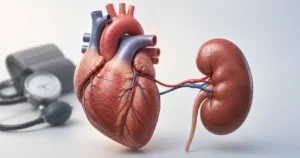
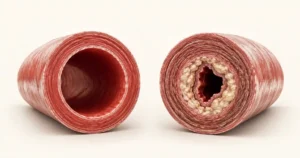
Then there are the causes that genuinely do represent damage, and in men over 50 the two that dominate are diabetes and long-standing hypertension. Raised pressure inside the glomerulus scars it slowly and painlessly over years, which is why we treat blood pressure aggressively in anyone with a drifting creatinine — the mechanism is covered in detail in our guide to how high blood pressure damages the kidneys.
Get the Blood Pressure & Kidney Protection Guide — what to test, what the numbers mean, and how to stop a drifting creatinine getting worse
Enter your email below to receive Dr. Khalid’s complete Blood Pressure & Kidney Protection Guide as a free, printable PDF.
The Urological Cause of High Creatinine That Gets Missed
Here is the part general kidney articles almost never cover properly. In men, a raised creatinine is not always a problem in the kidneys. It is frequently a problem below them.
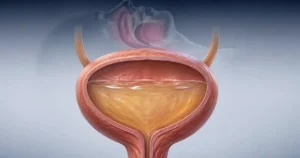
When an enlarged prostate obstructs the bladder outlet for long enough, the bladder stops emptying completely. Residual urine accumulates. Pressure inside the bladder rises and transmits backwards up the ureters into both kidneys, dilating the collecting systems — hydronephrosis — and progressively flattening the filtering tissue. Creatinine climbs as a direct mechanical consequence of urine that cannot get out.
What makes this dangerous is that chronic retention is usually painless. Acute retention is agony and sends men straight to the emergency room. Chronic retention builds over months, the bladder stretches to accommodate it, and the man reports nothing more dramatic than a slow stream and waking twice a night. He has adapted to it. The kidneys have not.
Assessment of lower urinary tract symptoms attributed to benign prostatic enlargement explicitly treats preservation of bladder function as a management priority, not an afterthought [6]. In practice that means a bladder ultrasound scan measuring post-void residual volume — a two-minute, painless test — belongs in the workup of any man over 60 with a raised creatinine and any urinary symptom at all. It is not routinely ordered, and that is the gap.
In My Practice
A retired teacher in his early seventies was referred to me with a creatinine of 320 µmol/L (3.6 mg/dL) and a working diagnosis of chronic kidney disease. He had already been booked for a nephrology appointment. When I asked how his waterworks were, he shrugged and said he had been “slow for years, like everyone my age.” His bladder scan showed just under 900 mL of residual urine. We passed a catheter in clinic. Over the following ten days his creatinine fell to 145 µmol/L (1.6 mg/dL) and stayed there.
Any man over 60 with an unexplained creatinine rise should have his bladder scanned before he is labelled with kidney disease — the test takes two minutes and occasionally changes the entire diagnosis.
What to Do Next: The Tests to Request
If you are holding one abnormal result, this is the sequence I would want followed.
- Repeat the test in 10 to 14 days, under controlled conditions. Stop creatine supplements for at least seven days beforehand, avoid heavy resistance training in the 48 hours before the draw, drink normally rather than fasting dry, and if you are mid-course on an antibiotic, wait until you have finished it.
- Ask for eGFR to be reported alongside the creatinine, and for a urine albumin-to-creatinine ratio on a first-morning sample. Albumin in the urine can flag kidney damage while filtration still reads normal, so the blood test alone leaves half the picture missing.
- Ask about a cystatin C-based eGFR if you are notably muscular, notably frail, or if the creatinine and how you actually feel do not agree. Combining both markers improves accuracy when a decision hangs on which side of a threshold you fall [2].
- Request a post-void bladder scan if you are male, over 60, and have any hesitancy, weak stream, dribbling or nocturia — even if you consider those symptoms normal for your age.
- Request a kidney ultrasound if the repeat confirms the elevation. It shows kidney size, cortical thickness and whether either collecting system is obstructed, and distinguishes a long-standing problem from a new one.
- Ask the clinic to pull your previous creatinine results. The trajectory over three years is worth more than any single value. A number that has crept up 15% since 2023 is a different situation from one that jumped last month.
The distinction that changes management is acute versus chronic. A rise of at least 0.3 mg/dL (26.5 µmol/L) within 48 hours, or one and a half times your own baseline within seven days, meets the standard definition of acute kidney injury and is investigated urgently [7]. A stable elevation present for months is a different, slower conversation about staging and protection — set out in our guide to the stages of chronic kidney disease.
When a High Creatinine Needs Same-Day Care
Contact your doctor today, or attend the emergency room, if a raised creatinine comes with any of the following:
- You have passed little or no urine in the last 12 hours
- A visibly swollen lower abdomen with a constant urge to urinate but almost nothing coming out
- New breathlessness lying flat, or swelling of both ankles that has appeared over days
- Confusion, persistent nausea and vomiting, or hiccups you cannot stop
- Fever with flank pain — infection behind an obstructed kidney is a surgical emergency
Frequently Asked Questions About High Creatinine Levels
Can high creatinine levels go back to normal?
Yes, when the cause is reversible. Dehydration corrects within days of proper fluid intake. Trimethoprim and cimetidine effects resolve within about a week of stopping the drug [4]. Obstruction from an enlarged prostate can improve substantially once the bladder is drained. What does not reverse is scarring from years of uncontrolled diabetes or hypertension — there the goal is halting further loss.
Why is my creatinine high but my eGFR normal?
Usually muscle mass. eGFR equations assume an average build for your age and sex, so a heavily muscled man generates more creatinine than the equation expects and can land above the reference range with normal calculated filtration. The reverse also happens: normal creatinine with real kidney damage, which is why a urine albumin test matters — see our guide to protein in the urine and what it means.
Should I stop taking creatine before a kidney blood test?
Yes — stop at least seven days before the draw, and tell whoever ordered the test that you take it. Supplemental creatine converts to creatinine directly, so it inflates the reading without affecting filtration [5]. Failing to mention it is one of the more common reasons a healthy man ends up in a nephrology clinic he never needed to visit.
Does drinking more water lower creatinine?
Only if you were dehydrated. Correcting genuine fluid depletion restores filtration pressure and brings the number down. Drinking beyond normal thirst in an already well-hydrated man does not improve kidney function and will not meaningfully move the result. Aggressive water loading before a blood test is not a fix — it just makes the reading harder to interpret [1].
Does high blood pressure cause high creatinine levels?
Over years, yes. Sustained pressure inside the glomerulus scars the filtering units gradually, and creatinine only rises once a substantial share of them are gone — which is why the damage is usually silent until late. The relationship runs both ways, because failing kidneys also drive pressure up. You can estimate your own risk with our blood pressure and kidney damage risk tool.
References
- National Institute of Diabetes and Digestive and Kidney Diseases. Chronic Kidney Disease Tests & Diagnosis. NIDDK
- Inker LA, Eneanya ND, Coresh J, et al. New creatinine- and cystatin C-based equations to estimate GFR without race. N Engl J Med. 2021;385(19):1737-1749. NEJM
- Kidney Disease: Improving Global Outcomes (KDIGO) CKD Work Group. KDIGO 2024 Clinical Practice Guideline for the Evaluation and Management of Chronic Kidney Disease. Kidney Int. 2024;105(4S). KDIGO
- Trimethoprim, creatinine and creatinine-based equations. Nephron Clin Pract. 2011;119(3):c187. Karger
- de Souza e Silva A, et al. Effects of creatine supplementation on renal function: a systematic review and meta-analysis. J Ren Nutr. 2019. PubMed
- American Urological Association. Management of Lower Urinary Tract Symptoms Attributed to Benign Prostatic Hyperplasia: AUA Guideline. 2026. AUA
- KDOQI US Commentary on the 2012 KDIGO Clinical Practice Guideline for Acute Kidney Injury. Am J Kidney Dis. 2013. AJKD
Dr. Muhammad Khalid
MBBS · FCPS (Urology) · MCPS (General Surgery) · CHPE · CRSM · IMC #539472
Specialist urologist with 11+ years of clinical experience across tertiary teaching hospitals. Trained at Lady Reading Hospital and Khyber Teaching Hospital, Peshawar. Author or co-author of five peer-reviewed international publications, including in Cureus and the World Journal of Surgery. Procedural expertise: URS, PCNL, RIRS, TURP, TURBT, and major open urological surgery. Full profile →
This article is for educational purposes only and does not constitute medical advice. Always consult your physician or urologist for diagnosis and treatment decisions specific to your condition.