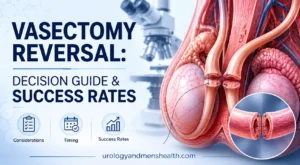
Vasectomy Reversal Success Rates: What They Really Mean
When a man asks me about vasectomy reversal success rates, he is usually quoting a 90% figure from a clinic website. That number is real — it just isn't measuring what he thinks it is.

Vasectomy reversal success rates are quoted so loosely that two men can be told the same number and hear two completely different promises. One clinic advertises 90%. Another quotes 50%. Neither is lying. They are measuring different things, and the gap between those two figures is where most of the disappointment in this operation lives. Sperm coming back into your ejaculate and your partner becoming pregnant are separate outcomes with separate odds, and the second one depends heavily on a variable no surgeon can operate on. Roughly 6% of men who have a vasectomy later want their fertility back [1], and most of them arrive in clinic having read a marketing number rather than a clinical one. This article breaks the figure apart: what patency means, what pregnancy means, how the interval since your vasectomy changes both, and when sperm retrieval with IVF is the better arithmetic. For the wider picture, see our Sexual Health Hub.
Key Takeaways
- Patency (sperm returning to the ejaculate) and pregnancy are two different success rates — patency is always the higher, more advertised number.
- In the largest published series, patency fell from 97% at under 3 years since vasectomy to 71% at 15 years or more, with pregnancy falling from 76% to 30%.
- Female partner age is an independent predictor of pregnancy after reversal and frequently outweighs the surgical variables entirely.
- If the vasal fluid contains no sperm at surgery, a straight vasovasostomy drops to roughly 60% patency — which is why the surgeon must be able to convert to vasoepididymostomy on the spot.
Patency and Pregnancy Are Two Different Numbers
Patency means sperm have reappeared in your semen after the reconnection. It is confirmed by a semen analysis, it is entirely under the surgeon’s control, and it is the number clinics advertise. Pregnancy means a conception happened. It depends on the surgery, on your sperm quality once flow resumes, and on your partner’s fertility. Patency is always the larger number.
There is a further problem hiding inside the patency figure: nobody agrees what counts as patent. A 2026 review of long-term vasovasostomy outcomes found that using a threshold of more than one million sperm, patency was 77% at twelve months — but applying a stricter definition of at least 30% motile sperm dropped the same figure to 33% [7]. Pregnancy rates across the studies in that review ranged from 28% to 54%. When a clinic quotes you a single percentage without telling you which definition it used, the number is close to meaningless.
Ask for both numbers, for that surgeon’s own series, with the patency definition stated. A microsurgeon who does this operation regularly will have them.
Vasectomy Reversal Success Rates by Time Since Vasectomy
The reference dataset is still the Vasovasostomy Study Group, which reported 1,469 microsurgical reversals across five institutions. Overall patency was 86% and pregnancy 52%, but broken down by the interval since vasectomy the pattern is clear [2]:
- Under 3 years: 97% patency, 76% pregnancy
- 3 to 8 years: 88% patency, 53% pregnancy
- 9 to 14 years: 79% patency, 44% pregnancy
- 15 years or more: 71% patency, 30% pregnancy
A long interval is not a disqualification. A single-surgeon series of 173 men reversed at least 15 years after vasectomy reported 85% patency, 43% pregnancy and a 36% birth rate; those at 15 to 19 years did better still at 89% and 49% [3]. The mean female partner age in that series was 34.3, which is not a coincidence.
The 2026 AUA guideline on fertility restoration is careful here: there is no discrete cutoff beyond which reversal stops being worth doing. What lengthens with the interval is the likelihood that the epididymis has blown out under back-pressure, forcing the surgeon into the harder operation [1]. And there is a counterweight worth knowing about — a German series using modern microsurgical technique found that neither the obstructive interval nor the presence of a sperm granuloma predicted patency or pregnancy once technique was controlled for, while female partner age remained an independent predictor [4].
Estimate your own patency and pregnancy odds by interval and partner age →
Vasectomy Reversal: The Questions to Ask Before You Book
Enter your email below to receive Dr. Khalid’s complete Male Fertility & Semen Analysis Guide as a free, printable PDF.
Vasovasostomy vs Vasoepididymostomy: The Decision Made While You Are Asleep
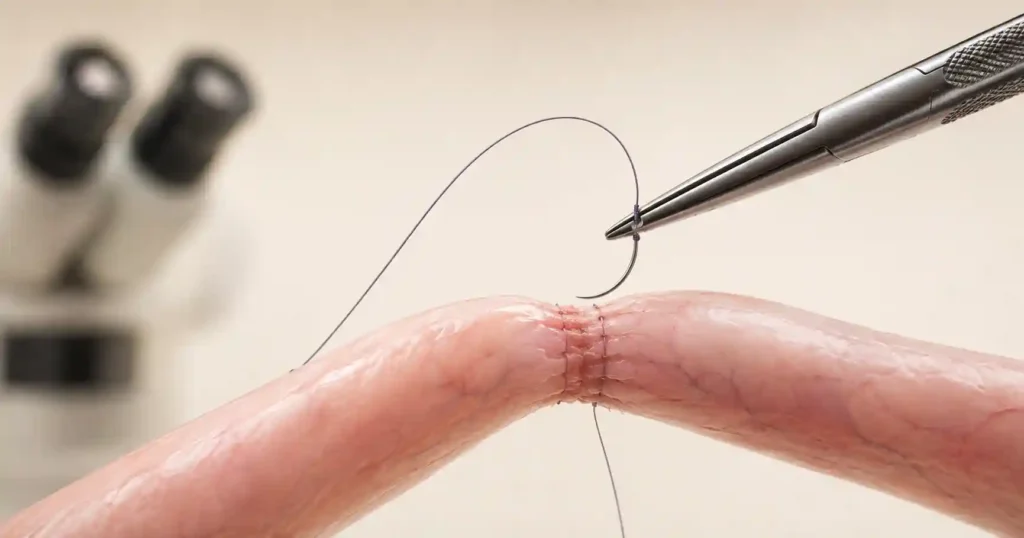
Vasovasostomy rejoins the two cut ends of the vas deferens. Vasoepididymostomy connects the vas directly to a tubule of the epididymis, and it is required when the epididymis itself has become obstructed from years of pressure behind the vasectomy. The second operation is technically far harder — the epididymal tubule is a fraction of the diameter of the vas — and the outcomes reflect that. The AUA and ASRM put vasovasostomy success at up to around 90% and vasoepididymostomy at roughly 60 to 70% [6].
Which one you get is not decided in the consultation. It is decided at the table, by putting a drop of the fluid from your vas under a microscope and looking for sperm. The 2026 AUA guideline makes microscopic evaluation of that vasal fluid a strong recommendation, graded on Level B evidence [1]. The reason is in the original study group data: when sperm were absent from the vasal fluid on both sides and the surgeon proceeded with vasovasostomy anyway, patency fell to 60% and pregnancy to 31% [2].
How long before sperm come back
After vasovasostomy I check the first semen analysis at around three months. After vasoepididymostomy, return is slower and follow-up in the published series runs out to 30 months [5] — an early negative sample after that operation tells you nothing at all. Robot-assisted vasovasostomy has been reported as a newer technique and is one of the areas where outcomes may improve [5]; if you are curious how robotic assistance is used across the specialty, we cover that in robotic surgery in urology.
What to ask, before booking: “Do you perform vasoepididymostomy yourself, and how many did you do last year?” A surgeon who cannot convert intraoperatively will perform a vasovasostomy regardless of what the fluid shows, because it is the only operation available to them. That is the single most important question in the consultation.
Your Partner’s Age Outweighs Almost Everything Else
The 2026 AUA guideline names three best preoperative predictors of reversal success: the obstructive interval, your age, and your female partner’s age [1]. Of those, partner age is the one that moves the pregnancy number most and the one that is almost never discussed at the reversal consultation, because the consultation is booked in the man’s name.
The mechanism is not subtle. A perfectly patent repair delivers sperm; it does not deliver oocytes. Female fertility declines meaningfully from the mid-thirties, and that decline applies to natural conception after reversal exactly as it applies to IVF [1]. This is why a man reversed at 18 years post-vasectomy with a 32-year-old partner can outperform a man reversed at 5 years with a 41-year-old partner, despite having the worse surgical profile.
In My Practice
A man came to me having already paid a deposit for a reversal elsewhere. He had memorised his own numbers — 11 years since vasectomy, no complications, good general health — and wanted me to confirm he was a strong candidate. I asked how old his wife was. Forty-three. Nobody had asked him that question in two prior consultations, and he had not thought it was relevant to his operation.
Before you commit to a reversal, your partner needs her own fertility assessment — an AMH level and antral follicle count at minimum — because that result can change which operation the couple should be paying for.
Reversal or Sperm Retrieval With ICSI: How the Two Compare
The AUA and ASRM treat both as legitimate options and stop short of ranking them, because there is no randomised trial comparing them and results vary widely between centers [1][6]. The honest framing is structural rather than statistical.
Reversal buys unlimited attempts. If the repair is patent, you can conceive naturally this year and again in three years with no further intervention. Nothing happens to your partner’s body. The cost is paid once, typically in the mid four to low five figures in the US, though this varies substantially by center.
Sperm retrieval with ICSI buys one cycle at a time. It bypasses the plumbing entirely, works regardless of how long ago the vasectomy was, and produces a result within months rather than waiting for patency. But your partner undergoes ovarian stimulation and egg retrieval, the cost recurs with every cycle, and success falls with her age just as natural conception does [1].
The rough decision rule I use: if the partner is under 35 and the couple wants more than one child, reversal usually wins on both economics and burden. If she is close to 40, or if there is a known female factor, the waiting period built into reversal is itself a cost, and retrieval with ICSI often makes more sense. A third route exists — reconstruct and cryopreserve sperm at the same operation, which the AUA and ASRM explicitly endorse as a viable option [6]. For a fuller walk through this choice, see our vasectomy reversal decision guide.
If a first reversal fails, a repeat is not futile: the study group reported 75% patency and 43% pregnancy across 222 repeat procedures [2]. It is a harder operation with a smaller margin, and it belongs with a high-volume microsurgeon.
Red Flags in a Reversal Consultation
Any one of these should make you pause before paying a deposit:
- A single headline success rate quoted with no distinction between patency and pregnancy, and no stated definition of patency.
- The surgeon does not perform vasoepididymostomy, or cannot say how many they did last year.
- No plan to examine the vasal fluid microscopically during the operation.
- Your partner’s fertility has not been assessed, or her age was not asked about.
- An operating microscope is not used — loupe-only reversal has materially worse outcomes than microsurgical repair.
Frequently Asked Questions
What vasectomy reversal success rate is realistic 10 years after the vasectomy?
In the Vasovasostomy Study Group series, men reversed 9 to 14 years after vasectomy had a 79% patency rate and a 44% pregnancy rate [2]. Contemporary microsurgical series report better patency at that interval, but pregnancy remains the harder number because it depends on your partner’s fertility as much as on the anastomosis.
Does a reversal still work if the surgeon finds no sperm in the vasal fluid?
Sometimes. When sperm were absent from the vasal fluid on both sides and the surgeon performed a vasovasostomy anyway, patency was 60% and pregnancy 31% [2]. That is exactly why the AUA recommends examining the vasal fluid under the microscope during surgery and converting to vasoepididymostomy when the findings call for it [1].
How soon after a vasectomy reversal should I get a semen analysis?
I check the first sample at about three months after vasovasostomy, then repeat at six and twelve months if the count is low. After vasoepididymostomy sperm can take far longer to appear, so one early negative sample proves nothing. Run each result through our semen analysis interpreter so you are comparing like with like.
Can a vasectomy reversal fail after sperm have already returned?
Yes. Scar tissue can close the anastomosis months after an initially patent repair, and long-term series show patency falling well below the twelve-month figure — as low as 33% when success is defined strictly by motile sperm rather than any sperm at all [7]. If you are not pregnant within a year, repeat the semen analysis before assuming the surgery held.
Does the type of vasectomy I had affect reversal success?
Indirectly. A vasectomy that removed a long segment of vas, or that was placed close to the epididymis, leaves less healthy vas to work with and raises the chance you will need a vasoepididymostomy. The technical details of your original procedure are worth retrieving from your operative note — see what a vasectomy actually involves.
References
- Schlegel PN, Clark JY, Coward RM, et al. Fertility Restoration After Vasectomy: AUA Guideline (2026) Part II. J Urol. 2026;215(3):250-255. Journal of Urology
- Belker AM, Thomas AJ Jr, Fuchs EF, Konnak JW, Sharlip ID. Results of 1,469 microsurgical vasectomy reversals by the Vasovasostomy Study Group. J Urol. 1991;145(3):505-511. PubMed
- Fuchs EF, Burt RA. Vasectomy reversal performed 15 years or more after vasectomy: correlation of pregnancy outcome with partner age and with pregnancy results of IVF with ICSI. Fertil Steril. 2002. Fertility and Sterility
- Magheli A, Rais-Bahrami S, Kempkensteffen C, et al. Impact of obstructive interval and sperm granuloma on patency and pregnancy after vasectomy reversal. Int J Androl. 2010. International Journal of Andrology
- Namekawa T, Imamoto T, Kato M, et al. Vasovasostomy and vasoepididymostomy: review of the procedures, outcomes, and predictors of patency and pregnancy over the last decade. Reprod Med Biol. 2018;17(4):343-355. Reproductive Medicine and Biology
- Brannigan RE, Hermanson L, Kaczmarek J, et al. Diagnosis and Treatment of Infertility in Men: AUA/ASRM Guideline (2020; amended 2024). American Urological Association
- Long-term patency and pregnancy after vasovasostomy: a comprehensive review. Arch Ital Urol Androl. 2026;98(1). Archivio Italiano di Urologia e Andrologia
Dr. Muhammad Khalid
MBBS · FCPS (Urology) · MCPS (General Surgery) · CHPE · CRSM · IMC #539472
Specialist urologist with 11+ years of clinical experience across tertiary teaching hospitals. Trained at Lady Reading Hospital and Khyber Teaching Hospital, Peshawar. Author or co-author of five peer-reviewed international publications, including in Cureus and the World Journal of Surgery. Procedural expertise: URS, PCNL, RIRS, TURP, TURBT, and major open urological surgery. Full profile →
This article is for educational purposes only and does not constitute medical advice. Always consult your physician or urologist for diagnosis and treatment decisions specific to your condition.