
Peyronie's Disease Self-Assessment
This Peyronie's disease self-assessment walks through five questions on how long your penis has been changing shape, whether the bend is still moving, and what it stops you doing. It sorts you into one of the three lanes urologists actually use: watch it, wait for it to settle, or correct it. Nothing is stored. For the wider picture, see the Sexual Health Hub.

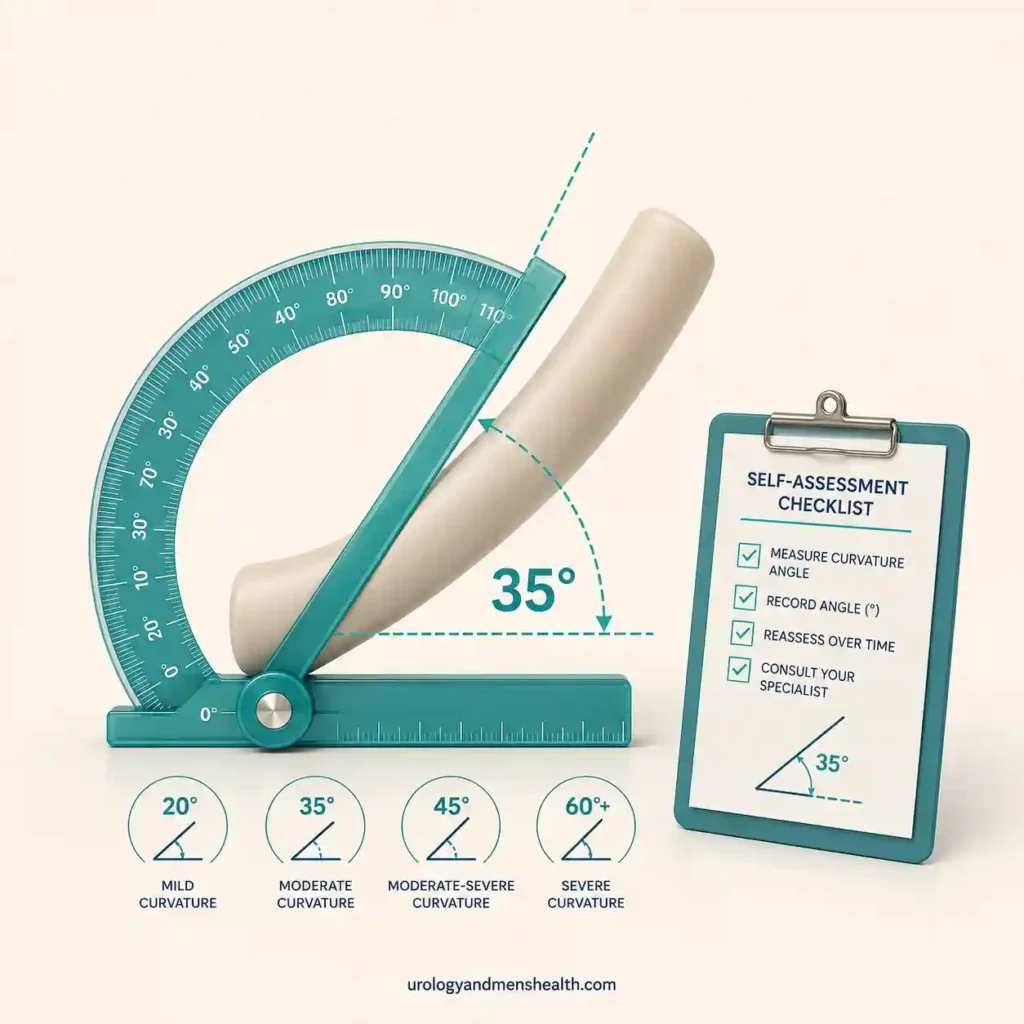
The Tool
Related Sexual Health Tools
Full Clinical Guide
In This Guide:
- Peyronie’s disease runs in two phases: an active, painful one where the plaque is still forming, and a stable one where the shape settles. Nothing is corrected until the second phase.
- The EAU calls disease stable when there has been no pain and no worsening for at least 3 months — usually reached around 12 months from the first symptom.
- Treatment follows function, not degrees. A 40-degree bend that lets you have sex is left alone; a 40-degree bend that stops you is a referral.
- It is never cancer. The EAU tells clinicians to say that out loud at the first visit.
What This Peyronie’s Disease Self-Assessment Measures
This Peyronie’s disease self-assessment does not produce a score, because Peyronie’s has no scored questionnaire that changes management. The Peyronie’s Disease Questionnaire exists, but the European Association of Urology is candid that it belongs mainly in clinical trials and is not mandatory in daily practice [1]. What does change management is a short chain of clinical facts, and that is what these five questions capture: how long the shape has been changing, whether it has moved in the last 3 months, whether erections still hurt, what the deformity stops you doing, and whether your erections are firm enough to carry it. Those five answers are the same ones I take in clinic, and they map onto the phase-differentiated algorithm the EAU published in its 2025 Sexual and Reproductive Health guideline [2] and onto the AUA’s Peyronie’s Disease Guideline [3]. If you want the plain-English condition overview first, read my full guide to the curved erection.
The Physiology Behind the Curve
Your erectile bodies sit inside a tough sheath called the tunica albuginea. When it erects, that sheath stretches evenly in every direction. Peyronie’s begins when repeated microscopic injury — usually trivial, usually never noticed — triggers abnormal wound healing, and a patch of the sheath is replaced by a fibrous plaque. Picture a strip of packing tape stuck along one side of a balloon: inflate it and the taped side refuses to lengthen, so the whole thing bends toward it. That is the entire mechanism, and it explains why the plaque is a firm ridge you can feel inside the shaft rather than a lump on the skin. It also explains the company it keeps: the same fibrotic tendency shows up as Dupuytren’s contracture in the palm and Ledderhose disease in the sole, and diabetes, hypertension, dyslipidaemia, smoking, low testosterone and previous pelvic surgery are all named as associated risk factors [2]. That vascular overlap is why erectile dysfunction and Peyronie’s so often arrive together — if that is your situation, the ED Vascular Risk Screener is the sensible companion.
How to Interpret Your Result
Two men can have an identical 45-degree bend and walk out of my clinic with completely opposite advice. The first has had it for two years, feels no pain, and tells me sex is unaffected — he gets a photograph, a yearly check, and nothing else, because straightening him would cost length and buy him nothing. The second developed his bend four months ago, still winces with every erection, and cannot penetrate at all — he gets pain relief and a three-month review, and he does not get an operation, because a plaque that is still remodelling will simply bend around the repair. That contrast is the whole tool. No correction needed means the disease has settled (or was never Peyronie’s at all, just a lifelong congenital curve) and sex works. Not yet stable means pain or movement in the last 3 months, so the correction conversation is premature. Correction on the table means the shape has stopped moving and is now the thing standing between you and sex. Only the third tier is a referral. If you are not certain the ridge you are feeling is even a plaque, start with the anatomy.
What to Do With Your Result
If you landed in No correction needed, take two dated photographs of a full erection — one from directly above, one from the side — and repeat yearly. Memory is a poor instrument for measuring a curve. If you landed in Not yet stable, ask for a plain non-steroidal anti-inflammatory such as ibuprofen for the erection pain, which the EAU recommends strongly, and note what it does not recommend: vitamin E, potassium para-aminobenzoate, tamoxifen, pentoxifylline and colchicine are all explicitly advised against [2]. Photograph monthly and book a firm 3-month review. If you landed in Correction on the table, the four lanes are these — intralesional collagenase clostridium histolyticum for a stable, non-calcified dorsal or lateral curve between 30 and 90 degrees with working erections [3]; tunical shortening such as Nesbit or plication for adequate length and a simple curve; grafting where length is short or the deformity is hourglass or hinge; and an inflatable prosthesis where tablets no longer produce a usable erection. Ask which lane you are in by name. Where the erection is the limiting factor rather than the bend, grade it first with the IIEF-5, then work the ladder.
If you are unsure about your result, the PDF report this tool generates gives you a ready-made framework to bring to your next appointment.
In My Practice
The single most useful thing a man with Peyronie’s has ever handed me was a phone album. Four photographs, one a month, all taken from the same angle, all dated. It took him thirty seconds a month and it answered in one swipe the question I otherwise spend a year trying to answer: has this stopped moving? He was operable eight months earlier than he would otherwise have been, because we could prove stability instead of guessing at it.
Almost nobody arrives with photographs, and almost everybody is asked to describe from memory a shape they have only ever seen while distracted. Start the album on the day you find the lump.
References
- EAU Guidelines on Sexual and Reproductive Health, 2025 edition. European Association of Urology. Peyronie’s disease chapter: diagnosis, conservative and surgical treatment recommendations.
- European Association of Urology Guidelines on Male Sexual and Reproductive Health: 2025 Update on Male Hypogonadism, Erectile Dysfunction, Premature Ejaculation, and Peyronie’s Disease. Eur Urol. 2025. European Urology. Source of the phase-differentiated algorithm, the 3-month stability rule, and the oral-agent recommendations against.
- Nehra A, Alterowitz R, Culkin DJ, et al. Peyronie’s Disease: AUA Guideline. J Urol. 2015;194(3):745-753. PubMed. Source of the collagenase criteria: stable disease, curvature above 30 and below 90 degrees, intact erectile function.
- Schwarzer U, Sommer F, Klotz T, et al. The prevalence of Peyronie’s disease: results of a large survey. BJU Int. 2001;88(7):727-730. PubMed. 8,000 men surveyed, 4,432 replies (55.4%); 142 men (3.2%) reported a new palpable plaque.
- Gelbard MK, Dorey F, James K. The natural history of Peyronie’s disease. J Urol. 1990. PubMed. Questionnaire study of 97 men: 13% reported gradual resolution, 47% little or no change, 40% gradual progression.
Frequently Asked Questions
Can Peyronie’s disease turn into cancer?
No. The plaque is scar tissue inside the tunica albuginea, and the European Association of Urology instructs clinicians to reassure men explicitly that Peyronie’s does not lead to any form of malignancy. What it can do is bend the penis, shorten it, and hurt during the active phase. A firm ridge inside the shaft is very different from a lump, ulcer, or bleeding on the skin or head of the penis, and those do need showing to a doctor.
Will the bend get better on its own if I wait?
Usually not. The best-known natural history study asked 97 men what their disease had done: 13% described gradual resolution, 47% little or no change, and 40% gradual progression. So waiting is a reasonable plan for pain, which reliably settles, and a poor plan for the curve itself. That is why the aim of the waiting year is documentation, not hope.
Does Peyronie’s disease cause erection problems?
Often, and for two reasons. The plaque can disturb how the erectile body seals blood in, and the same vascular risk factors that damage penile arteries also drive the fibrosis. In the original prevalence survey, 41% of men reporting a plaque also reported erectile dysfunction. If your erections faltered before the bend appeared, that ordering matters — erectile dysfunction can be the first sign of cardiovascular disease.
How accurate is this tool, and can I rely on it?
This is a screening aid built from the EAU and AUA treatment algorithms, not a diagnosis. It cannot feel your plaque, measure your angle, or see whether it has calcified, and those three things decide your treatment. It is accurate at sorting you into the right conversation and at telling you which questions to ask. It is not a substitute for a urologist examining you.
How do I use this result at my doctor’s appointment?
Press Download My Report. You get a two-page PDF with your five answers, the recommendation and its confidence level, my interpretation, your next steps, and a list of questions written for your specific result. Print it, or bring it on your phone alongside your dated erection photographs. Handing over a page beats trying to describe a curve you last saw in the dark.
Dr. Muhammad Khalid
MBBS · FCPS (Urology) · MCPS (General Surgery) · CHPE · CRSM · IMC #539472
Specialist urologist with 11+ years of clinical experience across tertiary teaching hospitals. Trained at Lady Reading Hospital and Khyber Teaching Hospital, Peshawar. Author or co-author of five peer-reviewed international publications, including in Cureus and the World Journal of Surgery. Procedural expertise: URS, PCNL, RIRS, TURP, TURBT, and major open urological surgery. Full profile →
This article is for educational purposes only and does not constitute medical advice. Always consult your physician or urologist for diagnosis and treatment decisions specific to your condition.