
ED Treatment Step-Up Pathway
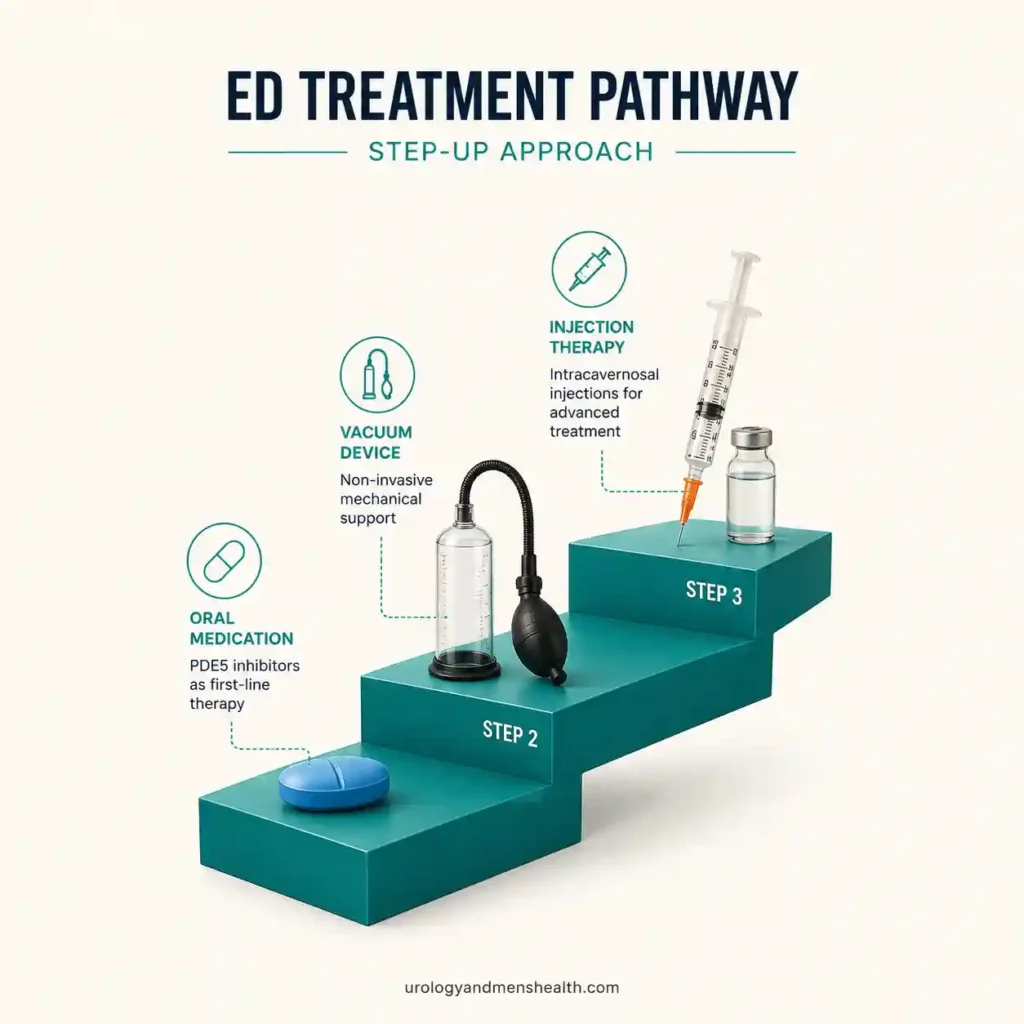
This ED treatment step-up tool turns a confusing menu into one clear next move. It asks up to four questions about what you have tried and how you tried it, then names the next evidence-based step - fix the tablet technique, add a missing test, or move past orals altogether. The logic follows AUA and EAU pathways. More tools and guides sit in the Sexual Health Hub.

The Tool
Related Sexual Health Tools
Full Clinical Guide
In This Guide:
- Most “tablet failures” are not drug failures – they are timing, food, dose or arousal problems, and they are fixable.
- The chance of success with a PDE5 inhibitor keeps rising with repeated attempts, plateauing at around 8 tries – one or two disappointing nights proves nothing.
- Beyond tablets there is no single next step. Vacuum device, injection and implant are a menu, and your priorities pick the route.
- A penile implant is definitive, not a punishment – but it is one-way, so it belongs after the earlier rungs, not instead of them.
What the ED Treatment Step-Up Pathway Measures
This ED treatment step-up tool does not score your symptoms. It locates you on a treatment pathway and names the next move. The pathway itself is not my invention – it is the sequence set out in the American Urological Association’s Erectile Dysfunction Guideline [1] and updated in the European Association of Urology’s 2025 Sexual and Reproductive Health guideline [2]: reversible causes and testosterone first, oral PDE5 inhibitors properly optimized next, then non-oral second-line options, then a penile implant as the definitive answer. What the 2025 EAU update changed is the tone. The rigid “oral, then injection, then surgery” escalator is gone, replaced by a modular pathway where the man’s priorities and the invasiveness he will accept steer the choice [2].
The Physiology Behind the Step-Up
An erection is a hydraulic event with a chemical trigger. Arousal releases nitric oxide in the penis, which raises cyclic GMP, which relaxes the smooth muscle of the corpora cavernosa so blood floods in and the drainage veins are pinched shut. Think of it as a tap and a plug: the tap must open, and the plug must seal.
Each rung of the ladder attacks a different part of that chain. PDE5 inhibitors – sildenafil, tadalafil, vardenafil, avanafil – block the enzyme that destroys cyclic GMP, so they amplify a signal that must already be there. That is the whole reason they fail without arousal, and why sildenafil taken after a heavy meal underperforms while tadalafil, active for up to 36 hours, is far more forgiving of timing. A vacuum erection device skips the chemistry and pulls blood in mechanically, holding it with a constriction ring. An intracavernosal injection of alprostadil bypasses the nitric oxide pathway entirely and relaxes the muscle directly – which is why it still works when the signal is gone. An inflatable implant abandons hydraulics altogether and replaces the erectile tissue’s function with a device. The decision rationale that separates these paths is not severity. It is which link in the chain is broken: a weak signal responds to tablets, absent smooth-muscle response needs injections, and destroyed erectile tissue needs an implant. If the underlying cause is arterial, that same arterial disease is in your heart too – worth testing with the BP & Kidney Damage Risk Tool.
How to Interpret Your Recommendation
A first-line step means the fix is still in the cheapest, safest lane. That covers four situations: bloods not yet done (blood pressure, fasting glucose or HbA1c, lipids, and an early-morning total testosterone – the AUA sets the low-testosterone cut-off at under 300 ng/dL, or 10.4 nmol/L, on two separate early-morning samples [6]); a tablet never titrated to sildenafil 100 mg or tadalafil 20 mg; a tablet used wrongly; or side effects that a switch of agent or a 5 mg daily tadalafil might solve. This is not a consolation prize. In a real-life study of men labelled non-responders to tadalafil and vardenafil, correcting instructions, fasting-state dosing and daily dosing salvaged roughly half of them [5].
A second-line step means the oral route is genuinely spent, or closed to you because of nitrates. A definitive step means an implant conversation. Two men can both fail tablets and get completely different advice here: the 52-year-old with post-prostatectomy nerve injury who wants reliability and will accept a needle goes to injections; the 71-year-old on nitrates with diabetic vascular disease who has already given injections a fair run goes to an implant. Same failure, different route, because the priorities differ.
What to Do With Your Result
If you landed on a first-line step, the job is to give it a fair trial. That means the maximum labelled dose, an empty stomach for sildenafil, an hour of lead time, real arousal, and at least eight separate attempts – because the cumulative probability of success keeps climbing with each try and only plateaus at around eight [3]. Grade the starting point objectively with the IIEF-5 assessment so you can prove to yourself whether anything changed.
If you landed on a second-line step, ask for the teaching visit, not just the prescription. In the pivotal self-injection study of 683 men, sexual activity was possible after 94 percent of injections and rated satisfactory by the men after 87 percent – but penile pain was reported by half the men at some point, even though it followed only 11 percent of injections, and that gap between “some pain ever” and “pain most times” is exactly what a proper teaching visit explains [4]. If you landed on the definitive step, ask about surgeon volume before you ask about anything else.
If you are unsure about your result, the PDF report this tool generates gives you a ready-made framework to bring to your next appointment.
In My Practice
The moment that decides most ED consultations is not the prescription – it is the sentence “how exactly did you take it?” Nine times out of ten, the man who has “failed” three drugs took each of them twice, after dinner, in a bad mood, and concluded the problem was unfixable. He was not a treatment failure. He was never treated.
Before you climb a rung, be certain you stood on the last one properly. The step-up pathway only earns its name if each step is actually taken.
References
- Burnett AL, Nehra A, Breau RH, et al. Erectile Dysfunction: AUA Guideline. American Urological Association, 2018. Source of the first-line PDE5 inhibitor recommendation, the instruction-and-titration recommendations, and the position that low-intensity shockwave therapy is investigational.
- Salonia A, Capogrosso P, Boeri L, et al. EAU Guidelines on Male Sexual and Reproductive Health: 2025 Update. European Urology, 2025;88(1):76-102. Source of the modular, patient-centred ED pathway that replaced the rigid stepwise escalator.
- McCullough AR, Barada JH, Fawzy A, et al. Achieving treatment optimization with sildenafil citrate in patients with erectile dysfunction. Urology, 2002;60(2 Suppl 2):28-38. In 1,276 men, the cumulative probability of intercourse success rose with each attempt and plateaued at roughly 8 attempts.
- Linet OI, Ogrinc FG. Efficacy and safety of intracavernosal alprostadil in men with erectile dysfunction. New England Journal of Medicine, 1996;334:873-877. In 683 men over six months: sexual activity after 94% of injections, rated satisfactory after 87% by men and 86% by partners; penile pain in 50% of men but after only 11% of injections.
- Treatment Strategy for “Non-Responders” to Tadalafil and Vardenafil: A Real-Life Study. European Urology, 2006. Overall salvage rates of 52% and 46% after correcting instructions, fasting-state dosing and daily dosing in men labelled non-responders.
- Evaluation and Management of Testosterone Deficiency: AUA Guideline. American Urological Association, 2018. Source of the under-300 ng/dL cut-off confirmed on two early-morning total testosterone measurements.
Frequently Asked Questions
My tablet worked at first and now it does not. Has it stopped working?
Usually not. True loss of response to a PDE5 inhibitor is uncommon; what has normally changed is the disease underneath it – worsening diabetes, rising blood pressure, a new medication, weight gain, or falling testosterone. The tablet is the same; the arterial supply it depends on has moved. Before anyone declares the drug dead, ask for a fresh vascular and hormonal review, as set out in my erectile dysfunction treatment protocol.
I take nitrates for angina. Does that end the conversation?
It ends the tablet conversation, permanently and without exception – PDE5 inhibitors with nitrates can cause a catastrophic drop in blood pressure. It does not end the ED conversation. Vacuum erection devices, intracavernosal injections and penile implants are all unaffected by nitrate use, and men on nitrates do well on all three. You are not out of options. You are out of one option.
Does shockwave therapy belong on this pathway?
Not yet, and this tool deliberately leaves it out. The AUA guideline classifies low-intensity extracorporeal shockwave therapy as investigational, and platelet-rich plasma as experimental. That does not mean they never work; it means the evidence is not strong enough to place them on a pathway ahead of treatments that are proven. If a clinic offers it as a first move before optimizing your tablet, ask why – I go through the evidence in shockwave therapy for ED.
How accurate is this tool, and can I rely on it?
This tool routes you along the treatment sequence set out in the AUA and EAU guidelines. It is a screening and preparation aid, not a diagnosis and not a prescription. It cannot examine you, read your blood results, check your medication list for interactions, or know your cardiac status. Its accuracy depends entirely on how honestly you answered – particularly about how you actually took your tablets. Treat the output as a well-informed starting point for a conversation with a doctor, never as a substitute for one.
How do I use this result at my doctor’s appointment?
Press Download My Report. You get a two-page PDF: page one records the answers you gave and the step the tool arrived at; page two carries the interpretation, the specific next steps, and a set of questions written for that exact result. Hand page two to your doctor or bring it up on your phone. It moves the appointment past “the tablets don’t work” and straight to the decision that actually needs making.
Dr. Muhammad Khalid
MBBS · FCPS (Urology) · MCPS (General Surgery) · CHPE · CRSM · IMC #539472
Specialist urologist with 11+ years of clinical experience across tertiary teaching hospitals. Trained at Lady Reading Hospital and Khyber Teaching Hospital, Peshawar. Author or co-author of five peer-reviewed international publications, including in Cureus and the World Journal of Surgery. Procedural expertise: URS, PCNL, RIRS, TURP, TURBT, and major open urological surgery. Full profile →
This article is for educational purposes only and does not constitute medical advice. Always consult your physician or urologist for diagnosis and treatment decisions specific to your condition.