
Acute Testicular Pain Triage Tool
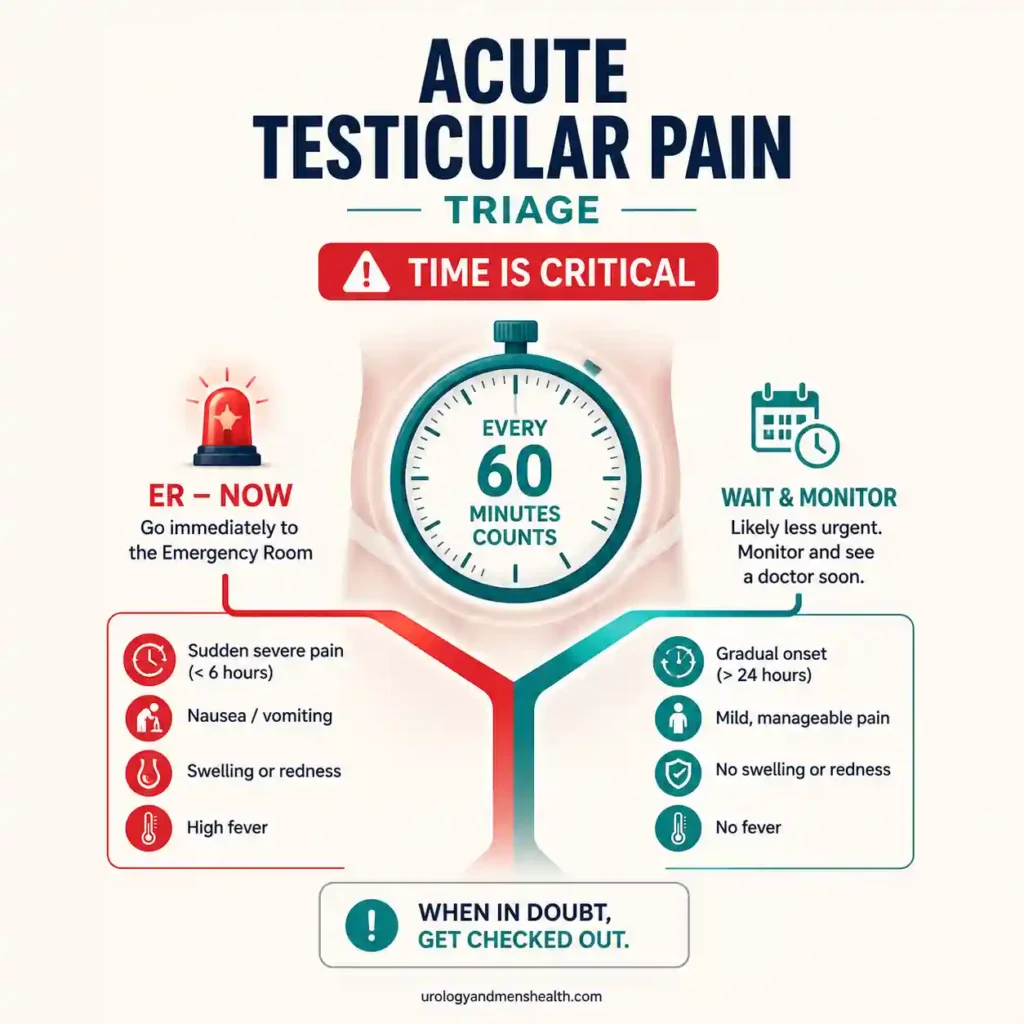
This acute testicular pain triage tool helps you decide how fast to act when one testicle suddenly hurts. Answer a few plain questions about how the pain started and what came with it, and you'll get one clear next step - emergency, urgent, or routine. It does not diagnose; it sorts urgency, because a twisted testicle is a race against the clock. See more in the UTIs & infections hub.

The Tool
Related Urology Tools
Full Clinical Guide
In This Guide:
- Sudden, severe pain in one testicle is an emergency – salvage is highest within about six hours, so go straight to the ER.
- This tool sorts urgency (emergency, urgent, or routine) – it does not diagnose.
- A gradual ache with burning urination or fever points more to infection than a twist, but still needs a same-day exam.
- Pain that comes and goes can warn of intermittent twisting and deserves a prompt urology review.
What This Tool Checks
This acute testicular pain triage tool helps you judge one thing: how fast you need to be seen when a testicle suddenly hurts. It is built on the patient-reportable parts of the TWIST score (Testicular Workup for Ischemia and Suspected Torsion), a checklist urologists use to gauge the risk of testicular torsion, first published by Barbosa and colleagues in 2013 [1]. The full TWIST score also needs a doctor’s hands – checking whether the testicle is hard, riding high, or has lost its normal reflex – so this tool deliberately uses only the signals you can report yourself: how the pain began, whether it is easing or worsening, nausea, urinary symptoms, injury, and whether it comes and goes. It sorts urgency into emergency, urgent, or routine. It does not diagnose, and it never replaces being examined.
Why Speed Matters: The Blood-Supply Clock
Testicular torsion means the spermatic cord – the bundle carrying blood to the testicle – has twisted and choked off its own blood supply. Starved of blood (ischemia), the testicle begins to die within hours. This is why timing dominates everything: when the twist is corrected within about six hours of the pain starting, the testicle is saved in roughly 90 to 100 percent of cases, and that figure falls steadily the longer it stays twisted [2][4][5]. Torsion causes only about 10 to 15 percent of sudden scrotal pain in boys and young men – infection and other causes are more common overall – but it is the one cause measured in hours, so it sets the pace for everyone [4].
How to Read Your Result
The tool ends on one of three levels. Emergency means your answers fit the sudden-onset pattern that could be a twist: go to the emergency room now. Urgent means a real problem that needs a hands-on exam within a day – most often epididymitis (infection-driven inflammation) or a swelling that has to be felt to be understood – but not, on what you have told me, the immediate can’t-wait picture. Routine means a mild, steady ache with no warning signs, worth a standard appointment. The gap between levels is real: a 16-year-old woken at 3 a.m. by sudden one-sided pain and a man with a three-day dull ache and burning urination need completely different speeds of care – one is a same-night operation, the other a clinic antibiotic. When unsure, the tool errs toward the emergency room.
Read: Testicular Torsion – The 6-Hour EmergencyWhat to Do Next
If you landed on emergency, stop reading and get to the emergency room – say the words “sudden testicular pain” at the desk so you are seen fast, and do not eat or drink in case surgery is needed. If you landed on urgent, get an in-person exam within 24 hours; if burning urination or discharge is part of the picture, the UTI vs STI symptom checker can help you describe it, and ask to be tested before antibiotics. If you landed on routine, book a standard appointment and get familiar with your baseline using the testicular self-exam walkthrough. Across all three, one rule holds: if a mild picture suddenly turns severe, treat it as an emergency. If you are unsure about your result, the PDF report this tool generates gives you a ready-made framework to bring to your next appointment.
Read: Epididymitis – The Swollen TesticleIn My Practice
The presentation that worries me most is the young man whose Doppler ultrasound read as “normal flow” early on. A twist that is partial, or that has briefly untwisted, can still show blood flow on a scan while it is strangling the testicle – I have operated on testicles a scan had called reassuring.
That is why the guidance I follow, and the reason this tool leans hard toward the emergency room, is that sudden testicular pain is a clinical diagnosis first. A normal scan does not cancel a convincing story – if the pain and the timing fit, you get examined and, if there is doubt, explored in theatre.
References
- Sheth KR, et al. Diagnosing Testicular Torsion before Urological Consultation and Imaging: Validation of the TWIST Score. Journal of Urology. 2016;195(6):1870-1876. Instrument validation.
- European Association of Urology. Guidelines on Paediatric Urology – Acute Scrotum. EAU Guidelines. Urgent surgical treatment; clinical diagnosis leads, imaging must not delay it.
- American Urological Association. Medical Student Curriculum: The Acute Scrotum. AUA. Salvage excellent within 4-6 hours; atrophy risk significant beyond 12 hours.
- Testicular Torsion: Diagnosis, Evaluation, and Management. American Family Physician. 2013;88(12):835-840. Salvage rates and epidemiology.
- A Systematic Review of Testicle Survival Time After a Torsion Event. Pediatric Emergency Care. Survival by time-to-treatment interval.
Frequently Asked Questions
Can this tool tell me if I have testicular torsion?
How is testicular torsion different from epididymitis?
The pain went away on its own – do I still need to be seen?
How accurate is this tool, and can I rely on it?
How do I use this result at my doctor’s appointment?
Dr. Muhammad Khalid
MBBS · FCPS (Urology) · MCPS (General Surgery) · CHPE · CRSM · IMC #539472
Specialist urologist with 11+ years of clinical experience across tertiary teaching hospitals. Trained at Lady Reading Hospital and Khyber Teaching Hospital, Peshawar. Author or co-author of five peer-reviewed international publications, including in Cureus and the World Journal of Surgery. Procedural expertise: URS, PCNL, RIRS, TURP, TURBT, and major open urological surgery. Full profile →
This article is for educational purposes only and does not constitute medical advice. Always consult your physician or urologist for diagnosis and treatment decisions specific to your condition.