
Sleep Apnea & High Blood Pressure Screening Tool (STOP-BANG)
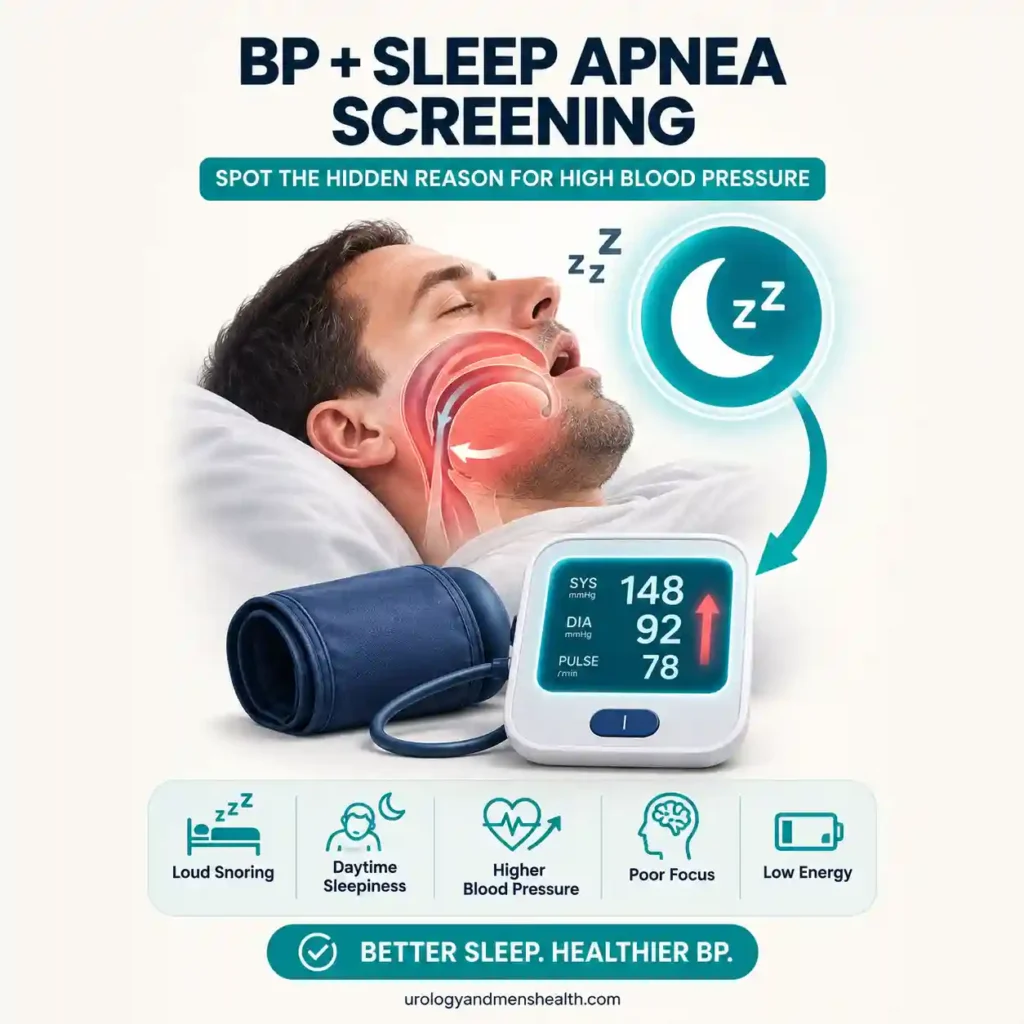
This sleep apnea and high blood pressure screening tool uses the validated STOP-BANG questionnaire to estimate your risk of obstructive sleep apnea - a common, hidden driver of hard-to-control hypertension. Answer eight quick questions about snoring, sleep, and your body, and get a clear risk band with what to do next. For the wider picture, start at our blood pressure hub.

The Tool
Related Blood Pressure Tools
Full Clinical Guide
In This Guide:
- This screen uses STOP-BANG, the validated questionnaire doctors use to flag who needs a sleep study.
- Sleep apnea is a leading, often-missed cause of hard-to-control high blood pressure, because it pushes your pressure up overnight.
- A score of 0-2 is low risk, 3-4 intermediate, 5-8 high risk – higher scores mean a sleep study is the sensible next step.
- Treating sleep apnea, usually with CPAP, can improve both your sleep and your blood pressure.
What This Tool Measures
This sleep apnea and high blood pressure screening tool scores you on the STOP-BANG questionnaire, an eight-item screen developed by Frances Chung and colleagues in 2008 and now the most widely used way to flag obstructive sleep apnea [1]. The name is an acronym: Snoring, Tiredness, Observed apnea, high blood Pressure, BMI over 35, Age over 50, Neck over 40 cm (about 16 inches), and male Gender. Each yes scores one point, from 0 to 8. It is a screening aid, not a diagnosis – it tells you how likely apnea is and whether a sleep study is worth arranging. Because it includes the blood-pressure item, it is a natural fit for men working out whether apnea is behind their hypertension. The apnea-hypertension link is covered in depth here.
The Physiology Behind the Score
In obstructive sleep apnea the upper airway collapses repeatedly during sleep. Each pause drops your oxygen and triggers a burst of sympathetic nervous system activity – the “fight or flight” system – which spikes your heart rate and blood pressure to jolt you back to breathing. Picture a smoke alarm going off dozens of times a night: your body keeps sounding the alarm to reopen the airway, and blood pressure surges each time. Over months this resets the system, so pressure stops falling normally overnight. Doctors call the healthy overnight drop “dipping”; in apnea you get a non-dipping pattern, where night-time pressure falls by less than 10 percent of daytime values [3]. Sustained sympathetic drive and activation of the renin-angiotensin-aldosterone system keep daytime pressure high too, which is why apnea so often shows up as hypertension that resists medication [2].
How to Interpret Your Result
STOP-BANG sorts you into three bands. A score of 0-2 is low risk: the questionnaire is good at ruling apnea out here, so moderate to severe disease is unlikely. A score of 3-4 is intermediate – the screen alone cannot settle it, and a large neck or a BMI over 35 pushes you toward the higher end. A score of 5-8 is high risk. The reason the cut-off matters: a score of 3 or more catches around 93 percent of men who turn out to have moderate to severe apnea on a sleep study, and the chance of moderate to severe apnea climbs from roughly 1 in 5 at the lowest scores to about 3 in 5 at the top of the range [1]. A man who scores 2 and a man who scores 6 get very different advice – the first can usually be reassured, the second needs a sleep study booked.
What to Do With Your Result
If you are low risk, keep a home blood pressure log and re-screen only if a partner reports new night-time pauses. If you are intermediate or high risk, the next step is a home sleep apnea test – a small overnight monitor you wear in your own bed – or, if that is inconclusive, an in-lab polysomnography study. Ask separately about 24-hour ambulatory blood pressure monitoring, which shows whether your pressure is failing to dip at night. If apnea is confirmed, CPAP (continuous positive airway pressure) is the standard treatment and often lowers overnight pressure alongside the daytime symptoms. It is worth tracking the two together, so pair this with the BP log and trend tracker, and consider checking your vascular age to see the wider cardiovascular picture. If you are unsure about your result, the PDF report this tool generates gives you a ready-made framework to bring to your next appointment.
In My Practice
The tell I trust most in clinic is the collar. A man can insist he sleeps fine, but when his shirt collar has gone up a size or two and his blood pressure will not settle on two or three tablets, I have learned to ask his partner what his breathing sounds like at night. More often than not, the answer changes the plan.
Sleep apnea is one of the most treatable hidden causes of stubborn hypertension – which is why I would rather over-screen for it than miss it in a man whose pressure is not responding as it should.
References
- Chung F, Abdullah HR, Liao P. STOP-Bang Questionnaire: A Practical Approach to Screen for Obstructive Sleep Apnea. Chest. 2016;149(3):631-638. PubMed. Scoring bands, thresholds, and sensitivity figures.
- Yeghiazarians Y, Jneid H, Tietjens JR, et al. Obstructive Sleep Apnea and Cardiovascular Disease: A Scientific Statement From the American Heart Association. Circulation. 2021;144(3):e56-e67. AHA / Circulation. OSA prevalence and cardiovascular links.
- Kario K, Hoshide S, Mogi M. Obstructive sleep apnea-related hypertension: a review of the literature and clinical management strategy. Hypertension Research. 2024. Nature. Nocturnal, non-dipping BP pattern in OSA.
- University Health Network. The Official STOP-Bang Questionnaire. stopbang.ca. Original item wording and risk classification.
Frequently Asked Questions
Can sleep apnea really raise my blood pressure?
I only snore – do I really need a sleep study?
What counts as a good or bad STOP-BANG score?
How accurate is this tool, and can I rely on it?
How do I use this result at my doctor’s appointment?
Dr. Muhammad Khalid
MBBS · FCPS (Urology) · MCPS (General Surgery) · CHPE · CRSM · IMC #539472
Specialist urologist with 11+ years of clinical experience across tertiary teaching hospitals. Trained at Lady Reading Hospital and Khyber Teaching Hospital, Peshawar. Author or co-author of five peer-reviewed international publications, including in Cureus and the World Journal of Surgery. Procedural expertise: URS, PCNL, RIRS, TURP, TURBT, and major open urological surgery. Full profile →
This article is for educational purposes only and does not constitute medical advice. Always consult your physician or urologist for diagnosis and treatment decisions specific to your condition.