
Testicular Self-Exam Walkthrough
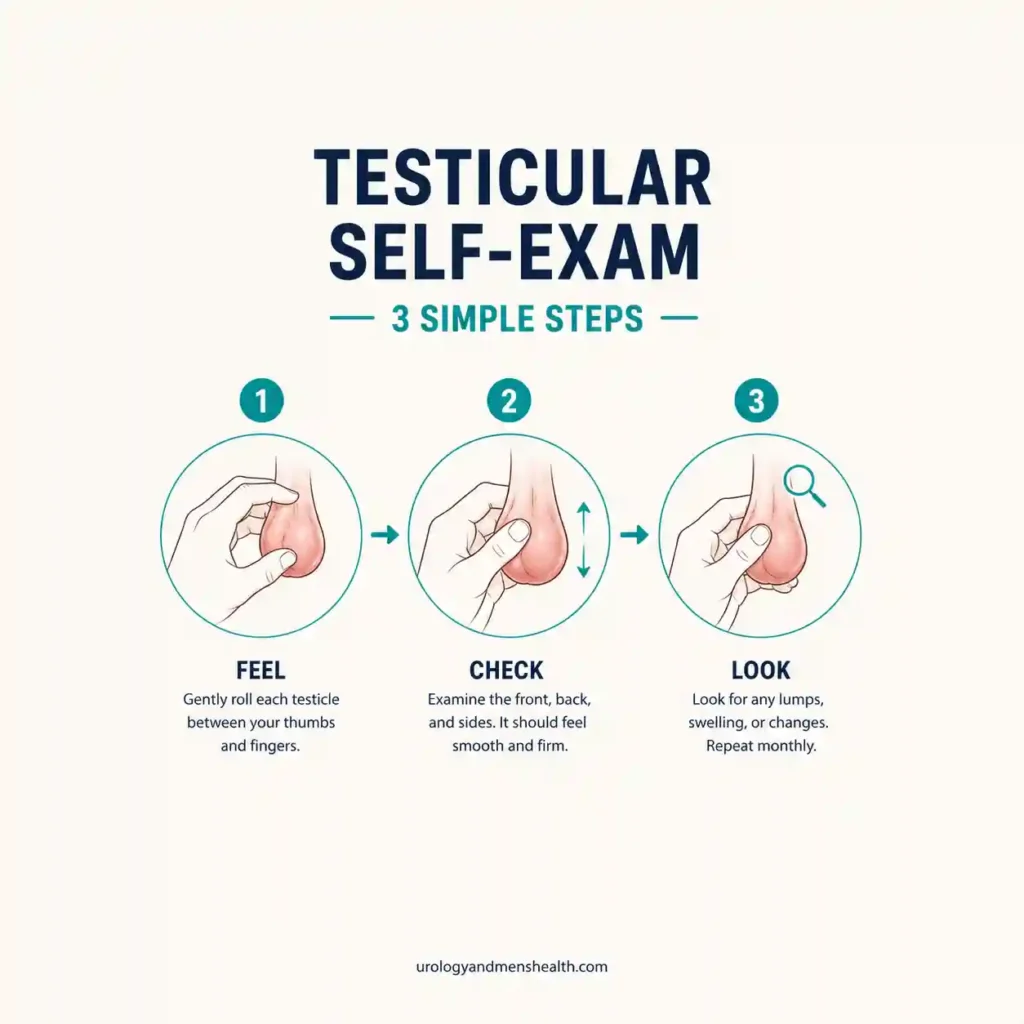
This testicular self-exam walkthrough guides you through checking each testicle the way a urologist would, then helps you make sense of anything you feel. It is a familiarity tool, not a cancer screen - the point is to learn your normal so a real change stands out. Answer a few questions about what you notice and get clear, calm advice on whether to watch, book a visit, or act now. Part of our urological surgery and recovery hub.

The Tool
Related Testicular & Surgery Tools
Full Clinical Guide
In This Guide:
- This is a familiarity tool, not a cancer screen – major bodies do not recommend routine testicular screening, but knowing your normal makes a real change easy to spot.
- A hard, painless lump growing from the testicle itself is the finding that matters most – it is the classic first sign of testicular cancer.
- Sudden, severe pain is different – that can be a torsion, an emergency to act on now, not something to self-monitor.
- Most “lumps” men find are the normal epididymis – the soft, rope-like tube at the back of each testicle.
What This Walkthrough Does
This testicular self-exam walkthrough helps you check each testicle carefully and then make sense of anything you feel – a firm lump, a soft swelling, an ache, or a sudden pain. It is honest about its own limits: there is no validated scoring instrument for a testicular self-exam, and the U.S. Preventive Services Task Force does not recommend routine self-screening in men without symptoms [1]. What a self-exam does well is build familiarity, so a genuine change stands out to you early – and early is exactly where it matters most.
That matters because testicular cancer is one of the most common cancers in men roughly between their late teens and mid-thirties [5], yet it is also among the most curable: when it is caught while still confined to the testicle, five-year survival is around 99 percent [4]. The tool is not there to diagnose. It is there to help you know your own normal and, if something has changed, to point you to the right next step. For the full written version, see testicular lumps and cancer: how to do a self-exam.
What a Normal Testicle Feels Like
A normal testicle is smooth, firm, and shaped like a small egg. Running along the top and back of each one is the epididymis – a soft, slightly rope-like tube that stores and carries sperm. It is meant to be there, and it is the single structure most men mistake for a lump the first time they feel for one. Above that sits the spermatic cord, which feels like a firmer cord running upward. Knowing these three normal structures is most of the skill: once you can tell them apart, anything that does not belong is easier to notice.
The one distinction that drives everything is where a finding sits. A lump that grows from the body of the testicle itself – intratesticular – is the one that has to be taken seriously, because that is how testicular cancer usually presents: a firm, often painless mass. A swelling that sits above or behind the testicle – extratesticular – is almost always benign: an epididymal cyst, a varicocele (dilated veins that feel like a bag of worms), or a hydrocele (fluid around the testicle). When there is any doubt, a high-frequency scrotal ultrasound (over 10 MHz) is the single test that separates the two, and both the European and American urology guidelines make it the first investigation for a suspicious mass [2][3].
How to Read What You Found
The walkthrough sorts what you feel into three levels of action. A routine result means both testicles felt smooth, even, and unchanged – keep the monthly habit and nothing more. A get-it-checked result covers soft swellings and slow aches: a cyst, varicocele, or hydrocele that is worth confirming, or an infection like epididymitis that needs antibiotics soon. A see-someone-promptly result covers the two findings that cannot wait – a firm lump on the testicle, and sudden severe pain.
A concrete contrast makes the split clear: a man who feels a soft lump at the back of his testicle and a man who feels a hard lump growing from the front of it get completely different advice. The first is almost always feeling his normal epididymis and needs only reassurance; the second has an intratesticular mass and needs a scrotal ultrasound this week. Same word – “lump” – opposite meaning. Sudden, severe pain is a separate track again: it can mean the cord has twisted (a torsion) and cut off blood flow, which is an emergency measured in hours.
Read: Testicular Torsion – a Time-Critical EmergencyIf your finding is sudden pain rather than a lump, the acute testicular pain triage tool is built for exactly that situation and will tell you how urgently to act.
What to Do With What You Found
For a routine result, the action is simply to repeat the exam monthly – the same day each month, after a warm shower, so the scrotum is relaxed and comparison is easy. For a soft swelling or a lingering ache, book a routine appointment within a week or two and ask whether a scrotal ultrasound is warranted; if there is pain, fever, or burning on passing urine, be seen sooner, because an infection needs antibiotics started early. For a firm lump, book a urology appointment within days and ask specifically for a scrotal ultrasound – and if a solid mass is confirmed, serum tumor markers (AFP, beta-hCG, and LDH) are part of the standard work-up. For sudden severe pain, go straight to the emergency room.
Read: Epididymitis – the Swollen, Painful TesticleWhatever you found, a self-exam is most useful as part of a wider habit of paying attention to your health; you can fold it into a broader check with the men’s health screening generator. If you are unsure about your result, the PDF report this tool generates gives you a ready-made framework to bring to your next appointment.
In My Practice
The men I worry about least are the ones who examine themselves and know exactly what their testicles feel like. The ones I worry about are the ones who found something weeks ago, decided that because it did not hurt it could wait, and only came in when it grew. Nearly every delayed testicular cancer I have seen was painless from the very start.
A self-exam is worth doing not because it is a proven screen, but because the man who knows his own normal is the one who catches a change early – and early is where testicular cancer is almost always curable.
References
- U.S. Preventive Services Task Force. Testicular Cancer: Screening (Grade D recommendation). USPSTF. Recommends against routine screening in asymptomatic males.
- EAU Guidelines on Testicular Cancer – Diagnostic Evaluation. European Association of Urology. Painless mass is the usual presentation; high-frequency (over 10 MHz) scrotal ultrasound recommended.
- Diagnosis and Treatment of Early-Stage Testicular Cancer: AUA Guideline. American Urological Association. Scrotal ultrasound with Doppler for a scrotal mass suspicious for neoplasm.
- Survival Rates for Testicular Cancer. American Cancer Society. Localized 5-year relative survival about 99 percent; overall about 95 percent.
- Cancer Stat Facts: Testicular Cancer. National Cancer Institute (SEER). Most frequently diagnosed in men aged 20 to 34; about 0.5 percent of new cancers.
Frequently Asked Questions
How do I actually perform a testicular self-exam correctly?
Do it standing, ideally after a warm shower when the scrotum is relaxed. Take one testicle at a time and roll it gently between your thumb in front and fingers behind, feeling the whole surface. It should be smooth, firm, and egg-shaped, with the soft epididymis along the back. Then compare with the other side. The full step-by-step is in how to do a testicular self-exam.
I found a lump. Does it mean I have cancer?
Not necessarily – most lumps men find are the normal epididymis or a benign cyst, varicocele, or fluid collection. What matters is where it sits: a firm lump growing from the body of the testicle needs a scrotal ultrasound promptly, while a soft swelling above or behind it is usually harmless. If instead the problem is sudden, severe pain, use the acute testicular pain triage tool to judge urgency.
How often should I do this, and at what age?
Once a month is enough, and there is no strict age rule – awareness matters most for men from their late teens into their forties, when testicular cancer is most common. Keeping it monthly, on the same day, makes any change easier to spot. You can fold it into a wider routine with the men’s health screening generator.
How accurate is this tool, and can I rely on it?
This walkthrough organizes what you feel into a sensible next step, but it is an educational self-monitoring aid, not a diagnosis or a validated screening test. It cannot see inside the testicle – only a scrotal ultrasound and a doctor’s examination can do that. Treat a concerning result as a prompt to be examined in person, not as a verdict either way.
How do I use this result at my doctor’s appointment?
Use the Download My Report button to save a dated PDF of what you found and the recommendation. Bring it to your appointment: it records when you noticed the change, what it felt like, and the questions worth asking, so your doctor can move quickly to the right examination or scan without you having to reconstruct the details from memory.
Dr. Muhammad Khalid
MBBS · FCPS (Urology) · MCPS (General Surgery) · CHPE · CRSM · IMC #539472
Specialist urologist with 11+ years of clinical experience across tertiary teaching hospitals. Trained at Lady Reading Hospital and Khyber Teaching Hospital, Peshawar. Author or co-author of five peer-reviewed international publications, including in Cureus and the World Journal of Surgery. Procedural expertise: URS, PCNL, RIRS, TURP, TURBT, and major open urological surgery. Full profile →
This article is for educational purposes only and does not constitute medical advice. Always consult your physician or urologist for diagnosis and treatment decisions specific to your condition.