
Post-Void Residual Danger Estimator
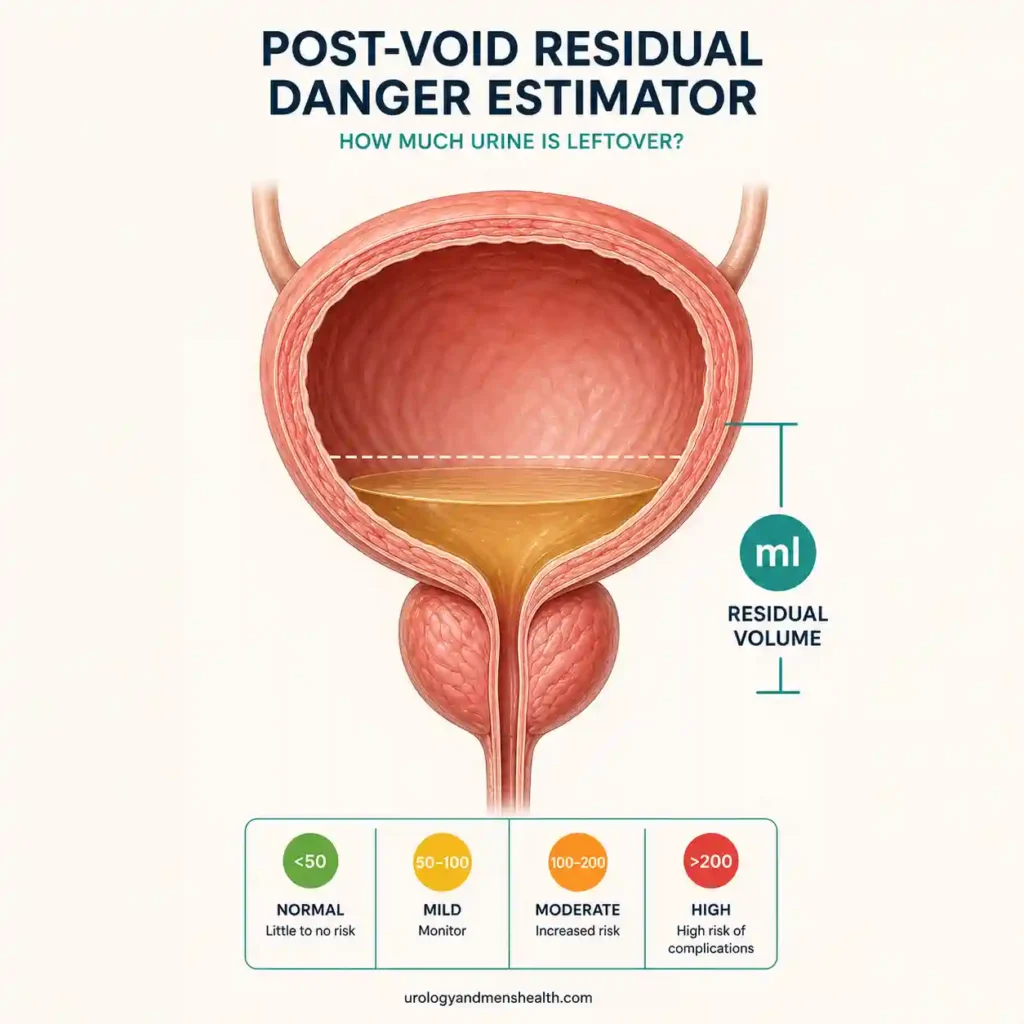
Your post-void residual is the amount of urine left in your bladder right after you finish urinating, and this estimator tells you whether your number sits in a safe range or points to a problem. Enter your bladder-scan result and a few details to see where you stand and what to do next. For the full picture, visit the UTIs and infections hub.

The Tool
Related Urinary Tools
Full Clinical Guide
In This Guide:
- A post-void residual under 100 mL is normal; up to 200 mL can be acceptable, especially in older men.
- Above 200 mL signals incomplete emptying, and 300 mL or more on a repeat scan is the threshold for chronic urinary retention.
- The real danger is not the number alone but what it does to your kidneys – swelling, reduced function, or repeated infections turn a borderline residual into a high-risk one.
- A high residual is very treatable: relieving the cause reverses most of the risk.
What This Tool Measures
Your post-void residual is the volume of urine left in your bladder immediately after you finish urinating. In a healthy bladder that number is close to zero; a rising residual means the bladder is no longer emptying completely. This estimator takes your measured residual – from a handheld bladder ultrasound scan or a catheter – and combines it with a few key details to tell you whether the number sits in a safe range or points to a problem that needs attention. The thresholds it uses come from published urology sources rather than a single cut-off, because no one number fits every man [1].
The Physiology Behind a High Residual
Emptying the bladder depends on two things happening together: the detrusor muscle squeezing down while the outlet relaxes and opens. A residual builds up when either half fails – most commonly an obstruction at the outlet (an enlarged prostate is the classic cause), or a detrusor that has weakened and can no longer generate a full squeeze. Both leave a pool of urine behind. That pool matters for two reasons. It becomes a warm reservoir where bacteria multiply, which is why a persistently high residual drives repeated infection – the same emptying problem that a UTI risk check often traces back to. And if pressure keeps building, it can back up toward the kidneys.
How to Read Your Number
Under 100 mL (about 3 fl oz) is generally considered normal, and up to 200 mL may be acceptable, particularly in older men [1]. Above 200 mL points to inadequate emptying, and a residual of 300 mL (about 10 fl oz) or more – confirmed on a repeat measurement – is the level urologists use to define chronic urinary retention [2]. Very large residuals, around 500 mL, often prompt immediate catheter drainage. The contrast is stark in clinic: a man who scores 60 mL needs only to know his baseline, while a man who scores 340 mL needs his kidneys checked – the same test, two completely different conversations.
Read: What Your Post-Void Residual Number Really MeansWhat to Do With Your Result
What flips a borderline number into an urgent one is not the volume alone – it is the company it keeps. A residual paired with kidney swelling (hydronephrosis), reduced kidney function (stage-3 chronic kidney disease), or repeated proven urinary infections is classified as high-risk retention and earns prompt specialist assessment [2]. This is also why guidelines advise against certain enlarged-prostate drug combinations once the residual climbs past 150 mL, and why kidney imaging is recommended when swelling is suspected [3]. If your residual is borderline and driven by an obstruction, grading your urinary symptoms with the IPSS symptom score helps decide whether treatment is worth starting. If you are unsure about your result, the PDF report this tool generates gives you a ready-made framework to bring to your next appointment.
Read: Acute Urinary Retention – When Not Being Able to Urinate Is an EmergencyIn My Practice
The same residual volume can mean two completely different things. I have seen 250 mL in a fit 55-year-old with a large prostate that we managed with a single tablet, and 250 mL in a man with a scarred, underactive bladder that never recovered its squeeze.
Two men with an identical residual can need opposite treatments – the driver behind the number is what counts, not the number by itself.
References
- Nosseir A, et al. Bladder Post Void Residual Volume. StatPearls. NCBI Bookshelf. Normal <100 mL; up to 200 mL may be acceptable; >200 mL indicates inadequate emptying.
- Stoffel JT, et al. AUA White Paper on Nonneurogenic Chronic Urinary Retention: Consensus Definition, Treatment Algorithm, and Outcome End Points. J Urol. 2017. American Urological Association. PVR >300 mL persistent defines chronic retention; high-risk = hydronephrosis, stage-3 CKD, or recurrent UTI/urosepsis.
- Gravas S, et al. EAU Guidelines on the Management of Non-neurogenic Male LUTS. European Association of Urology. PVR measurement is a routine part of assessment; renal imaging where hydronephrosis is suspected.
- Gratzke C, et al. EAU Assessment of Non-neurogenic Male LUTS including Benign Prostatic Obstruction. Eur Urol. PubMed. Post-void residual should be measured in the initial assessment of male LUTS.
Frequently Asked Questions
What post-void residual counts as dangerous?
Can a high residual damage my kidneys?
Why do I keep getting UTIs when my bladder does not empty?
How accurate is this tool, and can I rely on it?
How do I use this result at my doctor’s appointment?
Dr. Muhammad Khalid
MBBS · FCPS (Urology) · MCPS (General Surgery) · CHPE · CRSM · IMC #539472
Specialist urologist with 11+ years of clinical experience across tertiary teaching hospitals. Trained at Lady Reading Hospital and Khyber Teaching Hospital, Peshawar. Author or co-author of five peer-reviewed international publications, including in Cureus and the World Journal of Surgery. Procedural expertise: URS, PCNL, RIRS, TURP, TURBT, and major open urological surgery. Full profile →
This article is for educational purposes only and does not constitute medical advice. Always consult your physician or urologist for diagnosis and treatment decisions specific to your condition.