
ED Vascular Risk Screener
The ED Vascular Risk Screener asks eleven questions about how your erection difficulty behaves and what your arteries have been carrying, then shows how strongly the pattern points to a vascular cause rather than a psychological or hormonal one. It takes about two minutes, and nothing you enter leaves your browser. For the wider picture, start at the sexual health hub.

The Tool
Related Sexual Health Tools
Full Clinical Guide
In This Guide:
- Vascular ED has a signature: gradual onset over months to years, morning erections gone, and the problem happens in every situation. A sudden start with morning erections intact points somewhere else.
- The penile arteries are 1–2 mm wide against 3–4 mm for the coronaries — the same plaque burden causes symptoms in the penis first, which is why ED can arrive years before angina.
- ED is an independent predictor of cardiovascular events, and the excess risk runs highest in younger men and men whose calculated risk looks only intermediate.
- This screener is a routing aid, not a validated score. It decides who needs a blood pressure cuff and a blood form — it does not diagnose anything.
What This Tool Measures
The ED vascular risk screener does something different from every other erectile dysfunction questionnaire on this site. It does not grade how bad your ED is — the IIEF-5 already does that. It asks a narrower question: does your erection difficulty look like an artery problem? I score two things. First, the erection pattern itself, using the features the Princeton IV consensus panel uses to define vasculogenic ED: a gradual onset extending beyond six months, loss of nocturnal and morning erections, and difficulty that persists across every situation rather than switching off with a different partner or on your own [1]. Second, the conventional artery risk load — blood pressure, blood sugar, smoking, cholesterol, waist, activity, and family history. Neither half is diagnostic alone. Together they decide whether your next appointment should be about a prescription or about a blood test. If you want the plain-English version of why urologists ask about morning erections at all, I wrote it out in is it ED or heart disease.
The Physiology Behind the Score
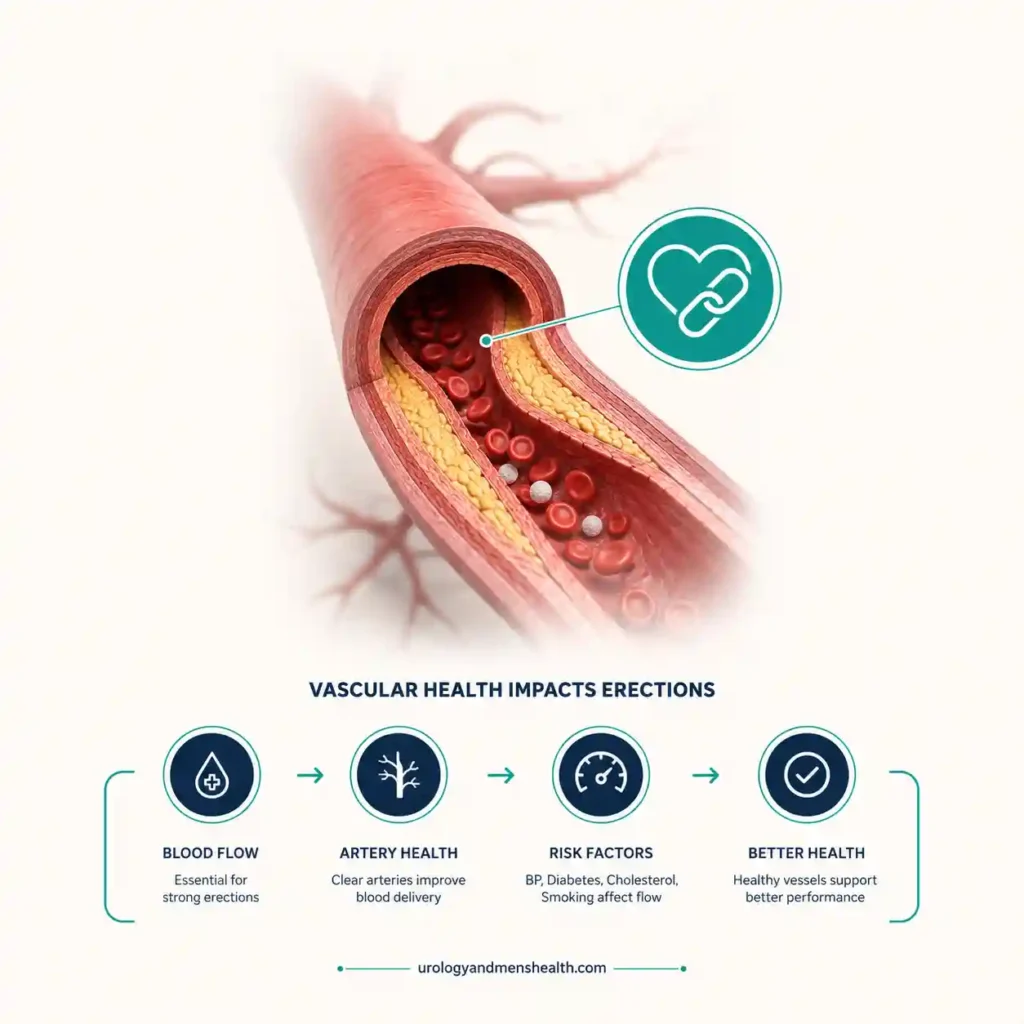
An erection is a plumbing event that runs on a chemical called nitric oxide, released by the lining of the penile arteries. That lining — the endothelium — is the same tissue that lines your coronaries. Damage it with high pressure, high sugar, nicotine, or LDL cholesterol and it fails everywhere at once. But it does not announce itself everywhere at once, and the reason is size. The penile arteries measure roughly 1 to 2 mm across; the coronaries are 3 to 4 mm and the carotids 5 to 7 mm [2]. A given thickness of plaque takes a much larger percentage bite out of a 1 mm vessel than a 4 mm one. That is the artery-size hypothesis, and it is why the penis is, mechanically, the earliest warning light on the dashboard. Montorsi’s study of 300 men with angiographically proven coronary disease found ED had appeared before their angina in nearly 70% of them [3]. Diabetes compounds this from both directions, damaging the lining and the nerves that trigger release — which is why over half of men with diabetes have ED, and typically 10 to 15 years earlier than men without it [4]. You can see the same risk factors expressed as an artery age in the vascular age calculator.
How to Interpret Your Result
Two men can both tick “erectile dysfunction” on a form and need completely opposite appointments. A man who scores 6 — problem started six weeks ago when his contract ended, wakes with an erection on a Sunday, fine on his own, never smoked, waist 88 cm (35 in) — needs his medication list reviewed and a morning testosterone. He does not need a cardiologist. A man who scores 26 — two years of slow decline, nothing in the morning for a year, difficulty every single time, waist 108 cm (43 in), HbA1c untouched since 2019, father dead at 58 — needs a blood pressure cuff before he needs a tablet. Same complaint, opposite pathways. That is what the two subscores are for: the Erection Pattern score out of 12 tells you whether the problem behaves like an artery problem, and the Vascular Risk Load score out of 21 tells you whether there is an arterial process plausibly driving it. A high pattern score with a low risk load usually means a venous leak or a nerve issue rather than plaque. A low pattern score with a high risk load means your arteries need attention regardless of what your erections are doing.
What to Do With Your Result
A low signal points to a medication review and a morning total testosterone drawn before 10am — both are part of the basic ED work-up the AUA describes, and both are cheap [5]. A moderate signal earns the panel: blood pressure, HbA1c, and a fasting lipid profile, plus a 10-year cardiovascular risk estimate that explicitly records ED as a risk-enhancing factor. Princeton IV goes further and suggests considering a coronary artery calcium score in men with ED whose calculated risk lands low to intermediate, precisely because the calculator under-calls them [1]; the EAU’s 2025 sexual health guideline reproduces that same algorithm [6]. A high signal means the cardiovascular assessment is the appointment and the erection is the reason you booked it — and if your pressure is the driver, the BP and kidney damage risk tool shows what the same process is doing to your other small arteries. Across every tier, one thing outperforms everything else: 150 minutes a week of brisk activity treats the erection and the artery at the same time.
If you are unsure about your result, the PDF report this tool generates gives you a ready-made framework to bring to your next appointment.
In My Practice
The consultation that changed how I run this clinic was a 54-year-old who came in wanting a repeat sildenafil prescription and nothing else. He was in and out in four minutes the first time. When he came back eight months later I asked the onset question properly and got “maybe three years, hard to say” — the answer that should have stopped me the first time. His blood pressure that day was 168/98 and he had never had it measured as an adult.
The prescription is the easiest thing in the room to hand over and the least important thing in the room. If a man books an appointment about his erections, that is often the only appointment he will book all decade — and it is the wrong one to waste.
References
- Kloner RA, Burnett AL, Miner M, et al. The Princeton IV Consensus Recommendations for the Management of Erectile Dysfunction and Cardiovascular Disease. Mayo Clinic Proceedings, 2024. Defines vasculogenic ED features, treats ED as a cardiac risk marker until proven otherwise, and introduces coronary artery calcium scoring for men with ED at low to intermediate estimated risk.
- Vlachopoulos C, et al.; Montorsi P, et al. Artery-size hypothesis: penile 1–2 mm vs coronary 3–4 mm vs carotid 5–7 mm. Biomedicines, 2021; original hypothesis Am J Cardiol, 2005 (PMID 16387561).
- Montorsi F, Briganti A, Salonia A, et al. Erectile dysfunction prevalence, time of onset and association with risk factors in 300 consecutive patients with acute chest pain and angiographically documented coronary artery disease. Eur Urol, 2003 (PMID 12932937). ED preceded angina in almost 70% of the men studied.
- Kouidrat Y, Pizzol D, Cosco T, et al. High prevalence of erectile dysfunction in diabetes: a systematic review and meta-analysis of 145 studies. Diabetic Medicine, 2017. 145 studies, 88,577 men; ED prevalence 52.5% adjusted, odds ratio 3.62 vs controls, onset 10–15 years earlier.
- Burnett AL, Nehra A, Breau RH, et al. Erectile Dysfunction: AUA Guideline. American Urological Association, 2018 (amended). States men should be counseled that ED is a risk marker for underlying cardiovascular disease; morning total testosterone is part of the basic work-up.
- Salonia A, Boeri L, Capogrosso P, et al. EAU Guidelines on Sexual and Reproductive Health — Management of Erectile Dysfunction. European Association of Urology, 2025. Reproduces the Princeton IV cardiovascular risk-assessment algorithm for men with ED and no overt cardiac disease.
- Vlachopoulos CV, Terentes-Printzios DG, Ioakeimidis NK, et al. Prediction of cardiovascular events and all-cause mortality with erectile dysfunction: a systematic review and meta-analysis of cohort studies. Circ Cardiovasc Qual Outcomes, 2013 (PMID 23300267). 14 studies, 92,757 men, mean follow-up 6.1 years; pooled relative risk 1.44 total CV events, 1.62 myocardial infarction, 1.39 cerebrovascular events, 1.25 all-cause mortality; risk higher at younger ages and in intermediate-risk groups.
Frequently Asked Questions
Can this screener tell me whether my ED is caused by my arteries?
No, and nothing that runs in a browser can. Confirming vasculogenic ED needs a penile duplex ultrasound, and confirming coronary disease needs imaging. What this tool does is sort you into the group whose pattern and risk profile make an artery cause plausible, versus the group where it does not. That is a routing decision, not a diagnosis. To see the same risk factors expressed as an artery age, use the vascular age calculator.
I have no morning erections. Does that mean it is definitely vascular?
No. Losing morning erections is one of the more useful clues, because erections during sleep happen without arousal or performance pressure — so when they stop, something physical usually changed. But low testosterone, poor sleep, sleep apnea, depression, and several common medications all suppress them too. It is one of eleven inputs here for exactly that reason, and it carries three points out of thirty-three, not a verdict.
My score is high but my heart feels completely fine. Why should I bother?
Because that is the point of the whole idea. Erectile dysfunction shows up earlier than chest symptoms because the penile arteries are smaller, so feeling fine is expected at this stage — it is the window, not the all-clear. Men with ED carry a measurably higher risk of cardiovascular events, and that excess runs highest in younger men and men whose calculated risk looks merely intermediate. The full explanation is in is it ED or heart disease.
How accurate is this tool, and can I rely on it?
Treat it as a structured way to organize your own history, not a validated instrument. There is no validated questionnaire that separates vascular from non-vascular ED, so this screener combines the vasculogenic features named in the Princeton IV consensus with a conventional artery risk-factor load. The individual components are well evidenced; the weighting is my clinical judgment. It cannot diagnose, and it cannot replace a blood pressure reading, a blood test, or an examination.
How do I use this result at my doctor’s appointment?
Press Download My Report. You get a two-page PDF: page one lists every answer you gave and your score with both subscores, page two carries my interpretation for your band, the next steps, and three or four questions written to open the specific conversation your result calls for. Hand it over at the start rather than describing it. A ten-minute appointment goes further when the history is already on paper.
Dr. Muhammad Khalid
MBBS · FCPS (Urology) · MCPS (General Surgery) · CHPE · CRSM · IMC #539472
Specialist urologist with 11+ years of clinical experience across tertiary teaching hospitals. Trained at Lady Reading Hospital and Khyber Teaching Hospital, Peshawar. Author or co-author of five peer-reviewed international publications, including in Cureus and the World Journal of Surgery. Procedural expertise: URS, PCNL, RIRS, TURP, TURBT, and major open urological surgery. Full profile →
This article is for educational purposes only and does not constitute medical advice. Always consult your physician or urologist for diagnosis and treatment decisions specific to your condition.