
Low Testosterone Symptom Quiz
This low testosterone symptom quiz scores 17 symptoms tied to falling testosterone, covering energy, sleep, mood, muscle, libido and morning erections, on the same 1 to 5 severity scale and 17 to 85 range used by the AMS. It takes about two minutes. The score does not diagnose anything. It tells you whether a morning blood test is worth asking for. Start with the sexual health hub for the wider picture.

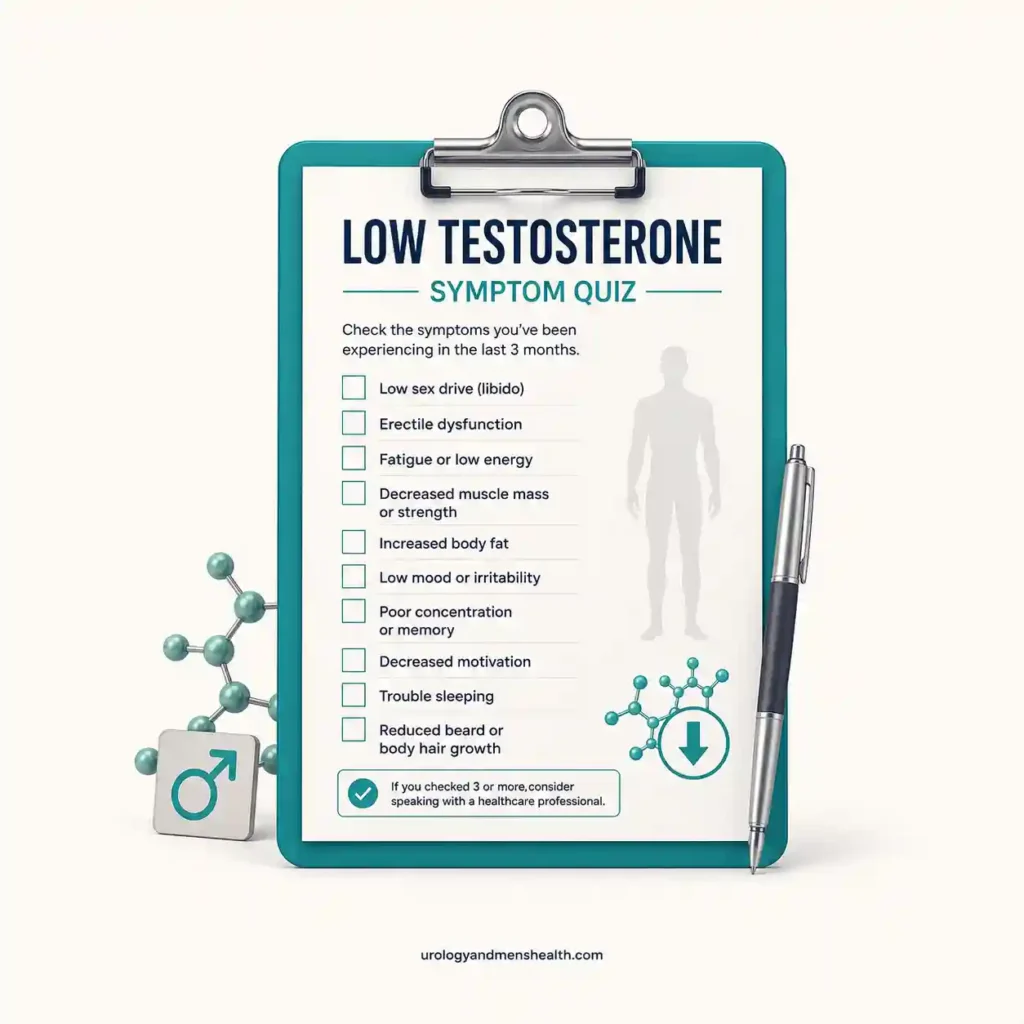
The Tool
Related Sexual Health Tools
Full Clinical Guide
In This Guide:
- This quiz uses the AMS scoring model: 17 symptoms, each rated 1 to 5, totalling 17 to 85.
- Two thresholds change what happens next: 37 (a morning blood test earns its place) and 50 (test within two weeks, with LH).
- The questionnaire is sensitive but not specific. Roughly four in ten men with perfectly normal testosterone still score above 37.
- Which subscore drove your total matters more than the total. Sexual items point at hormones; mood and body items point almost anywhere.
What This Low Testosterone Symptom Quiz Measures
This low testosterone symptom quiz scores the 17 complaints that the Aging Males’ Symptoms (AMS) scale was built around, using the same 1-to-5 severity rating and the same 17-to-85 total. The AMS came out of a comparison of more than 200 candidate variables, reduced by factor analysis to 17 items across three dimensions — somato-vegetative, psychological and sexual — and calibrated against a reference sample of 992 German men over 40 [1]. The symptom wording on this page is my own, because the AMS text is copyrighted; the scoring, the three domains and the severity bands are the instrument’s.
What the quiz does not do is diagnose anything, and I want to be blunt about that up front. The American Urological Association explicitly does not recommend questionnaires for deciding who is a candidate for testosterone therapy, or for tracking response to it [3]. The EAU says much the same, noting that questionnaire specificity is poor and that they should not be used to systematically screen men [4]. This is a conversation starter that tells you whether to ask for a blood test.
The Physiology Behind the Score
Testosterone is made in the Leydig cells of the testicles, on instruction from luteinizing hormone (LH) — a signal the pituitary gland releases in pulses, mostly overnight. Think of it as a night shift: the factory runs hardest while you sleep and winds down through the day. That overnight run is why morning erections exist at all, and why an afternoon sample can read meaningfully lower than the same man’s 8am draw. It is also why both the AUA and the EAU insist on an early-morning sample — EAU specifies between 07:00 and 11:00, fasting, on a reliable assay [3][4].
The quiz splits into three subscores because the three dimensions do not carry equal weight. The five sexual items — libido, morning erections, sexual activity, beard growth, and the sense of being past your peak — sit closest to the hormone itself. The seven body items and five mood items are androgen-sensitive, but they are also produced in full by untreated sleep apnea, depression, opioid painkillers and weight around the middle. Fat tissue converts testosterone into estradiol and drags the reading down, which is exactly why the EAU makes body mass index and waist circumference part of the standard work-up [4]. If your total was driven by the body and mood items with the sexual items intact, the BMI and metabolic syndrome screen is a better use of your next five minutes than a hormone panel.
How to Interpret Your Result
The AMS bands are fixed: 17 to 26 is no symptoms, 27 to 36 mild, 37 to 49 moderate, and 50 or more severe [1]. This tool folds the two lowest bands into one mild tier and keeps the two numbers that actually change what happens next: 37 and 50.
A man who scores 21 and a man who scores 58 get completely different advice from me, and not simply because one feels worse. The 21 gets no blood test at all. At that level the questionnaire cannot separate low testosterone from ordinary tired life, and testing him mostly produces a borderline number nobody knows what to do with. The 58 gets a morning total testosterone with LH in the same tube, inside two weeks, because scores that high almost always have something findable underneath them.
The 37 mark is where the questionnaire starts earning its keep, and even there it is a blunt instrument. In 146 ambulatory men aged 27 to 85, a cut-off of 37 gave a sensitivity of 76.0% and a specificity of only 61.6% against a total testosterone below 8 nmol/L; in men aged 65 or under the specificity fell to 56.3%, while in men over 65 it rose to 73.5% [2]. Read plainly: roughly four in ten men with normal hormones still fail it, and it is at its worst in exactly the age group most likely to be filling it in. A separate head-to-head against the ADAM questionnaire found the same weakness from the other direction [5].
What to Do With Your Result
Mild band: leave your blood alone and go after sleep, alcohol and waist size for three months, then retake. Moderate band: one early-morning fasting total testosterone, with LH in the same tube. Severe band: the same draw, but inside two weeks, plus prolactin if the LH comes back low or low-normal — AUA recommends prolactin in precisely that combination, because low testosterone with low LH is a pituitary question, not a gel question [3].
Then brace yourself for the fact that the threshold depends on where your doctor trained. AUA uses a total testosterone below 300 ng/dL (10.4 nmol/L), confirmed on two early-morning samples at the same laboratory using the same assay [3]. EAU uses 12 nmol/L (350 ng/dL), adds SHBG with a calculated free testosterone when the total lands between 8 and 12 nmol/L, and asks for a pituitary MRI below 6 nmol/L [4]. AUA itself notes that societies have drawn the line anywhere from 230 to 350 ng/dL [3], so a result of 320 is “normal” in one clinic and “treat” in the next. If erections are the loudest part of your score, run the ED vascular risk screener as well — in men over 40, erectile trouble is a cardiovascular signal at least as often as a hormonal one. If you are unsure about your result, the PDF report this tool generates gives you a ready-made framework to bring to your next appointment.
In My Practice
The single most common thing I correct in this clinic is not a hormone level, it is an expectation. Men arrive having already decided the answer is testosterone, usually after a quiz on a website that exists to sell the gel. What the bloods actually show is a spread: a minority genuinely below the cut-off, a larger group sitting in the 300s and 400s with a symptom score in the fifties, and a handful whose real diagnosis is untreated sleep apnea that has been quietly wrecking their nights for years.
The score tells you how loudly your body is complaining. It cannot tell you what it is complaining about. That is what the morning blood draw — and an honest conversation about sleep and weight — are for.
References
- Heinemann LAJ, et al. The Aging Males’ Symptoms (AMS) scale: update and compilation of international versions. Health and Quality of Life Outcomes, 2003. PubMed Central. Source of the 17-item structure, the three dimensions, and the 992-man reference sample.
- The “Aging Males’ Symptoms” Scale (AMS): predictive value for lowered circulating androgens. The Aging Male, 2012. DOI 10.3109/13685538.2012.729232. Source of the sensitivity and specificity figures at a cut-off of 37 in 146 men.
- American Urological Association. Evaluation and Management of Testosterone Deficiency: AUA Guideline. AUA. Source of the 300 ng/dL cut-off, the two early-morning samples, the LH and prolactin recommendations, the 230-350 ng/dL range across societies, and the statement against questionnaires.
- European Association of Urology. EAU Guidelines on Sexual and Reproductive Health — Male Hypogonadism, 2026. Uroweb. Source of the 12 nmol/L threshold, the 07:00-11:00 fasting draw, SHBG and calculated free testosterone between 8 and 12 nmol/L, pituitary MRI below 6 nmol/L, BMI and waist circumference, and the note on poor questionnaire specificity.
- Chueh KS, et al. The comparison of the Aging Male Symptoms (AMS) scale and Androgen Deficiency in the Aging Male (ADAM) questionnaire to detect androgen deficiency in middle-aged men. Journal of Andrology, 2012. DOI 10.2164/jandrol.111.015628.
- Comparison of questionnaires used for screening and symptom identification in hypogonadal men. The Aging Male, 2014. DOI 10.3109/13685538.2014.963041. Review of AMS, ADAM, qADAM, MMAS and NERI and why none of them replaces a blood test.
Frequently Asked Questions
Can this quiz diagnose low testosterone?
No, and no questionnaire can. At its research cut-off of 37, the AMS caught most men with a genuinely low testosterone but wrongly flagged around four in ten men whose levels were normal. The AUA goes further and does not recommend questionnaires for deciding who gets testosterone therapy at all. Use this score to decide whether to ask for a morning blood test, and nothing more.
Which blood test should I ask for, and when?
Ask for a total testosterone drawn between 8 and 10 in the morning, fasting, with luteinizing hormone in the same tube. Testosterone peaks overnight and drifts down through the day, so an afternoon sample can read falsely low. If the first result is below the cut-off, both the AUA and the EAU want a second morning sample before anyone calls it a diagnosis. More on what actually happens to testosterone after 40.
I am trying to conceive. Does a high score change anything?
Yes, and it changes the treatment more than the testing. Testosterone therapy shuts down the pituitary signal that drives sperm production, so it is the wrong first move for any man who still wants children. That conversation needs a fertility-aware urologist and a semen analysis first. Run your numbers through the semen analysis interpreter before you agree to any hormone treatment.
How accurate is this tool, and can I rely on it?
It reproduces the AMS scoring model faithfully, so the arithmetic is right. The instrument itself is a different matter: it is sensitive but not specific, meaning it rarely misses a hormone problem and often flags one that is not there. Depression, sleep apnea, obesity and opioid painkillers all produce the same score. Treat it as a screening aid and a conversation starter, never as a diagnosis.
How do I use this result at my doctor’s appointment?
Press Download My Report. You get a two-page PDF with your 17 answers, your total, your three subscores, my interpretation of your band, and a list of questions with your score already filled in. Hand it over at the start rather than describing your symptoms from memory. The subscore breakdown is the part that changes the conversation, because it shows which dimension drove your total.
Dr. Muhammad Khalid
MBBS · FCPS (Urology) · MCPS (General Surgery) · CHPE · CRSM · IMC #539472
Specialist urologist with 11+ years of clinical experience across tertiary teaching hospitals. Trained at Lady Reading Hospital and Khyber Teaching Hospital, Peshawar. Author or co-author of five peer-reviewed international publications, including in Cureus and the World Journal of Surgery. Procedural expertise: URS, PCNL, RIRS, TURP, TURBT, and major open urological surgery. Full profile →
This article is for educational purposes only and does not constitute medical advice. Always consult your physician or urologist for diagnosis and treatment decisions specific to your condition.