
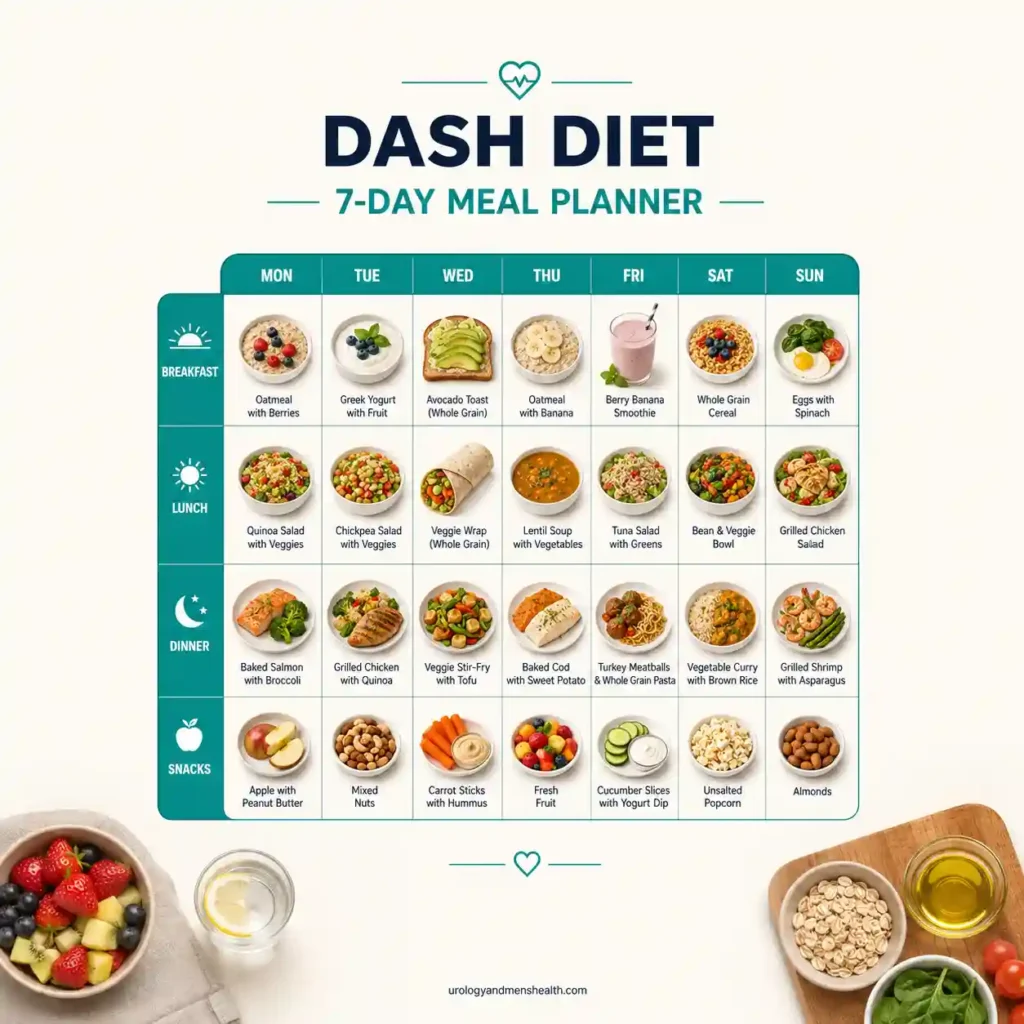
DASH Diet 7-Day Meal Planner
This DASH diet 7-day meal planner turns the most-studied eating plan for high blood pressure into a personal starting week. Answer four quick questions about your blood pressure, your current diet and how much you cook, and it matches you to the right sodium target and a plan you can actually keep. Built for men managing or preventing hypertension, it sits inside the blood pressure hub.

The Tool
Related Blood Pressure Tools
Full Clinical Guide
In This Guide:
- The DASH diet is a whole eating pattern, not a single food rule: more fruit, vegetables, whole grains and low-fat dairy, far less sodium.
- There are two sodium targets: 2,300 mg a day (standard) and 1,500 mg a day (lower). The lower target gives the bigger blood pressure drop.
- In people with hypertension, low-sodium DASH lowered systolic pressure by about 11.5 mmHg in the trial that defined it.
- This planner matches your blood pressure, habits and cooking to a starting track you can hold for a week and repeat.
What This DASH Diet 7-Day Meal Planner Does
This DASH diet 7-day meal planner takes the Dietary Approaches to Stop Hypertension (DASH) eating plan — developed and published by the U.S. National Heart, Lung, and Blood Institute (NHLBI) — and turns it into a starting week matched to you. Rather than hand you a generic menu, it asks four questions and points you to the right sodium target and plan format. DASH is not a fad: in the original randomized trial of 459 adults, the full DASH pattern lowered systolic blood pressure by about 5.5 mmHg across all participants, and by roughly 11.4 mmHg in those who already had hypertension [1]. For a fuller worked example of a week, pair this tool with my practical DASH meal plan for blood pressure.
Why DASH Lowers Blood Pressure
Blood pressure is not driven by salt alone — it responds to the balance between sodium and potassium. Think of it like a seesaw: most Western diets pile sodium on one side and leave potassium light, and blood pressure rises to match. DASH shifts weight to the other side. It raises potassium toward the plan’s target of about 4,700 mg a day from fruit, leafy greens, beans and potatoes, while cutting sodium, and it adds calcium and magnesium from low-fat dairy — all nutrients tied to healthier vessel tone. The sodium cut is where most men leave results on the table, because roughly three-quarters of dietary sodium is already inside packaged and restaurant food before you touch a salt shaker. Adding up a typical day with the sodium intake tracker is usually a sobering first step.
How to Read Your Plan
Your result names one of three starting tracks. The standard 2,300 mg track is the everyday DASH ceiling — about one level teaspoon of salt across the whole day — and suits prevention and milder cases. The lower 1,500 mg track is for diagnosed or medicated high blood pressure, or for anyone whose current diet is heavily processed, because that is where the largest reductions were recorded: in the DASH-Sodium trial of 412 adults, low-sodium DASH lowered systolic pressure by about 11.5 mmHg in people with hypertension versus a high-sodium control diet [2]. The 2-week transition track appears if you rarely cook and eat mostly processed food — jumping straight to 1,500 mg there usually ends in failure, so we ease the sodium down in stages first.
What to Do With Your Plan
Whichever track you land on, the daily shape of the week is the same DASH plate: 6 to 8 servings of whole grains, 4 to 5 vegetables, 4 to 5 fruits, 2 to 3 low-fat dairy, 6 oz (about 170 g) or less of lean meat, poultry or fish, plus 4 to 5 servings of nuts, seeds or legumes across the week. Build two or three grain-and-bean bases at the weekend and the weekdays become assembly. If you are on medication, this is an addition to your tablets, never a replacement — the diet may eventually let your doctor lower a dose, but that decision is theirs. The fastest way to expose hidden sodium sabotaging an otherwise good week is my hidden sodium calculator. If you are unsure about your result, the PDF report this tool generates gives you a ready-made framework to bring to your next appointment.
In My Practice
The single change that predicts whether a man sticks with DASH is not willpower – it is whether he prepped on Sunday. The men who fail almost always tried to decide each meal in the moment, hungry, at 7pm. The ones who succeed cooked a pot of brown rice and a pot of lentils on the weekend and spent the week adding vegetables, fruit and yogurt to a base that was already made.
DASH is not really a diet you follow – it is a fridge you set up. Win the weekend and the week takes care of itself.
References
- Appel LJ, Moore TJ, Obarzanek E, et al. A clinical trial of the effects of dietary patterns on blood pressure (DASH). N Engl J Med. 1997;336(16):1117-1124. Original DASH trial, 459 adults; combination diet -5.5 mmHg systolic overall, -11.4 mmHg in hypertensives.
- Sacks FM, Svetkey LP, Vollmer WM, et al. Effects on blood pressure of reduced dietary sodium and the DASH diet (DASH-Sodium). N Engl J Med. 2001;344(1):3-10. 412 adults; low-sodium DASH -11.5 mmHg systolic in hypertensives vs high-sodium control.
- 2025 AHA/ACC/Multisociety Guideline for the Prevention, Detection, Evaluation and Management of High Blood Pressure in Adults. Circulation. 2025. Strongly recommends DASH; sodium under 2,300 mg/day, 1,500 mg preferred; increased dietary potassium; BP goal under 130/80 mmHg.
- National Heart, Lung, and Blood Institute. DASH Eating Plan. NHLBI, NIH. Serving targets by food group; sodium 2,300 mg or 1,500 mg; potassium target about 4,700 mg/day.
- 2024 ESC Guidelines for the Management of Elevated Blood Pressure and Hypertension. European Society of Cardiology, 2024. Endorses DASH-style eating and dietary sodium reduction as first-line lifestyle therapy.
Frequently Asked Questions
Can the DASH diet lower my blood pressure without medication?
How much sodium should I aim for on this plan?
What is the difference between the 2,300 mg and 1,500 mg DASH plans?
How accurate is this tool, and can I rely on it?
How do I use this result at my doctor’s appointment?
Dr. Muhammad Khalid
MBBS · FCPS (Urology) · MCPS (General Surgery) · CHPE · CRSM · IMC #539472
Specialist urologist with 11+ years of clinical experience across tertiary teaching hospitals. Trained at Lady Reading Hospital and Khyber Teaching Hospital, Peshawar. Author or co-author of five peer-reviewed international publications, including in Cureus and the World Journal of Surgery. Procedural expertise: URS, PCNL, RIRS, TURP, TURBT, and major open urological surgery. Full profile →
This article is for educational purposes only and does not constitute medical advice. Always consult your physician or urologist for diagnosis and treatment decisions specific to your condition.