
Post-Op Recovery Planner (Day-by-Day)
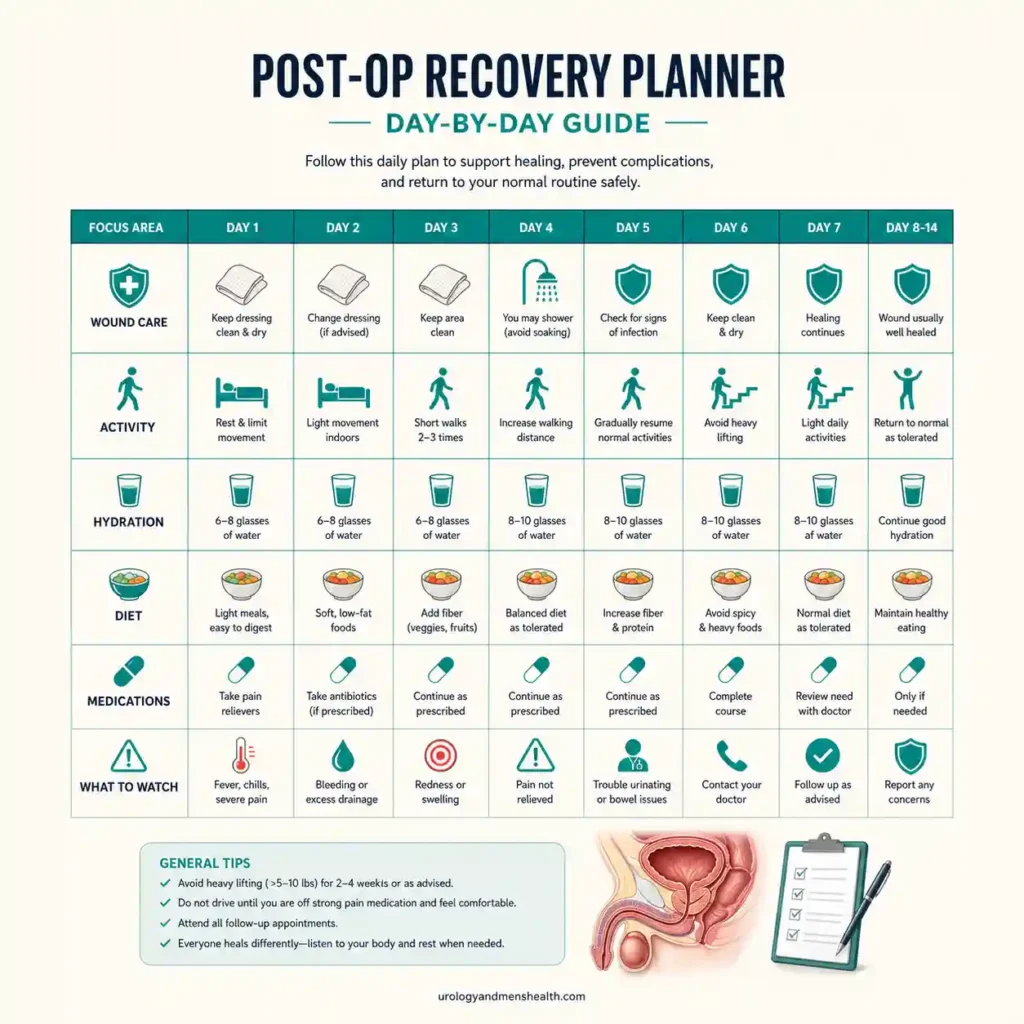
This post-op recovery planner gives you a day-by-day plan after urology surgery, tailored to your exact procedure and how far along you are. Whether you had prostate surgery, a radical prostatectomy, or stone surgery with a stent, it tells you what is normal, what to do this week, and the few symptoms that mean you should be seen the same day. Start here, then dig deeper in our urological surgery recovery hub.

The Tool
Related Surgery Tools
Full Clinical Guide
In This Guide:
- This post-op recovery planner tailors advice to your exact procedure and stage – healing after TURP, prostatectomy, and stone surgery runs on different clocks.
- The single biggest recovery mistake is doing too much too soon – straining and heavy lifting in the fragile middle weeks trigger fresh bleeding.
- Most bleeding and burning is expected and improving; the danger sign is a symptom that steadily worsens rather than settles.
- Two after-surgery emergencies need same-day care: clot retention (cannot pass urine) and fever with flank pain (a blocked, infected kidney).
What This Recovery Planner Does
This post-op recovery planner turns the generic “rest and drink fluids” advice into a plan built around your specific operation and how far along you are. It covers the four urological procedures men most often recover from at home: prostate surgery for an enlarged prostate (TURP or laser methods like HoLEP and GreenLight), radical prostatectomy (removal of the prostate for cancer), ureteroscopy with laser stone treatment (URS or RIRS, often leaving a temporary stent), and percutaneous nephrolithotomy (PCNL, keyhole stone surgery through the back). There is no single validated “recovery score” instrument for post-operative care, so this tool follows procedure-specific guidance from the American Urological Association and European Association of Urology patient information, plus the standard discharge advice used in urology practice.
Why Recovery Runs on Different Clocks
After prostate surgery for BPH, the surgeon removes tissue from inside the prostate and leaves a raw internal surface – think of it like a graze that happens to sit where urine flows over it constantly. A scab forms over the treated area, and it takes several weeks to heal underneath. That is why you can see blood in your urine on and off for up to six weeks, and why straining or heavy lifting too early can knock the scab and restart bleeding. A catheter drains the bladder while this settles – usually removed within one to three days after standard TURP, and often the next day after laser enucleation (HoLEP).
Radical prostatectomy is a different job entirely. Once the prostate is removed, the surgeon reconnects the bladder to the urethra, and that new join – the anastomosis – needs to be watertight before the catheter comes out. That is why the catheter stays in longer here, historically two to three weeks after open surgery and typically around one to two weeks after robotic surgery. Stone surgery adds its own twist: a ureteral stent, a soft plastic tube that keeps the ureter open while swelling settles, is often left in place and removed at a short follow-up visit, usually within one to two weeks.
How to Read Your Result
The planner sorts you into one of three bands, and the gap between them is wide. A man who comes out “On Track” in his first week after TURP and a man who flags “Get Checked Now” with fever and flank pain get completely different advice – one gets a hydration-and-rest plan for the week ahead, the other gets sent to the emergency room today. “On Track” means your symptoms fit the expected course for your procedure and stage: sore, tired, maybe some pink in the urine, but broadly as your surgeon described. “Watch Closely” means you have a real symptom – light bleeding or intermittent burning – that is usually harmless but deserves tracking, because the thing that matters is whether it improves or worsens over the next day or two.
“Get Checked Now” is the band that overrides everything else. It triggers on heavy bright-red bleeding or clots, an inability to pass urine, or fever with chills – symptoms that can mean a bladder that has clotted off or an infected, obstructed kidney. Those are not “sleep on it” problems.
What to Do With Your Result
If you are “On Track,” your job is to protect the healing you cannot see. Keep your urine pale by drinking steadily, avoid heavy lifting and straining for the window your surgeon gave you (roughly two to four weeks for most prostate and stone surgery, longer after PCNL), and keep your stool soft so you never bear down on the toilet. If you had stone surgery with a stent, expect some flank tug and urinary frequency until it is removed – a stent is genuinely uncomfortable but almost never dangerous, and an alpha-blocker like tamsulosin can take the edge off. Track your catheter or stent removal date; relief usually follows within a day of the stent coming out.
If you flagged “Watch Closely,” push fluids, watch the direction of travel over 24 to 48 hours, and check your temperature once a day. Improving is reassuring; worsening – or burning that turns into cloudy, foul-smelling urine with a fever – means you need a urine check and possibly antibiotics. If anything on the red-flag list appears, stop watching and get seen. If you are unsure about your result, the PDF report this tool generates gives you a ready-made framework to bring to your next appointment.
In My Practice
The question I am asked most in the weeks after surgery is some version of “is this normal?” – and the honest answer is that the symptom often matters less than its trajectory. A man who calls worried about pink urine that is fading by the day is usually fine. A man who mentions, almost in passing, that his burning has gone from occasional to constant over three days is the one I want to see.
I tell every post-op patient to treat their recovery like watching weather, not reading a thermometer: a single reading tells you little, but the trend tells you everything. Expected symptoms fade; complications build. If you learn to watch the direction rather than the snapshot, you will call me at the right time – not too early, and never too late.
References
- Urology Care Foundation. Benign Prostatic Hyperplasia (BPH): Treatment and Surgery Recovery. Urology Care Foundation. Catheter typically removed 1-3 days after TURP; next day after HoLEP.
- European Association of Urology. Kidney and Ureteral Stones – Patient Information (ureteroscopy, stenting). EAU Patient Information. Temporary ureteral stent commonly placed and removed at short follow-up.
- Busby D, Sood A. When to remove Foley catheter after robotic radical prostatectomy. Transl Androl Urol. 2022;11(11):1477-1479. PMC. Catheter historically 2-3 weeks after open RP; commonly shorter after robotic RP.
- EAU Guidelines on Urolithiasis – Follow-up of Urinary Stones. Uroweb (EAU). Post-operative course, stenting and follow-up imaging after stone surgery.
Frequently Asked Questions
How long will I see blood in my urine after prostate surgery?
When does my catheter or stent come out?
My stent is really uncomfortable – is something wrong?
How accurate is this tool, and can I rely on it?
How do I use this result at my doctor’s appointment?
Dr. Muhammad Khalid
MBBS · FCPS (Urology) · MCPS (General Surgery) · CHPE · CRSM · IMC #539472
Specialist urologist with 11+ years of clinical experience across tertiary teaching hospitals. Trained at Lady Reading Hospital and Khyber Teaching Hospital, Peshawar. Author or co-author of five peer-reviewed international publications, including in Cureus and the World Journal of Surgery. Procedural expertise: URS, PCNL, RIRS, TURP, TURBT, and major open urological surgery. Full profile →
This article is for educational purposes only and does not constitute medical advice. Always consult your physician or urologist for diagnosis and treatment decisions specific to your condition.