
Overactive Bladder Symptom Score (OABSS) Calculator
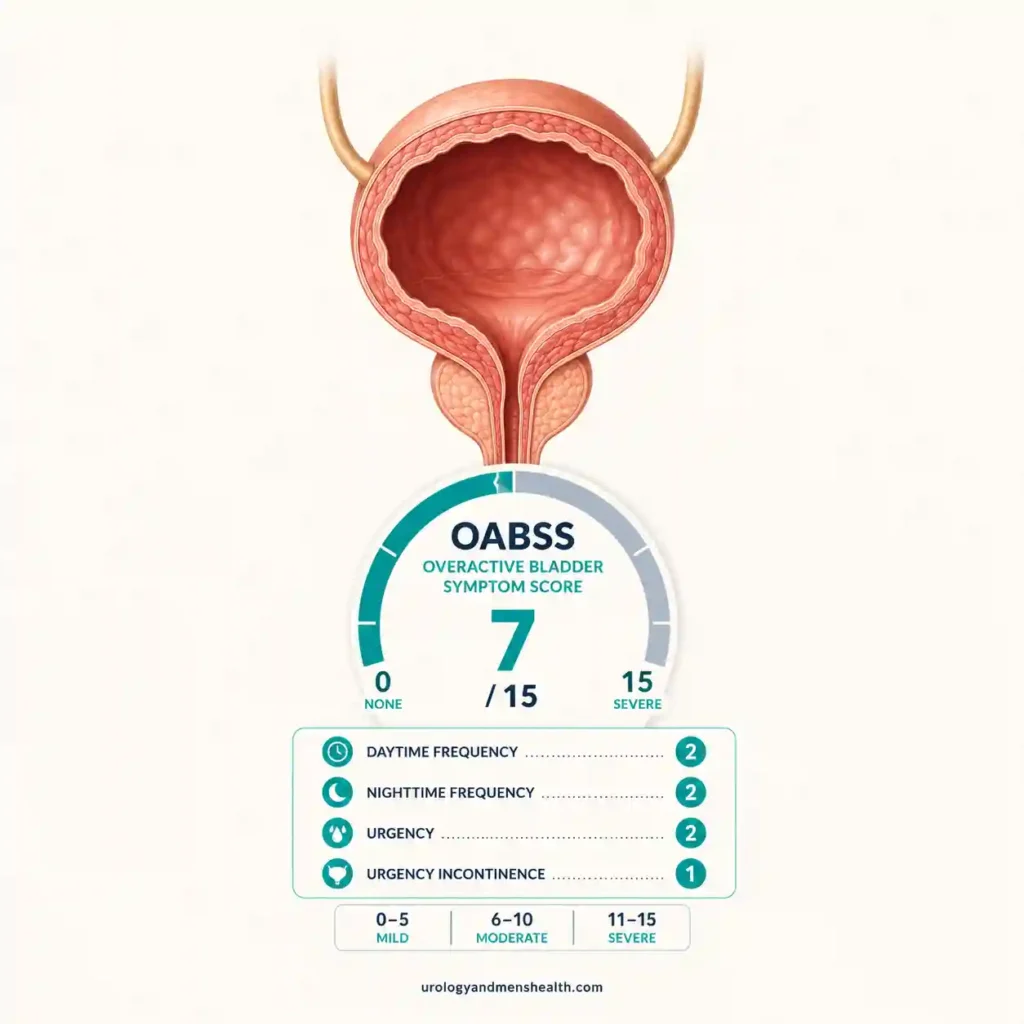
The Overactive Bladder Symptom Score (OABSS) turns urgency, daytime and night-time frequency, and urge leakage into one validated number from 0 to 15. Answer four quick questions about the past week to see whether your symptoms are mild, moderate, or severe, and what that means for treatment. It takes under a minute and nothing is stored. For more men's bladder and urinary guides, visit the Men's Wellness hub.

The Tool
Related Wellness Tools
Full Clinical Guide
In This Guide:
- The OABSS condenses four bladder symptoms into one score from 0 to 15: mild 0–5, moderate 6–11, severe 12 or more.
- Urgency and urge leakage carry the most weight — up to 5 points each; daytime frequency counts for at most 2.
- Overactive bladder is formally present when the total is 3 or more and the urgency answer scores 2 or more.
- Before any bladder-relaxing tablet, your doctor should check how well you empty, because a high post-void residual changes the safe choice.
What the Overactive Bladder Symptom Score Measures
The Overactive Bladder Symptom Score is a four-question instrument that converts the daily reality of an overactive bladder into a single number from 0 to 15. It was developed and validated by Yukio Homma and colleagues in 2006 and is now used worldwide to grade symptoms and track treatment [1]. The four items are deliberately weighted: daytime frequency scores at most 2 points, night-time frequency (nocturia) up to 3, while urgency and urgency incontinence carry up to 5 points each — because those two symptoms bother men the most. A total of 0–5 is mild, 6–11 moderate, and 12 or more severe. One clinically important detail the raw total can hide: overactive bladder is formally diagnosed when your total is 3 or more and your urgency answer scores 2 or more, so a “mild” score can still be a real diagnosis. For the wider picture, see this guide to overactive bladder in men.
The Physiology Behind the Score
An overactive bladder is a storage problem, not an emptying problem. The bladder muscle (the detrusor) is meant to stay relaxed while it fills and contract only when you decide to go. In overactive bladder it contracts too early, before the bladder is full — like a car that lurches forward the moment the light turns amber. That premature contraction is felt as urgency, and the urgency is what drives the extra daytime trips, the night-time waking, and, when the contraction wins, the leakage. This is why the score weights urgency so heavily. It also explains the one trap in interpreting it: the very same urgency and frequency can come from a bladder that is struggling to empty against an obstruction, where urine left behind keeps the bladder irritable. Telling those apart starts with measuring how much you leave behind — your post-void residual.
How to Interpret Your Result
Picture two men. One scores 3 — he passes urine a little often and feels an occasional urge, but rarely rushes and never leaks. The other scores 14 — daily urgency he cannot defer, several broken nights, and leaks he plans his week around. They get completely different advice. A mild score (0–5) usually means simple bladder-friendly changes are enough; the one thing to check is whether urgency is present at all, because that decides whether you technically have overactive bladder. A moderate score (6–11) is the band where most men benefit from adding a bladder-relaxing medication to those changes. A severe score (12–15) is disruptive but, reassuringly, the band where the most effective treatments live. Night-time waking deserves its own thought, because not all nocturia is overactive bladder.
Read: Nocturia – Why You Wake at Night to UrinateWhat to Do With Your Result
The 2024 AUA/SUFU guideline deliberately moved away from a rigid treatment ladder. Behavioral therapy — timed voiding, fluid and caffeine adjustment, pelvic-floor training — is offered to everyone, and tablets are a choice rather than an obligation [2]. If medication is added, the two main classes are beta-3 agonists and antimuscarinics; a beta-3 agonist is often tried first because antimuscarinics carry a cognitive caution in older men. The emptying check matters here: European guidance advises against antimuscarinics when the post-void residual is high (above roughly 150 mL), to avoid tipping the bladder into retention [3]. If you ever cannot pass urine at all, that is acute urinary retention and an emergency. When tablets and behavior are not enough, botulinum toxin injection and nerve stimulation work well. Because these symptoms often overlap with prostate-driven obstruction in men, it is worth separating the two with the IPSS prostate symptom score.
Read: Men’s Health Screening GeneratorIf you are unsure about your result, the PDF report this tool generates gives you a ready-made framework to bring to your next appointment.
In My Practice
The single most useful thing I ask a man to do before our next visit is not to change anything yet — it is to keep a three-day bladder diary. Time, rough volume, and whether an urge was attached. More than once, a “severe” sounding history has turned out to be two large evening coffees and a litre of water after dinner, and the diary made it obvious to both of us in a way the score alone never could.
The OABSS tells you how loud the symptoms are; a short diary tells you why — and the two together make the next decision far easier.
References
- Homma Y, Yoshida M, Seki N, et al. Symptom assessment tool for overactive bladder syndrome — overactive bladder symptom score. Urology. 2006;68(2):318–323. PubMed. The original OABSS development and validation study.
- Cameron AP, Chung DE, Dielubanza EJ, et al. The AUA/SUFU Guideline on the Diagnosis and Treatment of Idiopathic Overactive Bladder. J Urol. 2024;212(1):11–20. American Urological Association.
- European Association of Urology. Guidelines on the Management of Non-neurogenic Male Lower Urinary Tract Symptoms. EAU, 2025. Uroweb. Recommends avoiding antimuscarinics where post-void residual exceeds ~150 mL.
- Jiang YH, Lee CL, Kuo HC. Comparison of the OABSS, IPSS storage subscore and urgency severity scale in classifying overactive bladder severity. Low Urin Tract Symptoms. PMC. Supports the OABSS severity bands used here.
Frequently Asked Questions
What counts as a “normal” OABSS, and when is it overactive bladder?
A total of 0 to 5 is graded mild, 6 to 11 moderate, and 12 to 15 severe. But the grade is not the whole story: overactive bladder is formally present when your total is 3 or more and your urgency answer scores 2 or more, so even a mild total can be a genuine diagnosis. If your symptoms feel more like a slow, weak stream than sudden urgency, the IPSS prostate symptom score may fit you better.
Is the OABSS only for men?
No. The score was validated in both men and women and is used for either. This page frames it for men because that is who the site serves, and because in men an overactive bladder often overlaps with prostate-related symptoms that need separate attention. The leakage the score asks about is urge leakage — leaking with a sudden urge, not the leak-on-coughing that defines stress incontinence, which is scored differently.
My score is low but I still wake up a lot at night — what does that mean?
Night-time waking is not always overactive bladder. It can come from making too much urine overnight (nocturnal polyuria), drinking late, untreated sleep apnea, or leg-fluid that shifts when you lie down. A low daytime score with heavy nocturia points away from a purely overactive bladder. It is worth reading more on nocturia and why you wake at night and raising the pattern specifically with your doctor.
How accurate is this tool, and can I rely on it?
The OABSS is a validated symptom score, not a diagnosis. It reliably grades how severe your overactive bladder symptoms are and tracks whether treatment is helping, but it cannot tell you the cause. A high score can come from an overactive bladder, from a prostate that is obstructing flow, or occasionally from an infection. Use it to measure and monitor your symptoms, and let a clinical assessment confirm what is driving them.
How do I use this result at my doctor’s appointment?
Tap Download My Report to generate a two-page PDF with your score, your answers, an interpretation, and a short list of questions to ask. Bringing a specific number and a few targeted questions turns a vague “I’m going more often” into a focused conversation, and it gives your doctor a clear baseline to compare against at your next visit so you can both see whether treatment is working.
Dr. Muhammad Khalid
MBBS · FCPS (Urology) · MCPS (General Surgery) · CHPE · CRSM · IMC #539472
Specialist urologist with 11+ years of clinical experience across tertiary teaching hospitals. Trained at Lady Reading Hospital and Khyber Teaching Hospital, Peshawar. Author or co-author of five peer-reviewed international publications, including in Cureus and the World Journal of Surgery. Procedural expertise: URS, PCNL, RIRS, TURP, TURBT, and major open urological surgery. Full profile →
This article is for educational purposes only and does not constitute medical advice. Always consult your physician or urologist for diagnosis and treatment decisions specific to your condition.