
Urological Symptom Checker for Men
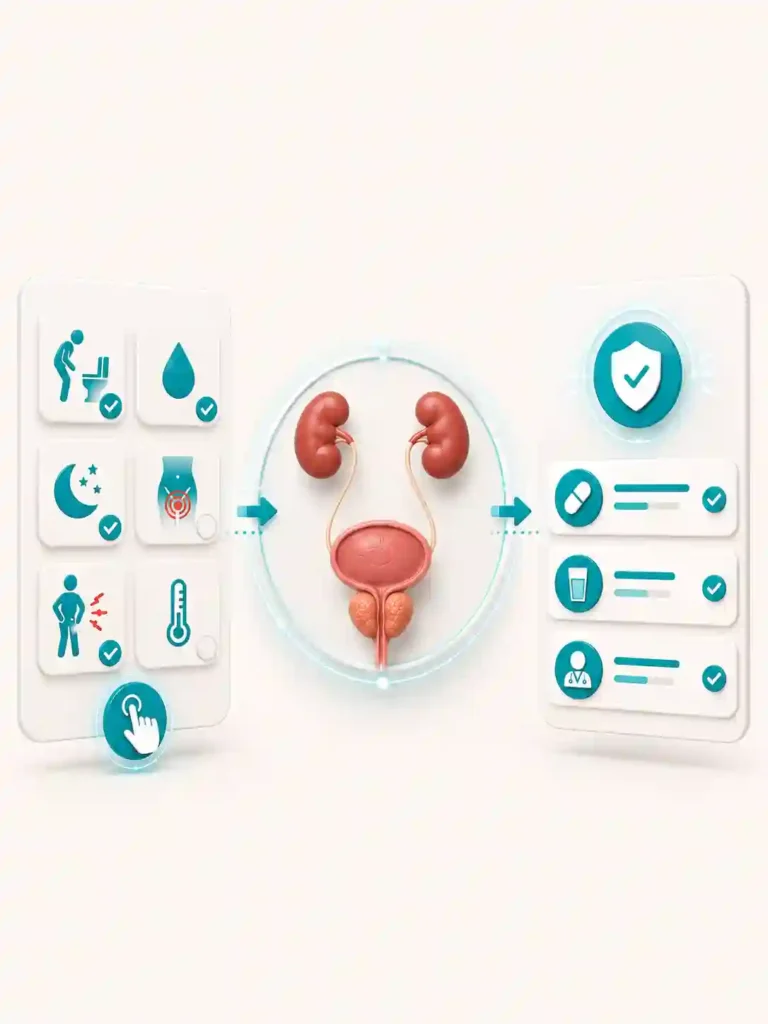
This urological symptom checker reads your age, your symptoms, and how long they have lasted, then ranks the conditions that best fit the whole picture and flags anything that needs urgent care. It covers prostate, bladder, kidney, infection, and sexual-health symptoms in men, and points you to the exact calculator and guide for your result. Browse every condition it covers in the conditions A to Z.

The Tool
Get the free Men’s Health Screening Checklist
The age-by-age guide to the tests every man actually needs — written by Dr. Khalid. Enter your email and I will send it over.
Related Tools
Full Clinical Guide
- Patterns beat single symptoms – the checker weighs your whole combination, adjusted for age, not one box.
- A few combinations are emergencies: sudden testicular pain, no urine at all, fever with flank pain, or blood with clots. Go now.
- Age shifts the odds – the same symptom means different things at 25 and 65.
- The result is a starting point: confirm with a urologist and the matched tool, not a diagnosis on its own.
How This Symptom Checker Works
This urological symptom checker turns a scattered set of complaints into a ranked, prioritized picture. You tell it your age, the symptoms you have, and how long they have lasted; it weighs each symptom, adjusts for your age, and screens first for the few patterns that need urgent care. What comes back is not a diagnosis. It is a triage and a shortlist: the conditions that best fit your whole picture, the single most useful tool to run next, and the guide that explains your situation in plain language. The logic follows the same diagnostic frameworks specialists use, drawn from the European Association of Urology [1] and the American Urological Association [3]. A man rarely has one symptom in isolation, and the value here is in reading the combination the way a clinician would in the first minute of a consultation.
Red Flags: When Symptoms Need Urgent Care
Most urological symptoms are not emergencies, but a handful are, and the cost of missing them is high – so the checker screens for these before anything else. Sudden, severe pain in one testicle can mean testicular torsion, where the blood supply twists shut and the testis can be lost within hours unless it is untwisted in the operating room. Being completely unable to pass urine, with a tense, painful lower abdomen, is acute urinary retention and needs a catheter the same day. An erection lasting more than four hours (priapism) is a true emergency for the tissue itself. Fever and chills with flank pain can mean an infected, obstructed kidney, which can turn into a bloodstream infection quickly [2]. Heavy visible blood in the urine, especially with clots, needs prompt assessment. A red banner is telling you to be seen now, not to read further.
How Symptoms Map to Conditions
The same symptom can point in very different directions, which is why age and pattern matter as much as the symptom itself. A weak stream, a sense of incomplete emptying, and waking at night to urinate in a man over fifty usually point to benign prostatic enlargement, where the prostate squeezes the urethra. The same frequency in a younger man with burning and discharge points instead toward infection or a sexually transmitted infection. Urologists separate voiding symptoms (weak stream, straining, hesitancy) from storage symptoms (urgency, frequency, night-time trips), because the first group suggests obstruction and the second suggests an overactive bladder – and they lead to different first-line treatment. Blood in the urine sits in its own category: at any adult age it warrants a full evaluation, because it can be the first and only sign of a bladder or kidney tumor [3]. The checker reads these clusters, not single boxes.
What to Do With Your Result
Your result sorts into one of three actions. If a red flag fired, the action is simple: go to an emergency room or call your doctor now, before reading further. If the tool points to a likely condition without an emergency flag, the next step is usually a primary care doctor or urologist within days to weeks, and it helps to arrive with specifics – ask for a urinalysis if there is burning or blood, a PSA blood test and a prostate exam if the picture is prostatic, a post-void bladder scan if emptying feels incomplete, or a kidney ultrasound if there is flank pain. If your symptoms are mild and long-standing, the matched tool on your result – such as the IPSS prostate score or the UTI risk checker – gives you a number to track over time. Whichever path you land on, bring the list of symptoms and how long you have had them; it shortens the consultation and sharpens the plan.
In My Practice
Most men who reach this page have been quietly worried about a single symptom for weeks – usually blood they saw once, or a stream that has slowed. What I tell them in clinic is the same thing this tool is built to do: one symptom on its own rarely settles anything, and the reassuring explanation and the urgent one often start from the same complaint.
The job is to read the pattern and the timeline, then test the few things that change what we do next. A man who has had a slow stream for two years and a man who suddenly cannot pass urine at all describe the same body part, but they need me on completely different timelines.
References
- European Association of Urology. EAU Guidelines (diagnostic frameworks for urological conditions). uroweb.org.
- European Association of Urology. EAU Guidelines on Urological Infections, 2024. uroweb.org.
- American Urological Association / SUFU. Microhematuria: AUA/SUFU Guideline (2020, amended 2025). auanet.org.
Frequently Asked Questions
Can this symptom checker diagnose my condition?
No. It reads your symptom pattern, flags anything that needs urgent care, and points you to the most relevant guide and tool. It cannot replace a physical exam, urine and blood tests, imaging, or a urologist’s judgment. Treat it as an informed starting point, then confirm with a clinician. To put a number on prostate-type symptoms first, use the IPSS prostate symptom score.
When should I go to the emergency room instead of using this tool?
Go straight to the emergency room for sudden severe testicular pain, being completely unable to pass urine, an erection lasting over four hours, heavy blood in urine with clots, or fever and chills with urinary symptoms or flank pain. These need hands-on assessment within hours, not an online tool. If you are unsure, the UTI when-to-worry guide explains the warning signs.
Why do some answers show a red warning?
Certain patterns – such as fever with flank pain, sudden scrotal pain, or an inability to urinate – can point to conditions where a delay changes the outcome. The tool flags these automatically so you do not wait at home. A red banner means seek care now; an amber one means see a doctor within days. When in doubt, the safer choice is always to be seen, as the blood in urine guide explains.
I have several symptoms at once. Will the tool handle that?
Yes. It weighs every symptom you select against age and duration, then ranks the conditions that best fit the whole picture rather than reacting to one box. That is why a man of 65 with a weak stream and night-time trips lands on enlarged prostate, while a man of 25 with the same urinary burning and discharge lands on infection. Selecting more symptoms makes the match sharper, not noisier. See the full health tools index for the matched calculators.
Is this tool only for men?
Yes – it is built around male urological symptoms, which is this site’s focus. Many conditions it covers, such as kidney stones, UTIs, and blood in urine, also affect women, but the diagnostic pathways differ. Women with urological symptoms should see their own primary care doctor or a urologist directly. For shared concerns like stones, the kidney stones guide still applies.
Dr. Muhammad Khalid
MBBS · FCPS (Urology) · MCPS (General Surgery) · CHPE · CRSM · IMC #539472
Specialist urologist with 11+ years of clinical experience across tertiary teaching hospitals. Trained at Lady Reading Hospital and Khyber Teaching Hospital, Peshawar. Author or co-author of five peer-reviewed international publications, including in Cureus and the World Journal of Surgery. Procedural expertise: URS, PCNL, RIRS, TURP, TURBT, and major open urological surgery. Full profile →
This article is for educational purposes only and does not constitute medical advice. Always consult your physician or urologist for diagnosis and treatment decisions specific to your condition.