Hydrocele & Spermatocele: Scrotal Swelling Explained
Most scrotal swellings men bring me turn out to be a harmless hydrocele or spermatocele. The job is proving that — and knowing the few that aren't.

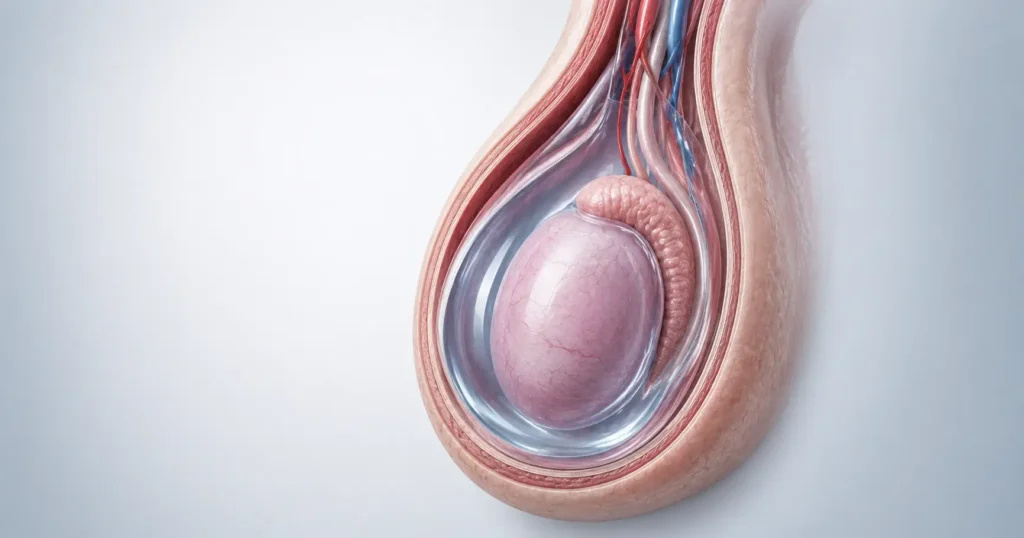
A hydrocele is one of the most common reasons a man comes to my clinic convinced something is badly wrong, and one of the most common things I get to reassure him about. It is a soft, usually painless swelling of the scrotum caused by fluid collecting around the testicle. Its close relative, the spermatocele, is a small fluid-filled cyst arising from the epididymis — the coiled tube behind the testicle. Both are benign. The reason they still deserve a proper look is that “soft painless scrotal swelling” is also how a few serious conditions can begin, and the only way to be sure which one you have is to examine it, shine a light through it, and often scan it. This article explains what these swellings are, how a urologist tells them apart from something that needs urgent action, and when treatment is genuinely worth it.
Key Takeaways
- A hydrocele is fluid around the testicle; a spermatocele is a cyst from the epididymis behind it. Both are benign and both light up when a torch is shone through them.
- Unlike infant hydroceles, adult hydroceles usually do not disappear on their own — but small, painless ones are often safely left alone.
- Any new scrotal swelling deserves at least one examination, and usually an ultrasound, before settling on watchful waiting — to rule out the conditions that mimic it.
- Surgery is offered for swellings that are large, heavy, or uncomfortable; needle drainage alone tends to recur and is not the standard fix.
What a Hydrocele and a Spermatocele Actually Are
Each testicle sits inside a thin double-layered sac called the tunica vaginalis. Normally there is just a trace of lubricating fluid between those layers. A hydrocele forms when that fluid builds up faster than the body reabsorbs it, so the layer fills like a water balloon and surrounds the testicle [1]. Because the fluid sits all around the testicle, the testicle itself can be hard to feel through it. This sits within our wider urological surgery and recovery hub.
A spermatocele is different in origin. It is a cyst that grows from the epididymis, the coiled tube sitting behind and above the testicle that stores and carries sperm. The cyst typically contains fluid with sperm in it, which is why it is sometimes called a spermatic cyst [2]. You usually feel it as a separate smooth lump above the testicle rather than a swelling wrapped around it.
Both share two reassuring features: they are typically painless, and they transilluminate — meaning if you shine a torch against the scrotum in a dark room, the swelling glows red because light passes through fluid. A solid lump does not do that. That single bedside test does a lot of the early work.
How to Tell It From Something Serious
This is the part that matters, because the whole point of seeing a doctor about a scrotal swelling is to separate the harmless majority from the few that are not. Several other conditions can present as a lump or swelling, and each is handled differently:
- Testicular torsion — sudden, severe pain with swelling, most often in younger men. This is a time-critical emergency, not something to watch overnight; the warning signs are covered in our guide to testicular torsion.
- Testicular cancer — usually a firm, painless lump on the testicle itself that does not transilluminate. Any solid, hard, or growing lump needs an urgent ultrasound. Knowing what normal feels like helps, which is the point of a regular testicular self-exam.
- Epididymitis — infection causing a painful, tender, swollen testicle, often with fever. This needs prompt treatment rather than observation; see our guide to epididymitis and the swollen testicle.
- Inguinal hernia — bowel pushing down into the scrotum, which can look similar but behaves differently on coughing and lying down.
In clinic the sequence is simple: feel it, transilluminate it, and if there is any doubt, get a scrotal ultrasound. Ultrasound is quick, painless, and settles almost every case — confirming a simple hydrocele or spermatocele, or flagging a solid mass that needs more attention [1].
In My Practice
A man in his thirties came to me convinced he had testicular cancer after feeling a soft swelling on one side. Two minutes with a pen-torch in a darkened room settled most of it — the swelling lit up bright red, the way fluid does and a solid tumour never would — and the ultrasound confirmed a simple hydrocele. He had spent three weeks barely sleeping.
Most scrotal swellings are benign, but the reassurance only counts once a solid mass has actually been ruled out — which is why I image rather than guess.
Preparing for urological surgery? Download Dr. Khalid’s Urology Surgery Recovery Guide.
Enter your email below to receive Dr. Khalid’s complete Urology Surgery Recovery Guide as a free, printable PDF.
When It Needs Treatment — and When to Leave It Alone
Here is the honest answer most men are relieved to hear: a confirmed simple hydrocele or spermatocele that is small and not bothering you can usually be left alone. The fluid is not damaging the testicle, and there is no prize for operating on a swelling that causes no symptoms. Adult hydroceles rarely vanish on their own the way infant ones do, but “won’t go away” is not the same as “must be removed” [1].
Treatment is offered when the swelling earns it — when it becomes large and heavy, drags or aches, interferes with sitting, sex, or activity, or grows enough to bother you. The definitive treatment is surgery. Draining the fluid with a needle might be done in specific situations, but on its own it tends to fill straight back up, so it is not the standard cure [2].
One thing worth weighing for a spermatocele in particular: because the cyst sits on the sperm-carrying epididymis, removing it carries a small risk to that side’s drainage. If you still hope to father children, say so before any operation — it changes the conversation.
Surgery and Recovery
Hydrocele surgery (hydrocelectomy) and spermatocele removal (spermatocelectomy) are day-case operations done through a small scrotal incision. The surgeon drains the fluid and either removes or folds back the sac so it cannot refill. You go home the same day, usually with supportive underwear in place to control swelling.
The scrotum swells and bruises after this kind of surgery — sometimes dramatically for a week or two — and that is expected, not a complication. Ice, rest, snug support, and simple painkillers carry you through the first week. Most men are back to desk work within a few days and to full activity over two to four weeks. For a stage-by-stage picture, our post-operative recovery timeline tool sets out what is normal at each point.
The recognized risks are a collection of blood (hematoma), infection, recurrence, and, less commonly, ongoing scrotal discomfort. These are uncommon, and for a swelling that is genuinely affecting your life, surgery is a reliable fix.
Scrotal Swelling That Cannot Wait
A painless swelling that transilluminates is usually harmless. These features are not:
- Sudden, severe pain with swelling, especially in a younger man — treat as testicular torsion and go to the ER immediately.
- A firm or hard lump that does not light up with a torch, or a swelling that keeps growing — needs an urgent ultrasound to exclude a tumour.
- Swelling with fever, redness, and one-sided pain may be infection and needs prompt treatment.
Frequently Asked Questions
Is a hydrocele dangerous?
A simple hydrocele is benign — it is just fluid, not a tumour, and in most cases it will not harm the testicle. The real risk is assuming a swelling is a hydrocele when it is not. That is why any new scrotal swelling deserves at least one proper examination, and usually an ultrasound, before you settle on watchful waiting. Knowing your own baseline through a testicular self-exam helps you notice change early.
What is the difference between a hydrocele and a spermatocele?
A hydrocele is fluid collecting around the testicle inside the tunica vaginalis, so it tends to surround the testis. A spermatocele is a cyst arising from the epididymis — the coiled tube behind the testicle — and typically contains fluid with sperm. Both are benign and both transilluminate, but they sit in slightly different places, which is how a urologist tells them apart on examination.
Will a hydrocele go away on its own in an adult?
Unlike infant hydroceles, which often resolve, adult hydroceles usually do not disappear by themselves. Many are simply left alone if they are small and not bothersome. Treatment is offered when the swelling becomes large, heavy, uncomfortable, or makes you self-conscious — not because the fluid is dangerous. You can read where these operations sit in our surgery and recovery hub.
Can a hydrocele or spermatocele affect fertility?
A hydrocele itself rarely affects fertility. A spermatocele usually does not either, though surgery to remove one carries a small risk of damaging the epididymis, which matters if you still want children. If fertility is a concern, raise it before any operation. A varicocele, a different scrotal swelling that can feel like a bag of worms, is the one more clearly linked to fertility and is sometimes confused with infection — see our guide to the swollen testicle.
How do I know if scrotal swelling is something serious?
The reassuring pattern is a soft, painless swelling that lights up when a torch is held against it. The patterns that need urgent review are sudden severe pain (possible torsion), a firm lump that does not transilluminate (possible tumour), or swelling with fever and pain (possible infection). When in doubt, get a scrotal ultrasound — it settles almost every case, as explained in our guide to sudden testicular pain.
References
- Hydrocele: Causes, Symptoms, Diagnosis & Treatment. Cleveland Clinic. 2025. Cleveland Clinic
- Rioja J, Sánchez-Margallo FM, Usón J, Rioja LA. Adult hydrocele and spermatocele. BJU Int. 2011;107(11):1852-1864. PubMed
Dr. Muhammad Khalid
MBBS · FCPS (Urology) · MCPS (General Surgery) · CHPE · CRSM · IMC #539472
Specialist urologist with 11+ years of clinical experience across tertiary teaching hospitals. Trained at Lady Reading Hospital and Khyber Teaching Hospital, Peshawar. Author or co-author of five peer-reviewed international publications, including in Cureus and the World Journal of Surgery. Procedural expertise: URS, PCNL, RIRS, TURP, TURBT, and major open urological surgery. Full profile →
This article is for educational purposes only and does not constitute medical advice. Always consult your physician or urologist for diagnosis and treatment decisions specific to your condition.