TURP Recovery Timeline: Week by Week Guide
Most men handle TURP recovery better than they expect — but the week-two bleed catches almost everyone off guard. Here's the honest week-by-week timeline I give my patients before they go home.


If you’re reading this before or after surgery, you want one thing: a realistic TURP recovery timeline so you know what is normal and what is not. After a transurethral resection of the prostate — the operation that trims away the prostate tissue blocking your urine flow — recovery follows a fairly predictable pattern, week by week. I’ve walked hundreds of men through it, and the good news is that most recover faster than they fear. The catch is that recovery isn’t a straight line: there’s a well-known dip around the second week that surprises men who weren’t warned about it. This guide lays out exactly what to expect from the hospital stay through to full healing at six to twelve weeks, where the bleeding fits in, and the specific warning signs that mean you should pick up the phone. For the wider picture of prostate procedures and aftercare, see our surgery and recovery hub.
Key Takeaways
- Most men go home within 1-2 days of a TURP, usually once the catheter is out and the urine runs clear.
- A secondary bleed around day 10-14 — when the internal scab separates — is normal and usually settles with rest and extra fluids.
- Burning, urgency, and frequency can last 4-6 weeks while the raw prostate bed heals; full internal healing takes 6-12 weeks.
- Being unable to pass urine, passing heavy clots, or running a fever needs urgent attention — not a wait-and-see approach.
What to Expect in the First Few Days After TURP
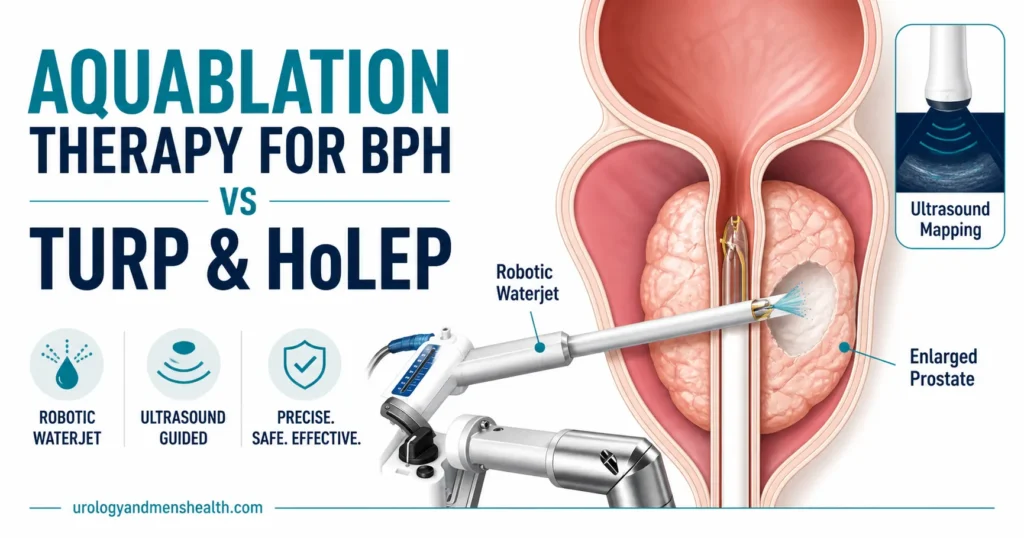
When you wake from a TURP, you’ll have a catheter draining your bladder. In most cases it’s a three-way catheter running continuous bladder irrigation: sterile fluid flushes through the bladder to wash out blood and stop clots forming while the raw prostate surface settles. The fluid in the bag often looks rosé-pink at first and clears over the next day or two. That is exactly what should happen.
Most men stay in hospital for one to two nights. The catheter usually comes out once your urine runs clear, often within 24 to 48 hours [1]. Before you go home, the team will want to see you pass urine on your own — sometimes called a trial without catheter. If you can’t go at first, don’t panic; a temporary re-catheter for a few days is common and not a failure.
If you’re reading this before your operation and still weighing your options, it helps to understand what the surgery itself involves — our guide on what a TURP actually involves, step by step covers the procedure, and if you’re comparing approaches, how TURP stacks up against newer options like aquablation is worth a read. Once the decision is made, the recovery pattern below is broadly the same.
TURP Recovery Timeline: Week by Week
Here is the honest, week-by-week TURP recovery timeline I give patients before they’re discharged. Use it as a map, not a stopwatch — people heal at slightly different speeds.
Week 1 — settling in at home. Expect burning when you pass urine, a frequent and urgent need to go, and some blood that comes and goes. Drink around 2 to 2.5 liters of water a day (about 68 to 85 fl oz, or 8 to 10 cups) to keep your urine dilute and flush out debris. You’ll feel tired — that’s the anesthetic and the surgery, not a setback.
Weeks 2-3 — the bleed nobody warned you about. Around day 10 to 14, the internal scab over the resected area separates as it heals, and this can release a sudden gush of bright red blood or a few clots. It looks alarming, but in most men it settles within a day or two with rest and a deliberate increase in fluids. The aim is to keep drinking so clots don’t build up.
Weeks 4-6 — turning the corner. By now most men notice a stronger, steadier stream and far less daytime urgency. The raw prostate bed is re-lining itself, a process that takes roughly six to eight weeks [1]. You can rebuild activity gradually in this window, but the inside is still healing even when you feel well.
Weeks 6-12 — full healing. The prostate channel finishes healing over the second and third months. Irritative symptoms such as occasional urgency or mild burning can linger into this period and still be completely normal. The flow and emptying you have by three months is usually your lasting result.
Map your own milestones with the Post-Operative Recovery Timeline toolPreparing for urological surgery? Download Dr. Khalid’s Urology Surgery Recovery Guide.
Enter your email below to receive Dr. Khalid’s complete Urology Surgery Recovery Guide as a free, printable PDF.
Common Recovery Symptoms and How to Manage Them
The most common complaints in the first month are burning when passing urine, urgency, and going more often than you’d like — including at night. These happen because the surgical area is raw and the bladder is irritated; they fade as the lining regrows. A symptom score like the IPSS urinary symptom questionnaire is a simple way to track whether your symptoms are genuinely improving week to week rather than relying on memory.
Some blood in urine after TURP is expected on and off for up to four to six weeks, especially after you’ve been more active. Light pink is fine. What isn’t fine is thick clots or urine the color of undiluted blood — more on that in a moment.
One change is usually permanent: after a TURP, around 65% of men have retrograde ejaculation, where semen travels backward into the bladder instead of out through the penis [3]. Orgasm still feels much the same — it’s simply dry. It doesn’t harm you, though it does reduce fertility, which matters if you still hope to father children.
In My Practice
The phone calls I get most often come on day twelve or thirteen — a man who sailed through his first week, then saw the toilet bowl turn red and assumed something had gone badly wrong. Almost every time, it’s the healing scab separating, and a quiet afternoon with a big jug of water settles it.
Knowing the week-two bleed is coming turns a frightening moment into a manageable one, which is exactly why I brief every patient on it before discharge.
When to Seek Urgent Help
Some symptoms after TURP are not part of normal healing and need same-day medical attention or a trip to the emergency room:
- You cannot pass urine at all after the catheter is removed — a sign of acute retention.
- You’re passing heavy clots, or your urine looks like undiluted blood and isn’t clearing.
- A fever of 38°C (100.4°F) or higher, shivering, or feeling generally unwell — possible infection.
- Severe pain that your prescribed painkillers aren’t controlling.
Returning to Work, Exercise, Driving, and Sex
For the first four to six weeks, avoid heavy lifting — nothing above roughly 5 kg (about 10 lb) — and skip straining, intense exercise, and long bike rides. Pressure and straining are what restart bleeding from the healing prostate bed. Gentle walking from day one is good for you; the gym can wait.
You can usually drive once your catheter is out, you’re off strong painkillers, and you could safely perform an emergency stop — often around one to two weeks. Desk-based work tends to be realistic within one to two weeks; if your job involves heavy lifting or manual labor, plan on four to six weeks before lifting and manual tasks [2].
I advise waiting about four to six weeks before ejaculating, to let the prostate bed heal. Keep your bowels soft and avoid straining on the toilet — constipation and pushing are a surprisingly common trigger for a fresh bleed, so a stool softener in the first couple of weeks is sensible.
Frequently Asked Questions
How long does TURP recovery take?
Most men feel substantially better within four to six weeks, though the inside of the prostate keeps healing for six to twelve weeks. Here is the realistic TURP recovery timeline: the catheter usually comes out in one to three days, desk work is often possible within one to two weeks, and irritative symptoms settle gradually. You can map your own milestones with our recovery timeline tool.
Is blood in my urine normal after TURP, and when should I worry?
Light pink or blood-tinged urine is expected on and off for up to four to six weeks, and a heavier bleed around day ten to fourteen — when the internal scab separates — surprises most men but usually settles with rest and extra fluids. Seek urgent care if you pass thick clots, your urine looks like undiluted blood, or you suddenly cannot pass urine at all. Our guide to what a TURP involves explains why the prostate bleeds as it heals.
When can I have sex again after TURP, and will it be different?
I advise waiting about four to six weeks before ejaculating, so the prostate bed can heal. Around 65% of men have retrograde ejaculation afterward, where semen passes backward into the bladder rather than out — orgasm still happens, it is simply dry, and it is usually permanent but harmless. Erections themselves are not typically affected by the resection. For the wider picture of prostate procedures and aftercare, see our surgery and recovery hub.
When can I drive and go back to work after TURP?
Driving is usually fine once your catheter is out, you are off strong painkillers, and you could safely perform an emergency stop — often around one to two weeks. Desk workers typically return within one to two weeks; if your job involves heavy lifting or manual labor, plan for four to six weeks and avoid lifting more than about 5 kg (10 lb) until then.
Why is my urine flow still weak weeks after TURP?
A weak or stop-start flow in the first few weeks is normal, because the prostate bed is still swollen and small pieces of healing tissue can briefly narrow the channel. Flow usually strengthens noticeably by week four to six. If it is getting worse rather than better, or you struggle to empty your bladder, book a review rather than waiting it out.
References
- American Urological Association. Management of Lower Urinary Tract Symptoms Attributed to Benign Prostatic Hyperplasia (BPH): AUA Guideline. American Urological Association. 2026. AUA
- European Association of Urology. Guidelines on the Management of Non-neurogenic Male LUTS. European Association of Urology. 2026. EAU
- National Institute of Diabetes and Digestive and Kidney Diseases. Enlarged Prostate (Benign Prostatic Hyperplasia). NIDDK. 2025. NIDDK
Dr. Muhammad Khalid
MBBS · FCPS (Urology) · MCPS (General Surgery) · CHPE · CRSM · IMC #539472
Specialist urologist with 11+ years of clinical experience across tertiary teaching hospitals. Trained at Lady Reading Hospital and Khyber Teaching Hospital, Peshawar. Author or co-author of five peer-reviewed international publications, including in Cureus and the World Journal of Surgery. Procedural expertise: URS, PCNL, RIRS, TURP, TURBT, and major open urological surgery. Full profile →
This article is for educational purposes only and does not constitute medical advice. Always consult your physician or urologist for diagnosis and treatment decisions specific to your condition.