PSA After Prostatectomy: What “Undetectable” Means
"Undetectable" sounds like zero, but it isn't. The number your lab reports — and the lab method it uses — decides whether a post-prostatectomy PSA is reassuring or the first sign of recurrence. Here's how I read the trend.

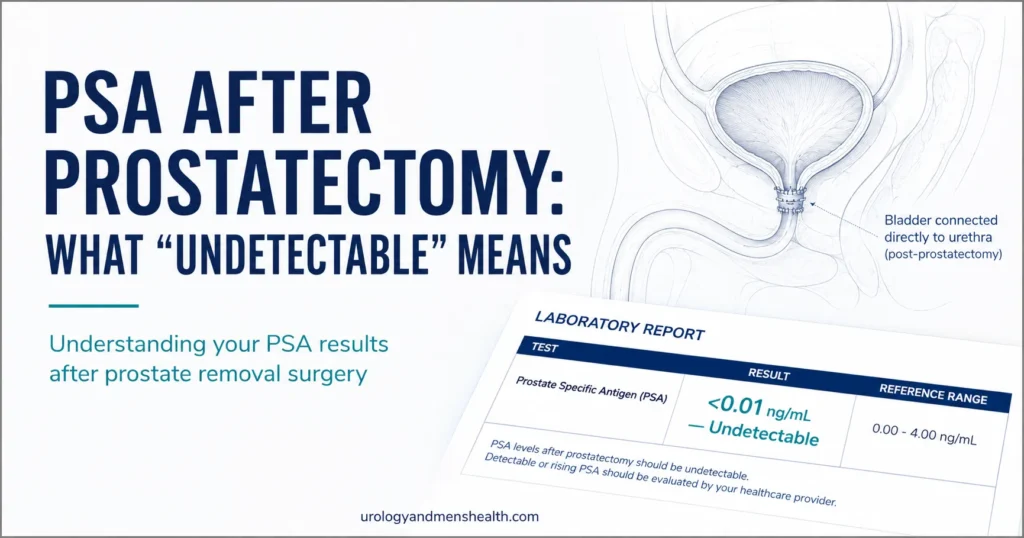
A normal PSA after prostatectomy should be undetectable — and that word means something very specific that most lab reports don’t explain. The number you see depends on which PSA assay your lab runs, and the difference between “<0.1 ng/mL” and “<0.01 ng/mL” can be the difference between reassurance and the first signal of recurrence. After a radical prostatectomy, your prostate is gone, so the gland that makes PSA is gone with it. Whatever PSA shows up in the blood from that point forward either comes from a tiny remnant of benign tissue, or it comes from prostate cancer cells that survived surgery. The job of every PSA test after that day is to tell those two possibilities apart. For the wider picture of how PSA fits into prostate care, see our complete Prostate Health Hub.
Key Takeaways
- Standard PSA assays report “undetectable” at <0.1 ng/mL; ultrasensitive assays report at <0.01 ng/mL. The two numbers are not interchangeable.
- A PSA that stays detectable at 6 weeks post-op (≥0.1 ng/mL) is “persistent PSA” and carries a worse prognosis than a PSA that rises later.
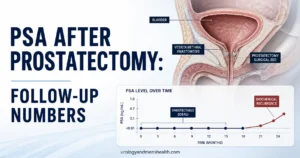
- Biochemical recurrence is defined by the AUA as a PSA ≥0.2 ng/mL on two consecutive readings — not a single value above zero.
- PSA doubling time matters more than the absolute number for predicting whether recurrence is local or distant.
Why PSA Should Be Zero After a Prostatectomy
PSA — prostate-specific antigen — is a protein made almost exclusively by the glandular cells inside the prostate. A radical prostatectomy removes the entire gland: the peripheral zone, the transition zone, the seminal vesicles, and the small amount of tissue at the bladder neck and apex. Once those tissues are out, the body has no significant source of PSA left. Within 4 to 6 weeks of surgery, any PSA in circulation from the surgery itself has been cleared by the kidneys and liver, and the next blood test should show a number close to zero.
“Close to zero” is the operative phrase. PSA has a half-life of roughly 2 to 3 days, so it takes about 5 half-lives (15 days minimum, usually longer) for a pre-surgery PSA to fall below the lab’s detection limit. This is why the first post-op PSA is drawn at 6 to 8 weeks, not earlier — too soon and you’re still measuring leftover signal from before surgery.
If your prostate has truly been removed completely and no cancer cells escaped before surgery, your PSA at 6 weeks should read “undetectable” — which on a standard assay means below 0.1 ng/mL. If it’s higher than that, something is producing PSA, and the work of the next few months is to figure out what.
“Undetectable” Is Not the Same as Zero
This is the single most misunderstood concept in post-prostatectomy follow-up. “Undetectable” is a lab term, not a biological one. It means the PSA in your blood is below the threshold the assay can reliably measure. It does not mean PSA is zero.
Two assays are in common use, and the threshold differs by a factor of ten:
- Standard PSA assay: reports “undetectable” at less than 0.1 ng/mL. Most US hospital labs default to this.
- Ultrasensitive PSA (uPSA) assay: reports “undetectable” at less than 0.01 ng/mL — or sometimes less than 0.003 ng/mL on the newest platforms.
So a man whose lab reports “PSA <0.1, undetectable" on a standard assay might actually have a measurable PSA of 0.04 ng/mL — well below the standard cutoff, but absolutely detectable on an ultrasensitive assay. Whether that 0.04 matters depends on whether it's stable or rising over time, and on the cancer's original pathology.
The AUA 2023 guideline on follow-up after localized prostate cancer treatment notes that ultrasensitive PSA can detect biochemical recurrence months to years earlier than standard PSA, but it can also generate anxiety from low-level fluctuations that never amount to anything [1]. Whether your urologist orders standard or ultrasensitive depends on your original cancer’s risk category and on local practice. Ask which one your lab is running — the number is not interpretable without knowing the method.
In My Practice
I had a patient three months out from a robotic prostatectomy for Gleason 3+4 disease come into clinic visibly shaking, holding his lab report. His PSA was 0.04 ng/mL. His previous lab had reported “<0.1, undetectable." He thought the cancer was back. Same blood, same body — the previous lab ran a standard assay, the new one ran ultrasensitive. The number hadn't changed; the resolution of the test had. We tracked it for 18 months and it stayed at 0.04 ng/mL. That's a stable, low-level signal — almost certainly benign tissue at the urethrovesical anastomosis, not cancer.
If you switch labs or your follow-up moves between hospitals, always ask which assay is being run, and never compare numbers across assay types without that information.
The Three PSA Patterns That Matter
After prostatectomy, your PSA result will fall into one of three patterns. The pattern dictates everything that happens next.
Pattern 1: Undetectable and stable
PSA is below the assay threshold at 6 weeks and stays there at every subsequent visit. This is the result you want. It does not mean cure is guaranteed — late recurrences (5 to 10 years out) do happen, particularly with adverse pathology — but the 5-year biochemical-recurrence-free survival in this group is around 90 to 95% depending on the original cancer’s risk category [2].
Pattern 2: Persistent PSA
PSA never drops below 0.1 ng/mL after surgery. This is called persistent PSA or PSA persistence, and it means one of two things: either there’s residual prostate cancer outside the surgical margin, or there’s a small amount of benign prostate tissue left behind (uncommon but possible, especially at the apex). The EAU defines persistent PSA as a PSA ≥0.1 ng/mL at 4 to 8 weeks post-surgery [3]. Prognosis is significantly worse than for delayed biochemical recurrence — the cancer was already disseminated at the time of surgery, in most cases. Imaging with PSMA PET-CT and early consideration of salvage radiotherapy is standard.
Pattern 3: Biochemical recurrence
PSA was undetectable, then becomes detectable, then continues to rise. The AUA defines biochemical recurrence as a PSA ≥0.2 ng/mL confirmed on two consecutive readings after prostatectomy [1]. A single PSA above 0.2 is not biochemical recurrence — it has to be confirmed, because lab error and assay drift can produce one-off values that don’t reflect anything real. The timing of when this happens is itself a prognostic factor: recurrence within 2 years of surgery suggests more aggressive biology than recurrence at 7 years.
Facing a PSA result you do not fully understand? Download Dr. Khalid’s PSA & Prostate Cancer Decision Guide.
Enter your email below to receive Dr. Khalid’s complete PSA & Prostate Cancer Decision Guide as a free, printable PDF.
Your PSA Monitoring Schedule
The AUA 2023 follow-up guideline recommends a structured schedule for PSA testing after radical prostatectomy [1]:
- First PSA: 6 to 8 weeks after surgery. This establishes whether PSA cleared completely or is persistent.
- Year 1: every 3 months. Most recurrences that are going to happen early will show themselves in this window.
- Years 2 to 5: every 6 months. Recurrence rate slows but does not stop.
- Year 5 onward: annually, for at least 10 years total. Late recurrences are uncommon but real, particularly with adverse pathology features.
If your pathology report after surgery showed adverse features — positive surgical margins, extracapsular extension, seminal vesicle invasion, or lymph node involvement — your urologist may shorten this interval, particularly in the first 2 years. The presence of adverse pathology shifts the conversation about adjuvant radiation versus early salvage radiation, both of which depend on close PSA monitoring. For a refresher on what the pathology terms on your report actually mean, see our companion piece on Gleason scores and biopsy report interpretation.
Always have PSA drawn at the same lab if you can. Inter-lab assay variability is real, and a “rising” PSA that’s actually a lab-to-lab difference is one of the most preventable sources of patient distress in this whole process.
PSA Velocity and Doubling Time: Why the Trend Matters More Than the Number
Once PSA becomes detectable, the speed of rise carries more clinical weight than the absolute value. Two numbers matter:
- PSA velocity: the rate of increase in ng/mL per year.
- PSA doubling time (PSADT): how long it takes the PSA to double. Calculated from at least three sequential readings over a minimum of 3 months.
A short doubling time — less than 6 months — suggests aggressive, often distant disease and predicts worse cancer-specific survival. A long doubling time — greater than 12 months — typically suggests slower, more local disease that may respond well to salvage radiotherapy. This distinction drives the entire treatment decision. The same PSA value of 0.5 ng/mL can mean very different things depending on whether the patient took 3 months or 3 years to reach it. For the underlying mechanics of how velocity is calculated and what doubling time means, our PSA Velocity Tracker walks through the math with your actual readings.
This is also why your urologist won’t usually act on a single elevated reading. Two confirmed readings with a calculated doubling time tells a much more reliable clinical story than one alarming number in isolation.
When a Rising PSA Means Treatment
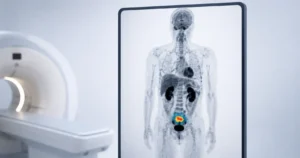
Once biochemical recurrence is confirmed (PSA ≥0.2 ng/mL on two readings), the workflow moves to imaging. The standard of care in 2026 is PSMA PET-CT — a scan that uses a tracer binding to prostate-specific membrane antigen to detect even small volumes of recurrent disease. PSMA PET is far more sensitive than older bone scans and pelvic CT at low PSA values, and current guidance is to image at PSA ≥0.2 ng/mL rather than waiting until PSA is higher [4].
What imaging finds determines what treatment looks like:
- Local recurrence only (prostate bed): salvage radiotherapy to the prostate bed, sometimes combined with short-course androgen deprivation therapy (ADT). Best outcomes when delivered at PSA <0.5 ng/mL.
- Pelvic lymph node involvement: extended-field salvage radiotherapy plus ADT, or systemic therapy depending on volume of disease.
- Distant metastases: systemic treatment — ADT, sometimes combined with newer agents (abiraterone, enzalutamide) depending on volume and pace of disease.
The single most important practical point: salvage radiotherapy works best when started early, ideally before PSA crosses 0.5 ng/mL. Waiting until PSA reaches 1.0 or 2.0 — sometimes done in the past — significantly reduces the chance of cure. Ask your urologist about referral to a radiation oncologist as soon as biochemical recurrence is confirmed, not after.
When to Contact Your Urologist Urgently
Not every detectable PSA needs an emergency call, but some patterns do. Reach out the same week if you see any of the following on your post-prostatectomy lab report:
- First post-op PSA at 6-8 weeks is ≥0.1 ng/mL — this is persistent PSA and needs urgent imaging discussion.
- Two consecutive PSA readings ≥0.2 ng/mL — this is confirmed biochemical recurrence; imaging and treatment planning should not be deferred.
- PSA doubling in less than 6 months at any value above the detection threshold — short doubling time changes urgency regardless of absolute number.
- New bone pain, unexplained weight loss, or back pain alongside a rising PSA — these are clinical signs that warrant immediate assessment, not the next routine appointment.
Living With Long-Term PSA Surveillance
For most men who have a prostatectomy with curative intent, PSA surveillance becomes a quiet ritual: a blood draw every 3 to 12 months for at least a decade, each one followed by a few days of low-grade anxiety waiting for the result. There is no clean way to escape that anxiety, but a few things help:
- Use the same lab and the same assay every time. If your urologist offers a choice between standard and ultrasensitive PSA, ask which one matches your pathology risk. Low-risk pathology rarely needs ultrasensitive monitoring; adverse pathology often benefits from it.
- Track your own numbers. A simple spreadsheet with date, lab, assay type, and value gives you a clearer picture than scattered patient-portal screenshots. If your urologist switches labs, you’ll spot it.
- Don’t compare your trajectory to anyone else’s. Online forums are full of men whose pathology, surgical approach, and post-op course are nothing like yours. Your pathology report is the only relevant comparator.
- Bring questions in writing. “Is this number consistent with my last one on the same assay?” is a more productive opening than “Is the cancer back?”
If your pathology was favorable (organ-confined Gleason 3+4 or lower, negative margins, undetectable PSA at every visit), the statistical likelihood of remaining recurrence-free at 10 years is high. If your pathology was adverse, surveillance is more intensive but salvage options are real and effective. The cardiovascular and lifestyle factors that affect general health also affect prostate cancer outcomes — there’s accumulating evidence that the same diet, exercise, and BP control patterns that protect the heart also slow biochemical recurrence in this population [5]. None of that replaces the PSA monitoring schedule, but it sits alongside it as something within your control.
Frequently Asked Questions
What is a normal PSA after prostatectomy?
A normal PSA after prostatectomy is “undetectable” — on a standard assay this means below 0.1 ng/mL, and on an ultrasensitive assay it means below 0.01 ng/mL. The two numbers are not interchangeable. Always confirm with your lab which assay they ran, because a value reported as “<0.1" on a standard assay could be 0.04 ng/mL on an ultrasensitive one — still undetectable in clinical terms, but it would set off alarms if you compared it incorrectly. See our PSA grey zone explainer for how thresholds differ in men who still have their prostate.
Is a PSA of 0.04 after prostatectomy bad?
Not by itself. On a standard PSA assay, 0.04 ng/mL is undetectable — well below the 0.1 ng/mL threshold. On an ultrasensitive assay, 0.04 is a measurable but very low value that may simply reflect a small amount of benign tissue at the urethrovesical anastomosis. What matters is whether 0.04 is stable across multiple readings or whether it’s rising. A stable 0.04 over 12 months is reassuring. A 0.04 that rises to 0.08, then 0.15, then 0.22 over the same period is biochemical recurrence in progress.
How quickly should PSA drop to undetectable after prostatectomy?
PSA has a half-life of 2 to 3 days, so within 4 to 6 weeks of surgery any pre-operative PSA should have cleared from the bloodstream. The first post-op PSA is therefore drawn at 6 to 8 weeks. If PSA is still ≥0.1 ng/mL at that point, this is called persistent PSA and indicates that some PSA-producing tissue — either cancer or, less commonly, benign remnant — was not removed by surgery. Persistent PSA typically prompts PSMA PET-CT imaging and a discussion about salvage radiotherapy.
What PSA level after prostatectomy needs treatment?
The AUA defines biochemical recurrence as a PSA ≥0.2 ng/mL confirmed on two consecutive readings. That’s the trigger for imaging and a treatment discussion — not the trigger for treatment itself. The actual treatment decision depends on where the cancer is (local prostate bed only versus nodal versus distant), how fast the PSA is rising (doubling time), and what your original pathology showed. Salvage radiotherapy generally works best when started at PSA below 0.5 ng/mL, so delaying past confirmed biochemical recurrence can reduce the chance of cure.
Can PSA go up after prostatectomy without cancer coming back?
Rarely, yes — but it’s the exception rather than the rule. The most common benign cause is a small amount of residual benign prostate tissue at the surgical margin, particularly at the apex, producing a stable low-level PSA (often 0.02 to 0.1 ng/mL on ultrasensitive testing) that never rises. Lab artifact and assay drift can produce a one-off elevated reading. This is why biochemical recurrence requires two consecutive readings ≥0.2 ng/mL, not one — the confirmation step exists precisely to filter out lab noise and stable benign readings from genuine recurrence.
How long do you need PSA tests after prostatectomy?
The AUA recommends PSA testing for at least 10 years after radical prostatectomy, and many urologists continue annual testing indefinitely. The schedule is intensive early (every 3 months in year 1, every 6 months in years 2-5) because most recurrences happen in that window, then annual after year 5. Late recurrences — 5 to 10 years or more after surgery — are uncommon but real, particularly in men with adverse pathology features like positive margins or extracapsular extension. Surveillance is not optional; it’s how curative-intent surgery delivers on its promise.
References
- American Urological Association. Advanced Prostate Cancer: AUA/SUO Guideline (2023 Amendment). AUA Guidelines. 2023. AUA
- Han M, Partin AW, Pound CR, et al. Long-term biochemical disease-free and cancer-specific survival following anatomic radical retropubic prostatectomy. Urol Clin North Am. 2001;28(3):555-565. PubMed
- Cornford P, van den Bergh RCN, Briers E, et al. EAU-EANM-ESTRO-ESUR-ISUP-SIOG Guidelines on Prostate Cancer. Eur Urol. 2024;86(2):148-163. EAU
- Jadvar H, Calais J, Fanti S, et al. Appropriate Use Criteria for Prostate-Specific Membrane Antigen PET Imaging. J Nucl Med. 2022;63(1):59-68. PubMed
- Kenfield SA, Stampfer MJ, Giovannucci E, Chan JM. Physical activity and survival after prostate cancer diagnosis in the Health Professionals Follow-up Study. J Clin Oncol. 2011;29(6):726-732. PubMed
Dr. Muhammad Khalid
MBBS · FCPS (Urology) · MCPS (General Surgery) · CHPE · CRSM · IMC #539472
Specialist urologist with 11+ years of clinical experience across tertiary teaching hospitals. Trained at Lady Reading Hospital and Khyber Teaching Hospital, Peshawar. Author or co-author of five peer-reviewed international publications, including in Cureus and the World Journal of Surgery. Procedural expertise: URS, PCNL, RIRS, TURP, TURBT, and major open urological surgery. Full profile →
This article is for educational purposes only and does not constitute medical advice. Always consult your physician or urologist for diagnosis and treatment decisions specific to your condition.