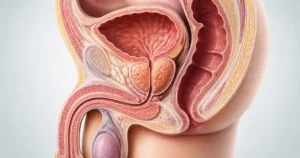
Finasteride Side Effects: BPH vs Hair Loss Trade-Offs
Men ask me whether the hair-loss pill and the prostate pill are the same drug — they are, just at different doses. Here's what finasteride trades away for what it gives, and who should think twice before starting it.

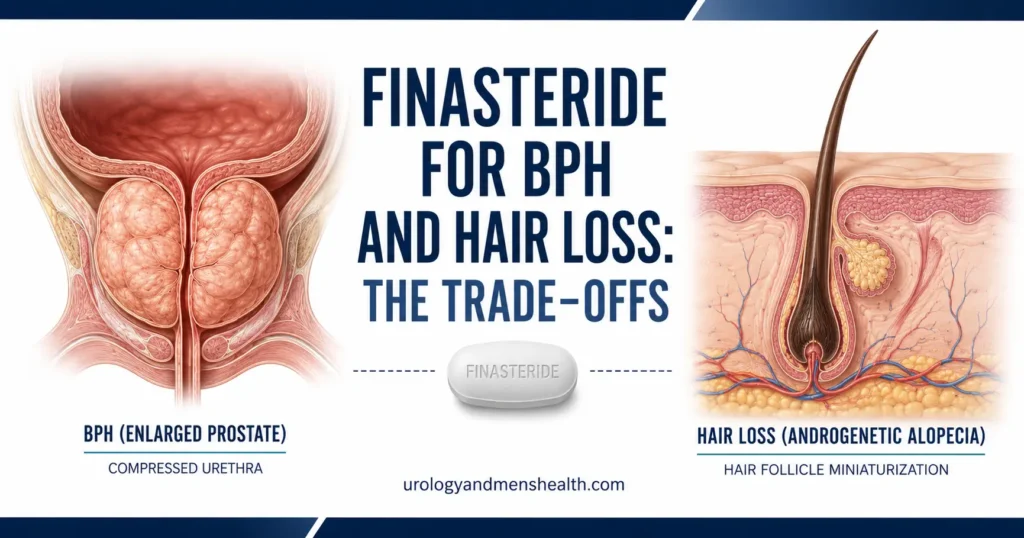
Finasteride side effects are the reason most men hesitate before filling the prescription — and the confusion usually starts with the dose. The exact same molecule treats an enlarged prostate at 5 mg (sold as Proscar) and male-pattern hair loss at 1 mg (sold as Propecia). It blocks an enzyme called 5-alpha reductase, lowering a hormone called DHT that drives both prostate growth and hair-follicle shrinkage. That single mechanism is why one pill can rescue your hairline and ease your urine stream — and why it can also blunt libido, soften erections, and quietly cut your PSA in half. None of that makes finasteride a bad drug. It makes it a drug with trade-offs that you should weigh deliberately rather than discover by accident. For the bigger picture on managing an enlarged prostate, see our Prostate Health Hub. This article walks through what you gain, what you give up, and who should think twice.
Key Takeaways
- Finasteride 5 mg (Proscar) treats an enlarged prostate; finasteride 1 mg (Propecia) treats hair loss — same drug, different dose.
- It shrinks the prostate by roughly 15-25% over six months by lowering DHT, but works only when the gland is actually enlarged.
- Sexual side effects — reduced libido, weaker erections, and lower semen volume — affect a minority of men and usually reverse after stopping, though persistent symptoms are reported.
- Finasteride lowers PSA by about 50%, so your urologist must double the result to read it correctly and avoid missing prostate cancer.
Finasteride 5 mg vs 1 mg: One Drug, Two Doses
The first thing I clear up in clinic is the dose. Finasteride 5 mg is approved for symptomatic benign prostatic hyperplasia (BPH) in men with an enlarged gland — to improve the urine stream, reduce the risk of sudden urinary retention, and lower the chance of needing surgery later. Finasteride 1 mg is approved for male-pattern hair loss. The active ingredient is identical; only the milligram strength on the label differs.
This matters because the side-effect conversation is the same conversation at both doses, even though the hair-loss dose is one-fifth the prostate dose. A man taking 1 mg for his hairline is exposed to the same biology — lower DHT — that affects libido and erections, just at a smaller magnitude. So if a dermatologist starts you on Propecia and a urologist later starts you on Proscar, you are not stacking two unrelated drugs. You are taking more of one.
Finasteride is also not the only prostate drug, and it works differently from the one most men try first. Alpha-blockers like tamsulosin relax the muscle around the bladder neck for fast symptom relief but do nothing to shrink the gland. Finasteride does the opposite — slow to act, but it actually reduces prostate size. If you want the full side-effect picture of the fast-acting option, read how tamsulosin compares for an enlarged prostate.
How Finasteride Works on the Prostate (and the Scalp)
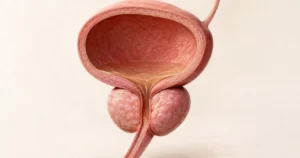
Testosterone is converted into a more potent androgen called dihydrotestosterone (DHT) by the enzyme 5-alpha reductase. Think of DHT as a stronger signal: it tells prostate tissue to keep growing and tells genetically sensitive hair follicles to keep shrinking. Finasteride blocks the type II form of that enzyme, so intraprostatic DHT falls sharply. The gland responds by slowly involuting — typically a 15-25% reduction in prostate volume over about six months [1].
The American Urological Association is specific about who benefits. 5-alpha reductase inhibitors are recommended for men with demonstrable prostate enlargement — judged by a volume above roughly 30 grams, a PSA above 1.5, or a prostate that feels enlarged on examination [2]. The same guideline recommends against using finasteride in men whose symptoms are not driven by an enlarged gland, because there is little to shrink and the side effects no longer buy you anything.
On the scalp, the same DHT drop slows follicle miniaturization, which is why the drug holds onto hair you still have rather than regrowing what is long gone. The biology is one pathway with two outcomes, which is exactly why the trade-offs travel together.
In My Practice
The most common moment of recognition I see is a man in his fifties who has been on the 1 mg hair-loss pill for years, now sitting in front of me for a weak urine stream — surprised to learn the 5 mg I am offering is the same drug he already trusts. The flip side is the younger man who started it purely for his hairline and never connected a gradual dip in libido to the prescription.
Whenever finasteride is on the table, I make sure the sexual and PSA effects are discussed up front, not discovered six months later.
The Sexual Side Effects: What the Trade-Off Really Costs
This is the part men actually want answered. Because finasteride lowers DHT, it can reduce libido, weaken erections, and lower semen volume and ejaculatory force. In the large prostate trials these effects showed up in a clear minority of men — single-digit percentages for each — and most resolved either over time on the drug or after stopping it [3]. At the 1 mg hair-loss dose the reported rates are lower still, but not zero.
The harder question is whether symptoms can persist after stopping — the issue often labeled post-finasteride syndrome. This is genuinely debated. Persistent sexual dysfunction after discontinuation has been reported, but it is uncommon and its true frequency is not settled [3]. I do not dismiss it, and I do not inflate it. What I tell men is this: if you notice a clear change in libido or erections, do not white-knuckle it for a year — tell me early, because the options differ depending on how long it has been going on.
One distinction worth making: low libido and weaker erections also have other causes that have nothing to do with finasteride, including falling testosterone with age. If your drive was already slipping before the prescription, the drug may not be the whole story — our guide to the low-testosterone symptoms doctors often miss helps you tell the two apart. To self-screen which finasteride effects you are actually experiencing, the BPH medication side effect checker walks you through it symptom by symptom.
Weak stream and night-time trips wearing you down? Download Dr. Khalid’s BPH & Enlarged Prostate Guide.
Enter your email below to receive Dr. Khalid’s complete BPH & Enlarged Prostate Guide as a free, printable PDF.
Finasteride and Your PSA: The Number You Must Double
This is the side effect that is invisible to you but matters most to your urologist. After about six months on finasteride, your PSA falls by roughly 50% [4]. The danger is not the lower number itself — it is misreading it. A PSA of 1.5 on finasteride is really behaving like a 3.0. If your doctor forgets you are taking the drug, a rising cancer signal can be masked and a diagnosis delayed.
The practical rule is simple: once you have been on finasteride for six months, multiply every PSA result by two to estimate the true value, and watch the trend rather than the single figure. Just as important — make sure finasteride is documented in your chart so whoever reads your bloodwork applies the correction. To see how an adjusted reading is actually interpreted by age, run your result through the age-adjusted PSA interpreter and bring the output to your appointment.
What to do: if you are about to start finasteride, ask your doctor to record a baseline PSA before your first dose, then repeat it at six months so you have a clean reference point. Any unexpected rise after that — even a “normal-looking” one — should prompt a conversation, not reassurance.
Who Should Take It — and Who Should Think Twice
Finasteride earns its place when the prostate is genuinely enlarged and the symptoms are bothersome. If your gland is large, your stream is weak, and you would rather avoid an operation, the slow shrinkage finasteride delivers — especially paired with an alpha-blocker — is a reasonable and well-evidenced path. It also has a niche role in reducing recurrent prostate-related bleeding.
I counsel men to pause and reconsider in a few situations: if your prostate is normal-sized, if you are actively trying to father a child (semen parameters can change), if you have had clear sexual side effects from it before, or if you have untreated depression, since mood changes are a labeled caution. None of these are absolute bans — they are reasons to talk it through rather than start on autopilot. And if medication is not controlling your symptoms, that is the moment to read about when surgery becomes the better answer for an enlarged prostate.
When to Call Your Doctor
Finasteride rarely causes emergencies, but contact your doctor promptly if you notice any of the following while taking it:
- New or worsening low mood, hopelessness, or thoughts of self-harm — mood changes are a recognized labeled caution.
- Breast tenderness, a lump, or nipple changes — uncommon, but always warrants examination to exclude male breast disease.
- Sexual side effects that persist or distress you, rather than waiting months to mention them.
- Any new rise in PSA, which must be interpreted with the drug’s effect in mind.
Frequently Asked Questions
Is the finasteride for hair loss the same drug as the one for an enlarged prostate?
Yes. It is one molecule at two strengths — 1 mg (Propecia) for male-pattern hair loss and 5 mg (Proscar) for an enlarged prostate. Both block the same enzyme and lower DHT, so the same finasteride side effects apply at both doses, just smaller at 1 mg. If you take both, you are taking more of one drug, not two different ones. For the wider treatment picture, see our Prostate Health Hub.
Does finasteride cause permanent erectile dysfunction?
For most men, sexual side effects are uncommon and reverse after stopping. Persistent erectile dysfunction after discontinuation has been reported but is rare and still debated. If you notice a clear change in erections, raise it early rather than waiting. Because age-related testosterone decline can mimic this, our guide to low testosterone in men over 40 helps separate the two causes.
Why does my urologist double my PSA result when I take finasteride?
Finasteride lowers PSA by about 50% after six months, so a measured value of 1.5 behaves like a true 3.0. Doubling the number prevents a cancer signal from being masked by the drug. Always make sure finasteride is noted in your chart, and check an adjusted reading against age norms using the age-adjusted PSA interpreter.
Can I take finasteride just for hair loss if I have a normal-sized prostate?
You can, but understand the trade-off. At 1 mg the prostate benefit is minimal because there is little gland to shrink, while the same DHT-lowering biology still applies. It will also lower your PSA, so screening must account for it. Before starting, screen yourself for likely effects with the BPH medication side effect checker.
How long before finasteride side effects show up or wear off?
Sexual side effects, if they occur, usually appear within the first weeks to months. The prostate-shrinking benefit and the roughly 50% PSA drop take about six months to stabilize. If you stop the drug, most side effects ease within weeks, though a minority report longer recovery. If symptoms persist, ask whether other enlarged-prostate treatments suit you better.
References
- Kim EH, Brockman JA, Andriole GL. The use of 5-alpha reductase inhibitors in the treatment of benign prostatic hyperplasia. Asian J Urol. 2018;5(1):28-32. PubMed Central
- Lerner LB, et al. Management of Lower Urinary Tract Symptoms Attributed to Benign Prostatic Hyperplasia: AUA Guideline. J Urol. 2021;206(4):806-817. AUA / Journal of Urology
- Trost L, Saitz TR, Hellstrom WJG. Side Effects of 5-Alpha Reductase Inhibitors: A Comprehensive Review. Sex Med Rev. 2013;1(1):24-41. PubMed Central
- Hamilton RJ, et al. Use of 5-alpha-reductase inhibitor and delay in prostate cancer diagnosis. Transl Androl Urol. 2020. PubMed Central
Dr. Muhammad Khalid
MBBS · FCPS (Urology) · MCPS (General Surgery) · CHPE · CRSM · IMC #539472
Specialist urologist with 11+ years of clinical experience across tertiary teaching hospitals. Trained at Lady Reading Hospital and Khyber Teaching Hospital, Peshawar. Author or co-author of five peer-reviewed international publications, including in Cureus and the World Journal of Surgery. Procedural expertise: URS, PCNL, RIRS, TURP, TURBT, and major open urological surgery. Full profile →
This article is for educational purposes only and does not constitute medical advice. Always consult your physician or urologist for diagnosis and treatment decisions specific to your condition.