Lemon Water for Kidney Stones: Does It Actually Work?
Does lemon water dissolve kidney stones? Learn the medical truth about this home remedy, how citrate works, and who it actually helps.


Lemon water for kidney stones is one of the most popular home remedies in urology — and one of the most misunderstood. Patients ask me almost every week whether daily lemon water will dissolve their stones or prevent the next one. The honest answer sits between the two extremes you usually hear online: lemon water is not a miracle, but it is not a myth either. For a specific subset of stone formers, the citrate in lemon juice does measurable work in the kidneys. For others, it changes nothing.
In this article I will walk you through exactly what citrate does at the tubular level, how much lemon juice you would need to match a prescription, which patients actually benefit, and when lemon water is a waste of effort. I will also tell you what to ask your urologist before you start — because the wrong stone type makes lemon water useless, and a 24-hour urine test is the only way to know.
Key Takeaways
- Lemon juice contains citric acid, which raises urinary citrate — the body’s main natural inhibitor of calcium oxalate stone formation.
- Four ounces of pure lemon juice daily (about half a cup, diluted in water) delivers roughly 5.9 grams of citric acid — meaningful but lower than a prescription potassium citrate dose.
- Lemon water helps most in patients with documented hypocitraturia (urinary citrate below 320 mg/day) and calcium oxalate stones.
- It does not work for uric acid, struvite, or cystine stones — and it does not dissolve existing stones already formed.
- A 24-hour urine test is what tells you whether lemon water is the right tool for your stone biology.
What Citrate Actually Does in the Kidney
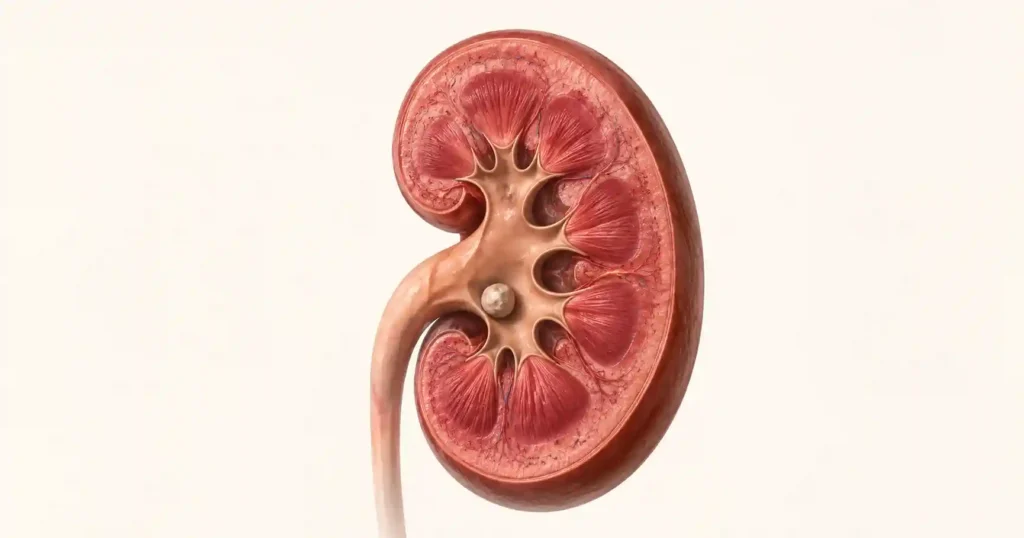
To understand whether lemon water for kidney stones works, you need to understand what citrate does inside the renal tubule — the microscopic pipe where urine is concentrated and where most stones begin to form.
Calcium oxalate stones — the most common type, accounting for roughly 75% of all kidney stones — form when free calcium ions in the urine bind with free oxalate ions and crystallize. Citrate is the body’s natural defense against this process. Citrate binds to calcium in the urine before oxalate can. Once calcium is locked up by citrate, oxalate has nothing to bind to and gets excreted harmlessly[1].
Citrate also raises urine pH slightly, which keeps uric acid dissolved (relevant for uric acid stones, though by a different mechanism). And it directly inhibits crystal aggregation — even when crystals do start to form, citrate makes them less likely to clump together and grow.
The clinical problem is that many recurrent stone formers have hypocitraturia — chronically low urinary citrate, typically defined as less than 320 mg in a 24-hour urine collection[2]. About 20–60% of calcium oxalate stone formers fall into this category depending on the study. Their natural anti-stone defense is broken, and they need to raise citrate from outside.
This is where lemon juice enters the picture. Lemons contain roughly 1.44 grams of citric acid per fluid ounce — far more than any other commonly consumed fruit. When you drink it, the citric acid is partially metabolized and partially excreted, raising urinary citrate output in a dose-dependent way[3].
In My Practice
I had a patient in his late 40s — three calcium oxalate stones in five years, two of them requiring ureteroscopy. His 24-hour urine came back with citrate at 180 mg, well below the 320 mg threshold. He had read about lemon water and asked if he could try it before starting prescription potassium citrate. I agreed, on one condition: he would repeat the 24-hour urine in eight weeks. Drinking 4 ounces of pure lemon juice daily, diluted in 2 liters of water, his citrate climbed to 410 mg. Three years later, no new stones.
That outcome is exactly what the evidence predicts for his specific biology — and exactly what does not happen when patients with the wrong stone chemistry try the same protocol.
How Much Lemon Juice Do You Actually Need?
The most-cited protocol comes from a small but well-designed study at the University of California San Diego stone clinic. Patients drank 4 ounces of pure lemon juice (about 120 mL, roughly half a cup) diluted in 2 liters (about 68 fl oz) of water daily[3]. This delivers approximately 5.9 grams of citric acid per day.
For comparison, a standard prescription dose of potassium citrate — the drug most urologists use for hypocitraturia — is 30 to 60 milliequivalents per day, equivalent to roughly 10 to 20 grams of citrate[2]. Lemon water at 4 oz of juice daily delivers about one-third to one-half of a prescription dose. That gap matters.
For mild hypocitraturia, that lower dose may be enough. For moderate-to-severe hypocitraturia — citrate below 150 mg/day, or a history of multiple recurrent stones — lemon water alone is unlikely to close the gap. This is the most common mistake patients make: assuming lemon water can replace a prescription when their citrate deficit is too large.
What about bottled lemon juice, lemonade, or lemon-flavored drinks? Most commercial lemonades contain trivial amounts of actual lemon juice and substantial added sugar — which independently increases stone risk. Bottled lemon juice (the kind sold in plastic squeeze bottles) is acceptable if it lists lemon juice as the first ingredient and no added sugar, but fresh lemon juice has higher citric acid content. Lime juice contains comparable citric acid and works similarly.
Related: How Much Water You Really Need to Prevent Kidney Stones →
Who Actually Benefits — and Who Is Wasting Their Time
This is the section that decides whether lemon water for kidney stones is worth your effort. The answer depends almost entirely on two variables: your stone composition and your 24-hour urinary citrate.
Strong benefit — start lemon water
Patients with documented calcium oxalate stones and 24-hour urinary citrate below 320 mg per day are the textbook candidates. The biology is exactly what citrate therapy is designed to correct. If you already know your stone composition from a previous procedure and you have hypocitraturia on a 24-hour urine, lemon water is a reasonable first step — particularly if your citrate is in the mild range (200–320 mg/day).
Modest benefit — consider it as one tool among several
Patients with recurrent calcium stones, normal citrate, but poor hydration may see some benefit — mostly because the protocol forces them to drink 2 liters of water daily. The citrate effect is small when baseline citrate is already normal, but the fluid effect is real. Honestly, in this group the water is doing most of the work, not the lemon.
Likely no benefit — skip it
Uric acid stones require urine alkalinization to dissolve, and while citrate does raise urine pH, the amount from lemon water is insufficient to reach the pH target (above 6.5) needed for active dissolution[4]. These patients need prescription alkali therapy and dietary changes — not lemon water.
Struvite stones form in the setting of urinary tract infection by urea-splitting bacteria. Citrate does nothing here — these stones require antibiotic and surgical management.
Cystine stones are caused by a genetic transport defect and need specific medical therapy (tiopronin, high fluid intake, urine alkalinization to pH above 7). Lemon water is far below the therapeutic threshold.
If you do not know your stone composition, you are guessing. Ask your urologist to send your next passed stone for analysis — most labs run a free spectrophotometric analysis, and the result fundamentally changes your prevention strategy. Until you have that result, you are treating a problem you cannot see. Our stone directory walks through what each composition means for prevention.
Worried about a stone coming back? Download Dr. Khalid’s 7-Day Kidney Stone Prevention Meal Plan.
Enter your email below to receive Dr. Khalid’s complete 7-Day Kidney Stone Prevention Meal Plan as a free, printable PDF.
Does Lemon Water Dissolve Existing Kidney Stones?
No. This is the single most common misconception I correct in clinic. Lemon water does not dissolve calcium oxalate stones — the most common type — because calcium oxalate is essentially insoluble at any urinary pH the human body can produce. The chemistry simply does not allow it.
What lemon water does is reduce the formation of new stones in susceptible patients. A stone already sitting in your kidney or ureter is not going to shrink because you started drinking lemon water last week. If you have a symptomatic stone — pain, blood in urine, infection — you need a treatment pathway, not a kitchen remedy. Our stone size chart explains when stones pass on their own and when they need intervention.
The one partial exception is uric acid stones, which can be dissolved with aggressive urinary alkalinization. But as covered above, lemon water does not raise urinary pH high enough to make this happen — prescription alkali (potassium citrate or sodium bicarbonate) is required.
Side Effects and Practical Considerations
Lemon water is generally safe, but it is not zero-risk. The two issues I warn patients about:
Dental enamel erosion. Citric acid is acidic enough to demineralize tooth enamel over time. Drink lemon water through a straw, rinse your mouth with plain water afterward, and avoid brushing your teeth for at least 30 minutes after drinking it (brushing softened enamel accelerates damage).
Gastric reflux. Patients with established gastroesophageal reflux disease may find that concentrated lemon juice worsens symptoms. Diluting in 2 liters of water across the day usually resolves this, but if you have refractory reflux, this protocol may not be tolerable.
Drug interactions are uncommon at dietary doses, but lemon juice can mildly affect the absorption of some medications. If you take blood pressure medication, antiarrhythmics, or anticoagulants, mention the protocol to your prescriber.
When to See a Doctor — Not the Kitchen
Lemon water is a prevention strategy, not a treatment for active stone disease. Stop the home remedies and seek urgent medical assessment if you have:
- Severe one-sided flank pain that comes in waves and radiates to the groin
- Visible blood in your urine, especially with pain
- Fever above 38°C (100.4°F) with any urinary symptoms — this can indicate an infected obstructed kidney, which is a surgical emergency
- Nausea and vomiting that prevents you from keeping fluids down
- A known stone and decreasing urine output
What Lemon Water Cannot Replace
Even when lemon water works, it works as part of a strategy — not as the whole strategy. The patients who actually stop forming stones are the ones who combine multiple levers. Drinking 2.5 to 3 liters of fluid daily to produce at least 2.5 liters of urine matters more than what is in the fluid[1]. Dietary sodium below 2,300 mg/day (about 1 teaspoon of salt) reduces calcium excretion. Adequate dietary calcium (1,000 to 1,200 mg/day from food, not supplements) binds oxalate in the gut. Moderating high-oxalate foods — covered in our oxalate food list — closes the loop.
Lemon water sits at the citrate corner of that strategy. If your citrate is low, it helps. If your citrate is fine and your sodium and oxalate are off, lemon water will not save you from the next stone.
Related: Foods That Cause Kidney Stones — The Oxalate and Sodium List →
A Practical 4-Week Trial Protocol
If you fit the strong-benefit profile — calcium oxalate stones, documented hypocitraturia — and want a structured starting point, this is how I set up a trial in clinic:
- Week 0: Confirm stone composition is calcium oxalate. Get a baseline 24-hour urine collection if you have not had one in the past 12 months. Ask your urologist for the citrate, calcium, oxalate, sodium, and urine volume numbers — write them down.
- Weeks 1–4: Squeeze 4 ounces (120 mL, half a cup) of fresh lemon juice each morning. Dilute in 2 liters of water and drink across the day. Use a straw. Aim for clear or pale yellow urine.
- Week 4: Repeat the 24-hour urine. If citrate has risen above 320 mg/day and urine volume is above 2.5 liters, you have your answer — continue. If citrate is still low, the deficit is too large for lemon water alone, and you need prescription potassium citrate.
- Ongoing: Repeat a 24-hour urine annually. Adjust based on numbers, not on how you feel — most stone formation is silent until pain hits.
If you want a structured way to track hydration and dietary adherence during the trial, our kidney stone prevention compliance tracker covers the daily metrics that actually matter.
Frequently Asked Questions
How much lemon water should I drink each day to prevent kidney stones?
The protocol used in clinical research is 4 fluid ounces (about 120 mL, or half a cup) of pure lemon juice diluted in 2 liters of water daily — drunk across the day rather than all at once. This delivers roughly 5.9 grams of citric acid, which is enough to raise urinary citrate in many patients with mild hypocitraturia. Patients with severe citrate deficiency usually need prescription potassium citrate as well — see our full kidney stone prevention protocol for context.
Does lemon water dissolve kidney stones that have already formed?
No. Lemon water does not dissolve calcium oxalate stones — the most common type — because calcium oxalate is insoluble at any urinary pH the body produces. It works only as prevention against new stone formation, primarily in patients with low urinary citrate. If you have a symptomatic stone, you need a clinical pathway, not a home remedy. Our guide to passing a stone covers what actually helps.
Is bottled lemon juice as effective as fresh lemon juice for kidney stones?
Bottled lemon juice is acceptable if it lists 100% lemon juice as the only ingredient and has no added sugar, though fresh lemon juice has slightly higher citric acid content. Avoid commercial lemonade entirely — most products contain very little real lemon juice and substantial added sugar, which independently increases kidney stone risk by raising urinary calcium and uric acid.
Can lemon water replace prescription potassium citrate for hypocitraturia?
Only for mild cases. Four ounces of lemon juice daily delivers approximately one-third to one-half of a standard prescription potassium citrate dose. Patients with moderate-to-severe hypocitraturia (urinary citrate below 150 mg/day) or those with multiple recurrent stones usually need the higher dose only a prescription can deliver. A repeat 24-hour urine after 8 weeks on lemon water tells you whether it is enough.
Does lemon water work for uric acid kidney stones?
Not effectively. Uric acid stones require urinary pH above 6.5 for prevention and above 7.0 for active dissolution. Lemon water raises urine pH slightly but cannot reach those targets — prescription alkali therapy (potassium citrate or sodium bicarbonate) is required. A stone composition analysis is the only way to know which type you have, which is why every passed stone should be sent to the lab.
Are there side effects to drinking lemon water daily?
The main concerns are dental enamel erosion from citric acid and worsened reflux in patients with established GERD. Use a straw, rinse your mouth with plain water afterward, and wait 30 minutes before brushing your teeth. If you take blood pressure medication, antiarrhythmics, or anticoagulants, mention the protocol to your prescriber — interactions are uncommon at dietary doses but worth flagging.
References
- Pearle MS, Goldfarb DS, Assimos DG, et al. Medical Management of Kidney Stones: AUA Guideline. Journal of Urology. 2014;192(2):316-324. AUA
- Zuckerman JM, Assimos DG. Hypocitraturia: Pathophysiology and Medical Management. Reviews in Urology. 2009;11(3):134-144. PubMed Central
- Penniston KL, Steele TH, Nakada SY. Lemonade therapy increases urinary citrate and urine volumes in patients with recurrent calcium oxalate stone formation. Urology. 2007;70(5):856-860. PubMed
- Türk C, Neisius A, Petřík A, et al. EAU Guidelines on Urolithiasis. European Association of Urology. 2024. EAU
Dr. Muhammad Khalid
MBBS · FCPS (Urology) · MCPS (General Surgery) · CHPE · CRSM · IMC #539472
Specialist urologist with 11+ years of clinical experience across tertiary teaching hospitals. Trained at Lady Reading Hospital and Khyber Teaching Hospital, Peshawar. Author or co-author of five peer-reviewed international publications, including in Cureus and the World Journal of Surgery. Procedural expertise: URS, PCNL, RIRS, TURP, TURBT, and major open urological surgery. Full profile →
This article is for educational purposes only and does not constitute medical advice. Always consult your physician or urologist for diagnosis and treatment decisions specific to your condition.