Acute Urinary Retention: A Urologist’s Emergency Guide
A man who suddenly can't pass urine despite a painfully full bladder has a true emergency — not something to sleep off. Here's what acute urinary retention is, why it happens, and exactly what the ER will do.

Acute urinary retention is one of the most genuinely agonizing problems I treat — a sudden, complete inability to pass urine while the bladder keeps filling and stretching. Men describe it as a desperate, building pressure low in the abdomen that no amount of straining will relieve. It is one of the most common urological emergencies, and unlike most prostate symptoms that creep up over months, this one arrives in hours. If you or someone you care for cannot urinate at all and the bladder feels full and painful, this is not something to wait out at home overnight — it needs same-day care. For the bigger picture on how the bladder and prostate change with age, see our Men’s Wellness Hub. In this guide I’ll explain what acute urinary retention actually is, why it happens (the prostate is usually, but not always, the culprit), what the emergency room will do to relieve it, and what the days and weeks afterward look like.
Key Takeaways
- Acute urinary retention is a sudden, painful inability to urinate that needs same-day emergency care — not a “wait and see” symptom.
- In men, an enlarged prostate (BPH) is the single most common cause, but anesthesia, alcohol, constipation, and ordinary cold or allergy medications can all be the trigger.
- The first treatment is a catheter to drain the bladder, which can release 500–1,000 mL (about 1–2 pints) or more of trapped urine.
- After 2–3 days on an alpha-blocker such as tamsulosin, roughly 6 in 10 men urinate on their own once the catheter is removed.
What Acute Urinary Retention Is — And What It Isn’t
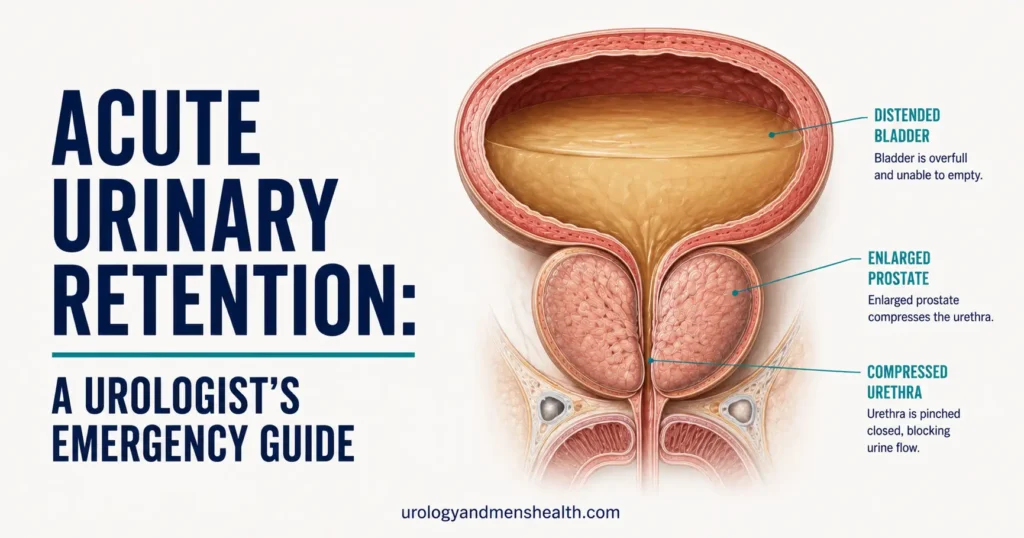
Acute urinary retention means the bladder is full but you cannot empty it. The bladder muscle still contracts and the urge is intense, but urine cannot get past the blockage at the outlet. Within a few hours the bladder stretches well beyond its comfortable capacity, which is what produces the relentless, cramping pressure.
It helps to separate acute from chronic retention, because they behave very differently. Acute retention is sudden and exquisitely painful — one moment you are straining at the toilet with nothing coming, the next you are doubled over. Chronic retention builds slowly over months and is often surprisingly painless; the bladder gradually stretches to hold a liter or more, and the first clue may be constant dribbling or leaking rather than pain. Acute retention is the true same-day emergency.
One distinction matters for your own peace of mind. Retention is not the same as your kidneys shutting down. In retention the kidneys are working fine and making urine — it is simply trapped in a bladder that cannot drain. It is also different from an overactive bladder, where you feel urgent and go too often but can still pass urine. If your real problem is urgency and frequency rather than a total inability to go, our guide to overactive bladder in men is the more useful starting point.
Why Men Suddenly Can’t Urinate: The Causes
In men, the leading cause is benign prostatic hyperplasia (BPH) — non-cancerous enlargement of the prostate that squeezes the urethra running through it. The risk of an episode climbs steeply with age: in the long-running Olmsted County study, retention rose more than tenfold from men in their 40s to men in their 70s [2]. Most men who land in the ER have had a slowly weakening stream for a year or two before the night it stopped completely. The enlarged prostate is the background; a trigger is what tips it over the edge. For the full picture of how prostate enlargement is treated, see our guide to the enlarged prostate and when surgery is needed.
The triggers I see most often are surprisingly ordinary. Recent surgery under anesthesia is a classic one — retention in the recovery ward is common. So is a heavy night of alcohol, severe constipation pressing on the outlet, and a urinary infection causing swelling. The one that catches men off guard is the medicine cabinet: decongestants such as pseudoephedrine tighten the bladder neck, while antihistamines and some antidepressants relax the bladder muscle. Either effect can push a marginally obstructed prostate into complete blockage.
Less common causes include a urethral stricture (a scarred narrowing of the urethra), blood clots blocking the outlet after bleeding, nerve problems affecting bladder signaling, and — occasionally — prostate cancer. A useful way to understand the chronic side of this is how much urine the bladder fails to empty each time, which you can estimate with our post-void residual danger estimator.
In My Practice
A man in his late 60s came in at 2 a.m. after a long-haul flight. He’d noticed his stream weakening for two years but never mentioned it to anyone. That evening he’d had a couple of drinks on the plane and taken an over-the-counter decongestant for a head cold. By the time he landed he couldn’t pass a drop. None of those three things alone would have done it — together, on top of a prostate that was already half-blocked, they finished the job.
Acute retention is almost always the prostate you’ve been quietly ignoring meeting a trigger you didn’t think twice about.
What Happens in the Emergency Room
The first and most important step is to drain the bladder, and the relief is immediate and dramatic. A thin, flexible catheter is passed up the urethra into the bladder, and the trapped urine flows out into a bag. Most men in acute retention have 500 to 1,000 mL (about 1 to 2 pints) drained straight away; chronically retained bladders can release well over 2 liters (around half a gallon). Within seconds the unbearable pressure lifts.
When a large volume comes out, the team watches for post-obstructive diuresis — a temporary phase where the kidneys flush out built-up fluid and salts, and you produce a lot of urine for a day or so. If more than roughly a liter is drained, you may be kept for monitoring of your fluid balance. The doctor will also check for infection and take a blood test for kidney function, because a bladder that has been backed up under pressure can temporarily strain the kidneys.
When to Go to the ER Now
Acute urinary retention is an emergency. Do not keep straining or wait until morning. Seek same-day care if you cannot pass any urine and:
- Your lower abdomen feels full, hard, and painful, and the pressure is building.
- You also have a fever, chills, or shivering — this points to infection on top of the blockage.
- You have back or flank pain, or you feel generally very unwell.
- You are an older man who becomes confused or drowsy — in the elderly, retention can present this way.
Trapped urine cannot resolve on its own. The longer the bladder stays over-stretched, the higher the risk of infection and kidney strain.
After the Catheter — and How to Lower Your Risk
The catheter is usually left in place for two to three days while you start an alpha-blocker — most often tamsulosin 0.4 mg, alfuzosin 10 mg, or silodosin 8 mg. These drugs relax the muscle at the bladder neck and within the prostate, giving the outlet a better chance of opening. The catheter is then removed for a trial without catheter, where the team checks whether you can urinate on your own. Roughly 6 in 10 men succeed on the first attempt, and starting an alpha-blocker beforehand roughly doubles the odds of a successful trial [1][3].
If the trial fails, it is not a disaster and it does not mean a permanent catheter. The options are to repeat the trial after a longer course of medication, to teach clean intermittent self-catheterization (which many men prefer to an indwelling tube), or to relieve the obstruction surgically with a procedure such as TURP or HoLEP. For larger prostates, adding a 5-alpha-reductase inhibitor like dutasteride lowers the long-term risk of another episode [1]. Even after a successful trial, the underlying prostate problem remains, so recurrence is possible — which is why follow-up matters.
You can lower your odds of ever being in this position. If your urine stream is weakening, you are getting up repeatedly at night, or you feel you never fully empty, get the prostate assessed rather than waiting for a crisis. Putting a number on your symptoms with our IPSS prostate symptom score gives your doctor a clear baseline. Treating bothersome BPH early, managing constipation, going easy on alcohol, and being cautious with cold and allergy remedies all reduce the risk. A practical place to start on the broader screening picture is our men’s health checklist for the over-40s.
Frequently Asked Questions
What is the difference between acute and chronic urinary retention?
Acute urinary retention comes on suddenly and is intensely painful — the bladder fills, you cannot pass any urine, and the pressure becomes unbearable within hours. Chronic retention builds slowly and is often painless; the bladder stretches over months to hold large volumes, and the first sign may be constant dribbling. Both need assessment, but acute retention is the true same-day emergency. You can gauge how much urine your bladder holds back with our post-void residual estimator.
How much urine is drained when a catheter is placed for acute urinary retention?
It varies widely. A man in acute retention typically has 500 to 1,000 mL (about 1 to 2 pints) drained immediately, and chronically retained bladders can release well over 2 liters. When more than about a liter comes out, we watch for post-obstructive diuresis — a temporary phase where the kidneys flush built-up fluid — and may keep you for monitoring. The underlying cause is usually an enlarged prostate.
Will I need a catheter permanently after acute urinary retention?
Usually not. The standard approach is to leave the catheter in for two to three days while you start an alpha-blocker, then remove it for a trial without catheter. Roughly 6 in 10 men urinate successfully on the first attempt. If that fails, options include a repeat trial, intermittent self-catheterization, or surgery — a permanent catheter is the exception. Tracking your symptoms with the IPSS prostate score helps guide what comes next.
Can acute urinary retention go away on its own without treatment?
No, and trying to wait it out is dangerous. A bladder that cannot empty keeps stretching, urine backs up toward the kidneys, and the risk of infection and kidney strain climbs by the hour. Acute urinary retention needs a catheter to drain the bladder promptly. If you cannot pass urine and your bladder feels full and painful, go to an emergency room the same day. Treating the enlarged prostate behind it is the longer-term fix.
Does acute urinary retention mean I have prostate cancer?
In most men, no. The far more common cause is benign prostatic hyperplasia — non-cancerous prostate enlargement. Cancer can occasionally cause retention, which is why your urologist will examine the prostate and may check a PSA once the acute episode settles. The episode itself is not evidence of cancer. Staying on top of routine checks with our men’s health checklist is the sensible response.
What medications can trigger acute urinary retention in men?
The common culprits are over-the-counter cold and allergy remedies. Decongestants such as pseudoephedrine tighten the bladder neck, while antihistamines and some antidepressants relax the bladder muscle — both can push a marginally obstructed prostate into complete blockage. If you have known prostate enlargement, treat these with caution. Our enlarged prostate guide explains how to manage the underlying obstruction.
References
- Sandhu JS, Bixler BR, Dahm P, et al. Management of Lower Urinary Tract Symptoms Attributed to Benign Prostatic Hyperplasia: AUA Guideline (Part I — Initial Work-up and Medical Management). Journal of Urology. 2021;206(4):806-817. AUA
- Jacobsen SJ, Jacobson DJ, Girman CJ, et al. Natural history of prostatism: risk factors for acute urinary retention. Journal of Urology. 1997;158(2):481-487. AUA
- Fitzpatrick JM, Desgrandchamps F, Adjali K, et al. Management of acute urinary retention: a worldwide survey of 6074 men with benign prostatic hyperplasia. BJU International. 2012;109(1):88-95. PubMed
Dr. Muhammad Khalid
MBBS · FCPS (Urology) · MCPS (General Surgery) · CHPE · CRSM · IMC #539472
Specialist urologist with 11+ years of clinical experience across tertiary teaching hospitals. Trained at Lady Reading Hospital and Khyber Teaching Hospital, Peshawar. Author or co-author of five peer-reviewed international publications, including in Cureus and the World Journal of Surgery. Procedural expertise: URS, PCNL, RIRS, TURP, TURBT, and major open urological surgery. Full profile →
This article is for educational purposes only and does not constitute medical advice. Always consult your physician or urologist for diagnosis and treatment decisions specific to your condition.