Retrograde Ejaculation After Prostate Surgery: What to Know
Almost nothing comes out when you climax after a TURP — and no one warned you. Here's what retrograde ejaculation after prostate surgery actually means, whether it can be reversed, and how it affects fertility.

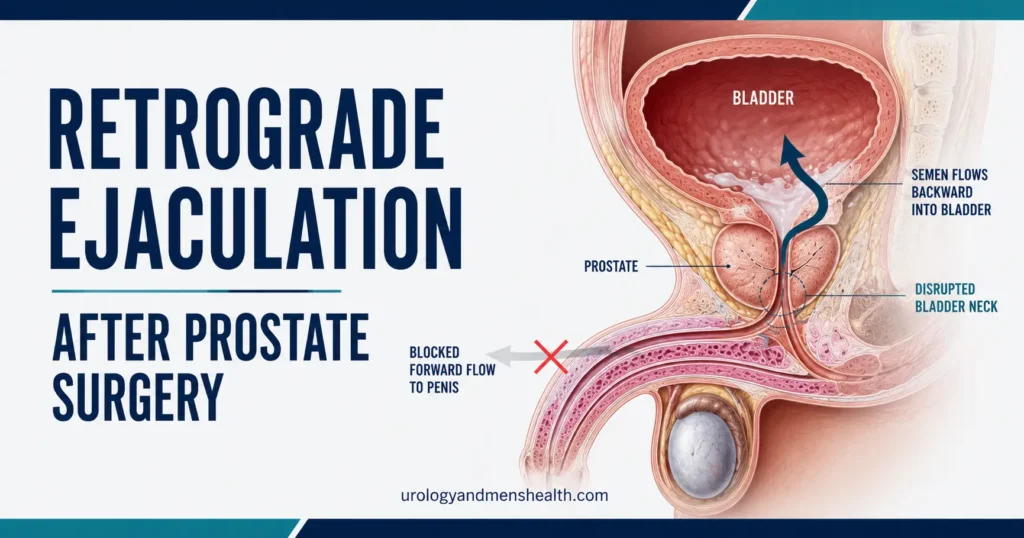
Retrograde ejaculation after prostate surgery catches a lot of men off guard. You have the operation, your urine flows freely, the obstruction that drove you to surgery is gone — and then, the first time you climax afterward, almost nothing comes out. The medical term is retrograde ejaculation, often called a dry orgasm: instead of traveling forward and out, semen flows backward into the bladder. It is one of the most common outcomes of a TURP (transurethral resection of the prostate) and similar procedures, yet it is one of the least clearly explained beforehand. I want to be straight with you about what is happening, whether it can be fixed, and what it means for your fertility. The honest short version: in most men this is harmless to your health and your orgasm sensation — but it is usually permanent, and that is the part the consent form rarely emphasizes. For the wider picture of male sexual function, see our Sexual Health Hub.
Key Takeaways
- Retrograde ejaculation after prostate surgery happens because the bladder neck — the muscular ring that normally seals shut during climax — is resected or disrupted, so semen takes the path of least resistance backward into the bladder.
- After a TURP, retrograde ejaculation affects roughly 65% of men and is usually permanent, because the cause is anatomical, not a chemical imbalance that a pill can correct.
- A dry orgasm does not damage your health, your erections, or the sensation of climax — the semen leaves harmlessly later in your urine.
- If you still want biological children, sperm can be recovered from post-ejaculatory urine and used for IUI or IVF/ICSI, so retrograde ejaculation rarely means the end of fertility.
What Retrograde Ejaculation Really Is — and Why a Dry Orgasm Won’t Hurt You
Ejaculation has two stages. First comes emission, where sperm and fluid collect in the urethra at the base of the penis. Then comes expulsion, where rhythmic muscle contractions push everything forward and out. For that forward push to work, a one-way valve at the base of the bladder — the bladder neck, also called the internal urethral sphincter — has to clamp shut so semen cannot travel backward.
When that valve no longer seals, semen follows the open route into the bladder instead of out the urethra. Nothing is lost or trapped: the semen simply mixes with urine and leaves the next time you pass water, which is why some men notice cloudy urine after sex. That is the whole of it — a redirection, not a blockage and not a sign of damage to anything else.
It is worth being clear about what retrograde ejaculation is not. Your erections, your libido, and the physical sensation of orgasm are usually unchanged, because those depend on entirely different nerves and blood vessels. This is not the same problem as erectile dysfunction, which has its own step-by-step treatment path. Many men conflate the two after surgery and worry needlessly — a dry climax and a soft erection are separate issues with separate causes.
Why Prostate Surgery Causes Retrograde Ejaculation
The bladder neck sits right at the top of the prostate. To relieve obstruction, surgery removes or opens the prostate tissue that is squeezing the urethra — and in doing so it almost inevitably disrupts that sealing ring. Once the bladder neck can no longer close tightly, retrograde ejaculation follows. This is a mechanical consequence of where the prostate sits, not a surgical error.
The classic example is TURP — what to expect before, during, and after — where a heated loop shaves away obstructing tissue around the bladder neck. According to American Urological Association (AUA) data, retrograde ejaculation occurs in roughly 65% of men after a standard TURP, and some series report rates as high as 90%[1]. Laser procedures such as HoLEP, along with bipolar and GreenLight techniques, carry broadly similar rates — ejaculation problems after prostate surgery affect close to three out of four men across these ablative operations.
The point I make to every patient beforehand is simple: this is one of the most predictable outcomes of the operation, not a rare complication. If you go in expecting it, a dry orgasm afterward is a known trade-off rather than a frightening surprise.
In My Practice
A man in his late 30s came to see me a year after a TURP done elsewhere for severe obstruction. His flow was excellent, but he was distraught — his orgasms were dry, and he and his wife had been trying for a baby. No one had told him before the operation that this could happen, let alone that it would likely be permanent. We confirmed retrograde ejaculation on a post-ejaculatory urine sample, recovered viable sperm, and his wife conceived through IUI six months later.
The dry orgasm was never the real problem — the missed pre-operative conversation was, and a single urine sample reopened the door to fertility.
Preparing for urological surgery? Download Dr. Khalid’s Urology Surgery Recovery Guide.
Enter your email below to receive Dr. Khalid’s complete Urology Surgery Recovery Guide as a free, printable PDF.
Can Retrograde Ejaculation After Surgery Be Reversed?
This is where I have to separate two very different situations, because the internet blurs them constantly. Retrograde ejaculation has two broad causes, and only one of them responds to medication.
When the cause is neurological or drug-related — diabetes, nerve injury, or alpha-blocker medications like tamsulosin — the bladder neck is structurally intact but simply not contracting on cue. In those men, sympathomimetic drugs that tighten the bladder neck can restore forward flow. A 2017 andrology study found that a short pseudoephedrine regimen improved seminal parameters in about 70% of treated men with mostly non-surgical retrograde ejaculation[3]. Imipramine, a tricyclic, is sometimes added.
After prostate surgery, the situation is different and I won’t pretend otherwise. The bladder neck has been physically resected — there is no functioning muscle left to tighten. That is why retrograde ejaculation treatment with pills usually fails after a TURP: you cannot pharmacologically close a valve that is no longer there. For most men, surgical retrograde ejaculation is permanent, and this dry-orgasm reality fits into the wider timeline of sexual recovery after prostate surgery. The good news is that “permanent” does not mean “untreatable” — it just means the answer lies in fertility techniques rather than tablets, which is the next section.
Retrograde Ejaculation and Your Fertility
Here is the reassurance most men are really looking for: retrograde ejaculation is not the same as infertility. Your testicles are still producing sperm normally — the sperm is just ending up in the bladder instead of the ejaculate. Recover it from the right place and it can still father a child.
The work-up starts with a semen analysis alongside a post-ejaculatory urinalysis: finding sperm in the urine after a dry climax confirms the diagnosis. If you want to make sense of those numbers, our semen analysis interpreter walks you through what each value means. From there, sperm is recovered from the bladder — the urine is alkalinized first to protect the sperm from its acidity — washed, and then used for intrauterine insemination (IUI) or IVF with ICSI, depending on how many viable sperm are retrieved[2].
If conception is your goal, the practical step is to ask for referral to a urologist with a fertility focus and to have both a semen analysis and a post-ejaculatory urine sample done within the first few months, rather than waiting. This is also the moment to look at the full male infertility work-up, since retrograde ejaculation is sometimes only one part of the picture.
Lowering Your Risk Before Surgery: Ejaculation-Sparing Options
If you are reading this before a planned operation and ejaculation matters to you — because you are younger, still want children, or simply value it — this is the conversation to have now. Not every prostate procedure carries the same risk, and the differences are large.
For smaller prostates, a transurethral incision of the prostate (TUIP) makes a relieving cut rather than removing a bulk of tissue. AUA data show retrograde ejaculation in around 18% of TUIP patients versus 65% after TURP[1] — a real difference for the right candidate. Minimally invasive options such as the prostatic urethral lift (UroLift) and water-vapor therapy (Rezum) preserve ejaculation in most men, because they relieve obstruction without destroying the bladder neck.
The trade-off is honesty in the other direction: these gentler options are not suitable for every prostate, can be less durable than a TURP, and may not relieve very severe obstruction or very large glands as completely. The right move is to ask your urologist directly — before you consent — whether an ejaculation-sparing approach is appropriate for your prostate size and symptoms, and what you would be giving up in durability to keep antegrade ejaculation.
When to Call Your Urologist
Retrograde ejaculation itself is not an emergency and needs no urgent care. But in the weeks after prostate surgery, contact your surgeon promptly if you notice any of the following, as they point to a genuine complication rather than a dry orgasm:
- Heavy bleeding or large blood clots in your urine, or an inability to pass urine at all (possible clot retention).
- Fever, chills, or burning with cloudy, foul-smelling urine — signs of a urinary tract infection.
- New, persistent pain with ejaculation that does not settle, rather than simply a dry climax.
- Worsening urinary leakage or a sudden inability to control urine.
Frequently Asked Questions
Is retrograde ejaculation after prostate surgery permanent?
In most men, yes. Because the bladder neck has been physically resected during the operation, there is no muscle left to tighten, so retrograde ejaculation after prostate surgery is usually permanent. This is different from retrograde ejaculation caused by diabetes or medication, where the muscle is intact and pills can sometimes restore forward flow.
Does a dry orgasm mean I am infertile?
No. Your testicles still make sperm normally — it is simply ending up in the bladder. Sperm can be recovered from a post-ejaculatory urine sample, washed, and used for intrauterine insemination or IVF with ICSI. Many men with retrograde ejaculation go on to father children this way, so a dry orgasm is a fertility hurdle, not a dead end.
Will pseudoephedrine fix retrograde ejaculation after a TURP?
Usually not. Pseudoephedrine works by tightening the bladder neck, which helps when the muscle is intact but not contracting — for example in diabetic or medication-related cases. After a TURP the bladder neck has been removed, so there is nothing for the drug to close. It is far more useful for non-surgical causes than for surgical retrograde ejaculation.
Is retrograde ejaculation the same as erectile dysfunction?
No, and the distinction matters. Erectile dysfunction is difficulty getting or keeping an erection and depends on nerves and blood flow. Retrograde ejaculation is about where semen goes during climax — your erection and the sensation of orgasm are typically unaffected. They can occur together after surgery, but they are separate problems with separate treatments.
Can I avoid retrograde ejaculation if I still need prostate surgery?
Possibly. For smaller prostates, a TUIP carries a much lower risk, and ejaculation-sparing options such as UroLift and Rezum preserve forward ejaculation in most men. Ask your urologist before consenting whether one suits your prostate, and weigh it against the strong, durable relief a TURP provides as part of your overall sexual recovery after surgery.
References
- American Urological Association. Management of Lower Urinary Tract Symptoms Attributed to Benign Prostatic Hyperplasia: AUA Guideline (Surgical Management). 2023 Amendment. AUA
- European Association of Urology. EAU Guidelines on Sexual and Reproductive Health (ejaculatory dysfunction and male fertility management). 2024. EAU
- Shoshany O, Abhyankar N, Mufarreh N, et al. Efficacy of treatment with pseudoephedrine in men with retrograde ejaculation. Andrology. 2017;5(4):744-748. PubMed
Dr. Muhammad Khalid
MBBS · FCPS (Urology) · MCPS (General Surgery) · CHPE · CRSM · IMC #539472
Specialist urologist with 11+ years of clinical experience across tertiary teaching hospitals. Trained at Lady Reading Hospital and Khyber Teaching Hospital, Peshawar. Author or co-author of five peer-reviewed international publications, including in Cureus and the World Journal of Surgery. Procedural expertise: URS, PCNL, RIRS, TURP, TURBT, and major open urological surgery. Full profile →
This article is for educational purposes only and does not constitute medical advice. Always consult your physician or urologist for diagnosis and treatment decisions specific to your condition.