How to Read Blood Pressure Numbers: A Doctor’s Guide
Two numbers and a slash decide whether you're fine or quietly at risk. Here's how to read your blood pressure numbers properly — and why the way you take the reading matters as much as the result itself.

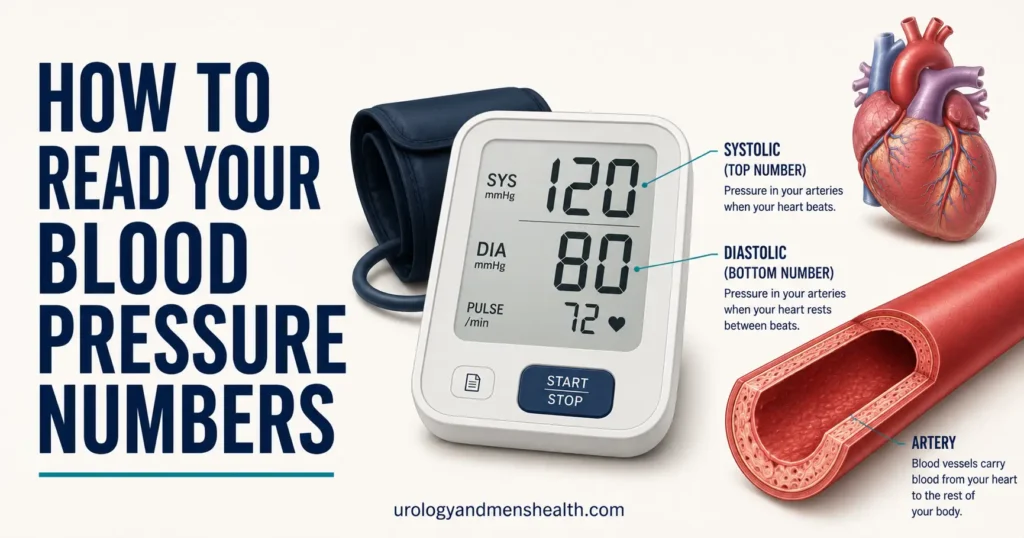
Learning how to read blood pressure numbers is one of the most useful skills I can teach a patient, because the cuff on your arm sees vascular trouble years before you feel a single symptom. Two numbers, a slash between them, and a category — that is the whole language, yet most people are never told what each part means or how badly a sloppy measurement can mislead them. I see men in clinic who panic over a single 150/95 taken seconds after rushing up a flight of stairs, and others who feel perfectly well at a quietly dangerous 138/88. For how raised pressure affects the kidneys and the rest of the cardiovascular system, our Blood Pressure & Cardiovascular Hub ties the whole picture together. This guide covers what the top and bottom numbers represent, where your reading falls on the standard chart, how to take a reading you can actually trust, and which numbers mean call now.
Key Takeaways
- The top number (systolic) is the pressure while your heart beats; the bottom number (diastolic) is the pressure while it rests between beats. After age 50, the systolic number predicts risk more strongly.
- Under current AHA/ACC categories, normal is below 120/80, and 130/80 or higher is stage 1 hypertension — there is no longer a safe “pre-high” cushion the way older charts implied.
- A reading is only as good as the technique: rest 5 minutes, feet flat, arm supported at heart level, and average two readings. Poor positioning alone can add 10–20 mmHg of pure error.
- A single high reading rarely means anything on its own. A one-week average that sits at or above 130/80 is what should prompt a conversation with your doctor.
Systolic and Diastolic: What the Two Numbers Mean
Your blood pressure is written as two numbers because your heart works in two phases. The top number is systolic pressure — the force against your artery walls at the instant your heart contracts and pushes blood out. The bottom number is diastolic pressure — the lower, resting pressure that remains between beats while the heart refills.
Think of an old hand pump on a garden hose. Each time you push the handle, pressure surges through the line — that surge is your systolic number. Between pushes, the line does not empty; some pressure stays in it — that residual is your diastolic number. A reading of 120/80 means a systolic peak of 120 mmHg and a diastolic floor of 80 mmHg.
Both numbers carry information, but they do not carry it equally at every age. In younger adults, a raised diastolic number often shows up first. From around age 50 onward, arteries naturally stiffen, and the systolic number becomes the stronger predictor of stroke, heart attack, and kidney strain. That is why a reading of 145/78 in a 60-year-old is treated seriously even though the bottom number looks fine — sustained high systolic pressure is exactly what damages the small vessels feeding the kidneys over time. If you want the mechanism in detail, see how silent high pressure quietly scars the kidneys.
The Blood Pressure Chart: Where Your Numbers Fall
A single reading only means something once you place it on the chart. The American Heart Association and American College of Cardiology use five categories, reaffirmed in their 2025 guideline [1]. Here is what a normal blood pressure reading looks like, and where the lines are drawn:
- Normal: below 120 systolic and below 80 diastolic.
- Elevated: 120–129 systolic and below 80 diastolic.
- Stage 1 hypertension: 130–139 systolic or 80–89 diastolic.
- Stage 2 hypertension: 140 or higher systolic or 90 or higher diastolic.
- Crisis range: higher than 180 systolic and/or higher than 120 diastolic — see the emergency section below.
Notice the small words “and” versus “or.” For the Normal and Elevated rows, both numbers have to stay in range. From Stage 1 upward, either number is enough to put you in that category — so 135/78 is stage 1, driven entirely by the top number. You always take the higher of the two categories your numbers point to.
One point for international readers: these US thresholds set the hypertension line at 130/80. Several other bodies, including the European and UK guidelines, keep the formal diagnosis line at 140/90 in the clinic. The disagreement is about where to label the problem, not about the biology — pressure between 130/80 and 140/90 still carries measurable risk, and lowering it still helps.
How to Read Blood Pressure Numbers Correctly at Home
This is where most people go wrong, and it is the part I spend the most clinic time correcting. A home reading taken in a calm room, with good technique, is often a more honest measure of your true pressure than one number grabbed in a rushed office visit [2]. But only if you set it up properly.
In the 30 minutes before you measure, avoid caffeine, smoking, and exercise, and empty your bladder — a full bladder alone can lift a reading by around 10 mmHg. Then sit and do nothing for a full 5 minutes. The stillness before the cuff inflates matters as much as the measurement itself.
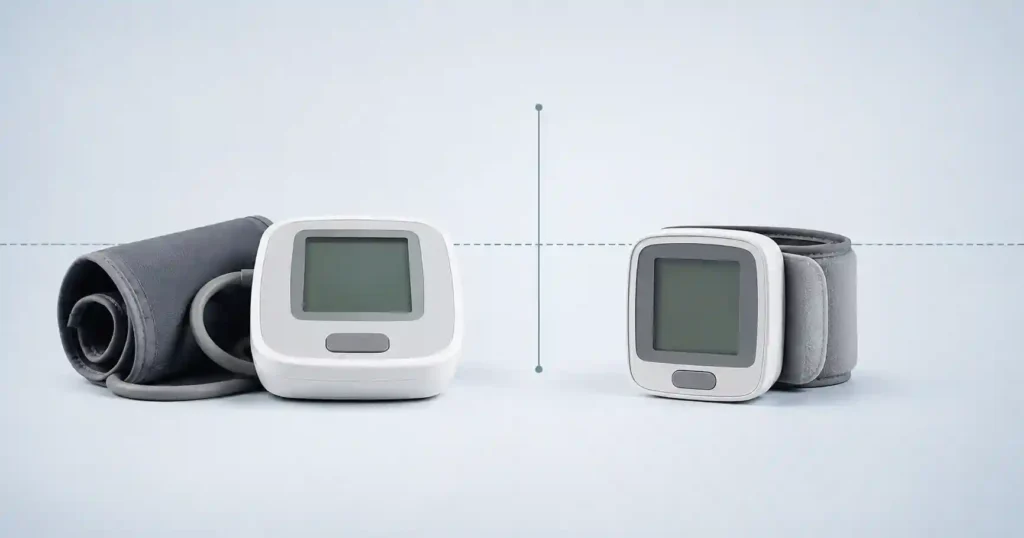
When you take the reading: sit with your back supported, feet flat on the floor, legs uncrossed. Rest your bare upper arm on a table so the cuff sits at heart level. Wrap a correctly sized cuff about 2 to 3 cm (around 1 inch) above the elbow crease, on skin, never over a sleeve. Stay quiet — no talking, no phone. Take two readings a minute apart and write down the average, exactly as displayed, without rounding.
The reason this rigour matters is that the errors are large, not trivial. Letting your arm dangle below heart level can overestimate systolic pressure by more than 6 mmHg; a cuff that is too small can push the error close to 20; and a reading taken over clothing can be off by anywhere from 5 to 50 points [3]. To turn scattered readings into a pattern you can actually act on, log them with our blood pressure log and trend tracker rather than trying to remember last Tuesday’s number.
High blood pressure and worried about your kidneys? Download Dr. Khalid’s Blood Pressure & Kidney Protection Guide.
Enter your email below to receive Dr. Khalid’s complete Blood Pressure & Kidney Protection Guide as a free, printable PDF.
What Your Numbers Are Telling You About Risk
A number is not a verdict; it is a forecast. Pressure that sits persistently at or above 130/80 keeps the artery walls under constant strain. Over years, that strain stiffens and thickens the vessels, which is why two people with the same age can have very different “vascular ages.” If you want to see roughly how old your arteries are behaving compared to the calendar, our vascular age calculator turns your reading and a few other inputs into an estimate.
For men, there is an early-warning sign worth naming. The arteries supplying the penis are small and react to vascular damage sooner than the larger coronary vessels, so new or worsening erectile difficulty can be the first visible symptom of pressure-driven vascular disease — sometimes years before a heart problem shows up. I treat a man’s blood pressure chart and his erectile function as two readings of the same underlying plumbing.
So what do you actually do with a worrying average? If your seven-day home average lands at or above 130/80, book a visit with your primary care doctor or urologist within the next two to three weeks, bring your logged readings, and ask whether a 24-hour ambulatory monitor or a repeat home series is needed to confirm it. If the diagnosis is settled, lifestyle change is the first lever, and it works — start with the evidence-based steps in how to lower blood pressure naturally before assuming medication is inevitable.
In My Practice
A 58-year-old came to me convinced he needed medication after a pharmacy machine flashed 168/98 and printed a slip telling him to see a doctor urgently. He had taken it over a thick sweater, moments after carrying grocery bags in from the car, on a cuff that was visibly too small for his arm. Seated, rested, and on a correctly fitted cuff, he read 128/82 — stage 1, worth watching, but nowhere near the crisis the machine implied.
Before acting on a frightening number, reproduce it correctly at rest, because with blood pressure the technique is half the diagnosis.
When a Reading Is an Emergency
Most high readings are not emergencies — they are signals to measure again and book an appointment. But there is a threshold where the rules change. A reading higher than 180 systolic and/or higher than 120 diastolic is what the 2025 guideline now calls severe hypertension, and it needs same-day attention.
How you respond depends entirely on whether you have symptoms with it. With no symptoms, sit quietly for 5 minutes and take the reading again; if it is still at or above 180/120, contact your doctor the same day. With symptoms, do not recheck and do not wait — that combination can mean active organ damage is happening.
When to Go to the ER
Call 911 (or your local emergency number) immediately if a reading higher than 180/120 mmHg comes with any of these:
- Chest pain or pressure
- Shortness of breath
- Sudden vision change or blurring
- Weakness or numbness, especially on one side
- Difficulty speaking or slurred speech
- A severe, sudden headache unlike your usual headaches
Frequently Asked Questions
How do I read blood pressure numbers like 120/80?
Read it as “120 over 80.” The first number, 120, is your systolic pressure — the peak force in your arteries when your heart beats. The second, 80, is your diastolic pressure — the resting force between beats. Both are measured in mmHg. A reading of 120/80 sits right at the top of the normal range, with anything below it considered normal.
Which number matters more, the top or the bottom?
It depends on your age. In adults under about 50, a raised diastolic (bottom) number is often the earlier warning. From 50 onward, arteries stiffen and the systolic (top) number becomes the stronger predictor of stroke and heart attack. This is why a reading of 150/78 in an older adult is taken seriously despite a normal-looking bottom number.
Why is my blood pressure higher at the doctor’s office than at home?
This is called white-coat effect, and it is extremely common. The stress of a clinical setting genuinely raises your reading. A properly taken home average, recorded over several days, is usually a more honest picture of your everyday pressure, which is exactly why doctors increasingly ask for home logs before deciding anything.
How many days should I track before I know my real blood pressure?
One reading is just a snapshot. To estimate your true pressure, take two readings (a minute apart) each morning and evening for at least three to seven days, then average them — discarding the first day if it is an outlier. Recording each session in a blood pressure trend tracker makes the pattern obvious and gives your doctor something solid to work from.
Is a single reading of 140/90 something to worry about?
Usually not on its own. Blood pressure swings constantly with stress, caffeine, posture, and time of day, so one elevated reading is rarely meaningful. Rest five minutes and repeat it. What matters is the pattern: if your readings stay around or above 130/80 across a week, that is the signal to speak with your doctor.
References
- Jones DW, et al. 2025 AHA/ACC Guideline for the Prevention, Detection, Evaluation and Management of High Blood Pressure in Adults. Hypertension. 2025. AHA Journals
- American Heart Association. Monitoring Your Blood Pressure at Home. heart.org
- American Heart Association. How to Accurately Measure Blood Pressure at Home. heart.org
Dr. Muhammad Khalid
MBBS · FCPS (Urology) · MCPS (General Surgery) · CHPE · CRSM · IMC #539472
Specialist urologist with 11+ years of clinical experience across tertiary teaching hospitals. Trained at Lady Reading Hospital and Khyber Teaching Hospital, Peshawar. Author or co-author of five peer-reviewed international publications, including in Cureus and the World Journal of Surgery. Procedural expertise: URS, PCNL, RIRS, TURP, TURBT, and major open urological surgery. Full profile →
This article is for educational purposes only and does not constitute medical advice. Always consult your physician or urologist for diagnosis and treatment decisions specific to your condition.