GLP-1 Drugs and Male Fertility: Help or Harm?
The fear about GLP-1 drugs and male fertility runs backwards. The 2026 evidence favors them, and shows why the testosterone treatment many men are offered instead is the one that stops sperm production.

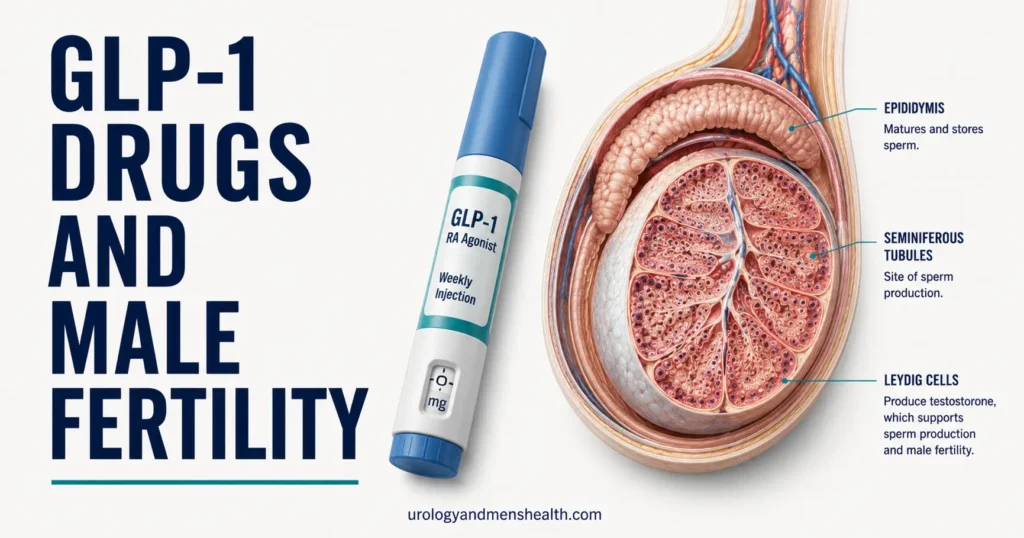
GLP-1 drugs and male fertility come up in my clinic almost every week now, and the question is nearly always the same: is Ozempic going to make me infertile? It usually comes from a man in his thirties or forties who has lost a serious amount of weight on semaglutide or tirzepatide and then read something alarming online. The answer is more reassuring than the forums suggest, but that is not the interesting part. The interesting part is that most men asking me this are worried about the wrong drug. If your testosterone is low because of your weight, the treatment you are most likely to be offered instead — testosterone replacement — is the one that will stop your sperm production, sometimes for many months after you quit it. The GLP-1 does close to the opposite. That contrast is now supported by randomized trials, and it is what this article is really about. For the wider picture on hormones, weight and sexual function, see our complete Sexual Health Hub.
Key Takeaways
- Testosterone replacement therapy suppresses the pituitary signals that drive sperm production and functions as a contraceptive in many men who take it.
- GLP-1 drugs raise testosterone by restarting that signalling instead of replacing the hormone, so LH and FSH are preserved or rise rather than shut down.
- A 2026 review of 10 studies covering 639 men found semen parameters improved in men with obesity or low testosterone, and unchanged in healthy men.
- In a randomized head-to-head against testosterone therapy, semaglutide improved the proportion of normally shaped sperm while testosterone therapy did not.
- Sperm takes about three months to be produced, so nothing you change today shows up in a semen analysis before roughly twelve weeks.
GLP-1 Drugs and Male Fertility: What the 2026 Evidence Shows
The most useful summary published so far pooled 10 studies covering 639 men [1]. Three findings came out of it, and each one answers a different man’s question.
First, total testosterone rose consistently, and most reliably in men with obesity, type 2 diabetes or functional hypogonadism — meaning low testosterone driven by metabolic problems rather than by disease of the testicles themselves. Free testosterone moved less predictably, because a protein called sex hormone-binding globulin rises at the same time and binds some of the extra hormone.
Second, and this is the finding that should change how you think about your options: luteinizing hormone and follicle-stimulating hormone were preserved or increased in men taking GLP-1 drugs. Those two hormones are the pituitary’s instructions to the testicles — LH tells them to make testosterone, FSH tells them to make sperm. In the comparison groups taking testosterone therapy, both were suppressed.
Third, semen parameters improved in men who were obese or hypogonadal, and showed no significant change in healthy men. That is not a weak result. It tells you the drug is correcting a metabolic problem rather than doing something unpredictable to normal reproductive machinery.
Why Excess Weight Lowers Testosterone and Damages Sperm
To understand why removing weight helps, you need the mechanism, and it is simpler than most men expect.
Abdominal fat is not inert storage. It contains an enzyme called aromatase that converts testosterone into estrogen. The more abdominal fat you carry, the more of your own testosterone gets converted. Your pituitary detects the rising estrogen, reads it as a signal that there is plenty of sex hormone in circulation, and reduces its output of LH and FSH. Less LH means less testosterone made. Less FSH means less sperm made. The lower testosterone then makes it harder to lose fat, which makes the conversion worse. It is a loop that tightens on itself, and it explains why so many men with obesity have low testosterone and poor semen results with nothing wrong with their testicles at all. Our detailed guide to how obesity drives low testosterone covers this mechanism in full.
Break the loop by removing the fat and the whole sequence runs backwards. That is the mechanism by which a weight-loss drug becomes a fertility intervention, and it does not require the drug to act on the testicles at all.
The Trap: Testosterone Therapy Is a Contraceptive
Here is the part I wish more men knew before they started treatment somewhere else.
When you take testosterone from outside the body — a gel, an injection, a pellet — your pituitary detects high levels and switches off its own signalling. LH and FSH fall, often to nearly nothing. Without FSH, the testicles largely stop producing sperm. This is so reliable that testosterone has been studied as a male contraceptive. Sperm counts can drop to zero, and recovery after stopping is measured in months, sometimes more than a year, and is not guaranteed in every man.
A man with obesity-driven low testosterone who walks into a telehealth clinic describing fatigue and low libido is very likely to be offered testosterone. If he also wants children in the next few years and nobody asks him about that, the treatment intended to fix his symptoms may quietly remove his fertility while doing nothing about the excess weight that caused the problem. Our full guide to what I tell patients before starting testosterone replacement sets out the questions to ask first.
In My Practice
A 34-year-old man came to me for fertility testing after eighteen months of trying to conceive. His semen analysis showed no sperm at all. He had been on testosterone injections for two years, prescribed online after a single low reading, and had never been asked whether he wanted children. Nobody had checked his LH or FSH, which were both undetectable. We stopped the testosterone, started a medication to restart his own axis, and it took eleven months before sperm reappeared in his ejaculate. He had also gained weight throughout, because nothing had ever addressed why his testosterone was low in the first place.
Any man of reproductive age offered testosterone should be asked about future fertility before the first prescription, and if that question is not asked, it is a reason to find a different clinician.
Trying to conceive? Get the semen analysis and hormone checklist I use before treating any man for low testosterone
Enter your email below to receive Dr. Khalid’s complete Male Fertility & Semen Analysis Guide as a free, printable PDF.
What Happened When Semaglutide Was Tested Against Testosterone Therapy
Researchers ran this comparison directly. They randomized 25 men with type 2 diabetes, obesity and functional hypogonadism — average BMI around 36 — to either semaglutide 1 mg weekly or intramuscular testosterone undecanoate, and measured semen quality at baseline and again at 24 weeks [2]. Baseline sperm quality in this group was poor, below the fifth percentile of reference values.
In the semaglutide arm, the proportion of normally shaped sperm rose significantly, from 2% to 3.5%. Testosterone therapy produced no equivalent improvement, and suppressed the gonadotropins as expected.
I want you to see that honestly. Twenty-five men is a small trial, and moving normal morphology from 2% to 3.5% is a modest absolute change in men whose sperm was severely abnormal to begin with. This is not a fertility treatment. What it establishes is direction, and direction is what men in this situation actually need, because they are being asked to choose between two options that move sperm production in opposite ways.
Two other randomized comparisons point the same way. A 16-week study of 30 obese men compared liraglutide against testosterone gel: the liraglutide group lost an average of 7.9 kg (about 17 lb) against 0.9 kg (about 2 lb) on testosterone, and showed a significant rise in LH and FSH that the testosterone group did not [3]. Testosterone rose more on the gel, at roughly 170 ng/dL versus 75 ng/dL, which is exactly what you would expect when you administer the hormone directly — but it rose at the cost of shutting down the system that makes sperm. A larger four-month study of 110 obese men with functional hypogonadism compared liraglutide against gonadotropin injections and against testosterone gel, and reported better sperm counts and motility in the liraglutide group [4].
Worried about erections rather than fertility? Here is what the 2026 evidence says about GLP-1 drugs and erectile dysfunctionIf You Are Lean and Fertile, This Probably Does Nothing for You
Every benefit described above was found in men whose reproductive hormones were suppressed by metabolic disease. In healthy men with normal weight and normal hormones, GLP-1 drugs did not meaningfully change reproductive hormones or semen parameters in either direction [1][5].
That cuts both ways, and you should hear both. If you are lean, fertile and taking one of these drugs for a modest amount of weight, do not expect a fertility benefit. And if you are lean, fertile and worried the drug is harming you, the available evidence does not support that worry either.
There is a caution worth stating plainly. The researchers presenting the 2026 systematic review data were careful to note that the improvements seen in obese hypogonadal men are most likely driven by weight loss and improved metabolic health, rather than by a proven direct action of these drugs on the reproductive axis. Animal work has raised questions about direct testicular effects that human studies have not yet resolved [6]. The human trials are small, short and few. Treat this as a reasonable expectation supported by early evidence, not as settled fact.
Trying to Conceive on a GLP-1: What I Actually Advise
- Get a semen analysis before you judge anything. Without a baseline you cannot tell whether a later result is a change or simply where you always were. Request it now rather than after six months of trying, and use our semen analysis interpreter to understand what each number on the report means.
- Allow one full sperm cycle before repeating it. Producing sperm takes roughly 74 days, so a repeat analysis inside three months tells you very little. Book the repeat for twelve weeks out.
- Ask for LH and FSH alongside a morning testosterone, not testosterone alone. A testosterone reading on its own cannot distinguish an axis that is suppressed by weight from one that is suppressed by medication, and that distinction determines the entire treatment plan.
- Understand who the stop-before-pregnancy rule is written for. The advice to discontinue a GLP-1 two months before conception applies to the partner who will carry the pregnancy. You do not pass the drug to a pregnancy through sperm, and this gets misapplied to men constantly.
- Do not accept testosterone to boost fertility. If a clinician offers it while you are trying to conceive, ask directly what it will do to your FSH, and get a second opinion from a urologist before starting.
When to Get a Urologist Involved Rather Than Waiting
Weight loss takes months to show up in a semen analysis, and waiting is often the right call. These situations are not.
- You have been trying to conceive for 12 months, or 6 months if your partner is over 35, with no semen analysis done
- You are currently taking testosterone in any form and want children in the foreseeable future
- A semen analysis has come back showing no sperm at all, at any point
- You have a lump, swelling or persistent ache in a testicle, which needs assessment regardless of anything in this article
- Your testosterone is low and nobody has checked your LH and FSH
Frequently Asked Questions
Will Ozempic or Wegovy lower my sperm count?
There is no good evidence that semaglutide lowers sperm count in men. The reverse is more likely if your weight is what suppressed it, because losing abdominal fat lifts the pituitary signals that drive sperm production. In healthy men of normal weight, studies found no meaningful change in either direction. If your results are already abnormal, our guide to the causes of male infertility covers what else to investigate.
Do GLP-1 drugs and male fertility mix when you are trying to conceive?
For the man taking the drug, generally yes. You do not transmit the medication to a pregnancy through sperm, so the guidance about stopping two months before conception is written for the partner who carries the pregnancy, not for you. Get a baseline semen analysis before drawing conclusions, and repeat it after twelve weeks rather than sooner.
Is a GLP-1 better than testosterone therapy if I want children?
If your testosterone is low because of excess weight, the evidence favors it. Testosterone therapy suppresses LH and FSH and can reduce sperm counts to zero, while GLP-1 drugs preserved or raised those hormones in randomized comparisons. This is a decision to make with a urologist rather than a telehealth questionnaire. Our low testosterone symptom quiz is a reasonable starting point before that appointment.
How long after starting a GLP-1 would my semen analysis improve?
Plan on three to six months at the earliest. Sperm production takes about 74 days from start to finish, so any change you make today is invisible on a test done before roughly twelve weeks. Meaningful weight loss takes longer still. Repeat the analysis at three months and again at six rather than testing repeatedly in between, which mostly captures normal variation.
Does the amount of weight I lose matter for fertility?
Yes, and you may need less than you think. Improvements in testosterone and semen parameters have been reported with losses in the range of 5 to 10% of body weight, which is well within what these medications achieve. Losing weight very rapidly on a severely restricted diet works against you though, because energy deficit suppresses the same hormone axis you are trying to restore. Our guide to obesity and testosterone explains why.
References
- Deameh MG, Ramez M, Rowaiee R, et al. Effects of glucagon-like peptide-1 receptor agonists on male reproductive hormones, semen parameters, and metabolic outcomes: a systematic review. J Sex Med. 2026;23(2):qdaf381. DOI
- Gregoric N, et al. Semaglutide improved sperm morphology in obese men with type 2 diabetes mellitus and functional hypogonadism. Diabetes Obes Metab. 2025. DOI
- Jensterle M, Podbregar A, Goricar K, Gregoric N, Janez A. Effects of liraglutide on obesity-associated functional hypogonadism in men. Endocr Connect. 2019;8(3):195-202. PubMed
- La Vignera S, et al. Sexual and reproductive outcomes in obese fertile men with functional hypogonadism after treatment with liraglutide: preliminary results. J Clin Med. 2023;12(2):672. DOI
- Corona G, et al. Emerging effects of glucagon-like peptide-1 receptor agonists and sodium-glucose cotransporter 2 inhibitors on male sexual hormones and behaviors: systematic review and meta-analysis. Andrology. 2026. DOI
- Du Plessis SS, Omolaoye TS, Cardona Maya WD. Potential impact of GLP-1 receptor agonists on male fertility: a fable of caution. Front Physiol. 2024;15:1496416. DOI
- American Urological Association. Testosterone Deficiency: AUA Guideline. auanet.org. AUA
Dr. Muhammad Khalid
MBBS · FCPS (Urology) · MCPS (General Surgery) · CHPE · CRSM · IMC #539472
Specialist urologist with 11+ years of clinical experience across tertiary teaching hospitals. Trained at Lady Reading Hospital and Khyber Teaching Hospital, Peshawar. Author or co-author of five peer-reviewed international publications, including in Cureus and the World Journal of Surgery. Procedural expertise: URS, PCNL, RIRS, TURP, TURBT, and major open urological surgery. Full profile →
This article is for educational purposes only and does not constitute medical advice. Always consult your physician or urologist for diagnosis and treatment decisions specific to your condition.