Does Cycling Cause Erectile Dysfunction? The Evidence
Most men who worry about cycling and erectile dysfunction are reacting to one numb ride. Here is what the actual data shows about saddles, mileage, and real risk — and who genuinely needs to pay attention.

Does cycling cause erectile dysfunction? It is one of the most common questions I get from men who ride seriously, and it usually follows a long session that left the perineum numb and tingling. The honest answer is that for most recreational riders, cycling does not damage your erections — but the risk is real for a specific group, and it is not spread evenly. A man riding 30 minutes a few times a week on a well-fitted saddle sits in a completely different category from someone logging 150 miles a week (about 240 km) on a narrow racing seat. Below I separate what the published evidence actually supports from locker-room myth, explain how a saddle can interrupt blood flow and nerve signaling to the penis, and give you specific steps to keep riding without losing function. For the broader picture on erection problems and what drives them, see our complete Sexual Health Hub.
Key Takeaways
- For most recreational cyclists, large studies comparing riders to swimmers and runners found no worse erectile function — the panic is usually overblown.
- Risk concentrates in high-mileage riders on narrow, nose-heavy saddles; an age-adjusted analysis found a measurable but modest association (odds ratio around 1.55), not a guarantee of harm.
- Persistent perineal numbness is the warning sign that matters — it means the pudendal nerve and its blood supply are being compressed, not just briefly bruised.
- Most saddle-related erection problems reverse with a no-nose or cut-out saddle, a flatter position, and standing periodically — medication or surgery is rarely the answer.
What the Evidence Actually Says About Cycling and ED
Start with the most reassuring data, because it is also the largest. A multinational study of more than 4,000 athletes compared cyclists against swimmers and runners using validated questionnaires, and found that cyclists were no more likely to report erectile dysfunction or worse urinary function than the other two groups [3]. In other words, when you measure erections properly and compare riders to other fit men, the cycling boogeyman largely disappears.
That does not mean the risk is zero. A 2021 systematic review and meta-analysis pooled six studies covering roughly 3,330 cyclists and 1,524 non-cycling controls, and concluded there is limited evidence for a positive correlation between cycling and ED once you adjust for age and comorbidities [1]. An age-adjusted figure from that body of work put the odds ratio at about 1.55 — real, but modest, and weighed down by significant differences between studies.
Here is how I read those two findings together: cycling is not a meaningful threat to the average rider, but a subset of high-volume cyclists on the wrong equipment do take a hit. The trick is knowing which group you are in. If your erections have weakened gradually and the problem is present even when you have not touched the bike for days, the saddle is probably not your culprit — that pattern points toward vascular causes, and I cover it in detail in why morning erections are a built-in heart-health check.
How a Bike Saddle Can Interfere With Erections
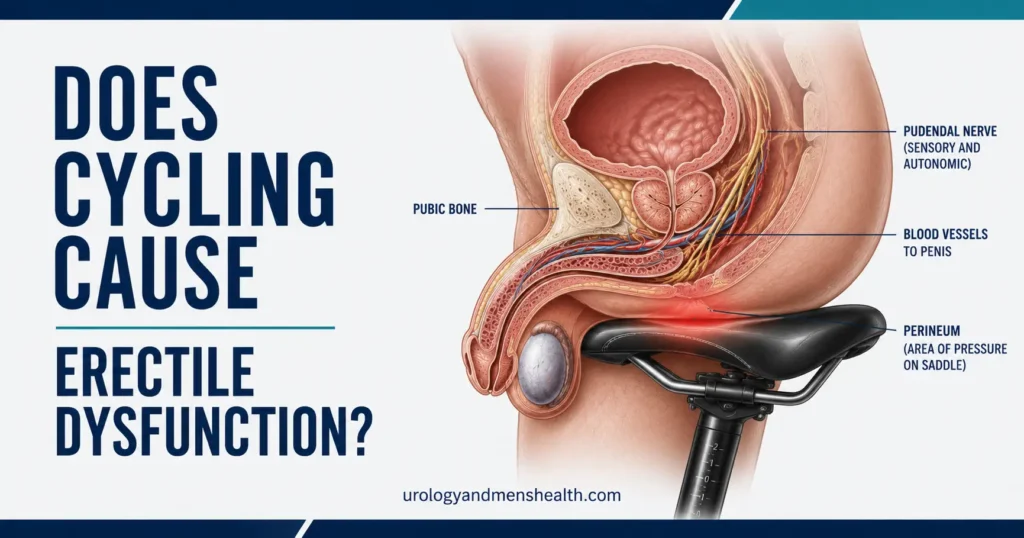
To understand the risk you have to understand the plumbing. The nerves and arteries that supply the penis do not run down the center of where you sit — they run through the perineum, the soft strip of tissue between the scrotum and the anus. The pudendal nerve travels through a tunnel called Alcock’s canal, and its branches, along with the artery to the penis, pass close to the surface right where a narrow saddle nose presses up against the pubic bone.
When you sit on a conventional nose-heavy saddle, your body weight pins those structures between the seat and bone. Researchers have measured the result directly: a narrower saddle nose lowers oxygen pressure inside the penis and reduces blood flow, while sustained pressure on the nerve produces the numbness so many riders know well. Perineal numbness is the most commonly reported cycling symptom of all, with prevalence across studies running anywhere from 22% to 91% depending on equipment and mileage [2].
Numbness itself is the signal to take seriously. A brief tingle that clears in minutes is your tissue protesting; numbness that lingers for an hour or returns on every ride means the nerve and its blood supply are being compressed repeatedly. If you want to gauge whether reduced penile blood flow is plausibly part of your picture, our ED vascular risk screener walks you through the circulatory factors worth checking.
In My Practice
I had a competitive amateur in his late thirties, no cardiovascular risk factors, who arrived convinced he had a testosterone problem. His one consistent symptom was that the tip of his penis went numb on every long ride and stayed numb for an hour afterward. We changed nothing but his saddle — a flat, cut-out design set slightly nose-down — and within a month both the numbness and the softer erections he had blamed on hormones resolved.
When erection problems track exactly with saddle time and perineal numbness, the saddle is the suspect long before the hormones are.
ED that is not responding to the usual pills? Download Dr. Khalid’s ED & Sexual Function Action Plan.
Enter your email below to receive Dr. Khalid’s complete ED & Sexual Function Action Plan as a free, printable PDF.
Who Is Actually at Risk
The risk is dose-dependent and equipment-dependent. The riders I worry about share a recognizable profile, and if none of these apply to you, the odds your erections are suffering from cycling are low.
- High weekly volume. The association with ED tends to show up in men riding more than about 3 hours a week, not in casual riders.
- A narrow, nose-heavy saddle. The seat design that pins the perineum is the single biggest modifiable factor.
- An aggressive forward-leaning position. Dropped road-bike bars rotate your pelvis forward and shift weight onto the soft perineal tissue instead of the sit bones.
- Extra body weight. More mass means more pressure transmitted through the same small contact area.
- Existing vascular risk. If your circulation is already borderline, you have less reserve to spare.
One factor that compounds the problem off the bike is prolonged sitting. If you ride hard and then spend eight hours a day pressing the same perineal structures into an office chair, you are stacking the load — something I unpack in what all-day sitting does to your prostate and bladder. To put a number on your own erectile function rather than guessing, the validated IIEF-5 self-assessment takes two minutes and gives you a score you can track over time.
How to Keep Cycling Without Risking Your Erections
Almost every saddle-related complaint I see is fixable without giving up the sport — and you should not give it up, because the cardiovascular benefit of regular cycling is exactly what keeps erections healthy in the long run. Work through these changes in order:
- Switch to a no-nose or wide cut-out saddle. These designs measurably raise penile oxygen pressure and cut perineal pressure compared with a standard seat — this is the highest-yield change you can make.
- Level the saddle, or tilt it slightly nose-down. A nose-up tilt drives pressure straight into the perineum.
- Get the saddle height right. Too high forces a rocking motion that grinds the perineum side to side.
- Wear padded cycling shorts and stand on the pedals for a few seconds every 10 to 15 minutes to let blood return.
- Invest in a professional bike fit if you ride seriously — position errors you cannot feel are often the root cause.
Give these changes four to six weeks. If your erections recover, you have your answer. If ED persists after you have fixed the saddle and the numbness is gone, the bike was likely a red herring, and you should move to a proper workup — I lay out exactly how that escalates, from first-line tablets onward, in my step-by-step erectile dysfunction treatment protocol.
When the Bike Isn’t the Problem
Some symptoms mean you need a urologist, not a new saddle. Get assessed promptly if you notice any of these:
- Erectile dysfunction that continues for several weeks after you stop riding or change saddles
- Perineal or genital numbness that lasts more than a week off the bike
- Blood in the urine or semen, or a weakening urine stream — high-intensity cyclists have higher rates of urethral stricture
- ED that came on gradually alongside fatigue, low libido, or chest tightness on exertion, which points to vascular or hormonal causes rather than the saddle
Frequently Asked Questions
Does cycling cause erectile dysfunction permanently?
In the vast majority of cases, no. Saddle-related erectile dysfunction is a compression and blood-flow problem, and it usually reverses once the pressure on the perineum is removed by changing the saddle, position, and riding habits. Permanent damage is rare and tends to involve years of high mileage on poor equipment. If you want to track your recovery objectively, score yourself with the IIEF-5 self-assessment before and after making changes.
How long does numbness after cycling last, and is it dangerous?
A brief tingle that clears within minutes of standing up is normal and harmless. Numbness that lingers for an hour after a ride, or returns on every outing, is the warning sign that the pudendal nerve and its blood supply are being compressed repeatedly. That pattern deserves attention before it affects erections. Our ED vascular risk screener can help you judge whether blood-flow factors are in play.
Are no-nose bike saddles actually proven to help erections?
Yes. Studies measuring perineal pressure and penile oxygen levels consistently show that no-nose and wide cut-out saddles reduce compression and raise penile oxygen pressure compared with a standard nose-heavy seat. For most riders it is the single most effective change. If symptoms persist despite a saddle swap, move to a structured workup using my erectile dysfunction treatment protocol.
Is my ED from cycling or from something else like heart disease?
The timing tells you. Saddle-related ED tracks with riding and comes paired with perineal numbness. Vascular ED is gradual, present even on days you have not cycled, and typically dulls your morning erections too. Because the penile arteries are narrow, ED can be an early warning of wider circulatory disease — I explain that link in why morning erections double as a heart check.
Should I stop cycling if I have erectile dysfunction?
Usually not. Regular cycling improves cardiovascular fitness, and good circulation is what powers reliable erections, so quitting often does more harm than good. The smarter move is to modify the setup — saddle, tilt, position, and standing breaks — rather than abandon the activity. For the full context on erection problems and their causes, see our Sexual Health Hub.
References
- Gan ZS, Ehlers ME, Lin FC, et al. Systematic Review and Meta-Analysis of Cycling and Erectile Dysfunction. Sex Med. 2021;9(2):304-311. PubMed
- Baran C, Mitchell GC, Hellstrom WJG. Cycling-Related Sexual Dysfunction in Men and Women: A Review. Sex Med Rev. 2014;2(3-4):94-99. PubMed
- Awad MA, Gaither TW, Murphy GP, et al. Cycling, and Male Sexual and Urinary Function: Results from a Large, Multinational, Cross-Sectional Study. J Urol. 2018;199(3):798-804. Journal of Urology
Dr. Muhammad Khalid
MBBS · FCPS (Urology) · MCPS (General Surgery) · CHPE · CRSM · IMC #539472
Specialist urologist with 11+ years of clinical experience across tertiary teaching hospitals. Trained at Lady Reading Hospital and Khyber Teaching Hospital, Peshawar. Author or co-author of five peer-reviewed international publications, including in Cureus and the World Journal of Surgery. Procedural expertise: URS, PCNL, RIRS, TURP, TURBT, and major open urological surgery. Full profile →
This article is for educational purposes only and does not constitute medical advice. Always consult your physician or urologist for diagnosis and treatment decisions specific to your condition.