Gleason Score Explained: What Your Biopsy Report Means
Decode your prostate biopsy results. Understand your Gleason score, ISUP grade, and how these numbers directly dictate your treatment options.

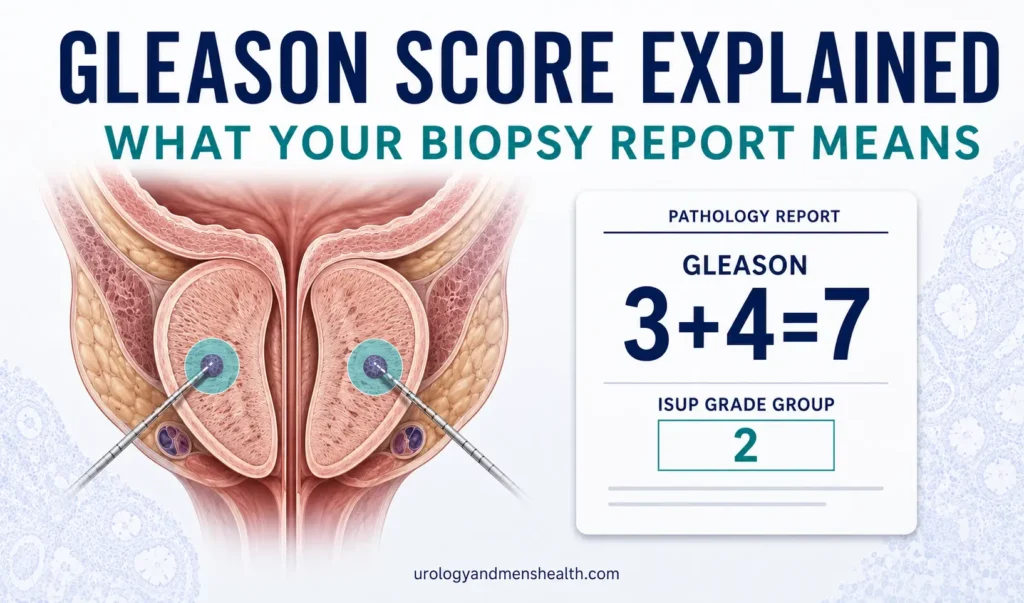
A Gleason score is the single number on your prostate biopsy report that decides almost everything that happens next — whether you watch, treat, or panic. And yet most men leave the consultation knowing the number but not what it means. I have sat across from patients who were told they had “Gleason 7” and assumed it was a near-death sentence, when in fact their cancer was one of the most treatable forms of prostate cancer that exists. I have also sat across from men told the same “Gleason 7” who needed surgery scheduled within weeks. Same number. Two very different cancers. This guide explains why — and translates every line of your biopsy report into the language your urologist is actually using. If you have just received a prostate biopsy result, or you are about to, read this before your follow-up. For the wider context, see our full Prostate Health Hub.
Key Takeaways
- The Gleason score is the sum of two numbers: the most common cancer pattern in your biopsy plus the second-most common. The lowest score now reported is 3+3=6 (ISUP Grade Group 1).
- Gleason 3+4=7 and 4+3=7 are biologically different cancers. The first letter is the dominant pattern, and Pattern 4 dominance roughly doubles the risk of progression.
- The ISUP Grade Group system (1 through 5) is what your urologist actually uses to plan treatment — not the raw Gleason number.
- A Gleason 6 (Grade Group 1) cancer almost never spreads or kills. Active surveillance is the preferred initial approach in AUA 2024 guidelines for most men with this result.
- Tertiary Pattern 5 — even in a small percentage of the biopsy — changes prognosis and should be specifically named on the report.
What a Gleason Score Actually Measures
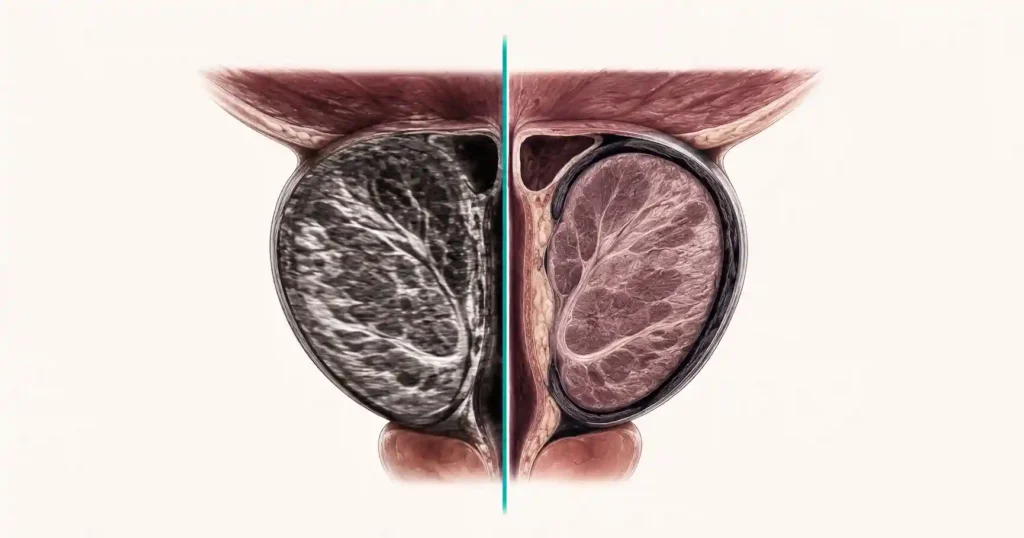
The Gleason score grades how abnormal your prostate cancer cells look under the microscope — specifically, how disorganized the glandular architecture has become. Normal prostate tissue forms neat, recognizable gland structures. Cancer disrupts that architecture in predictable, gradable ways. Pathologist Dr. Donald Gleason developed the system in the 1960s, and despite multiple revisions since, the core principle holds: the more chaotic the gland architecture, the more aggressive the cancer behaves clinically[1].
The pathologist looks at your biopsy cores under a microscope and identifies Gleason “patterns” — graded 1 through 5. In modern practice, Patterns 1 and 2 are essentially never reported, because what they describe is no longer considered cancer. Pattern 3 is the lowest grade you will see on a real biopsy report. Pattern 4 means the glands are fusing, becoming cribriform (sieve-like), or losing their lumens. Pattern 5 means the architecture has collapsed — sheets of cells, individual cells infiltrating tissue, no gland formation at all[2].
Your Gleason score is the sum of two numbers: the most common pattern in your biopsy, plus the second-most common. So a report that reads “Gleason 3+4=7” means Pattern 3 was the dominant finding, with Pattern 4 as the secondary finding. The minimum modern score is 3+3=6. The maximum is 5+5=10. Anything you read online from before 2005 that mentions “Gleason 4” or “Gleason 5” as a diagnosis is outdated — those low scores stopped being assigned to cancer over twenty years ago[3].
The Three Patterns You Will See on Your Report
Pattern 3 is the most common finding in early-detected prostate cancer. The cancer glands are still discrete and individually recognizable, with visible lumens (the hollow center of each gland). They vary in size and shape, but they look like glands. Pattern 3 cancer rarely spreads beyond the prostate, almost never invades the lymph nodes, and is the reason active surveillance has become a mainstream first-line management option[4].
Pattern 4 is where the biology shifts. The glands fuse into each other, form cribriform (Swiss-cheese) patterns, or become glomeruloid (resembling a glomerulus in the kidney). Some glands lose their lumens entirely. This is the threshold pattern — the presence of Pattern 4 in any meaningful percentage is what separates cancers that we tend to watch from cancers we tend to treat. Within Pattern 4, the cribriform subtype is particularly aggressive and recent guidelines recommend it be specifically named on pathology reports[5].
Pattern 5 is the most disorganized form. There are no glands left to grade — instead, the pathologist sees solid sheets of cancer cells, single cells infiltrating tissue, or comedo necrosis (dead cancer cells at the center of cell clusters). Pattern 5 is the prognostic alarm bell. Even when present as a minor component, it changes management.
The ISUP Grade Group: What Your Urologist Actually Uses
Here is where most online explanations stop being useful. The raw Gleason score (6, 7, 8, 9, 10) hides a problem: a Gleason 3+4=7 and a Gleason 4+3=7 add up to the same number but behave very differently. To fix this, the International Society of Urological Pathology (ISUP) introduced the Grade Group system in 2014, now endorsed by both the World Health Organization and the AUA[6].
The five Grade Groups translate Gleason into a more honest clinical tier:
- Grade Group 1 — Gleason ≤6. Very low-risk cancer. Almost never spreads. Active surveillance is the default management.
- Grade Group 2 — Gleason 3+4=7. Pattern 3 dominant. Most are still appropriate for active surveillance in selected men.
- Grade Group 3 — Gleason 4+3=7. Pattern 4 dominant. Treatment is usually recommended.
- Grade Group 4 — Gleason 8 (4+4, 3+5, or 5+3). High-risk cancer. Definitive treatment is the standard.
- Grade Group 5 — Gleason 9 or 10 (4+5, 5+4, 5+5). Very high-risk. Multimodal treatment — surgery or radiation plus hormonal therapy — is typical.
When you sit down with your urologist, ask for your Grade Group, not just your Gleason. The Grade Group is the number that drives every decision tree in modern guidelines, including the AUA/ASTRO/SUO 2024 prostate cancer guideline that informs US-based treatment recommendations[7].
In My Practice
I remember a man in his early sixties who came to me visibly shaking, holding a printout that said “Gleason 7.” He had spent the previous week reading that Gleason 7 was associated with a 15-year mortality of around 20% and had already written a will. What his report actually said, when I pulled it up, was 3+4=7 — Grade Group 2, with cancer in only one core out of fourteen, occupying less than 5% of that one core, with no Pattern 4 cribriform morphology and no tertiary Pattern 5. He was a textbook candidate for active surveillance. He cried in clinic. Not from fear — from relief. The number on the page had been the same. The clinical reality was completely different.
The lesson I take from cases like this: the Gleason number alone is almost useless without the Grade Group, the percentage of each pattern, and the cribriform status. Always ask for those three details.
Why 3+4 and 4+3 Are Different Cancers
This is the single most misunderstood point in patient-facing prostate cancer information. Both 3+4=7 and 4+3=7 sum to 7. They are not the same cancer.
In 3+4=7 (Grade Group 2), Pattern 3 occupies the majority of the cancer — often 60–80% — and Pattern 4 the rest. The cancer is still architecturally well-differentiated overall, with a minority aggressive component. In 4+3=7 (Grade Group 3), those proportions flip: the majority is Pattern 4, with a smaller well-differentiated Pattern 3 component. The amount of Pattern 4 — the actual percentage — is the strongest single predictor of how the cancer behaves[8].
A large cohort study following men after radical prostatectomy found that 4+3=7 cancers carried roughly double the risk of biochemical recurrence at five years compared with 3+4=7 cancers, even after adjusting for PSA and stage[9]. That is the same number on the report, but a meaningfully different cancer. Modern reports should also tell you the percentage of Pattern 4 within a Grade Group 2 or 3 result, because that percentage refines the risk further. Ask for it if it is not stated.
Facing a PSA result you do not fully understand? Download Dr. Khalid’s PSA & Prostate Cancer Decision Guide.
Enter your email below to receive Dr. Khalid’s complete PSA & Prostate Cancer Decision Guide as a free, printable PDF.
Tertiary Pattern 5: The Detail That Quietly Changes Prognosis
Sometimes a pathologist sees three patterns in a single biopsy — the dominant pattern, the secondary pattern, and a small amount of an even higher-grade pattern. By convention, the Gleason score only uses the two most common patterns. So if your cancer is mostly Pattern 3, with some Pattern 4, and a small focus of Pattern 5, the score on paper reads “3+4=7.”
That sounds fine — until you realize the report has hidden the most aggressive component. To prevent this, modern reporting standards require pathologists to name any tertiary Pattern 5 separately, typically described as “Pattern 5 present, less than 5% of total cancer.” Even a small amount of Pattern 5 worsens prognosis enough that the cancer is generally treated as a Grade Group 4 or 5 lesion regardless of the headline number[2]. If your report mentions any Pattern 5 at all, that detail belongs at the top of the conversation with your urologist, not buried in the small print.
How Grade Group Connects to Treatment Decisions
Your Grade Group is one input among several — PSA level, MRI findings, clinical stage, number of positive cores, and the percentage of each core involved all contribute. But the Grade Group sets the framework. The 2024 AUA/ASTRO/SUO guideline lays out the management defaults as follows[7]:
- Grade Group 1 (Gleason 6): Active surveillance is the preferred initial approach for nearly all men. Definitive treatment is reasonable only in selected cases (younger age, large-volume disease, family history).
- Grade Group 2 (Gleason 3+4): Active surveillance is appropriate for men with favorable features — low PSA density, limited cancer volume, no cribriform Pattern 4. Definitive treatment is equally reasonable.
- Grade Group 3 (Gleason 4+3): Treatment is usually recommended — radical prostatectomy or radiation therapy with or without short-term hormonal therapy.
- Grade Group 4 (Gleason 8): Definitive treatment. Often radiation plus 18–24 months of hormonal therapy, or radical prostatectomy with consideration of adjuvant treatment.
- Grade Group 5 (Gleason 9–10): Aggressive multimodal treatment. Radiation plus 24–36 months of hormonal therapy is a common pathway. Surgery is appropriate for selected men, often with adjuvant therapy.
For a more detailed breakdown of when surveillance is the right answer rather than immediate treatment, see our guide to active surveillance for prostate cancer. The key thing to internalize: a Grade Group 1 result is not a directive to do nothing. It is a directive to monitor carefully on a defined schedule — PSA every 6 months, MRI annually, repeat biopsy at intervals — so that any progression is caught early.
→ Related Read: When a genomic test adds information beyond your Gleason gradeWhat Else on the Report Matters
The Gleason score and Grade Group are the headlines. But a complete biopsy report contains other details that change management. When you read your report, look for these:
- Number of positive cores out of total taken. A standard transrectal biopsy takes 10–14 cores. One positive out of 12 is a very different finding from eight positive out of 12.
- Percentage of cancer in each positive core. A core with 5% cancer involvement is treated differently from a core with 80% involvement, even at the same Grade Group.
- Maximum cancer length per core, in millimeters. This adds nuance to the percentage and is now standard reporting.
- Perineural invasion. Cancer cells tracking along a nerve. Not as ominous as it sounds, but worth noting and discussing.
- Cribriform Pattern 4. If present, should be explicitly stated. Cribriform is a more aggressive subtype of Pattern 4 and can disqualify a man from active surveillance.
- Intraductal carcinoma. Cancer cells growing within prostatic ducts. Strongly associated with aggressive disease and a reason to escalate treatment.
- The biopsy approach used. A transperineal or MRI-targeted biopsy generally samples the prostate more thoroughly than a standard transrectal systematic biopsy. The 2024 AUA guidelines now favor transperineal approaches for many men[10].
If anything on your report seems ambiguous or contradictory, asking for a second pathology opinion is not paranoid — it is sometimes the right call. Studies of expert pathology re-review have shown that the Grade Group changes in roughly 15–20% of cases when read by a dedicated genitourinary pathologist, often shifting men out of (or into) active surveillance eligibility[11]. For high-stakes decisions — Grade Group 1 versus 2, or 2 versus 3 — that is worth knowing.
Putting Your Result Into Context
If you have not had your biopsy yet but you are anticipating one, our guide to prostate biopsy preparation and recovery walks through what the procedure actually involves and how to minimize discomfort and infection risk. If your PSA is what put you on this path, our explainer on PSA results in the 4 to 10 ng/mL grey zone covers when a borderline PSA actually warrants a biopsy versus repeat testing or imaging.
For men weighing whether immediate treatment or surveillance is the right path, you can model your individual risk using our free prostate cancer risk calculator, which combines PSA, Grade Group, clinical stage, and other variables into a pre-treatment risk tier. A separate Gleason score risk interpreter walks through what your specific Grade Group means in practical terms — including likely follow-up schedule and treatment options.
The wider context matters too. Prostate cancer is one of several men’s cancers where early detection meaningfully changes outcomes. If you are reading this because a biopsy result has shifted your awareness of cancer risk generally, our guides to testicular self-examination and the broader men’s health checklist for men over 40 cover the wider screening picture.
When to Push Back on Your Report
Even with a positive biopsy in hand, there are situations where you should ask your urologist directly — and where a delay in clarification can be costly. Contact your urologist or seek a second opinion within days, not weeks, if any of these apply:
- Your report gives a Gleason score but does not state the ISUP Grade Group.
- The percentage of Pattern 4 in a Grade Group 2 or 3 cancer is not stated.
- The cribriform Pattern 4 status is not explicitly addressed (present or absent).
- You see any mention of Pattern 5, including tertiary, but it has not been discussed with you.
- Your biopsy was systematic only (no MRI guidance) and your PSA or imaging suggests possible front-of-prostate disease.
- You are being offered immediate treatment for a Grade Group 1 result without active surveillance being discussed as an option.
Questions Patients Ask Me About Gleason Scores
Is a Gleason score of 6 actually cancer?
Yes, technically — but it is the lowest-grade cancer the system reports and it behaves almost benignly. Gleason 6 (ISUP Grade Group 1) lacks the molecular and clinical features that define aggressive cancers. It rarely spreads beyond the prostate and almost never causes death. This is why active surveillance is now the preferred initial approach for nearly all men with this finding. Some pathologists argue Grade Group 1 should be renamed to reduce unnecessary alarm, though the cancer label remains the consensus standard for now.
What is the difference between Gleason 3+4=7 and Gleason 4+3=7?
The first number is the dominant Gleason pattern in your biopsy; the second is the secondary pattern. In 3+4=7, Pattern 3 is dominant and Pattern 4 is minority — this is Grade Group 2. In 4+3=7, those proportions reverse — Pattern 4 dominant, Pattern 3 minority — and the result is Grade Group 3. Despite both summing to 7, the risk of recurrence after treatment is roughly double for 4+3=7 versus 3+4=7. Always ask which version of “Gleason 7” you have.
Can my Gleason score change between biopsies?
Yes, and this is one of the reasons active surveillance includes scheduled repeat biopsies. A first biopsy may sample only a small portion of the prostate, and a more aggressive cancer focus elsewhere in the gland may not have been hit. Repeat biopsy or MRI-targeted biopsy upgrades the Grade Group in roughly 20–30% of men on surveillance at some point during follow-up. An upgrade does not mean the cancer “got worse” — it usually means the original biopsy missed a higher-grade area that was always there.
Why does my report mention “cribriform” — does that matter?
It matters considerably. Cribriform Pattern 4 — where cancer glands fuse into a sieve-like or perforated pattern — is the most aggressive subtype within Pattern 4. Its presence is independently associated with worse outcomes and is generally considered a disqualifier for active surveillance, even at Grade Group 2. If your report mentions cribriform morphology, raise it directly with your urologist when discussing treatment options.
How accurate is the Gleason score from biopsy compared with the final score after surgery?
The biopsy Gleason score and the final pathology from a radical prostatectomy specimen agree in roughly 60–70% of cases. About 25–30% of men are “upgraded” at surgery — meaning the prostate specimen shows higher-grade cancer than the biopsy detected. A smaller percentage are downgraded. This is one reason MRI-guided and transperineal biopsy approaches are now favored — they sample the prostate more representatively and reduce the upgrade rate.
Should I get a second opinion on my biopsy pathology?
For a borderline result — particularly Grade Group 1 versus 2, or 2 versus 3 — a second opinion from a dedicated genitourinary pathologist is reasonable and sometimes changes management. Roughly 15–20% of community pathology readings get reclassified by subspecialty review. If your decision tree turns on the difference between active surveillance and immediate treatment, the cost and time of a second pathology read is small relative to the decision it informs.
References
- Gleason DF. Classification of prostatic carcinomas. Cancer Chemother Rep. 1966;50(3):125-128. PubMed
- Epstein JI, Egevad L, Amin MB, et al. The 2014 ISUP Consensus Conference on Gleason Grading of Prostatic Carcinoma. Am J Surg Pathol. 2016;40(2):244-252. PubMed
- Epstein JI. An update of the Gleason grading system. J Urol. 2010;183(2):433-440. PubMed
- Ross HM, Kryvenko ON, Cowan JE, et al. Do adenocarcinomas of the prostate with Gleason score (GS) ≤6 have the potential to metastasize? Am J Surg Pathol. 2012;36(9):1346-1352. PubMed
- Kweldam CF, van der Kwast T, van Leenders GJ. On cribriform prostate cancer. Transl Androl Urol. 2018;7(1):145-154. PubMed
- Epstein JI, Zelefsky MJ, Sjoberg DD, et al. A Contemporary Prostate Cancer Grading System: A Validated Alternative to the Gleason Score. Eur Urol. 2016;69(3):428-435. PubMed
- Eastham JA, Auffenberg GB, Barocas DA, et al. Clinically Localized Prostate Cancer: AUA/ASTRO Guideline. American Urological Association. 2024. AUA
- Sauter G, Steurer S, Clauditz TS, et al. Clinical Utility of Quantitative Gleason Grading in Prostate Biopsies and Prostatectomy Specimens. Eur Urol. 2016;69(4):592-598. PubMed
- Wright JL, Salinas CA, Lin DW, et al. Prostate cancer specific mortality and Gleason 7 disease differences in prostate cancer outcomes between cases with Gleason 4+3 and 3+4. J Urol. 2009;182(6):2702-2707. PubMed
- Wei JT, Barocas D, Carlsson S, et al. Early Detection of Prostate Cancer: AUA/SUO Guideline 2023. American Urological Association. 2023. AUA
- Brimo F, Schultz L, Epstein JI. The value of mandatory second opinion pathology review of prostate needle biopsy interpretation before radical prostatectomy. J Urol. 2010;184(1):126-130. PubMed
Dr. Muhammad Khalid
MBBS · FCPS (Urology) · MCPS (General Surgery) · CHPE · CRSM · IMC #539472
Specialist urologist with 11+ years of clinical experience across tertiary teaching hospitals. Trained at Lady Reading Hospital and Khyber Teaching Hospital, Peshawar. Author or co-author of five peer-reviewed international publications, including in Cureus and the World Journal of Surgery. Procedural expertise: URS, PCNL, RIRS, TURP, TURBT, and major open urological surgery. Full profile →
This article is for educational purposes only and does not constitute medical advice. Always consult your physician or urologist for diagnosis and treatment decisions specific to your condition.