Active Surveillance for Prostate Cancer: A Urologist’s Guide
Discover why monitoring low-risk prostate cancer is often preferred over surgery. Understand the criteria, schedules, and treatment triggers.

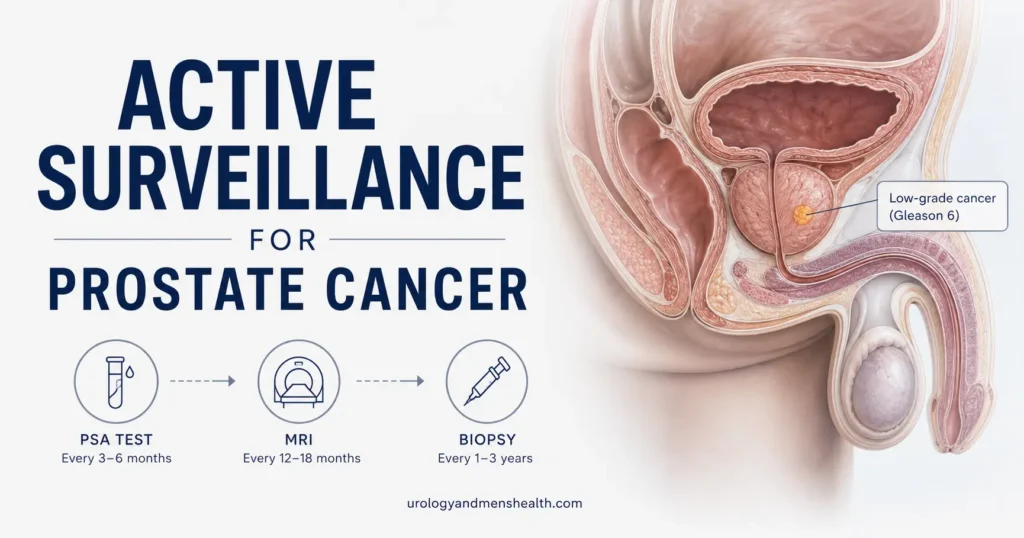
Active surveillance for prostate cancer means we have found cancer, confirmed it is low-risk, and made a deliberate clinical decision to monitor it closely rather than treat it immediately. This is not denial, and it is not “doing nothing.” It is the recommended first-line management for most men diagnosed with low-risk disease, endorsed by the American Urological Association (AUA), the European Association of Urology (EAU), and the National Comprehensive Cancer Network (NCCN). Long-term US and international data now show that men on active surveillance for low-risk prostate cancer have prostate cancer-specific survival of roughly 99% at 10 years — essentially identical to men treated immediately, but without the erectile dysfunction, incontinence, and bowel problems that surgery and radiation can cause. The catch is that surveillance is real medicine: structured testing, repeat biopsies, and a defined plan for when to switch to treatment. In this guide, I will walk you through who qualifies, what the monitoring schedule looks like, and the specific findings that should trigger a move from surveillance to definitive treatment. For the broader context on prostate cancer detection and risk, see our complete Prostate Health Hub.
Key Takeaways
- Active surveillance is the preferred first-line management for most men with Gleason 6 (Grade Group 1) prostate cancer, with prostate cancer-specific survival around 99% at 10 years in major US and international cohorts.
- You qualify if your Gleason score is 3+3=6 (or favorable 3+4=7 in select cases), PSA is under 10 ng/mL, and biopsy shows limited tumor volume — typically two or fewer positive cores with less than 50% involvement each.
- The standard schedule includes PSA every 6 months, a confirmatory multiparametric MRI plus biopsy within 6–12 months of diagnosis, and surveillance biopsies every 2–5 years thereafter.
- Roughly 30–50% of men on active surveillance eventually move to treatment within 10 years — most due to grade reclassification on repeat biopsy, not because surveillance “failed.”
What Active Surveillance Actually Is (And What It Is Not)
Active surveillance is a structured, treatment-with-intent strategy: we monitor your low-risk prostate cancer closely, and the moment it shows signs of becoming more aggressive, we move to curative treatment. The goal is not to avoid treatment forever. The goal is to avoid unnecessary treatment for cancers that would never have caused you problems in your lifetime.
This matters because most prostate cancers diagnosed in the US today are low-risk. The widespread adoption of PSA screening pulled forward thousands of diagnoses of small, indolent tumors. Without surveillance as an option, every one of those men would face surgery or radiation — with the associated risks of erectile dysfunction (up to 60–80% after radical prostatectomy), urinary incontinence (5–20% long-term), and bowel toxicity (5–15% after radiation). For many low-risk cancers, those risks outweigh the benefit of treatment.
Active surveillance is also distinct from watchful waiting, and the two get confused constantly. Watchful waiting is reserved for older men with limited life expectancy where the plan is to treat symptoms if they appear — but there is no intent to cure. Active surveillance is the opposite: the plan is to cure if the cancer ever shows it needs treating. The monitoring is more intensive, and the patient population is younger and healthier.
Who Qualifies for Active Surveillance
The AUA 2022 Localized Prostate Cancer Guideline and the NCCN 2024 guidelines define low-risk prostate cancer with specific criteria. You are a candidate for active surveillance if you meet all of the following:
- Gleason score 6 (Grade Group 1) — this is the foundational criterion. Gleason 6 cancer cells, by current pathology standards, do not have the biological machinery to metastasize. Many pathologists and urologists now openly debate whether Gleason 6 should even be called “cancer.”
- PSA under 10 ng/mL at diagnosis, with PSA density under 0.15 ng/mL/cc preferred.
- Clinical stage T1c or T2a — the tumor is not palpable on digital rectal exam (T1c) or involves less than half of one side of the prostate on exam (T2a).
- Limited biopsy involvement — typically two or fewer positive cores, with less than 50% cancer in any single core. Some centers use stricter thresholds.
A growing group of men with favorable intermediate-risk disease (Gleason 3+4=7 with a low percentage of Gleason 4 pattern, low tumor volume, low PSA) are also being offered surveillance in carefully selected cases. This is not standard everywhere, and the evidence is still maturing — but the NCCN guidelines now formally include favorable intermediate-risk patients as candidates for active surveillance after thorough shared decision-making. If your biopsy report shows Gleason 3+4=7, ask your urologist whether you fall into this favorable subgroup. Use our Gleason Score Risk Interpreter to understand exactly where your biopsy result places you.
Life expectancy also matters. Surveillance assumes you would benefit from cure if the cancer ever progressed. For men with serious competing medical conditions and a life expectancy under 10 years, watchful waiting may be more appropriate than surveillance, since the monitoring burden no longer makes clinical sense.
In My Practice
A 58-year-old patient came to me terrified after his urologist told him his biopsy showed cancer. PSA 6.2, one positive core out of twelve, Gleason 3+3=6, less than 10% involvement of that single core. His wife had already booked a second opinion at a robotic surgery center. We sat for an hour and went through his biopsy report line by line. By the end, he understood that his cancer fit textbook low-risk criteria, that his 10-year prostate cancer-specific survival on surveillance would be around 99%, and that immediate surgery offered no survival benefit but came with real risks to erectile function and continence. He chose surveillance. Three years in, his repeat MRI is stable, his PSA has not risen meaningfully, and he is grateful nobody operated.
The clinical takeaway: the most important conversation in low-risk prostate cancer happens between the biopsy result and the treatment decision — and it often determines whether a man spends the next decade in good function or managing surgical side effects unnecessarily.
The Monitoring Schedule: What Actually Happens
The active surveillance protocol I follow is built on the AUA 2022 framework, with elements adapted from the Johns Hopkins, Sunnybrook, and University of California San Francisco (UCSF) protocols — three of the largest and longest-running surveillance cohorts in the world.[1]
Year 1 — Confirmatory phase: PSA every 3–6 months. Digital rectal exam every 6–12 months. Multiparametric MRI of the prostate within 6 months of diagnosis. Confirmatory biopsy — typically MRI-targeted plus systematic — within 6–12 months. This step matters: roughly 20–30% of men have their grade reclassified on the confirmatory biopsy, usually because the initial diagnostic biopsy under-sampled a higher-grade focus.
Year 2 onward — Maintenance phase: PSA every 6 months. Digital rectal exam annually. Surveillance biopsy every 2–5 years (most US centers use 2–3 years). Multiparametric MRI annually or every 2 years depending on the protocol. The exact biopsy interval depends on your PSA stability, MRI findings, and how recently your last biopsy was performed.
PSA tracking is the most frequent test, but a single PSA reading is rarely the trigger to do anything. What matters is the trend. A PSA that drifts up slowly over several years may be due to benign prostatic enlargement, prostatitis, or normal variation. A PSA that doubles in under 3 years on surveillance is a red flag and prompts immediate MRI and biopsy. To understand your own PSA pattern between visits, use the PSA Velocity Tracker — it calculates doubling time and flags concerning trajectories.
Facing a PSA result you do not fully understand? Download Dr. Khalid’s PSA & Prostate Cancer Decision Guide.
Enter your email below to receive Dr. Khalid’s complete PSA & Prostate Cancer Decision Guide as a free, printable PDF.
The Role of MRI: Why It Has Changed Active Surveillance
Multiparametric MRI (mpMRI) is the single biggest change in active surveillance in the past decade. Before MRI was widely used, surveillance relied entirely on PSA trends and systematic 12-core biopsies — and we know now that those biopsies missed clinically significant cancer in roughly 20–25% of cases.[2] MRI lets us see the prostate. It identifies suspicious lesions, allows targeted biopsies of those specific areas, and dramatically improves our ability to detect higher-grade disease that was hiding.
MRI findings are scored on the PI-RADS scale (1 to 5). PI-RADS 1–2 lesions are very unlikely to be clinically significant cancer. PI-RADS 4–5 lesions warrant targeted biopsy. PI-RADS 3 is the indeterminate middle ground that requires clinical judgment — often combining MRI with PSA density and prior biopsy results to decide whether to re-biopsy now or watch.
For a deeper explanation of how MRI changes the diagnostic pathway, see our guide to prostate MRI vs biopsy first. If you want to put your own diagnostic numbers into context, our Prostate Cancer Risk Calculator incorporates PSA, age, family history, and DRE findings to estimate 5-year cancer risk — useful both for men considering surveillance and those weighing repeat testing.
→ Related Read: How genomic tests like Decipher and Prolaris factor into the surveillance decisionWhen to Switch from Surveillance to Treatment
The decision to leave active surveillance and move to definitive treatment is the most important point in the entire pathway. Get it right, and the cancer remains curable. Get it wrong by waiting too long, and you risk losing the window. Four findings should trigger a serious conversation about switching:
- Grade reclassification on repeat biopsy. If a surveillance biopsy shows Gleason 4+3=7 (Grade Group 3) or higher, or a meaningful increase in Gleason 4 pattern, the cancer is no longer low-risk and treatment is generally recommended. This is the most common reason men leave surveillance.
- Increase in tumor volume. More positive cores, higher percentage involvement per core, or bilateral involvement on repeat biopsy — even at the same Gleason score — can shift the risk category.
- MRI progression. A new PI-RADS 4 or 5 lesion, growth of an existing lesion, or extracapsular extension on MRI warrants targeted biopsy and often treatment.
- PSA kinetics. A confirmed, sustained rise in PSA — particularly a doubling time under 3 years — should prompt re-imaging and re-biopsy, even if absolute numbers remain modest. A single high reading is not enough; trends matter.
Patient preference also matters. Some men, despite stable findings, find the psychological burden of surveillance unbearable. That is a legitimate reason to choose treatment, and it should not be dismissed. The clinical data show that men who switch to treatment for anxiety-driven reasons have outcomes essentially identical to men who started with immediate treatment — they have not “lost” anything by trying surveillance first.[3]
In the major US and international surveillance cohorts, roughly 30–50% of men move to treatment within 10 years, with the majority doing so within the first 5 years.[4] That is the system working — surveillance catches the cancers that need treating, and spares the ones that don’t.
Active Surveillance vs Watchful Waiting: The Difference Matters
These two terms get used interchangeably by patients, journalists, and even some clinicians — but they describe two completely different strategies for two completely different patient populations.
Active surveillance is for men with low-risk disease and a life expectancy long enough that cure would be meaningful. The intent is curative if treatment is ever needed. The monitoring is intense: PSA every 6 months, periodic MRI, repeat biopsies. The trigger to treat is any evidence of progression to higher-risk disease.
Watchful waiting is for older men, men with serious competing illnesses, or men with a life expectancy under 10 years where curative treatment would not extend life. The intent is palliative — managing symptoms if and when they appear. Testing is minimal. The trigger to act is symptoms, not biopsy findings.
If your urologist mentions either term, ask which one they mean and why. The two pathways have very different testing schedules, very different goals, and apply to very different patients. Confusing them can lead either to over-monitoring an older man who would not benefit from cure, or under-monitoring a younger man whose cancer is actually progressing.
Long-Term Outcomes: What the Evidence Actually Shows
Active surveillance is one of the best-studied management strategies in all of urologic oncology. Three large datasets define the evidence base.
The Sunnybrook cohort (Klotz et al., Toronto), the longest-running prospective surveillance series, followed 993 men with a median follow-up of 6.4 years. At 10 years, prostate cancer-specific survival was 98.1%. At 15 years, it was 94.3%. Metastasis-free survival was 95% at 15 years.[1]
The Johns Hopkins cohort (Tosoian et al.), with over 1,800 men followed up to 18 years, reported 10-year prostate cancer-specific survival of 99.9% and metastasis-free survival of 99.4%.[5] These are essentially the same numbers as immediate treatment in matched low-risk cohorts.
The ProtecT trial (UK), the only large randomized trial comparing active monitoring with surgery and radiotherapy, reported 15-year outcomes in 2023. Prostate cancer-specific mortality was 3.1% in the active monitoring group, 2.2% in the prostatectomy group, and 2.9% in the radiotherapy group — a small absolute difference that did not reach statistical significance. Critically, men in the active monitoring arm had significantly better urinary continence, sexual function, and bowel function than men randomized to surgery or radiation.[6]
What this evidence tells us, clearly and consistently, is that for genuinely low-risk prostate cancer, the survival cost of starting with surveillance is small to none, and the quality-of-life benefit is substantial. The men who eventually need treatment overwhelmingly remain curable.
The Honest Downsides You Should Hear
Active surveillance is the right answer for most low-risk patients, but it is not free of cost or risk. Three downsides deserve honest discussion:
The repeat biopsies. Surveillance biopsies carry the same risks as any prostate biopsy: bleeding, infection (around 1–3% with proper antibiotic prophylaxis), urinary retention, and discomfort. Over a 10-year surveillance course, you may have 3–5 biopsies. Each one is a procedure. To understand what each biopsy involves, see our guide to what to expect from a prostate biopsy.
The anxiety. Some men adapt to knowing they have cancer in their body and tolerate surveillance well. Others find it intolerable. Anxiety is a real reason men leave surveillance, and it should not be treated as weakness. If anxiety is significantly affecting your quality of life, treatment is a legitimate choice — even if your cancer remains formally low-risk.
The risk of grade misclassification. A small percentage of men on surveillance will turn out to have had higher-grade cancer that was missed on initial biopsy. This is precisely why the confirmatory biopsy within 6–12 months is so important — it catches most of these cases before any meaningful delay in treatment. With modern MRI-guided protocols, the rate of clinically significant grade reclassification at confirmatory biopsy has fallen, but it is not zero.
These downsides should be weighed against the very real downsides of immediate treatment in a low-risk cancer: erectile dysfunction, urinary incontinence, bowel toxicity, and the costs and recovery time of a major procedure. For low-risk disease, the math usually favors surveillance.
What to Ask Your Urologist
If you have been diagnosed with low-risk prostate cancer, the following questions will help you and your urologist arrive at a defensible decision together:
- Based on my Gleason score, PSA, PSA density, and biopsy findings, do I formally meet AUA/NCCN criteria for active surveillance?
- What does your specific surveillance protocol look like — how often will I have PSA, MRI, and repeat biopsies?
- Will my confirmatory biopsy be MRI-targeted, systematic, or both?
- What specific findings would trigger you to recommend switching to treatment?
- What is my estimated life expectancy from competing health conditions, and how does that affect whether surveillance or watchful waiting is right for me?
- If I do eventually need treatment, what curative options would still be available given my age and overall health?
For the broader screening framework that led you to this diagnosis, see our Prostate Cancer Screening: The Age-by-Age Guide. If you are still trying to understand a borderline PSA result that has not yet led to a biopsy, our explainer on PSA in the grey zone of 4 to 10 ng/mL addresses that earlier decision point. And if you are interested in the long-term ED risk that comes with definitive treatment — one of the major reasons surveillance is so attractive — our guide on erectile dysfunction and vascular health covers what to expect and how to mitigate it.
When to Push for Earlier Reassessment
- A PSA that doubles in less than 3 years on surveillance — request MRI and likely repeat biopsy
- New onset of urinary obstruction, bone pain, or unexplained weight loss
- Any palpable nodule on digital rectal exam that was not previously present
- A surveillance biopsy showing Gleason 4 pattern, even at a small percentage — request a treatment discussion
- MRI showing a new PI-RADS 4 or 5 lesion or extracapsular extension
Frequently Asked Questions
Is active surveillance for prostate cancer safe in the long term?
Long-term US and international cohort data show 10-year prostate cancer-specific survival of 98–99% for men on active surveillance for low-risk disease, with 15-year metastasis-free survival above 94% in the Sunnybrook cohort. The ProtecT randomized trial confirmed that men on active monitoring had statistically similar prostate cancer-specific mortality at 15 years compared with men randomized to surgery or radiation. For appropriately selected low-risk patients, surveillance is one of the safest evidence-based strategies in urologic oncology. See our full Gleason Score Risk Interpreter to understand where your biopsy result sits on the risk spectrum.
What is the difference between active surveillance and watchful waiting for prostate cancer?
Active surveillance is intensive monitoring of low-risk prostate cancer in men healthy enough to benefit from cure if the cancer ever progresses. It includes PSA every 6 months, periodic MRI, and repeat biopsies, with the intent to treat curatively at the first sign of progression. Watchful waiting is reserved for older men or men with serious competing illnesses where curative treatment would not extend life. The intent is palliative — testing is minimal and the trigger to act is symptoms, not biopsy findings.
How often do men on active surveillance for prostate cancer end up needing treatment?
In the major surveillance cohorts, roughly 30–50% of men move to definitive treatment within 10 years, with the majority doing so in the first 5 years. The most common reason is grade reclassification on a repeat biopsy showing Gleason 4 pattern. This is not surveillance “failing” — it is the protocol working as designed by catching cancers that need treating before they progress beyond curability.
Does active surveillance work for Gleason 3+4=7 prostate cancer?
It can, for carefully selected patients with favorable intermediate-risk disease — meaning Gleason 3+4=7 with a low percentage of Gleason 4 pattern, low tumor volume, low PSA, and favorable MRI findings. The NCCN 2024 guidelines formally include this group as candidates for surveillance after thorough shared decision-making. The data is less mature than for Gleason 6 disease, so the conversation needs to be detailed. Talk to your urologist about whether your specific biopsy result places you in this favorable subgroup.
How accurate is MRI on active surveillance for prostate cancer?
Multiparametric MRI has substantially improved active surveillance accuracy. It detects clinically significant cancer that systematic biopsies missed in roughly 20–25% of cases, and it enables targeted biopsy of suspicious lesions rather than blind sampling. MRI findings are scored on the PI-RADS scale from 1 to 5 — PI-RADS 1–2 lesions are very unlikely to harbor significant cancer, PI-RADS 4–5 warrant targeted biopsy, and PI-RADS 3 is indeterminate. MRI is now a core part of every modern surveillance protocol.
Can I switch to active surveillance after starting treatment?
No — once you have had radical prostatectomy or radiation therapy, you cannot switch back to surveillance because the cancer has been treated. The follow-up after definitive treatment uses PSA monitoring to detect recurrence, not to monitor an in-situ tumor. The decision point for active surveillance is before any definitive treatment begins. That is why the conversation between biopsy result and treatment plan matters so much.
References
- Klotz L, Vesprini D, Sethukavalan P, et al. Long-term follow-up of a large active surveillance cohort of patients with prostate cancer. J Clin Oncol. 2015;33(3):272-277. PubMed
- Ahmed HU, El-Shater Bosaily A, Brown LC, et al. Diagnostic accuracy of multi-parametric MRI and TRUS biopsy in prostate cancer (PROMIS): a paired validating confirmatory study. Lancet. 2017;389(10071):815-822. PubMed
- Carlsson S, Benfante N, Alvim R, et al. Long-term outcomes of active surveillance for prostate cancer: the Memorial Sloan Kettering Cancer Center experience. J Urol. 2020;203(6):1122-1127. PubMed
- Eastham JA, Auffenberg GB, Barocas DA, et al. Clinically Localized Prostate Cancer: AUA/ASTRO Guideline. Part II: Principles of Active Surveillance, Principles of Surgery, and Follow-Up. J Urol. 2022;208(1):19-25. AUA Guideline 2022
- Tosoian JJ, Mamawala M, Epstein JI, et al. Intermediate and longer-term outcomes from a prospective active-surveillance program for favorable-risk prostate cancer. J Clin Oncol. 2015;33(30):3379-3385. PubMed
- Hamdy FC, Donovan JL, Lane JA, et al. Fifteen-year outcomes after monitoring, surgery, or radiotherapy for prostate cancer. N Engl J Med. 2023;388(17):1547-1558. PubMed
Dr. Muhammad Khalid
MBBS · FCPS (Urology) · MCPS (General Surgery) · CHPE · CRSM · IMC #539472
Specialist urologist with 11+ years of clinical experience across tertiary teaching hospitals. Trained at Lady Reading Hospital and Khyber Teaching Hospital, Peshawar. Author or co-author of five peer-reviewed international publications, including in Cureus and the World Journal of Surgery. Procedural expertise: URS, PCNL, RIRS, TURP, TURBT, and major open urological surgery. Full profile →
This article is for educational purposes only and does not constitute medical advice. Always consult your physician or urologist for diagnosis and treatment decisions specific to your condition.