Recurrent Kidney Stones: Why They Keep Coming Back
Most patients treat a second or third kidney stone as a stroke of terrible luck. It isn't bad luck at all—it's a blaring, measurable signal that your urine chemistry is off, and without fixing it, you have a coin-flip chance of ending up back in the ER. Here is exactly why your body keeps building them, and what a real medical workup to stop them looks like.

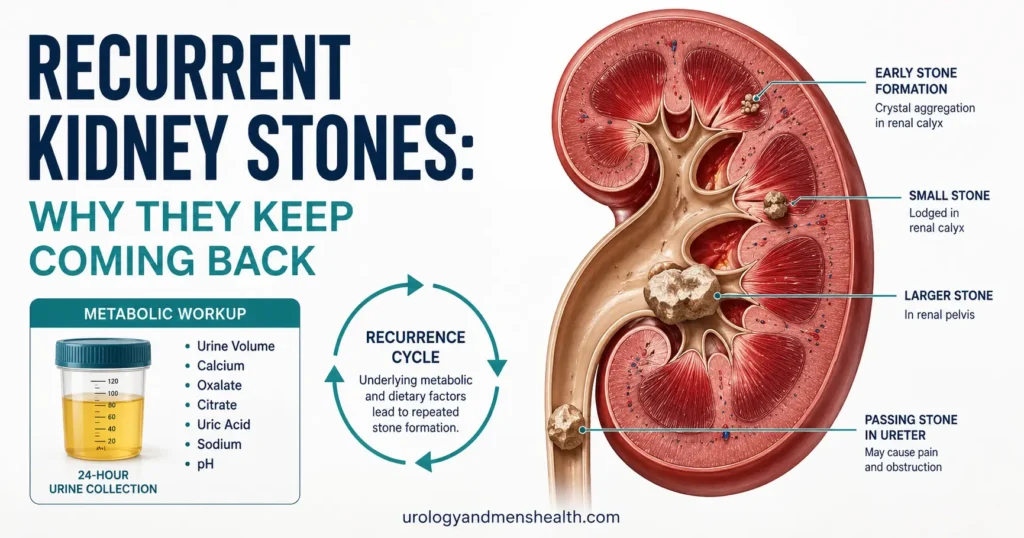
If you’ve already passed one kidney stone, your body has told you something important: it knows how to make another. The single best predictor of a future kidney stone is having already had one. Within five years, somewhere between 35 and 50 percent of stone formers will form another, and by ten years that figure climbs above 50 percent in most published cohorts.[1] Recurrent kidney stones are not bad luck. They are a metabolic signal that something measurable, and almost always fixable, is going on inside your urine chemistry. In this article I’ll explain why stones come back, what a proper metabolic workup actually involves, and the four mechanisms that account for the overwhelming majority of recurrences I see in clinic.
Key Takeaways
- Without a metabolic workup, recurrent kidney stone risk is 35-50% at 5 years and over 50% at 10 years.
- The 24-hour urine test is the single most important investigation after a second stone and is recommended by both AUA and EAU.
- Four mechanisms explain most recurrences: low urine volume, high urine calcium, low urine citrate, and high uric acid or oxalate.
- Drug therapy (thiazides, potassium citrate, allopurinol) is added when fluid and diet alone do not normalize urine chemistry within 3-6 months.
What Counts as Recurrent Kidney Stones?
A recurrent stone former is anyone who has produced more than one stone episode, or whose imaging shows multiple stones forming over time even if only one has been symptomatic. That definition matters because many men assume “recurrent” means three or four episodes. It does not. The 2022 AUA/EAU consensus on stone management treats anyone with two or more documented stones, or one stone plus a high-risk feature, as a candidate for full metabolic evaluation.[2]
High-risk features that escalate even a first-time stone former into the recurrent-management pathway include a personal history of bowel disease or bariatric surgery, a family history of stones, a stone composed of cystine or struvite, and certain medication exposures such as long-term topiramate or carbonic anhydrase inhibitors. The reason for this aggressive classification is straightforward — the cost of investigating a metabolic abnormality once is small, and the cost of forming another stone is enormous in both pain and lost productivity.
Use the Kidney Stone 5-Year Risk Profiler to estimate your own recurrence risk based on dietary, metabolic, and family history inputs before reading further.
→ Calculate your 5-year stone recurrence riskWhy Kidney Stones Keep Coming Back
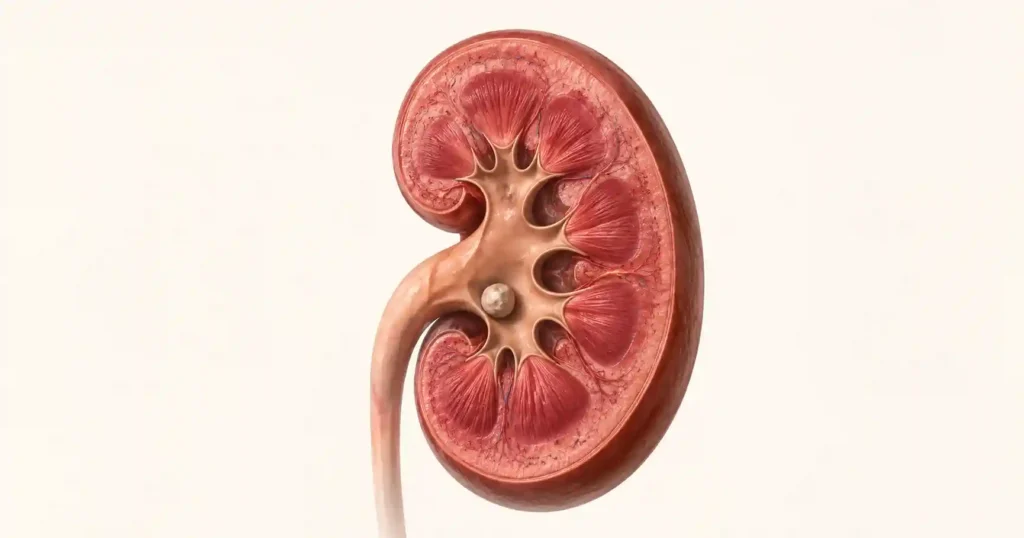
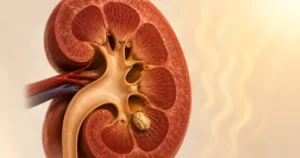
Stones form when urine becomes supersaturated with stone-forming salts — predominantly calcium oxalate, calcium phosphate, uric acid, or, less often, cystine and struvite. Supersaturation is a function of two variables: how much salt is dissolved in the urine, and how much water is dissolving it. When the balance tips, crystals nucleate, aggregate, and either anchor to a small calcified plaque on the renal papilla (Randall’s plaque) or form free in the collecting duct. From there, they grow into the stone you eventually feel.
Recurrence happens because the underlying urine chemistry hasn’t changed. Most patients I see after a first stone have been told to drink more water and avoid spinach, and that’s the entire conversation. That is not stone prevention — it’s hope. Without testing, you have no idea whether your problem is calcium, oxalate, citrate, uric acid, or simple volume, and the targeted treatment for each is different.
The four mechanisms below account for most recurrences in men. Identifying which of them is yours is the entire point of the metabolic workup.
The 4 Fixable Causes of Recurrent Stones
1. Low Urine Volume (the most common, most ignored)
A 24-hour urine volume below 2 liters concentrates every other risk factor. The AUA target is at least 2.5 liters of urine output per day, which usually requires drinking 3 liters (around 100 fl oz / 12 cups) of fluid because of insensible losses through sweat, breath, and stool.[2] Men in hot climates, manual workers, and anyone who exercises without aggressive rehydration are routinely producing 1.2-1.5 liters of urine daily and wondering why they keep forming stones.
2. Hypercalciuria (too much calcium in the urine)
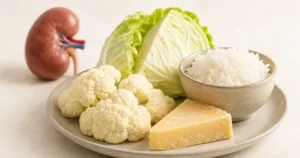
Urine calcium above 250 mg per day in men is the single most common metabolic abnormality in calcium oxalate stone formers. It usually reflects either increased intestinal absorption of calcium, leaking of calcium from bone, or a renal tubular handling defect. Counterintuitively, the answer is rarely a low-calcium diet — restricting dietary calcium increases oxalate absorption and worsens stone risk. The right answer is normal calcium intake (1,000-1,200 mg daily) with reduced sodium and reduced animal protein, and in resistant cases, thiazide diuretics to pull calcium back into bone.
3. Hypocitraturia (too little protective citrate)
Citrate is the body’s natural stone inhibitor — it binds urinary calcium and prevents crystal aggregation. A urine citrate below 320 mg per day means your urine has lost its main defense. Hypocitraturia is driven by chronic acid loads (high-meat diets), distal renal tubular acidosis, chronic diarrhea, and certain medications. Treatment is potassium citrate supplementation and dietary increases of citrate-rich foods, particularly lemons and limes — which is where the lemon water advice comes from, although the dose required is higher than most patients realize.
4. Hyperuricosuria or Hyperoxaluria
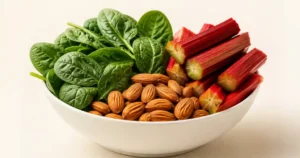
Urinary uric acid above 800 mg per day in men promotes both pure uric acid stones and calcium oxalate stones, because urate crystals seed calcium oxalate nucleation. It is driven almost entirely by purine intake — red meat, organ meat, shellfish, anchovies, and beer. Hyperoxaluria, defined as urine oxalate above 40 mg per day, comes from high-oxalate diets (spinach, almonds, beets, chocolate, tea), low dietary calcium (more oxalate gets absorbed), or fat malabsorption following bariatric surgery or inflammatory bowel disease.
The Stone Directory tool shows exactly which dietary modifications correspond to your specific stone type, and the Stone Composition Identifier can help you understand a stone analysis report if you’ve had a stone retrieved.
In My Practice
One of the most consistent patterns I see is the man in his 40s on his second or third stone who has never had a 24-hour urine test ordered. He’s been told to drink water and avoid spinach. When we finally do the workup, he turns out to have a urine volume of 1.4 liters, a urine sodium of 220 mmol (well above the 150 target), and a urine calcium of 380 mg — classic hypercalciuria driven by a high-sodium diet, not by anything he eats that contains calcium.
The fix in that scenario isn’t avoiding cheese. It’s halving his sodium intake, adding a thiazide, and pushing his fluid to 3 liters daily — and the recurrence curve typically flattens within 6-12 months.
The Metabolic Workup: What It Actually Involves
A proper metabolic workup for recurrent stones is built around the 24-hour urine collection, ideally performed twice on a normal home diet (not while travelling, not on antibiotics, not the week after a stone has been removed). The two collections are then compared — single collections can mislead because of day-to-day variation. The urine is analyzed for volume, calcium, oxalate, uric acid, citrate, sodium, magnesium, phosphate, pH, and supersaturation indices.
Alongside the urine collections, you should expect a blood panel measuring serum calcium, phosphate, electrolytes, bicarbonate, creatinine (with eGFR), uric acid, and parathyroid hormone if calcium is elevated. Stone analysis on any retrieved fragment is essential — if you haven’t had your stone analyzed, you and your urologist are guessing about composition. Imaging is typically a non-contrast CT KUB to document residual stones, which silently grow between episodes.
This workup is not exotic, not expensive in most healthcare systems, and not optional after a second stone. The AUA, EAU, and NICE all recommend it as standard of care.[2][3]
Worried about a stone coming back? Download Dr. Khalid’s 7-Day Kidney Stone Prevention Meal Plan.
Enter your email below to receive Dr. Khalid’s complete 7-Day Kidney Stone Prevention Meal Plan as a free, printable PDF.
When Diet Alone Isn’t Enough: Drug Therapy for Recurrent Stones
Most patients can normalize urine chemistry with three fluid and dietary moves: total fluid intake of 3 liters daily (around 100 fl oz / 12 cups), sodium reduction to below 2,300 mg daily (about 1 teaspoon of salt — most US men eat twice this), and animal protein moderation to roughly 1 g per kg body weight per day. Add to this normal dietary calcium of 1,000-1,200 mg daily from food (not supplements taken on an empty stomach), and you address the majority of stone chemistry abnormalities without medication.
When repeat 24-hour urine testing at 3-6 months shows residual abnormality, targeted drug therapy is added based on the abnormality:
- Thiazide diuretics (hydrochlorothiazide, chlorthalidone, indapamide) for persistent hypercalciuria — they reduce urine calcium by about 30-50%.
- Potassium citrate for hypocitraturia or low urine pH — typically 30-60 mEq daily in divided doses, raising both urine citrate and urine pH.
- Allopurinol for hyperuricosuria with recurrent calcium oxalate or uric acid stones — reduces urinary uric acid by blocking xanthine oxidase.
- Pyridoxine (vitamin B6) for primary hyperoxaluria — modest effect but well-tolerated.
Drug therapy is not a permission slip to ignore fluid and diet — it’s an add-on when the fundamentals haven’t fully corrected the problem. Long-term medication adherence is the single biggest predictor of whether thiazide or citrate therapy actually prevents recurrence, and adherence drops sharply after 12-24 months in most studies.[4]
Red Flags: When to Get Imaging Now
Recurrent stone formers should not assume every flank pain is a new stone, but they also can’t ignore certain warning signs. Get same-day imaging if you have:
- Flank pain plus a fever above 38°C (100.4°F) — possible obstructed infected stone, a urological emergency
- Inability to keep fluids down with persistent vomiting
- Blood in the urine plus reduced urine output
- Pain that hasn’t responded to your usual analgesia within 4-6 hours
- Single functioning kidney with new flank pain — never wait this out
Building a Long-Term Prevention Protocol
A workable prevention protocol for recurrent stones rests on five things you can verify and track. First, daily urine output above 2.5 liters — measure this by collecting one full day’s urine into a marked container at least once every six months to confirm you’re hitting target. Second, urinary sodium below 150 mmol (which corresponds to dietary sodium below about 3,500 mg) — track via the 24-hour collection. Third, urine calcium below 250 mg in men. Fourth, urine citrate above 320 mg. Fifth, repeat imaging — typically ultrasound annually or non-contrast CT every 2-3 years — to detect silent stone growth before it becomes symptomatic.
The patients who succeed long-term treat stone prevention like blood pressure management — a chronic condition that requires ongoing measurement, not a one-time fix. The ones who come back with stone number four are the ones who hit their numbers for six months, felt better, and stopped tracking. Beyond fluid and diet, weight reduction matters in obese stone formers; for related guidance see my clinical protocol for the kidney stone diet. And because hypertension shares many of the same dietary drivers as stone disease, treating one often helps the other.
→ Read the full Kidney Stone Diet clinical protocolFrequently Asked Questions
How likely am I to get another kidney stone after my first one?
Without preventive treatment, the 5-year recurrence rate for kidney stones is between 35 and 50 percent, and the 10-year rate exceeds 50 percent in most published cohorts. With a proper metabolic workup and targeted treatment, that risk drops by roughly half. Estimate your personal risk using the 5-Year Stone Risk Profiler, which factors in dietary, metabolic, and family history inputs.
What does a 24-hour urine test for recurrent kidney stones measure?
A standard stone workup 24-hour urine collection measures volume, calcium, oxalate, citrate, uric acid, sodium, magnesium, phosphate, pH, and supersaturation indices for calcium oxalate, calcium phosphate, and uric acid. Two collections on a normal home diet are ideal — single collections can mislead because urine chemistry varies day to day. Both AUA and EAU recommend this testing after a second stone or after a first stone with high-risk features.
Should I stop eating calcium-rich foods if I have calcium oxalate stones?
No, and this is one of the most common mistakes recurrent stone formers make. Restricting dietary calcium actually increases oxalate absorption from the gut and raises stone risk. The correct approach is normal dietary calcium intake of 1,000-1,200 mg daily from food sources eaten with meals — dairy, leafy greens, and fortified products. Calcium supplements taken on an empty stomach are different and may raise stone risk if used inappropriately. See the Stone Directory for dietary specifics by stone type.
Does lemon water actually prevent recurrent kidney stones?
Lemon and lime juice contain citrate, which is a natural urinary stone inhibitor, so the principle is sound — but the dose required is higher than most people drink. To meaningfully raise urinary citrate you typically need the juice of 4-5 lemons daily, or pharmaceutical-grade potassium citrate. Adding lemon to your water is helpful and harmless, but it is not a substitute for a 24-hour urine test and targeted treatment in someone who keeps forming stones.
How long after a kidney stone should I get the metabolic workup done?
Wait at least 6 weeks after a stone episode or a procedure (like a ureteroscopy or shockwave lithotripsy) before doing the 24-hour collections. You want the testing to reflect your normal baseline urine chemistry, not the post-procedure or post-illness state. Eat your usual diet during the collection days — avoid traveling, antibiotics, and unusual food choices that would distort the result.
Will medications like thiazides or potassium citrate cure recurrent kidney stones?
They reduce recurrence substantially but do not cure the underlying tendency, so adherence has to be long-term. Studies show thiazides and potassium citrate roughly halve recurrence rates when taken consistently, but the benefit disappears within 1-2 years of stopping. Medication works best alongside the fluid and dietary measures, not instead of them. Most urologists reassess every 12 months with a repeat 24-hour urine to confirm the drug is still doing its job.
References
- Rule AD, Lieske JC, Pais VM Jr. Management of Kidney Stones in 2020. JAMA. 2020;323(19):1961-1962. PubMed
- Skolarikos A, Jung H, Neisius A, et al. EAU Guidelines on Urolithiasis 2024. European Association of Urology. 2024. EAU Guidelines
- Pearle MS, Goldfarb DS, Assimos DG, et al. Medical Management of Kidney Stones: AUA Guideline. Journal of Urology. 2014 (amended 2023);192(2):316-324. AUA Guidelines
- Phillips R, Hanchanale VS, Myatt A, et al. Citrate salts for preventing and treating calcium containing kidney stones in adults. Cochrane Database of Systematic Reviews. 2015;(10):CD010057. Cochrane
- National Institute of Diabetes and Digestive and Kidney Diseases. Kidney Stones in Adults. NIDDK. 2024. NIDDK
Dr. Muhammad Khalid
MBBS · FCPS (Urology) · MCPS (General Surgery) · CHPE · CRSM · IMC #539472
Specialist urologist with 11+ years of clinical experience across tertiary teaching hospitals. Trained at Lady Reading Hospital and Khyber Teaching Hospital, Peshawar. Author or co-author of five peer-reviewed international publications, including in Cureus and the World Journal of Surgery. Procedural expertise: URS, PCNL, RIRS, TURP, TURBT, and major open urological surgery. Full profile →
This article is for educational purposes only and does not constitute medical advice. Always consult your physician or urologist for diagnosis and treatment decisions specific to your condition.