Testosterone Replacement Therapy (TRT): Before You Start (Guide)
Patients often arrive at my clinic holding a single low blood test, completely sold on the idea that TRT is the magic fix for all their fatigue. The reality is, while testosterone therapy is life-changing for the right candidate, it is a permanent medical commitment that will shut down your natural production and fertility. This guide is the unfiltered clinical conversation you need to hear before letting anyone write you a prescription.

Most men who walk into my clinic asking about testosterone replacement therapy have already decided they want it. They’ve read the marketing from low-T clinics, they’ve seen the before-and-after photos, and they’ve convinced themselves that a single low reading on a lab report explains every problem in their life. My job in that first consultation is not to prescribe — it is to slow them down. TRT works exceptionally well for the right patient. For the wrong patient, it shuts down their fertility, raises their hematocrit into dangerous territory, and commits them to lifelong injections for a problem that was never hormonal to begin with. This article is the conversation I have before I write the prescription.
Key Takeaways
- A single low testosterone result is never enough — AUA guidelines require two morning readings below 300 ng/dL on separate days plus clinical symptoms before TRT is considered.
- The TRAVERSE trial (NEJM 2023) found TRT did not raise the rate of major cardiac events compared with placebo, but it did increase rates of atrial fibrillation, pulmonary embolism, and acute kidney injury.
- TRT shuts down sperm production within 3-6 months in most men. If you want biological children, freeze sperm before starting or discuss alternative therapies like clomiphene or hCG.
- Hematocrit must be monitored every 3-6 months — values above 54% require dose reduction or therapeutic phlebotomy.
- If your testosterone is low because you sleep 5 hours a night, carry 40 extra pounds, and drink 4 nights a week, TRT is treating the symptom, not the disease.
Who Actually Needs Testosterone Replacement Therapy
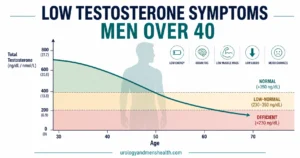
The American Urological Association’s 2018 guideline on testosterone deficiency, amended in 2024, is unambiguous: TRT is indicated for men with both a total testosterone below 300 ng/dL on two separate morning blood draws AND clinical symptoms consistent with deficiency [1]. Both criteria are required. A man with a testosterone of 250 ng/dL who feels fine does not need TRT. A man who feels exhausted but whose testosterone is 450 ng/dL does not need TRT either — his fatigue is caused by something else, and treating him with testosterone will not fix it.
The morning timing matters. Testosterone follows a circadian rhythm — it peaks between 7 and 10 AM and drops by as much as 30% by late afternoon. Drawing labs at 4 PM and calling the result “low” is one of the most common diagnostic errors I see in referrals from primary care. Before TRT is even on the table, I want two morning readings, taken on separate days, ideally fasted, between 7 and 10 AM.
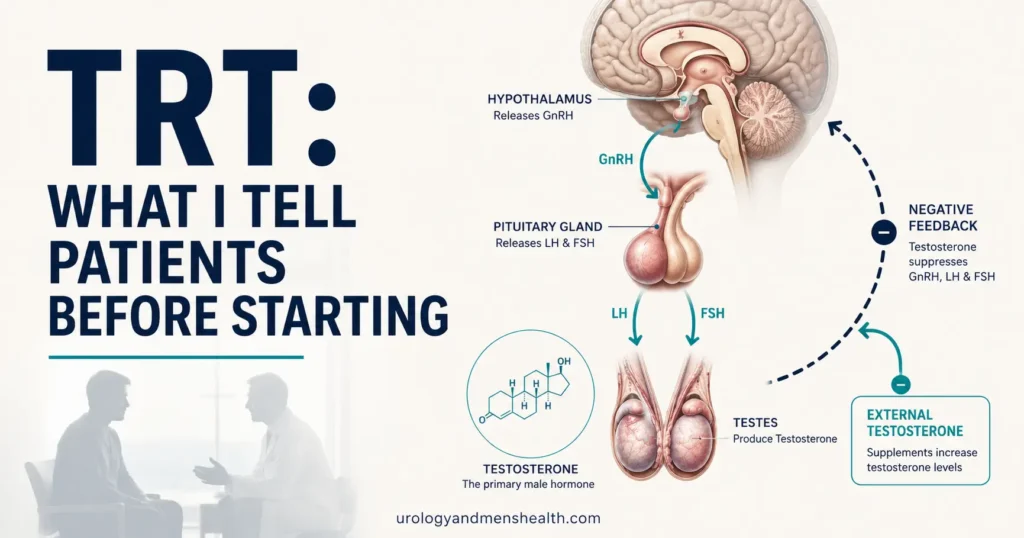
I also want to know why the testosterone is low. This is the question most low-T clinics skip entirely. The hormone is produced by the testes under instruction from the pituitary gland, which itself is instructed by the hypothalamus. A breakdown anywhere along this chain produces low testosterone, but the treatment changes depending on where the breakdown is. Primary hypogonadism — where the testes themselves have failed — shows up with low testosterone and high LH and FSH. Secondary hypogonadism — where the pituitary is the problem — shows up with low testosterone and low or normal LH and FSH. The second pattern can be caused by pituitary tumors, sleep apnea, severe obesity, opioid use, or chronic illness, and many of these are reversible without TRT at all [2].
If your numbers are borderline and you have not yet ruled out the reversible causes, take the symptom check first before committing to lifelong therapy.
→ Take the AMS/ADAM Low Testosterone Symptom QuizThe 5 Tests I Run Before Writing a Prescription
A complete pre-TRT workup is not just a testosterone level. It is a panel that confirms the diagnosis, identifies the cause, and establishes baseline measurements I will need to monitor for the rest of the patient’s life on therapy.
- Two morning total testosterone readings. Drawn between 7 and 10 AM, on separate days, fasted if possible. Both must be below 300 ng/dL (10.4 nmol/L) per AUA criteria.
- Free or bioavailable testosterone. Total testosterone can be misleading in men with abnormal sex hormone binding globulin (SHBG) — common in obesity, diabetes, and aging. Free testosterone below 65 pg/mL with normal total can still mean true deficiency.
- LH and FSH. These tell me whether the problem is at the testicles or at the pituitary. They change the entire treatment conversation.
- Prolactin and a morning cortisol. A markedly elevated prolactin can indicate a pituitary adenoma, which requires an MRI of the pituitary before any hormone replacement is started.
- Baseline hematocrit, PSA, and lipid panel. Hematocrit because TRT raises red cell mass and can push it into thrombotic territory. PSA because TRT does not cause prostate cancer but can accelerate the growth of an undiagnosed one. Lipids because TRT can alter HDL.
In My Practice
A 38-year-old patient came to me last year having been prescribed testosterone gel by a telehealth clinic based on a single 4 PM testosterone reading of 280 ng/dL. He had been on it for 8 months. When I repeated his labs at 8 AM off therapy, his baseline testosterone was 480 ng/dL — entirely normal. His symptoms (fatigue, low libido, weight gain) turned out to be untreated obstructive sleep apnea. We stopped the gel, started CPAP, and within 4 months his energy and libido were better than they had been in a decade.
The lesson is not that TRT is bad — it is that diagnosis comes before prescription, and the cost of skipping that step is treating the wrong disease for years.
What the TRAVERSE Trial Actually Showed
For more than a decade, the central unanswered question about TRT was whether it caused heart attacks. Earlier observational studies pointed in both directions, and the FDA added a cardiovascular warning to all testosterone products in 2015 based on the available data. The TRAVERSE trial, published in the New England Journal of Medicine in 2023, was the definitive randomized trial designed to answer this question. It enrolled 5,246 men aged 45-80 with confirmed hypogonadism and either pre-existing cardiovascular disease or high cardiovascular risk, and followed them for an average of 22 months [3].
The primary finding: testosterone therapy was non-inferior to placebo for major adverse cardiac events (cardiovascular death, non-fatal myocardial infarction, or non-fatal stroke). The rate was 7.0% in the testosterone group versus 7.3% in the placebo group. For the first time, we had robust randomized evidence that TRT in symptomatic hypogonadal men does not, on average, raise the risk of heart attack or cardiovascular death.
That is the headline. The footnotes are where the honest conversation lives. TRAVERSE also found that men on testosterone had statistically higher rates of atrial fibrillation (3.5% vs 2.4%), pulmonary embolism (0.9% vs 0.5%), and acute kidney injury (2.3% vs 1.5%) [3]. These are not catastrophic absolute rates, but they are real, and they are the reason I will not prescribe TRT to a man with active atrial fibrillation, a recent DVT, or unstable kidney function without a long conversation about whether the benefit is worth the added risk.
The Fertility Problem Nobody Mentions in the Brochure
This is the single most important conversation I have with men under 45 who are considering TRT, and it is the one most likely to be glossed over by commercial clinics. External testosterone shuts down the pituitary’s signal to the testicles. Within 3-6 months of starting therapy, the vast majority of men become functionally infertile — sperm counts drop, often to zero, and testicular size visibly decreases. In one prospective study of men on long-term testosterone, 65% became azoospermic within 4 months [4].
Recovery is not guaranteed. After stopping testosterone, most men regain sperm production within 6-24 months, but a meaningful minority do not recover to baseline at all, particularly men who were on therapy for several years or who already had marginal sperm parameters before starting. If you are under 45 and there is any possibility you want biological children, the conversation is not optional — it is mandatory before the first dose. The options at that point are: freeze sperm before starting TRT, use clomiphene citrate or anastrozole instead (which raise endogenous testosterone without suppressing the axis), or add hCG to TRT to maintain testicular function.
If fertility is on the table for you in any form, read the broader picture on male reproductive health before you commit to a treatment path that could remove the option.
→ Male Infertility: The Conversation Most Urologists SkipNot sure your testosterone symptoms are what they seem? Download Dr. Khalid’s Low Testosterone Testing & Treatment Guide.
Enter your email below to receive Dr. Khalid’s complete Low Testosterone: Testing & Treatment Guide as a free, printable PDF.
Delivery Methods: What Each One Actually Feels Like
There are four mainstream delivery methods, and the choice is not trivial — it affects how steady your levels are, how often you think about your treatment, and what your partner and household are exposed to.
Intramuscular injections (testosterone cypionate or enanthate) are the most prescribed. Typically 100-200 mg once weekly or every two weeks, self-administered. Peaks and troughs are real — many men feel excellent for the first 4-5 days after an injection and progressively flatter as the next dose approaches. Splitting the weekly dose into two smaller injections smooths this out considerably, which is what I recommend for most men who report mood or energy swings.
Topical gels (testosterone 1% or 2%) applied daily to the shoulders or abdomen produce steadier levels than injections but carry a real risk of transference. A child or partner who touches the application site within 2-6 hours of application can absorb measurable testosterone — and case reports of accelerated puberty in children of TRT-using fathers exist [5]. I do not prescribe gels to men with young children in the household.
Subcutaneous pellets (Testopel) are implanted in the hip every 3-6 months. Set-and-forget convenience, very stable levels, but the dose cannot be adjusted once implanted, and if side effects develop, the pellets must be surgically removed.
Oral testosterone undecanoate (Jatenzo, Tlando) is newer and bypasses the liver toxicity that killed earlier oral forms. Twice-daily dosing, no injections, no gels — but expensive, and long-term cardiovascular data is still maturing.
The Monitoring Schedule I Use
Starting TRT is a 20-year commitment in most men. The monitoring is not optional — it is what distinguishes therapy from a vanity prescription, and it is where most low-T clinics fail their patients.
- 3 months after starting: Total testosterone (target mid-normal range, around 450-600 ng/dL), hematocrit, PSA, symptom review.
- 6 months: Repeat the 3-month panel. Adjust dose if levels are too high or symptoms are not controlled.
- 12 months and annually thereafter: Full panel including hematocrit, PSA, lipid panel, and a digital rectal exam if age-appropriate.
- Hematocrit above 54%: Reduce dose, increase dose interval, or refer for therapeutic phlebotomy. Do not ignore this — polycythemia from TRT is one of the few side effects with a clear thrombotic signal.
- PSA rise greater than 1.4 ng/mL in any 12-month period: Stop and reassess. TRT does not cause prostate cancer, but it will accelerate the growth of an undiagnosed one, and a sudden PSA velocity change while on therapy is not something to wait out.
If your PSA changes while on TRT, the trajectory matters more than the absolute number. Track it with the tool I built for exactly this scenario.
→ Use the PSA Velocity Tracker to monitor your readingsWhen TRT Is Not the Answer
Roughly 40% of men referred to my clinic for “low testosterone” leave with a treatment plan that does not involve testosterone at all. The reasons are usually one of three patterns. The first is reversible secondary hypogonadism — obesity, sleep apnea, opioid medications, alcohol overuse, or uncontrolled diabetes are suppressing the pituitary, and addressing the underlying cause restores testosterone to normal without lifelong therapy. The second is symptoms in the absence of biochemical deficiency — fatigue, low libido, and erectile dysfunction have many causes, and chasing testosterone numbers when the testosterone is normal is treating the wrong target. The third is a vascular cause masquerading as a hormonal one — particularly with erectile dysfunction, where the underlying issue is often cardiovascular rather than endocrine.
→ GLP-1 weight loss as an alternative to TRT for obesity-driven low TThe last category is the one I worry about most. A man in his 50s with new erectile dysfunction and borderline-low testosterone is far more likely to have early cardiovascular disease than primary hypogonadism, and prescribing him testosterone without investigating his vascular health misses the diagnosis that will actually kill him.
→ Is It ED or Heart Disease? Why Morning Wood Is a Cardiovascular CheckWhen to Stop TRT and See Your Doctor Urgently
If you are already on testosterone replacement therapy, contact your urologist or seek emergency care for any of the following:
- Sudden chest pain, shortness of breath, or unilateral leg swelling — possible pulmonary embolism or DVT
- Severe headache, vision changes, or new arrhythmia — possible blood pressure crisis or atrial fibrillation
- Hematocrit above 54% on routine bloodwork
- A PSA rise greater than 1.4 ng/mL in a 12-month period, or any PSA above 4.0 ng/mL on therapy
- New or worsening urinary symptoms — frequency, weak stream, incomplete emptying — that suggest prostate enlargement is accelerating
- Severe acne, mood changes, or aggression that did not exist before starting
Frequently Asked Questions About TRT
Will I have to stay on testosterone replacement therapy for life?
For most men with confirmed primary hypogonadism, yes — the testicles will not resume production once therapy is stopped, and symptoms return within weeks to months. For men with reversible secondary hypogonadism (obesity, sleep apnea, opioid-related), addressing the root cause can sometimes restore natural production. Either way, stopping TRT abruptly produces a hypogonadal crash. If you ever stop, do it under your urologist’s supervision with a tapering protocol or a transition to a restart protocol.
Does TRT cause prostate cancer?
The current evidence, including TRAVERSE, does not show that testosterone replacement therapy causes prostate cancer. However, TRT can accelerate the growth of an existing, undiagnosed prostate cancer, which is why a baseline PSA and a careful PSA monitoring schedule are mandatory before and during therapy. Men with known prostate cancer or a PSA above 4.0 ng/dL at baseline should not start TRT without urological evaluation first.
What are the most common TRT side effects in the first 6 months?
The most common early side effects of testosterone replacement therapy are acne (especially on the back and shoulders), elevated hematocrit visible on routine bloodwork, fluid retention, and worsening of pre-existing sleep apnea. Testicular shrinkage and reduced fertility begin within the first few months. Less common but more serious effects include atrial fibrillation, polycythemia requiring phlebotomy, and pulmonary embolism — the TRAVERSE trial documented modest but statistically significant rate increases for each [3].
Can I preserve fertility while on TRT?
Yes, but it requires planning before you start. The three options are: freeze sperm at a fertility clinic before your first dose; use clomiphene citrate or anastrozole instead of testosterone (these raise your own testosterone without suppressing the testicular axis); or add hCG injections to your TRT regimen to maintain testicular function. Once TRT has been started without one of these strategies, sperm production typically drops within 3-6 months, and recovery after stopping is not guaranteed.
How quickly will I feel different on TRT?
Energy and mood improvements typically begin within 3-4 weeks. Libido changes are usually noticeable within 6-8 weeks. Erectile function, when testosterone deficiency is the actual cause, improves within 2-3 months — but if vascular disease is the underlying problem, TRT alone will not fix it. Body composition changes (muscle mass increase, fat reduction) take 6-12 months and require resistance training to fully realize. If you feel no clinical benefit after 6 months on a properly dosed regimen with mid-normal levels, the diagnosis itself should be revisited — testosterone deficiency was likely not the primary problem.
References
- Mulhall JP, Trost LW, Brannigan RE, et al. Evaluation and Management of Testosterone Deficiency: AUA Guideline. Journal of Urology. 2018;200(2):423-432. Amended 2024. AUA Guideline
- Bhasin S, Brito JP, Cunningham GR, et al. Testosterone Therapy in Men With Hypogonadism: An Endocrine Society Clinical Practice Guideline. Journal of Clinical Endocrinology & Metabolism. 2018;103(5):1715-1744. PubMed
- Lincoff AM, Bhasin S, Flevaris P, et al. Cardiovascular Safety of Testosterone-Replacement Therapy. New England Journal of Medicine. 2023;389(2):107-117. PubMed
- Patel AS, Leong JY, Ramos L, Ramasamy R. Testosterone Is a Contraceptive and Should Not Be Used in Men Who Desire Fertility. World Journal of Men’s Health. 2019;37(1):45-54. PubMed
- U.S. Food and Drug Administration. FDA Drug Safety Communication: Testosterone gel safety concerns prompt FDA to require label changes, warning. Updated 2024. FDA.gov
Dr. Muhammad Khalid
MBBS · FCPS (Urology) · MCPS (General Surgery) · CHPE · CRSM · IMC #539472
Specialist urologist with 11+ years of clinical experience across tertiary teaching hospitals. Trained at Lady Reading Hospital and Khyber Teaching Hospital, Peshawar. Author or co-author of five peer-reviewed international publications, including in Cureus and the World Journal of Surgery. Procedural expertise: URS, PCNL, RIRS, TURP, TURBT, and major open urological surgery. Full profile →
This article is for educational purposes only and does not constitute medical advice. Always consult your physician or urologist for diagnosis and treatment decisions specific to your condition.