Testicular Self-Exam: Lumps, Cancer & Diagnosis
Discovering a new lump on your testicle usually triggers immediate panic about cancer, or conversely, a false sense of security if the mass isn't actively painful. In my clinic, I constantly remind patients that a painless lump is the one you can never ignore. The reassuring truth is that most masses are benign, and even true testicular cancer boasts a cure rate of over 95% when caught early. This guide provides the strict clinical protocol for examining yourself correctly, breaking down the six most common causes of scrotal lumps and exactly what your diagnosis pathway will look like.

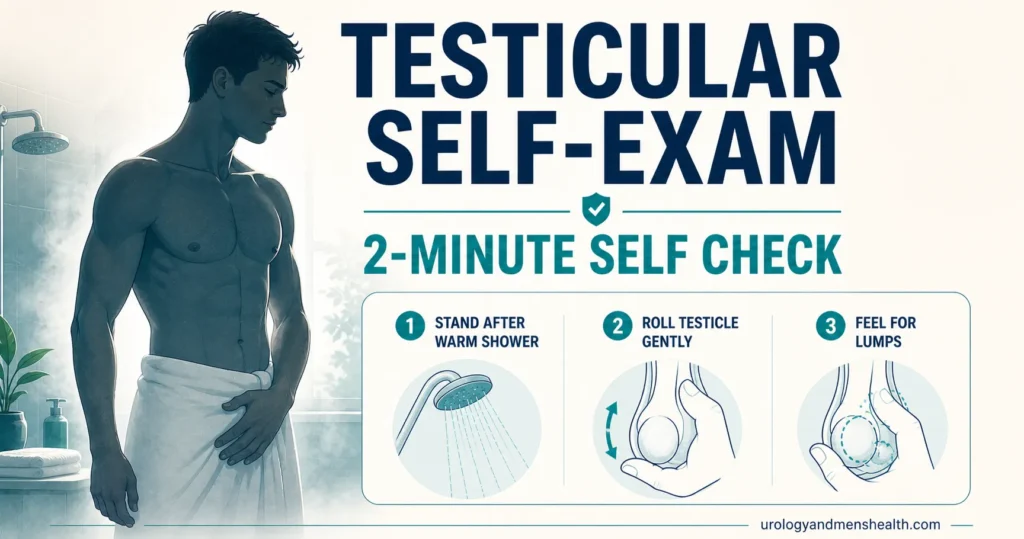
If you’ve felt something in your scrotum that wasn’t there before, the testicular self-exam you do tonight is the most useful two minutes you’ll spend this year. I’m Dr. Muhammad Khalid, a specialist urologist. In clinic I see men every week who delayed coming in because the lump didn’t hurt — and that’s the trap. Painless lumps are exactly the ones that matter. The good news is that the vast majority of testicular lumps are not cancer, and even when they are, testicular cancer has one of the highest cure rates of any cancer in medicine — over 95% overall.
This guide gives you the exact technique I teach my patients, the difference between a normal finding and a red flag, the six common causes of a scrotal lump, and the diagnosis pathway from your first phone call to your final answer. Read it once, do the exam, and bookmark it for next month.
Key Takeaways
- A monthly testicular self-exam takes 2 minutes and is the single most effective screening tool we have for men aged 15–35.
- The classic cancer lump is hard, painless, and fixed to the testicle itself — pain usually means infection or torsion, not cancer.
- Most scrotal lumps are benign — epididymal cysts, hydroceles, and varicoceles are far more common than cancer.
- If you feel a lump, see a doctor within a week — a scrotal ultrasound gives an answer the same day.
- Testicular cancer is over 95% curable overall, and 99% curable when caught at Stage I.
How to Do a Testicular Self-Exam (Step-by-Step)
The testicular self-exam is so simple that most men dismiss it — and that’s why it gets skipped. Here is the exact technique I teach in clinic. Do it once a month, on a fixed day (the first of the month works for most patients), and the whole thing takes under two minutes.
Step 1 — Pick the right time
Do the exam after a warm shower or bath. Heat relaxes the cremaster muscle and the scrotal skin, which lets the testicles hang lower and makes anything abnormal much easier to feel. A cold scrotum tightens up and hides everything.
Step 2 — Examine each testicle separately
Stand in front of a mirror. Cup your scrotum in one hand and look first — you’re checking for any obvious swelling on one side, redness, or asymmetry. It’s normal for one testicle (usually the left) to hang slightly lower than the other. It’s also normal for one to be slightly larger. What you’re watching for is a sudden change from your baseline.
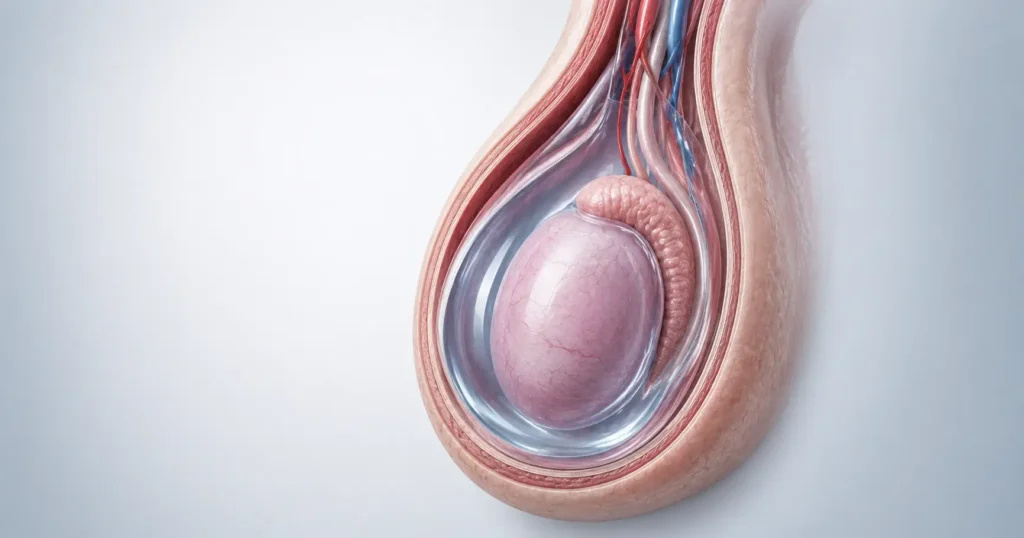
Then examine each testicle one at a time. Place your thumb on top and your index and middle fingers underneath. Roll the testicle gently between your fingertips. The whole surface should feel smooth, oval, and firm — about the consistency of a peeled hard-boiled egg.
Step 3 — Find the epididymis (this is normal)
At the back of each testicle you’ll feel a soft, slightly tender, comma-shaped structure. This is the epididymis, the tube where sperm matures. Many men feel this for the first time during a self-exam and panic. It’s supposed to be there. It feels different from the testicle — softer, more rope-like — but it’s a normal part of your anatomy on both sides.
Step 4 — Feel for anything new
You’re looking for a lump or hard area on or in the testicle itself — not the epididymis. A cancerous lump is typically hard, painless, and feels like part of the testicle has become solid. It might be the size of a pea or the size of a grape. It does not move freely the way a cyst would. Compare both sides — almost every man has one testicle that’s a fingerprint different from the other, and that’s fine. What matters is change.
→ Related Read: Testicular Torsion — The 6-Hour Emergency Every Young Man Should KnowWhat’s Normal vs. What’s a Red Flag
The reason patients delay coming in is that they don’t know what counts as a red flag. Here is the framework I use in clinic.
Normal findings (no action needed)
- One testicle slightly lower or larger than the other.
- A soft, comma-shaped structure at the back (epididymis).
- A small bump where the spermatic cord enters the testicle.
- Mild tenderness with pressure — testicles are normally pressure-sensitive.
Red flags — see a doctor within a week
- A hard, painless lump on or within the testicle itself.
- One testicle clearly larger or heavier than the other when this is new.
- A dull ache or “dragging” feeling in the scrotum, lower abdomen, or groin.
- Sudden fluid build-up around the testicle.
- Breast tenderness or swelling — sometimes the first sign of a hormone-producing tumor.
- Lower back pain that won’t go away (can indicate cancer that has spread to lymph nodes).
💡 In My Practice
I had a 26-year-old patient — a software engineer — come in after his girlfriend insisted he get checked. He’d had a “small marble” on his right testicle for nearly four months. No pain. He kept telling himself it was nothing. Ultrasound showed a 1.4 cm seminoma. Because he came in when he did, his cancer was Stage I. He had a single surgery, didn’t need chemotherapy, and was discharged from active surveillance after five clear scans.
The lesson I give every young man in clinic: painless does not mean harmless. Pain in the scrotum almost always brings men in. The killer is the painless lump that feels like nothing — because nothing is exactly what it feels like.
Causes of a Testicular Lump (Most Aren’t Cancer)
Before you assume the worst, understand that [1] the majority of scrotal lumps are benign. Here are the six conditions I see most often, ranked roughly by frequency.
1. Epididymal cyst
A small, smooth, fluid-filled sac on the epididymis (the structure behind the testicle). It feels like a soft pea, separate from the testicle itself. Painless. Extremely common — up to 30% of adult men have one. No treatment needed unless it grows large enough to cause discomfort.
2. Hydrocele
A collection of clear fluid around the testicle, inside its protective sac. The whole side of the scrotum feels enlarged but soft and squishy. Classic finding: when a doctor shines a torch through it, the fluid lights up (transillumination). Painless and usually slow-growing. Hydroceles and spermatoceles are the painless swellings most often confused with cancer.
3. Varicocele
Dilated veins above the testicle, almost always on the left side. Classically described as feeling like “a bag of worms” when you stand up, and disappearing when you lie down. Affects about 15% of men. Often painless but can cause a dull ache and is a treatable cause of male infertility.
4. Spermatocele
A cyst at the head of the epididymis (top of the testicle), filled with sperm-containing fluid. Soft, mobile, painless. Treatment is rarely needed.
5. Epididymitis (or epididymo-orchitis)
Infection or inflammation of the epididymis, often spreading to the testicle. The scrotum becomes hot, red, swollen, and painful. Often follows a UTI or sexually transmitted infection. Pain is the differentiator — testicular cancer doesn’t cause this picture.
6. Testicular cancer
The lump is hard, painless, fixed to the testicle, and feels like part of the testicle has become solid. About 90% of testicular cancers are germ cell tumors, split into seminomas (slower-growing, very chemo-sensitive) and non-seminomas (faster-growing, mixed histology). The remaining 10% are stromal tumors and lymphomas, more common in older men.
→ Related Read: When Should a Young Man See a Urologist? Early Warning SignsTesticular Cancer: The Facts You Actually Need
Testicular cancer is uncommon overall but it is the most common solid cancer in men aged 15 to 35 [2]. The lifetime risk for a man in the United States is roughly 1 in 250. Around 9,700 new cases are diagnosed in the US each year.
Who is at higher risk?
- Cryptorchidism (undescended testicle) as a child — increases risk 4 to 10-fold, even after corrective surgery.
- Family history — having a brother with testicular cancer raises your risk roughly 8-fold; having a father with it raises it about 4-fold.
- Personal history — having had cancer in one testicle gives a 12-fold higher risk in the other.
- HIV infection — modestly higher risk of seminoma.
- Klinefelter syndrome and certain genetic conditions.
Race matters too — the disease is far more common in white men of European descent than in Black or Asian men, although the reasons aren’t fully understood.
What testicular cancer is NOT
- Not caused by injury. A blow to the testicle may draw your attention to a lump that was already there, but trauma does not cause cancer.
- Not caused by vasectomy. Multiple large studies have ruled this out.
- Not caused by sexual activity, masturbation, or how you wear underwear. These myths waste clinic time.
- Not contagious.
[INSERT MAILERLITE OPT-IN FORM HERE — see Section 6 of system prompt, Wellness pillar, “Men’s Health Screening Checklist” magnet, form ID 184208464787014831 — note: Wellness ID isn’t on the v5.2 system prompt mapping table, so use Sexual Health pillar form 184210609355966378 with adjusted PDF title — see PDF substitution note below]
Not sure what is normal down there? Download Dr. Khalid’s Testicular Cancer Self-Check Guide.
Enter your email below to receive Dr. Khalid’s complete Testicular Cancer Self-Check Guide as a free, printable PDF.
The Diagnosis Pathway: From Lump to Answer
If you find something on a testicular self-exam, here is exactly what happens next. Knowing the pathway removes most of the fear — the workup is fast and well-defined.
Stage 1 — Primary care visit (within 1 week)
Your primary care doctor or urologist will examine the scrotum, including transillumination (a small torch held against the scrotum — fluid-filled lumps light up; solid ones do not). They will also check the abdomen and lymph nodes for any obvious spread. Expect an urgent referral for imaging.
Stage 2 — Scrotal ultrasound (same week)
This is the single most important diagnostic test. A scrotal ultrasound is painless, takes 15 minutes, and is over 95% sensitive for detecting testicular masses [3]. The radiologist will report the mass as either:
- Cystic / fluid-filled — almost certainly benign (cyst, hydrocele).
- Solid intratesticular mass — assumed to be cancer until proven otherwise.
- Solid extratesticular mass — usually benign (epididymal cyst, lipoma).
Stage 3 — Tumor markers (blood test)
If the ultrasound shows a solid mass, the next step is a blood test for three tumor markers: alpha-fetoprotein (AFP), beta-human chorionic gonadotropin (β-hCG), and lactate dehydrogenase (LDH). These help classify the tumor type, stage the disease, and serve as a baseline for monitoring after treatment.
Stage 4 — Radical inguinal orchiectomy
This is where testicular cancer differs from almost every other cancer. We do not biopsy a suspicious testicular mass. Putting a needle through the scrotum risks seeding cancer cells into a different lymphatic drainage area and worsening the prognosis. Instead, the affected testicle is removed surgically through an incision in the groin (inguinal approach). The pathologist examines the whole testicle. The surgery is both diagnostic and therapeutic for early-stage disease, and is usually done as a day case.
Stage 5 — Staging scans
A CT scan of the chest, abdomen, and pelvis confirms whether the cancer is confined to the testicle (Stage I), has spread to retroperitoneal lymph nodes (Stage II), or has spread further (Stage III). Tumor markers are repeated post-surgery — a drop to normal is reassuring; persistent elevation suggests residual disease.
→ Related Read: Hydrocele and Spermatocele — The Painless Scrotal Swelling ExplainedTreatment and Survival: Why Testicular Cancer Is Different
This is the part of the conversation I most enjoy having with patients, because the news is genuinely good. Testicular cancer has the highest cure rate of any solid cancer in men, largely because the germ cells that cause most cases are exquisitely sensitive to chemotherapy [4].
5-year survival by stage (US data)
- Stage I (confined to testicle): 99% survival.
- Stage II (spread to retroperitoneal lymph nodes): 96% survival.
- Stage III (spread beyond retroperitoneal nodes): 73% survival — still remarkable for any metastatic cancer.
- All stages combined: over 95%.
Treatment options after orchiectomy
- Active surveillance — chosen for many Stage I patients; involves regular CT scans, exams, and tumor markers for 5 years. About 80% of Stage I patients never need further treatment.
- Chemotherapy (BEP regimen) — bleomycin, etoposide, cisplatin. Three or four cycles depending on stage and risk.
- Radiation therapy — used selectively for Stage I and IIA seminomas, less common now in favor of surveillance.
- Retroperitoneal lymph node dissection (RPLND) — surgical removal of abdominal lymph nodes for selected non-seminoma cases.
What about fertility, hormones, and “manhood”?
Honest answer: most men with one testicle have normal testosterone, normal libido, normal erections, and normal fertility. The remaining testicle compensates almost completely. We routinely offer sperm banking before any treatment, because chemotherapy can affect future fertility. A testicular prosthesis can be placed at the time of orchiectomy for men who want it — it’s a saline implant, cosmetic only, and the choice is entirely personal.
⚠️ When to See a Doctor — Urgently
- Sudden, severe testicular pain — this is a possible testicular torsion and a 6-hour surgical emergency. Go to the emergency room (ER) immediately.
- Hard, painless lump on the testicle — see a doctor within the week, not “next month”.
- Sudden swelling of the scrotum with fever and pain — likely epididymitis but needs antibiotic treatment, not waiting it out.
- Persistent dull ache or “heaviness” in the scrotum or groin lasting more than 2 weeks.
- Lower back pain plus a testicular change — assess for advanced disease.
Frequently Asked Questions
How often should I do a testicular self-exam?
Once a month is the right frequency for adult men, especially between ages 15 and 35 when testicular cancer risk is highest. Pick a fixed day so you don’t forget — the first of the month works for most patients. The whole exam takes under 2 minutes after a warm shower. If you found this article helpful, you may also want to read when a young man should see a urologist for the broader warning-sign list.
What does a cancerous testicular lump feel like?
The classic testicular cancer lump is hard, painless, fixed to the testicle, and feels like part of the testicle has become solid. It usually doesn’t move freely the way a cyst would. Size varies — anywhere from a pea to a grape. Pain is unusual and is more typical of torsion or epididymitis. Any new firm area found on a testicular self-exam needs evaluation within a week.
Are most testicular lumps cancer?
No — the majority of scrotal lumps are benign. Common non-cancer causes include epididymal cysts, hydroceles, varicoceles, spermatoceles, and infections. Hydroceles and spermatoceles, in particular, are painless swellings often confused with cancer. That said, every new lump deserves a urological exam and ultrasound to be sure — the test is quick, painless, and definitive.
Can a hit to the testicles cause cancer?
No. Trauma does not cause testicular cancer. What sometimes happens is that an injury draws your attention to a lump that was already there but had been ignored. The classic scenario is a young man hit during sport, suddenly checking himself, and finding something he had missed. The injury is the messenger, not the cause.
Will I need both testicles removed?
In the vast majority of cases, no. Testicular cancer is usually one-sided, and only the affected testicle is removed (radical inguinal orchiectomy). The remaining testicle almost always produces enough testosterone to maintain normal libido, erections, and fertility. If both testicles are affected — which is rare, but possible in men with a prior history — testosterone replacement and sperm banking become part of the conversation.
How accurate is a scrotal ultrasound?
Scrotal ultrasound is over 95% sensitive and 99% specific for detecting testicular tumors. It distinguishes solid masses (almost always cancer) from cystic ones (almost always benign), and tells your urologist whether the lump is inside the testicle or in the surrounding structures. It’s painless, takes 15 minutes, and is the single most useful test in this whole workup.
📚 References
- Stephenson AJ, Gilligan TD. Neoplasms of the Testis. In: Partin AW, et al., eds. Campbell-Walsh-Wein Urology. 12th ed. Elsevier; 2021:1568–1596. AUA Guidelines
- American Cancer Society. Key Statistics for Testicular Cancer. Cancer Facts & Figures. 2024. American Cancer Society
- Marko J, Wolfman DJ, Aubin AL, Sesterhenn IA. Testicular Seminoma and Its Mimics: From the Radiologic Pathology Archives. RadioGraphics. 2017;37(4):1085–1098. doi:10.1148/rg.2017160164. PubMed
- Gilligan T, Lin DW, Aggarwal R, et al. Testicular Cancer, Version 2.2020, NCCN Clinical Practice Guidelines in Oncology. J Natl Compr Canc Netw. 2020;18(12):1529–1554. doi:10.6004/jnccn.2020.0058. PubMed
- EAU Guidelines on Testicular Cancer. European Association of Urology; 2024. EAU Guidelines
Dr. Muhammad Khalid
MBBS · FCPS (Urology) · MCPS (General Surgery) · CHPE · CRSM · IMC #539472
Specialist urologist with 11+ years of clinical experience across tertiary teaching hospitals. Trained at Lady Reading Hospital and Khyber Teaching Hospital, Peshawar. Author or co-author of five peer-reviewed international publications, including in Cureus and the World Journal of Surgery. Procedural expertise: URS, PCNL, RIRS, TURP, TURBT, and major open urological surgery. Full profile →
This article is for educational purposes only and does not constitute medical advice. Always consult your physician or urologist for diagnosis and treatment decisions specific to your condition.