Best Home Blood Pressure Monitors for Men 2026
Patients routinely trust their cardiovascular health to whatever blood pressure monitor has the most five-star reviews online. The dangerous reality is that most of those cheap devices are completely unvalidated by medical authorities, and a reading just 10 points off can leave you secretly damaging your kidneys. Here is the clinical list of the exact monitors proven accurate enough to actually trust with your health.

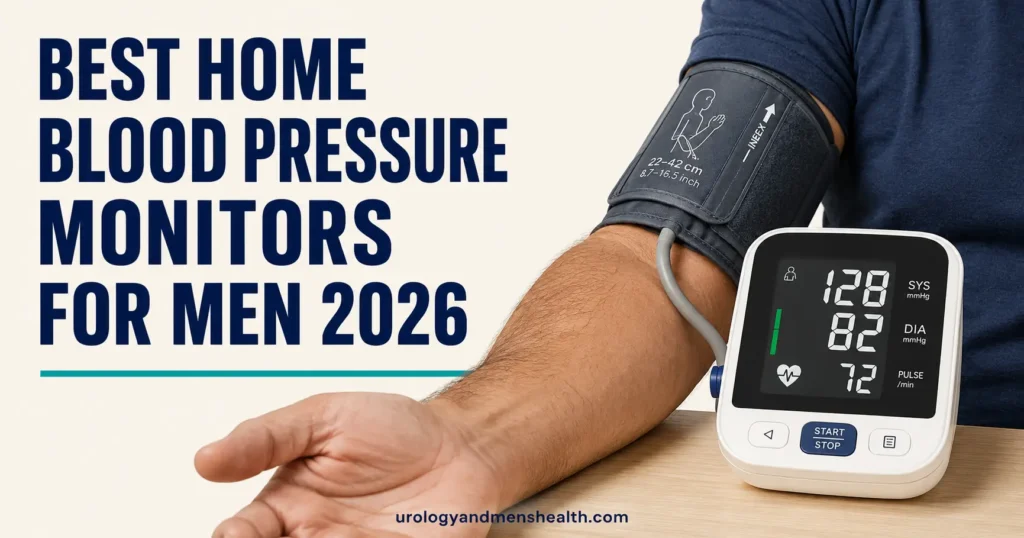
The best home blood pressure monitors for men in 2026 are the ones the American Medical Association has actually tested for accuracy — not the ones with the most five-star reviews. Most monitors sold on Amazon are not on the AMA Validated Device Listing, which means nobody outside the manufacturer has confirmed they read within 3 mmHg of a mercury sphygmomanometer. I see men in clinic every month who have been treated — or not treated — based on readings from a $25 unvalidated device, and the consequences are not small. A monitor that reads 10 mmHg low can leave a man with stage 2 hypertension thinking he is fine while his kidneys quietly accumulate damage. I have written this guide because the wrong device is worse than no device at all.
Key Takeaways
- The AMA Validated Device Listing (VDL) is the single most important specification — it confirms the monitor reads within 3 mmHg of a mercury sphygmomanometer in clinical trials.
- Upper-arm cuff monitors outperform wrist monitors. Both the AUA and AHA explicitly recommend against wrist devices for routine home monitoring.
- The Omron 3 Series BP7150 is the best entry point — VDL-validated, around $50, Bluetooth syncs to phone for unlimited readings.
- If your reading at home is 130/80 mmHg or higher on two separate days, that meets the 2025 AHA/ACC threshold for hypertension and warrants a primary care or urology referral.
- Cuff size matters more than monitor brand. A cuff that is too small adds 5 to 10 mmHg of artificial elevation — a wide-range 9-to-17-inch cuff fits most adult men.
In This Guide:
Why “Validated” Matters More Than “Best-Selling”
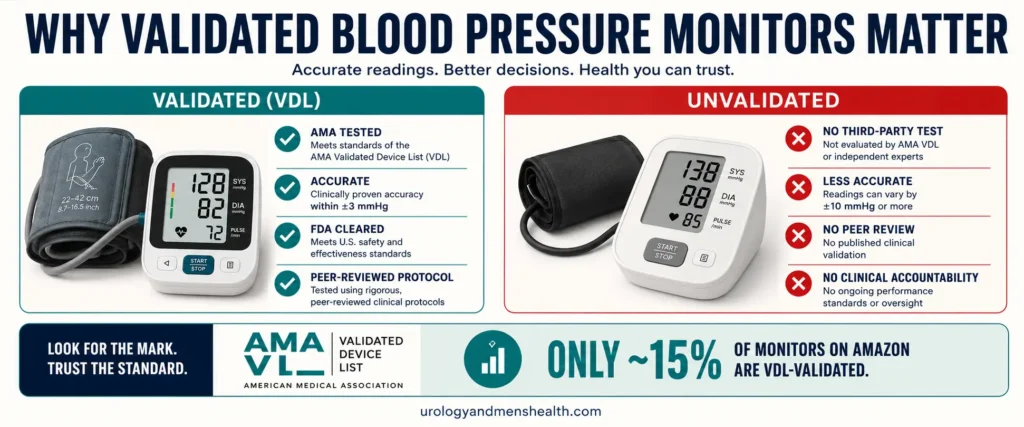
The single most important fact about home blood pressure monitors is that most of them have never been independently tested for accuracy. The American Medical Association created the U.S. Blood Pressure Validated Device Listing (VDL) precisely because the FDA-clearance process for a 510(k) Class II device does not require head-to-head accuracy testing against a mercury sphygmomanometer in a real clinical population. VDL is the standard that does [1]. To make the list, a monitor must pass the ISO 81060-2:2018 protocol — readings on at least 85 patients across a range of arm sizes, with mean error within 5 mmHg and standard deviation under 8 mmHg.
When I evaluate a monitor for a patient, the first thing I do is open validatebp.org and search for the model number. If it is not on the list, I do not recommend it — regardless of how many Amazon reviews it has or what its price tier is. The most common pitfall I see is a man buying a $25 device with 50,000 reviews and using it to make decisions about whether to take his lisinopril. The reviews are real. The accuracy is not.
The second filter is cuff size. A standard-sized cuff on a larger upper arm artificially inflates the systolic reading by 5 to 10 mmHg [2]. This is the most under-discussed source of false hypertension diagnoses in primary care. Every monitor in this guide ships with a wide-range cuff that fits arms from approximately 9 to 17 inches in circumference, which covers the great majority of adult men.
In My Practice
A 56-year-old patient came to me last year convinced he had refractory hypertension. He had been on three antihypertensive medications for two years. His home monitor — an unvalidated $30 device with a standard cuff — was reading 158/96 mmHg consistently. His arm circumference was 16 inches. I asked him to come back with a VDL-validated monitor and a wide-range cuff. The next reading was 132/82 mmHg. Same arm, same morning routine, same medications. His “refractory hypertension” was a cuff sizing artifact.
The lesson: validate the device before you validate the diagnosis.
Upper-Arm vs Wrist Monitors: Why I Will Not Recommend a Wrist Device
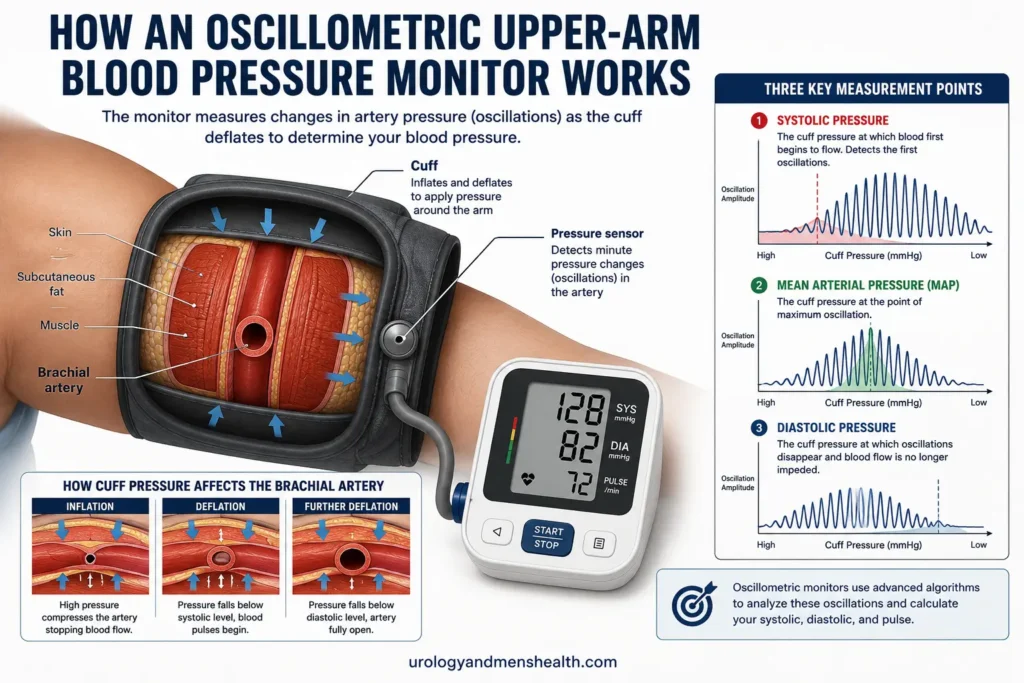
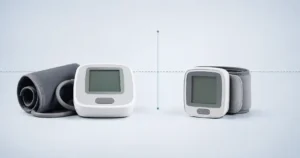
Both the American Heart Association and the American Urological Association recommend against wrist blood pressure monitors for routine home use, and neither does Consumer Reports in its annual testing [3]. The reason is mechanical: wrist arteries are smaller, more peripheral, and far more sensitive to wrist position relative to heart level. A wrist held 2 inches below heart level can read 10 mmHg high, while one held 2 inches above can read 10 mmHg low. The error margin is structural to the anatomy, not the device.
Upper-arm oscillometric monitors work by inflating a cuff above systolic pressure to occlude the brachial artery, then slowly deflating while a pressure sensor detects oscillations from each pulse wave. The cuff identifies systolic blood pressure as the first detectable oscillation, diastolic as the last, and mean arterial pressure as the largest amplitude in between. The brachial artery is larger, more central, and closer to heart level when the arm is properly supported — which is why every monitor in this guide is an upper-arm device. The only context where a wrist monitor is the right answer is in patients whose upper-arm circumference exceeds 17 inches and who cannot get a properly-fitting extra-large cuff. That is a small population, and even those patients should discuss device choice with their physician.
The Five Best Home Blood Pressure Monitors for Men in 2026
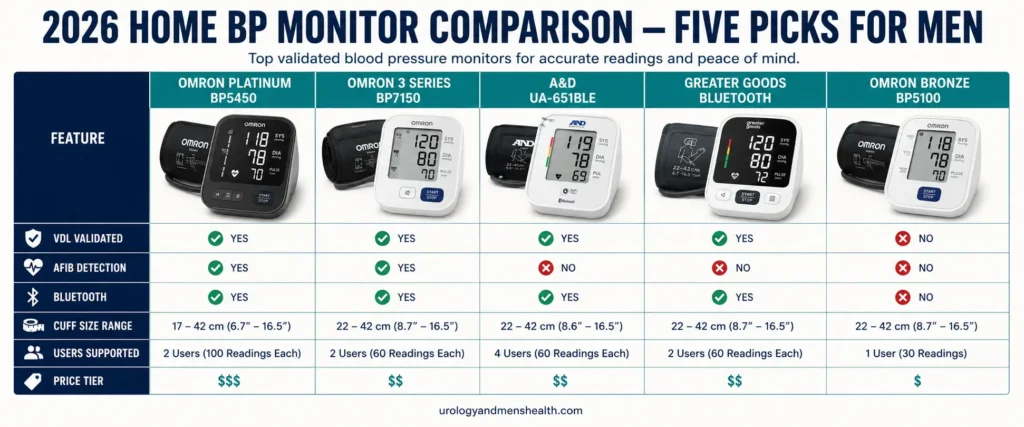
Every monitor below is FDA-cleared, currently in stock on US Amazon as of May 2026, and fits an adult male upper arm without an accessory purchase. Four of the five are on the AMA Validated Device Listing. I have ranked them by the use case they fit best, not by price or popularity.
1. Best Overall — Omron Platinum BP5450
The Omron Platinum BP5450 is the monitor I recommend when a man wants one device that will serve him for the next decade. It is VDL-validated, FDA-cleared, and includes Omron’s TruRead technology, which automatically takes three sequential readings 30 seconds apart and reports the average — exactly what the 2025 AHA/ACC guidelines specify as the proper home monitoring protocol [4]. It stores 100 readings each for two users on the device itself, syncs unlimited readings to the OMRON Connect app via Bluetooth, and includes a high morning average indicator that flags the early-AM blood pressure surge most strongly associated with cardiovascular events.
It also detects atrial fibrillation. AFib is the single most common arrhythmia I see picked up incidentally during BP monitoring, and many men with paroxysmal AFib have no symptoms — they only discover it because their monitor flagged an irregular rhythm. The Platinum’s AFib indicator does not diagnose AFib on its own, but it gives the patient and the urologist or cardiologist a concrete reason to order an ECG. For any man over 55, this feature alone justifies the price difference over the budget pick.
The cuff fits arms 9 to 17 inches in circumference. The only drawback is the price — it sits at the top of the consumer range — and the fact that it requires four AA batteries (an AC adapter is sold separately). For a man who is going to test daily for years, this is the device that makes the most clinical sense.
2. Best Value — Omron 3 Series BP7150
If I had to recommend one monitor to every man over 40 who has never owned a BP device, it would be the Omron 3 Series BP7150. It is the best-selling home BP monitor in the United States for a reason: VDL-validated, FDA-cleared, Bluetooth-enabled, around $50 to $70 depending on the week. It does the three things a home monitor needs to do — measure accurately, log readings, and sync to your phone — without paying for features most men do not use.
What it gives up: it does not average three readings automatically (you take them and average them yourself), it has a basic yes/no irregular heartbeat indicator rather than an AFib-specific algorithm, and it stores only 14 readings on the device. The Bluetooth sync solves the storage problem completely — once paired with the OMRON Connect app, every reading uploads automatically and you can share trend graphs with your doctor via PDF.
For a man who needs to confirm whether he has hypertension at all, or to track response to a new medication for six months, this is the right device. The cuff fits 9 to 17 inches and comes in the box.
3. Best Non-Omron Upper-Arm — A&D Medical UA-651BLE
If you want a VDL-validated alternative to Omron, the A&D Medical UA-651BLE is the cleanest option. A&D has been making professional-grade blood pressure equipment for over 40 years — their devices are common in primary care offices and remote patient monitoring programs in the US. The UA-651BLE is FDA-cleared, listed on the AMA VDL, and validated to the ISO 81060-2:2018 protocol [5].
It includes a feature Omron’s budget models lack: Snapshot Averaging, which calculates a baseline blood pressure from all stored readings automatically. The wide-range cuff fits 8.6 to 16.5 inches, and accessory cuffs (small, medium, large) are available separately for men outside that range. Pairs via Bluetooth with the free A&D Heart Track app and a number of third-party apps including SmartBP. The device stores 30 readings on its own memory.
I recommend this monitor for two specific situations: men who already own A&D’s compatible weight scale or thermometer ecosystem, and men whose physicians use a remote patient monitoring platform that integrates with A&D devices. Otherwise, it is functionally equivalent to the Omron 3 Series at a similar price point.
High blood pressure and worried about your kidneys? Download Dr. Khalid’s Blood Pressure & Kidney Protection Guide.
Enter your email below to receive Dr. Khalid’s complete Blood Pressure & Kidney Protection Guide as a free, printable PDF.
4. Best Budget Pick — Greater Goods Bluetooth Blood Pressure Monitor
The Greater Goods Bluetooth BP Monitor is the only sub-$50 monitor I am willing to recommend. It is FDA-cleared (510(k) #K131395), listed on the AMA Validated Device Listing as model 0040/0604/0664, and has been a Wirecutter top pick five times. The cuff fits 8.7 to 16.5 inches. Bluetooth pairs to the free Balance Health app on iOS and Android. The kit ships with the monitor, cuff, AC adapter, AAA batteries, and a hard-shell travel case — most monitors at this price ship with only batteries.
The trade-off versus the Omron 3 Series is the app ecosystem — Omron’s app is more mature, syncs with Apple Health and Google Fit natively, and is easier for physicians to receive shared reports from. The Greater Goods app does the same job at a more basic level. For a man on a tight budget who needs a clinically defensible device for around $40, this is the answer. Skip the unbranded $20 monitors on Amazon entirely. The Greater Goods is the floor.
5. Best for Travelers — Omron Bronze BP5100
For men who travel often and want the cleanest possible carry-on profile, the Omron Bronze BP5100 is the lowest-friction option. It is FDA-registered, VDL-approved, and FSA/HSA-eligible. The cuff is the standard wide-range 9 to 17 inches, the device is Bluetooth-capable, and the design is single-user with a 14-reading on-device memory plus unlimited storage via the OMRON Connect app. It includes a storage case in the box.
What it gives up versus the Platinum: no AFib detection, no TruRead three-reading averaging, no dual-user storage, no morning average indicator. What it keeps: Omron’s clinical accuracy heritage and a hypertension category indicator that flags systolic readings of 130 mmHg or above. For a frequent business traveler who wants to keep tracking BP through time zone changes and irregular sleep schedules — both of which are documented BP-elevation triggers — the small form factor is the deciding feature.
What to Avoid: Three Categories I Will Not Recommend
- Wrist monitors. Both the AHA and AUA recommend against them. The wrist artery is the wrong site for routine measurement.
- Finger-only monitors and smartwatches with BP claims. No smartwatch on the market is on the AMA VDL for clinical accuracy. Apple, Samsung, and Garmin BP-adjacent features measure pulse transit time or photoplethysmography — useful for trends, not for diagnosing or managing hypertension.
- Unbranded Amazon monitors with no model number listed in the VDL database. If the manufacturer name is one I cannot find on validatebp.org, the device does not get used to make medication decisions. Period.
How to Use Your Monitor Correctly (and Why Most Men Get This Wrong)
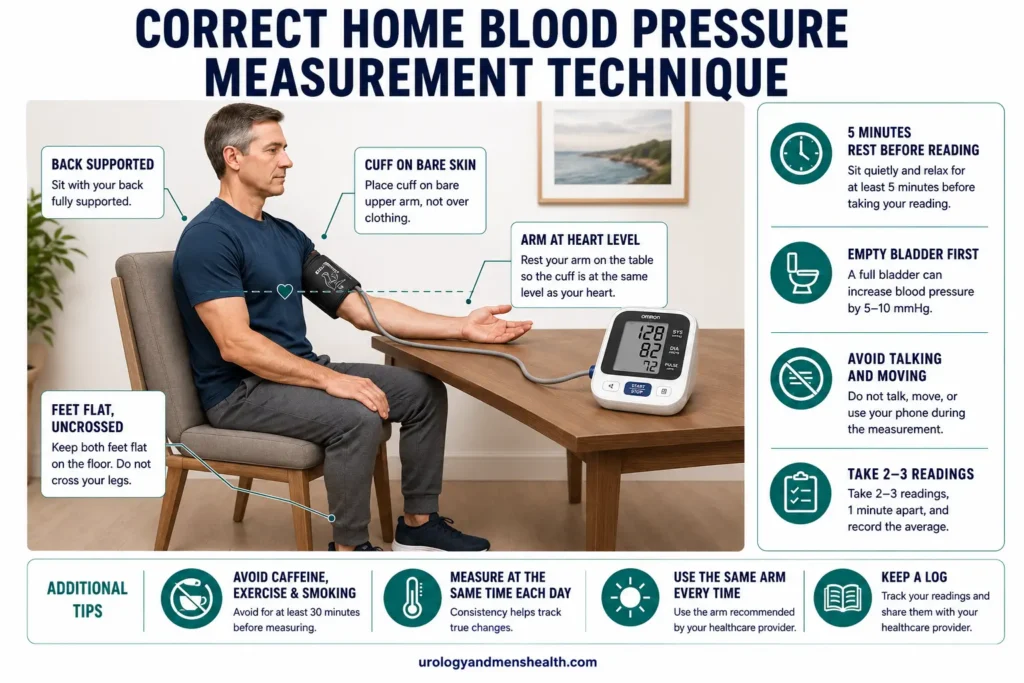
A validated monitor used incorrectly produces invalid data. The 2025 AHA/ACC guidelines specify a standardised home measurement protocol because the difference between a “casual” reading and a protocol reading can be 15 mmHg or more [4]. The protocol is straightforward:
- Avoid caffeine, nicotine, and exercise for 30 minutes before measurement. All three transiently elevate systolic readings by 5 to 10 mmHg.
- Empty your bladder. A full bladder raises systolic BP by approximately 10 mmHg through sympathetic activation.
- Sit quietly for 5 minutes before the first reading. This is not optional. The “sit and immediately measure” approach is responsible for most false-positive home hypertension diagnoses I see in clinic.
- Back supported, feet flat on the floor, legs uncrossed. Crossed legs add 2 to 8 mmHg.
- Cuff on bare skin, not over a sleeve. Cuff on a long-sleeved shirt artificially elevates systolic readings.
- Arm supported at heart level. Arm hanging at the side adds approximately 10 mmHg. Arm above heart level subtracts roughly the same.
- Take three readings, one minute apart, and average the second and third. The first reading is almost always the highest — discard it. This is the AHA/ACC protocol.
Measure twice daily — morning before medication and food, evening before dinner — for at least seven days when establishing a baseline. A reading taken on one isolated afternoon does not constitute home blood pressure monitoring in any clinical sense.
Red Flags: When a Home Reading Means Same-Day Medical Care
Most elevated home readings are not emergencies. These are:
- Systolic 180 mmHg or higher, or diastolic 120 mmHg or higher, with symptoms (chest pain, shortness of breath, severe headache, vision changes, weakness, confusion). This is a hypertensive emergency — call 911.
- Systolic 180 mmHg or higher, or diastolic 120 mmHg or higher, without symptoms, confirmed by two readings 5 minutes apart. This is severe asymptomatic hypertension — go to the emergency room or contact your physician same-day.
- Any home reading paired with new chest pain, new neurological symptoms, or new shortness of breath.
Why This Matters: The Kidney-Blood Pressure Connection
The reason a urologist is writing about blood pressure monitors is that uncontrolled hypertension is the second leading cause of end-stage kidney disease in the United States, behind only diabetes [6]. The mechanism is mechanical: persistently elevated BP damages the glomerular capillaries — the microscopic filters inside each nephron — and once a critical mass of nephrons is lost, the kidney cannot regenerate them. This damage accumulates silently. Serum creatinine often stays “normal” until 50% of kidney function is gone.
Men with hypertension also face a documented bidirectional link with erectile dysfunction — both because the small vessels of the corpora cavernosa share the same endothelial biology as the renal arterioles, and because some antihypertensive medications themselves contribute to ED [7]. A man’s blood pressure number is not just a cardiovascular metric. It is the strongest single predictor of his urological future. The right monitor is the entry point to a measurement habit that protects both organs.
Frequently Asked Questions
Are home blood pressure monitor readings as accurate as readings in a doctor’s office?
With a VDL-validated upper-arm device used correctly, home readings are often more accurate than office readings because they capture multiple data points across different times of day and eliminate the “white coat effect” — the well-documented BP elevation many patients experience in clinical settings. The 2025 AHA/ACC guidelines specifically endorse home blood pressure monitoring as a tool to confirm or rule out hypertension, particularly when office readings sit in the 130-159/85-99 mmHg range. The accuracy advantage disappears if the device is not VDL-validated, the cuff size is wrong, or the measurement technique is poor — all three issues I cover above in the Use Your Monitor Correctly section.
Why is the Omron 3 Series BP7150 better than cheaper monitors with higher Amazon ratings?
The 3 Series is on the AMA Validated Device Listing, which means it has been independently tested against a mercury sphygmomanometer in over 85 patients per the ISO 81060-2:2018 protocol. Most monitors with 4.7-star ratings and 50,000 reviews have never been through that testing — Amazon reviews measure customer satisfaction with packaging, ease of use, and perceived value, not clinical accuracy versus a gold-standard device. The price of validation is roughly $30 over the unvalidated equivalent. For a measurement you may use to decide medication dosing, that is not where to save money.
Should I get the Omron Platinum BP5450 if I do not have AFib?
You may not have AFib yet. Paroxysmal AFib — episodes that come and go — affects an estimated 1 in 25 men over 60 and is often completely asymptomatic until it causes a stroke. The Platinum’s AFib screening feature does not diagnose the condition (only a 12-lead ECG can do that), but it gives you and your physician a concrete reason to investigate further. For men over 55, particularly those with hypertension, diabetes, or a family history of stroke, the AFib screening alone justifies the price difference over the 3 Series. Younger men without risk factors can reasonably choose the 3 Series and save $50.
Is the wrist monitor my father uses really inaccurate?
It is more accurate to say wrist monitors are less consistently accurate. They can give correct readings when wrist position relative to the heart is exactly right — but most patients cannot reproduce that position reliably across hundreds of measurements. The American Heart Association and the Consumer Reports testing program both explicitly recommend upper-arm devices for routine home monitoring. The only situations where a wrist monitor makes clinical sense are very large arm circumferences (above 17 inches) where no fitting cuff is available, or specific medical conditions affecting the upper arm. Otherwise, switch to a validated upper-arm device — the Omron 3 Series at $50-70 is the most accessible upgrade.
How often should a man over 40 measure his blood pressure at home?
If you do not have a diagnosis of hypertension and your office readings are below 130/80 mmHg, twice a year — once a quarter is fine but not required. If you are in the “elevated” range (120-129/under 80) or have a family history of hypertension, monthly readings are reasonable to catch any upward drift. If you have been diagnosed with hypertension or are on antihypertensive medication, the AHA/ACC recommends home monitoring twice daily (morning and evening) for at least one week each month, plus an intensive week before any physician visit. Use the BP Log & Trend Tracker to generate a printable summary for your appointment.
What blood pressure reading at home actually means I have hypertension?
Per the 2025 AHA/ACC guidelines, hypertension is diagnosed when home blood pressure readings consistently show systolic 130 mmHg or higher and/or diastolic 80 mmHg or higher across multiple readings over at least 7 days. A single reading of 135/85 mmHg on a stressful afternoon does not constitute hypertension. A pattern of morning averages of 130/80 mmHg or higher across an entire week does. If your home readings meet that threshold, the next step is a primary care or urology consultation to assess kidney function, evaluate cardiovascular risk, and discuss whether medication is appropriate — the answer is often no, and lifestyle modification is the first step in stage 1 hypertension.
References
- American Medical Association. US Blood Pressure Validated Device Listing. validatebp.org. validatebp.org
- Ishigami J, et al. Effects of Cuff Size on the Accuracy of Blood Pressure Readings: The Cuff(SZ) Randomized Crossover Trial. JAMA Intern Med. 2023;183(10):1061-1068. PubMed
- American Heart Association. Monitoring Your Blood Pressure at Home. heart.org. Updated 2024. AHA
- Jones DW, et al. 2025 AHA/ACC/AANP/AAPA/ABC/ACPM/AGS/AMA/ASPC/NMA/PCNA Guideline for the Prevention, Detection, Evaluation, and Management of High Blood Pressure in Adults. Hypertension. 2025. PubMed
- Topouchian J, et al. Validation of the A&D BP UA-651 device with a wide-range cuff for home blood pressure measurement according to the European Society of Hypertension International Protocol revision 2010. Blood Press Monit. 2015;20(1):52-55. PubMed
- National Institute of Diabetes and Digestive and Kidney Diseases. High Blood Pressure & Kidney Disease. niddk.nih.gov. 2024. NIDDK
- Nunes KP, et al. New insights into hypertension-associated erectile dysfunction. Curr Opin Nephrol Hypertens. 2012;21(2):163-170. PubMed
Dr. Muhammad Khalid
MBBS · FCPS (Urology) · MCPS (General Surgery) · CHPE · CRSM · IMC #539472
Specialist urologist with 11+ years of clinical experience across tertiary teaching hospitals. Trained at Lady Reading Hospital and Khyber Teaching Hospital, Peshawar. Author or co-author of five peer-reviewed international publications, including in Cureus and the World Journal of Surgery. Procedural expertise: URS, PCNL, RIRS, TURP, TURBT, and major open urological surgery. Full profile →
This article is for educational purposes only and does not constitute medical advice. Always consult your physician or urologist for diagnosis and treatment decisions specific to your condition.