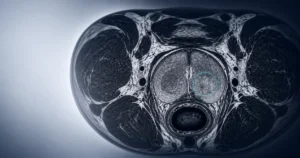
Prostate Biopsy: What to Expect & How to Prepare
Hearing you need a prostate biopsy usually triggers immediate anxiety about the physical procedure itself. Yet the actual process is a quick outpatient visit that feels more like firm pressure than the sharp pain men imagine. Here is what I explain in clinic.

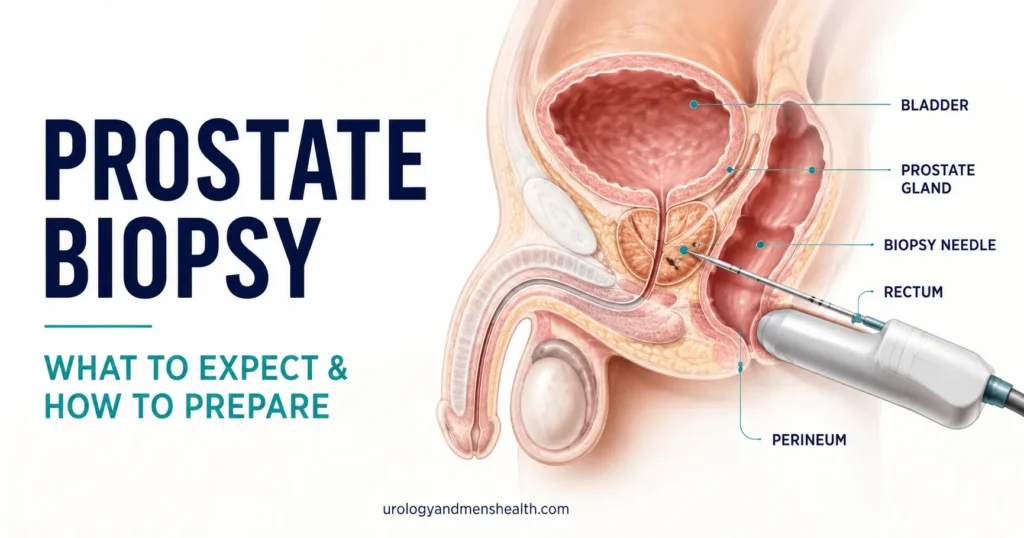
A prostate biopsy what to expect question is the one I get most often after a man learns his PSA is elevated or his MRI shows a suspicious lesion. The anxiety is rarely about cancer itself at that point — it is about the procedure. Men have heard the word “biopsy” associated with the prostate and assumed something far worse than the reality. In my clinic, the most common reaction after the procedure is, “That was it?” The procedure takes 15 to 20 minutes, is performed under local anaesthesia in most cases, and the discomfort is closer to a firm pressure than the sharp pain men imagine. What matters far more than the procedure itself is the preparation, the type of biopsy chosen, and the conversation about what to do with the results.
Key Takeaways
- A modern prostate biopsy takes 15-20 minutes under local anaesthesia and most men describe it as uncomfortable pressure rather than sharp pain.
- Transperineal biopsy has a near-zero sepsis risk compared with 2-5% for transrectal biopsy, and AUA 2024 guidance now favors transperineal as the default approach.
- You should request an MRI before biopsy if you have not already had one — the AUA 2024 amendment recommends multiparametric MRI as the first-line investigation for elevated PSA.
- Antibiotic prophylaxis, holding blood thinners under cardiology guidance, and bowel preparation for transrectal biopsies are the three preparation steps that determine your infection and bleeding risk.
- Blood in urine for up to 2 weeks and blood in semen for up to 6 weeks are normal — they do not mean something has gone wrong.
Why a Prostate Biopsy Gets Recommended in the First Place
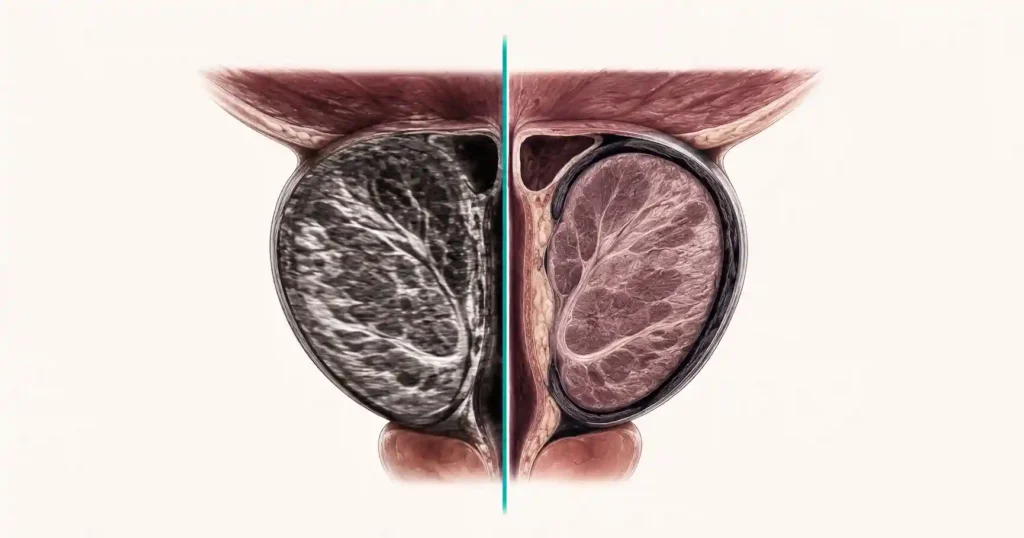
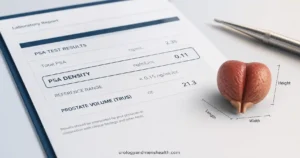
A prostate biopsy is the only definitive way to confirm or rule out prostate cancer. Imaging and PSA tests can raise suspicion, but they cannot give a tissue diagnosis. The American Urological Association 2024 guideline amendment [1] recommends biopsy when one or more of the following are present: a confirmed elevated PSA after repeat testing, a PSA velocity greater than 0.75 ng/mL per year, an abnormal digital rectal examination, a suspicious lesion on multiparametric MRI rated PI-RADS 3 with elevated PSA density or PI-RADS 4 or 5, or a strong family history with rising PSA in a man over 45.
What has changed since 2019 is the role of MRI. The AUA now recommends multiparametric MRI before a first biopsy in most men with elevated PSA. This single change has reduced unnecessary biopsies by roughly 30% in the populations where it has been adopted [2]. If your urologist has scheduled you for a biopsy without an MRI, that is a question worth raising — there are scenarios where it is still appropriate (PSA above 20, very abnormal DRE, or limited MRI access), but for the typical grey-zone PSA between 4 and 10 ng/mL, MRI-first is now the standard of care.
→ Related read: Prostate MRI vs. Biopsy — Why MRI Should Come FirstTransperineal vs Transrectal: The Most Important Decision
There are two main approaches to a prostate biopsy, and the difference between them matters more than most men realise. The traditional approach is transrectal ultrasound-guided biopsy (TRUS), where the needle passes through the rectal wall to reach the prostate. The newer approach is transperineal biopsy, where the needle enters through the perineum — the skin between the scrotum and the anus — and the rectum is never breached.
The clinical difference comes down to infection risk. Transrectal biopsies carry a 2-5% risk of post-biopsy sepsis, and that risk has been rising globally as antibiotic resistance grows [3]. Transperineal biopsies have a sepsis rate close to zero — published data puts it below 0.1% [4]. The AUA 2024 amendment now favors transperineal biopsy as the default approach in centers that have adopted it. The trade-off used to be that transperineal biopsies required general anaesthesia, but local-anaesthesia transperineal technique is now widely available and most men tolerate it well.
In My Practice
I had a patient last year — a fit 62-year-old runner with PSA of 6.8 — who had read online that transrectal biopsies were “what everyone gets” and was genuinely surprised when I offered him a transperineal approach instead. He asked why his GP had not mentioned it. The honest answer is that uptake is uneven, and many men who book biopsies at general hospitals are still defaulted to transrectal because that is what the rota is set up for. He had his transperineal biopsy under local, was home in two hours, and his only complaint was a small bruise.
If you are scheduling a biopsy in 2026, ask explicitly which approach you will receive and why — the answer reveals how current the unit is.
How to Prepare for a Prostate Biopsy: The 7-Day Timeline
Preparation determines two things: your infection risk and your bleeding risk. Both are manageable if you do the right things at the right time.
7 Days Before
Review every medication you take with both your urologist and your prescribing doctor — never stop a blood thinner on your own. Aspirin is usually safe to continue for transperineal biopsy and is often stopped 7 days before transrectal biopsy. Clopidogrel, ticagrelor, warfarin, apixaban, rivaroxaban, and edoxaban require a coordinated stop date and, in some cases, bridging — that decision must come from the cardiologist who placed your stent or initiated the medication, not from a website. Fish oil, vitamin E, ginkgo, and high-dose turmeric supplements all have antiplatelet effects and should be stopped 7 days before. Document the conversation in your notes — “Dr. [name] confirmed stop apixaban X days before, restart Y days after.”
3 Days Before
If you are having a transrectal biopsy, your urologist will prescribe antibiotic prophylaxis — typically a fluoroquinolone such as ciprofloxacin, or a more targeted antibiotic based on rectal swab culture in centers that perform “targeted prophylaxis.” Take the antibiotic exactly as prescribed. Do not skip doses because you “feel fine.” Confirm with the prescribing doctor that you have no fluoroquinolone allergy and no recent tendon problems — fluoroquinolones carry a small but real tendinopathy risk that matters in active men. For transperineal biopsies, a single dose of antibiotic at the time of procedure is usually sufficient, sometimes none at all in lowest-risk patients.
The Day Before
For transrectal biopsies, you will be asked to use a phosphate or saline enema 1-2 hours before the procedure to clear the rectum. Follow the instructions exactly — a partial bowel preparation is worse than none because it leaves debris around the needle path. Eat a normal evening meal, hydrate well, and avoid alcohol. For transperineal biopsies, bowel preparation is usually not required, which is one of the smaller but genuinely appreciated advantages.
Facing a PSA result you do not fully understand? Download Dr. Khalid’s PSA & Prostate Cancer Decision Guide.
Enter your email below to receive Dr. Khalid’s complete PSA & Prostate Cancer Decision Guide as a free, printable PDF.
What the Procedure Actually Feels Like
I want to describe this honestly because the imagined version is almost always worse than the reality. You will be positioned either on your side with knees drawn up (transrectal) or on your back with legs supported (transperineal). The doctor performs a digital rectal examination first, then an ultrasound probe is inserted into the rectum to image the prostate. This part is uncomfortable pressure, not pain. Most men describe it as similar to a firm DRE.
Local anaesthetic is then injected around the prostate — this is the moment most men brace for and almost universally report as “not as bad as expected.” There is a sharp pinch lasting 2-3 seconds, then numbness. Once the local has taken effect, the biopsy itself is taken in cores using a spring-loaded needle device. You will hear a loud click each time a core is taken. The click is louder than the sensation. Most men describe a quick pressure or thump, not pain. A typical biopsy takes 10-14 cores and the sampling phase lasts 5-8 minutes.
If you are having an MRI fusion biopsy — where the MRI images are overlaid on the live ultrasound to target specific lesions — the procedure takes slightly longer (15-20 minutes total) because targeted cores are taken from the suspicious area in addition to the systematic sampling. This is the gold standard when an MRI has identified a PI-RADS 4 or 5 lesion [5].
The First Week After: What’s Normal and What Isn’t
Three side effects are normal and should not alarm you, but they last longer than most men expect.
Blood in urine (hematuria) is normal for up to 2 weeks. The colour can range from pale pink to bright red and may come and go. As long as the urine is flowing freely and the colour is not deep crimson with clots, this is expected. Blood in semen (hemospermia) is normal for up to 6 weeks and can look alarming because the semen turns rust-coloured, brown, or even black as old blood breaks down. This is harmless. Tell your partner in advance so neither of you panics the first time it appears. Blood in stool may occur for 1-3 days after a transrectal biopsy and should be minor — streaks rather than active bleeding.
When to Go Straight to the Emergency Room
The single most dangerous post-biopsy complication is sepsis, which usually presents 24-72 hours after a transrectal biopsy. Go to the emergency room the same day — do not wait for an urgent care appointment — if you develop any of the following:
- Fever above 38.5°C (101.3°F), with or without chills or shaking
- Inability to pass urine for more than 8 hours combined with abdominal discomfort
- Heavy bleeding from the rectum that does not stop within 30 minutes of pressure
- Bright red urine with large clots that you cannot pass
- Severe lower abdominal or back pain, especially with feeling unwell
- Confusion, dizziness, or rapid heartbeat
Bring a written note of your biopsy date, the antibiotic you took, and any allergies. Ask specifically to be assessed for post-biopsy urosepsis — early IV antibiotics save lives.
Understanding Your Biopsy Results
Results typically take 7-14 working days. The pathology report will fall into one of three broad categories.
Benign (no cancer detected) means no cancer cells were seen in the cores taken. It does not absolutely rule out cancer — a biopsy samples roughly 1% of the prostate volume — but combined with a reassuring MRI it is highly reassuring. You will likely be returned to PSA surveillance every 6-12 months, with a repeat biopsy considered only if the PSA rises significantly or the MRI changes.
Atypical findings (ASAP or HGPIN) are pre-cancerous or suspicious cellular changes that are not cancer but increase the likelihood that cancer is present nearby. Atypical small acinar proliferation (ASAP) carries a 30-40% risk of cancer being found on repeat biopsy within 12 months [6]. High-grade prostatic intraepithelial neoplasia (HGPIN) carries a lower but still real risk. Both findings warrant a follow-up MRI and a planned repeat biopsy, usually within 6-12 months.
Cancer detected means at least one core showed adenocarcinoma. The report will give you a Gleason score — two numbers added together (for example, 3+4=7) — and a corresponding Grade Group from 1 to 5. Grade Group 1 (Gleason 3+3=6) is the lowest-risk cancer and is increasingly managed by active surveillance rather than immediate treatment. Grade Group 5 (Gleason 9-10) is high-risk and requires prompt treatment decisions. The number of positive cores, the percentage of each core involved, and any extracapsular extension noted on MRI all factor into the staging conversation.
→ Related read: Gleason Score Explained — What Your Biopsy Report MeansQuestions to Ask Your Urologist Before the Biopsy
The single best predictor of a smooth biopsy experience is asking the right questions in advance. Print this list and bring it to your pre-biopsy consultation:
- Have I had a multiparametric MRI? If not, request one before biopsy unless your urologist gives a specific reason against it.
- Will this be a transperineal or transrectal approach, and why? The answer reveals how current the unit’s practice is.
- If transrectal, am I a candidate for rectal swab targeted antibiotic prophylaxis? This reduces sepsis risk further.
- How many cores will be taken and from which zones? Standard is 10-14 systematic cores; targeted cores are added if there is an MRI lesion.
- Who reviews the pathology, and how do I receive the result? Confirm whether you will be called or expected to attend an appointment, and the expected timeframe.
- What is the plan if the result is benign but my PSA continues to rise? This is the question most men forget to ask. A follow-up plan should exist before the biopsy, not after.
If your urologist cannot answer these questions clearly, request a second opinion before proceeding. A biopsy is a low-risk procedure when done well, but the decisions around it deserve a clinician who treats you as a partner in the process. You can use the Prostate Cancer Risk Calculator to estimate your 5-year risk and bring that number to the conversation as well.
Frequently Asked Questions
How painful is a prostate biopsy?
Most men describe a modern prostate biopsy as uncomfortable pressure rather than sharp pain. Local anaesthetic is injected around the prostate before any cores are taken, and the injection itself causes a brief 2-3 second sting before the area goes numb. The biopsy needle device makes a loud clicking sound that is more startling than painful. If you have a low pain tolerance or significant anxiety, ask whether sedation or general anaesthesia is available at your hospital.
How long does it take to recover from a prostate biopsy?
Most men return to office work the next day and resume light exercise within 3-4 days. Avoid heavy lifting, cycling, and vigorous exercise for 7 days to reduce bleeding risk. Sexual activity can usually resume after 7-10 days, though semen will remain rust-coloured or brown for up to 6 weeks — this is harmless. The full healing of the prostate tissue takes around 6 weeks. If you have a desk job, plan to take the day of the biopsy off and you will usually feel ready to work the following morning.
What is the difference between transperineal and transrectal prostate biopsy?
The biopsy needle takes a different path. In a transrectal biopsy, the needle passes through the rectal wall to reach the prostate, which carries a 2-5% risk of sepsis. In a transperineal biopsy, the needle enters through the skin between the scrotum and anus, avoiding the rectum entirely — sepsis risk is below 0.1%. The AUA 2024 amendment now favors transperineal as the default approach. Cancer detection rates are similar between the two, sometimes slightly better with transperineal for anterior tumors.
Can a prostate biopsy miss cancer?
Yes. A standard biopsy samples roughly 1% of the prostate volume across 10-14 cores, so it can miss small cancers, particularly those in the anterior gland that are harder to reach via the transrectal approach. This is exactly why multiparametric MRI before biopsy matters — it identifies suspicious areas that targeted cores can then sample directly, raising detection of significant cancers by around 30%. If your PSA continues to rise after a negative biopsy, a repeat MRI and targeted re-biopsy is the standard next step rather than waiting.
How long does it take to get prostate biopsy results?
Most pathology laboratories return results within 7-14 working days. Complex cases involving immunohistochemistry or second-opinion pathology review can take up to 3 weeks. Ask your urologist’s office at the time of biopsy whether they will phone you with the result or expect you to attend an appointment. If you have not heard anything by day 14, call the office — do not assume “no news is good news.” Results occasionally get held up at the pathology lab rather than the urology clinic.
What blood thinners do I need to stop before a prostate biopsy?
This decision must come from the doctor who prescribed the medication — usually your cardiologist or stroke physician — not from a website or your urologist alone. Aspirin is often continued for transperineal biopsy and stopped 7 days before transrectal. Clopidogrel, warfarin, apixaban, rivaroxaban, and edoxaban require a coordinated stop and restart plan based on why you are on them (recent stent vs atrial fibrillation vs DVT history). Fish oil, vitamin E, and ginkgo should all be stopped 7 days before. Get the plan in writing.
References
- Wei JT, Barocas D, Carlsson S, et al. Early Detection of Prostate Cancer: AUA/SUO Guideline 2023 Amendment. American Urological Association. 2023. AUA
- Kasivisvanathan V, Rannikko AS, Borghi M, et al. MRI-Targeted or Standard Biopsy for Prostate-Cancer Diagnosis (PRECISION trial). N Engl J Med. 2018;378(19):1767-1777. NEJM
- Liss MA, Ehdaie B, Loeb S, et al. The Prevention and Treatment of the More Common Complications Related to Prostate Biopsy Update. Journal of Urology. 2017;198(2):329-334. AUA
- Pradere B, Veeratterapillay R, Dimitropoulos K, et al. Nonantibiotic Strategies for the Prevention of Infectious Complications following Prostate Biopsy: A Systematic Review and Meta-Analysis. Journal of Urology. 2021;205(3):653-663. AUA
- EAU Guidelines on Prostate Cancer. European Association of Urology. 2024 Edition. EAU
- Epstein JI, Herawi M. Prostate Needle Biopsies Containing Prostatic Intraepithelial Neoplasia or Atypical Foci Suspicious for Carcinoma: Implications for Patient Care. Journal of Urology. 2006;175(3):820-834. PubMed
Dr. Muhammad Khalid
MBBS · FCPS (Urology) · MCPS (General Surgery) · CHPE · CRSM · IMC #539472
Specialist urologist with 11+ years of clinical experience across tertiary teaching hospitals. Trained at Lady Reading Hospital and Khyber Teaching Hospital, Peshawar. Author or co-author of five peer-reviewed international publications, including in Cureus and the World Journal of Surgery. Procedural expertise: URS, PCNL, RIRS, TURP, TURBT, and major open urological surgery. Full profile →
This article is for educational purposes only and does not constitute medical advice. Always consult your physician or urologist for diagnosis and treatment decisions specific to your condition.