
IPSS Prostate Symptom Score Calculator
The IPSS is the internationally validated questionnaire urologists use to grade an enlarged prostate (BPH) — seven questions plus a quality-of-life rating, under two minutes, scored mild, moderate, or severe. Answer for the past month, track the number over time, and take it to your appointment. It is a screening aid, not a diagnosis. For related guides, see the full Prostate Health Hub.

The Tool
Related Prostate Tools
Full Clinical Guide
In This Guide:
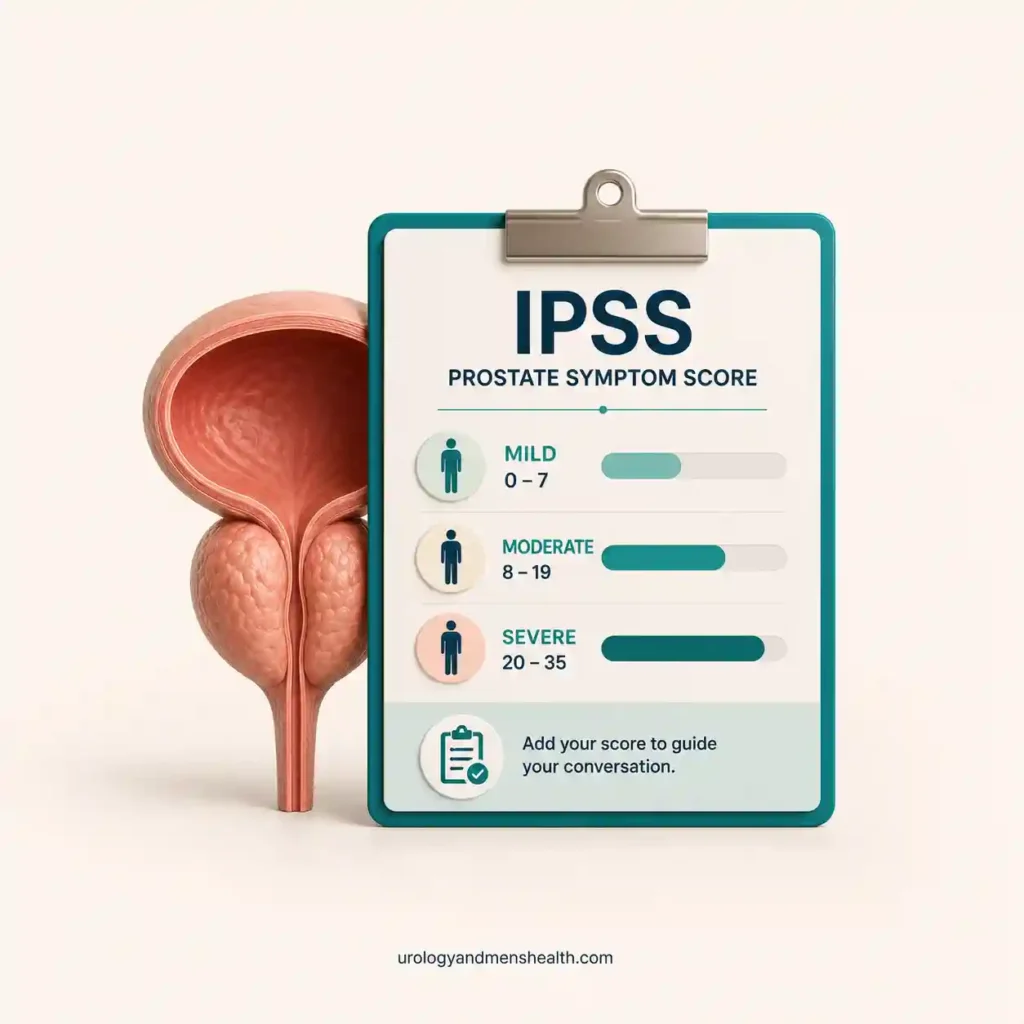
- The IPSS scores seven urinary symptoms from 0 to 35: 0–7 mild, 8–19 moderate, 20–35 severe.
- It splits into voiding (obstruction) and storage (bladder overactivity) symptoms — and the split points toward different treatments.
- The trend over time matters more than any single score — retake it to see whether treatment is working.
- It is a screening aid to bring to your doctor, not a diagnosis.
What the IPSS Prostate Symptom Score Measures
The IPSS prostate symptom score measures the burden of lower urinary tract symptoms (LUTS) in men, from seven questions about voiding and storage difficulties plus an eighth quality-of-life rating. The questionnaire was developed by a measurement committee of the American Urological Association and validated in a landmark 1992 study by Barry and colleagues, conducted in 318 men – 210 with BPH and 108 controls – which established the scoring tiers still used today [1]. The American Urological Association continues to recommend the IPSS as the first-line symptom assessment in its BPH/LUTS guideline [2], and the European Association of Urology endorses the same instrument internationally [4]. The tool exists because a number is more useful than a description: “I pee a lot at night” tells me little, but a nocturia score of 4 with a total of 22 tells me exactly where to start.
The Physiology Behind the Score
The prostate sits like a ring around the urethra at the base of the bladder. As men age the gland enlarges and squeezes the urethra running through it – exactly as a thumb pinching a garden hose narrows the stream. This obstruction produces the voiding symptoms (weak stream, hesitancy, intermittency, incomplete emptying), captured by four of the seven questions. Behind that obstruction the bladder muscle has to push harder to overcome the resistance, and over months to years it becomes irritable and overactive. That irritability produces the storage symptoms (frequency, urgency, and waking at night to urinate, called nocturia), captured by the other three. This is why the IPSS splits into two domains: voiding-dominant scores point toward outflow obstruction, storage-dominant scores point toward bladder overactivity, and the treatment paths diverge from there. The BPH Treatment Finder uses that same domain breakdown to map you to a first-line therapy.
How to Interpret Your Result
A score of 0 to 7 is mild, the same cut-offs used in national guidelines [3]: most men here do not need medication, and structured behavioral measures alone produce meaningful improvement. A score of 8 to 19 is moderate – the band where most men with BPH first present, and where medication is genuinely worth discussing. The shift from mild to moderate usually reflects the bladder starting to compensate for prostatic resistance, the point at which lifestyle alone tends to plateau. A score of 20 to 35 is severe: the obstruction is significant enough that the long-term risk of acute urinary retention (sudden inability to pass urine, needing emergency catheterization) is meaningfully higher, and surgical options enter the conversation. Untreated, symptoms tend to creep upward slowly – population data show the average score rising by roughly 2 points over 5 years – so the trend over time matters more than any single reading.
Read: Enlarged Prostate (BPH) – When Surgery Becomes the AnswerWhat to Do With Your Result
If your score is mild, run a six-week behavioral trial: cut caffeine after mid-afternoon, limit fluids to about 150 mL (5 fl oz) per hour in the three hours before bed, retrain your bladder with timed voiding every 2.5 to 3 hours, and add ten slow pelvic floor contractions twice daily – then retake the IPSS. If it is moderate, book a urology or primary care appointment within two to four weeks and ask specifically for a PSA blood test, a urine flow rate (uroflowmetry), and a prostate and bladder ultrasound with post-void residual [2]; those tests decide whether tamsulosin alone or combination therapy is the right start. If you have already started a prostate medication, the BPH Medication Side Effect Checker helps you track which symptoms are responding. If your score is severe, see a urologist within about two weeks and pair this result with the Prostate Volume Calculator to clarify whether surgical options are realistic. If you are unsure about your result, the PDF report this tool generates gives you a ready-made framework to bring to your next appointment.
Read: Nocturia – Why You Wake at Night to UrinateIn My Practice
The IPSS is most useful when men retake it and bring me the trend. I had a patient who scored 18 at his first visit, started tamsulosin, and came back six weeks later at 9. Textbook response – and the temptation is to call it cured. It is not. The medication relaxes the muscle and masks the obstruction; stop it and the score climbs back. So I tell every patient the same thing: a falling IPSS means the treatment is working, not that the disease has gone.
The score is a thermometer, not a cure – use it to track whether treatment is working, not to tell you whether the disease is still there.
References
- Barry MJ, Fowler FJ Jr, O’Leary MP, et al. The American Urological Association symptom index for benign prostatic hyperplasia. J Urol. 1992;148(5):1549-1557. The validation study behind the IPSS (318 men).
- Sandhu JS, Bixler BR, Dahm P, et al. Management of Lower Urinary Tract Symptoms Attributed to Benign Prostatic Hyperplasia: AUA Guideline. American Urological Association.
- National Institute for Health and Care Excellence. Lower urinary tract symptoms in men: management (CG97). Defines the mild 0-7, moderate 8-19, severe 20-35 bands.
- Gravas S, Cornu JN, Gacci M, et al. EAU Guidelines on Management of Non-Neurogenic Male LUTS. European Association of Urology.
Frequently Asked Questions
What is the IPSS prostate symptom score and why do urologists use it?
The IPSS prostate symptom score is a validated 7-question symptom questionnaire developed by the American Urological Association and endorsed by the European Association of Urology as the standard tool for evaluating lower urinary tract symptoms in men. A score of 0 to 7 is mild, 8 to 19 is moderate, and 20 to 35 is severe. Urologists use it to guide treatment decisions, track response to medication, and judge whether surgery needs discussing. It is the fastest way to turn your symptoms into a clinically actionable number. Read more in our guide to BPH treatment options.
At what IPSS score does a urologist typically recommend medication for BPH?
Guidelines support watchful waiting for mild symptoms (0 to 7) with no real impact on quality of life. For moderate symptoms (8 to 19), medication is discussed, usually starting with an alpha-blocker such as tamsulosin, which relaxes the smooth muscle in the prostate and bladder neck. For severe symptoms (20 to 35), combination therapy or surgical referral is often appropriate. The quality-of-life answer carries real weight too: a man with a moderate score of 12 but a QoL of 6 (Terrible) is treated more actively than his raw number alone suggests. The BPH Treatment Finder walks through how options are matched to a symptom pattern.
Can my IPSS prostate symptom score improve without medication?
Yes, particularly for mild to low-moderate scores. Timed voiding (training the bladder to hold urine at gradually longer intervals), restricting fluids in the 2 to 3 hours before bed, cutting caffeine and alcohol, and pelvic floor exercises all help. In practice these behavioral measures together can move a score by several points, which is clinically meaningful. For men in the moderate range I usually give a dedicated 6-week lifestyle trial before introducing medication. See our BPH treatment article for the full conservative protocol.
Does a high IPSS score mean I might have prostate cancer?
No. The IPSS measures urinary symptoms, which are caused by benign prostatic hyperplasia far more often than by cancer. Early prostate cancer usually causes no urinary symptoms at all, which is exactly why a separate PSA blood test exists for screening. A high score is a reason to see a urologist, who will also check your PSA and examine you, but it does not imply cancer. The two can coexist, but one does not predict the other. Our prostate cancer screening guide explains what testing fits your age.
How fast can my IPSS score change?
Behavioral changes can shift a score by several points within four to six weeks. Untreated BPH itself progresses slowly – population data show the average score rising by roughly 2 points over a 5-year period, though individual variation is wide. What matters is the trend over a six- to twelve-month window, not a single snapshot. A jump of several points between assessments without an obvious trigger is worth a urology appointment to rule out infection, retention, or rapid enlargement. Track alongside the BPH Medication Side Effect Checker if you have started a new prescription.
How accurate is this tool, and can I rely on it?
This tool uses the validated International Prostate Symptom Score exactly as it is scored in clinical practice, so the number it produces is the same one a doctor would calculate from the same answers. Barry and colleagues’ 1992 validation study showed strong test-retest reliability and clear separation between symptomatic and asymptomatic men, and both the AUA and EAU recommend it as first-line. What it cannot do is examine you, measure your flow, or rule out other causes. It is a screening aid to inform a conversation with your doctor, not a replacement for assessment. Use it to prepare, then take the result to a clinician, and read our BPH guide for the workup that follows.
How do I use this result at my doctor’s appointment?
Use the Download My Report button after finishing the questionnaire. The PDF lists every question and your answer, your total score, your storage and voiding subscores, your quality-of-life rating, your next steps, and a short set of score-specific questions for your doctor. Bring it printed or open on your phone and hand it over at the start of the consultation rather than waiting to be asked. It saves the doctor several minutes of history-taking and keeps the appointment focused on the things you wanted to raise. Read our BPH guide before your visit.
Dr. Muhammad Khalid
MBBS · FCPS (Urology) · MCPS (General Surgery) · CHPE · CRSM · IMC #539472
Specialist urologist with 11+ years of clinical experience across tertiary teaching hospitals. Trained at Lady Reading Hospital and Khyber Teaching Hospital, Peshawar. Author or co-author of five peer-reviewed international publications, including in Cureus and the World Journal of Surgery. Procedural expertise: URS, PCNL, RIRS, TURP, TURBT, and major open urological surgery. Full profile →
This article is for educational purposes only and does not constitute medical advice. Always consult your physician or urologist for diagnosis and treatment decisions specific to your condition.