
UTI Risk Assessment for Men
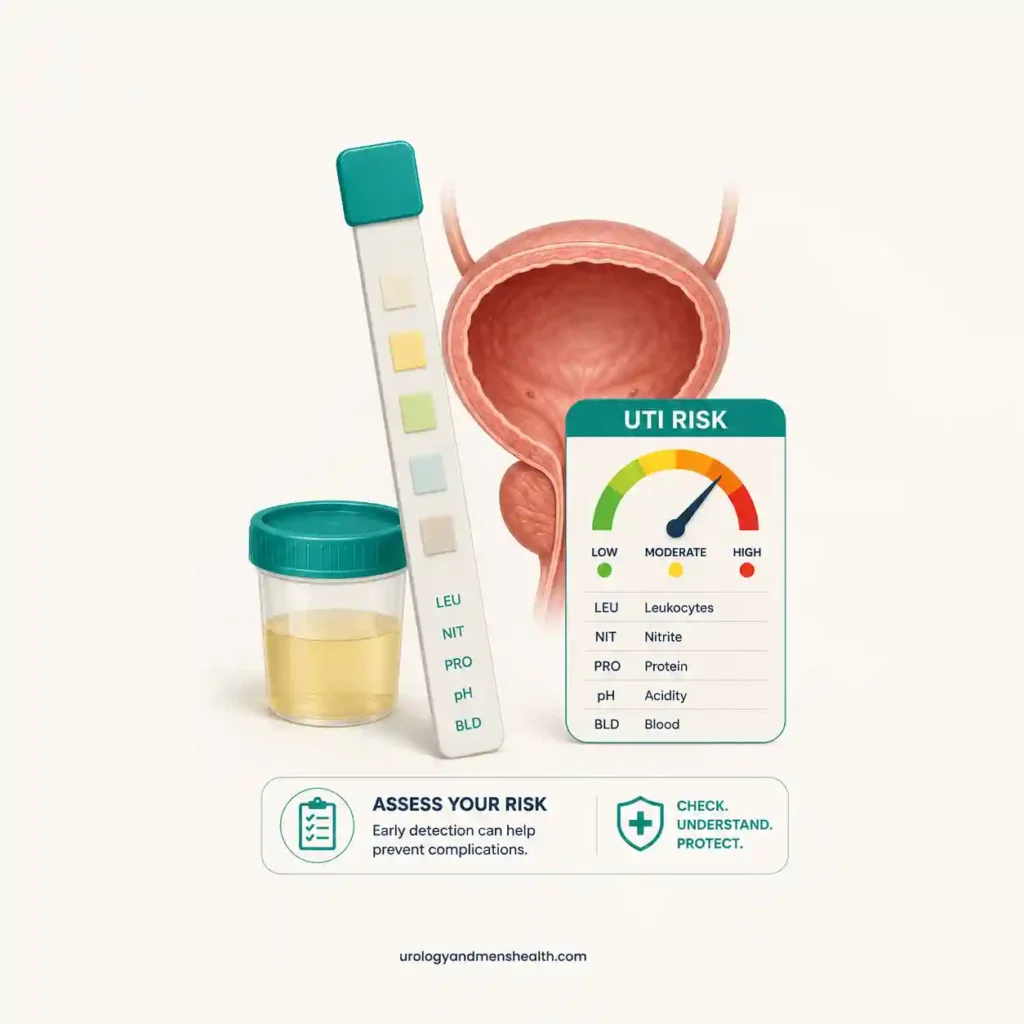
This UTI risk assessment for men helps you work out what to do about your urinary symptoms right now - whether you need emergency care, a doctor's visit with a urine culture, or simply watchful waiting. It is built for men, because a urinary tract infection behaves and is managed differently in men than in women. Answer a few plain questions about your symptoms and health, then read the full guide in the UTIs & Infections hub.

The Tool
Related UTI Tools
Full Clinical Guide
In This Guide:
- A UTI in a man is never “just” a UTI – guidelines now sort it by whether the infection has stayed in the bladder or moved beyond it.
- Fever, one-sided back pain, or inability to urinate mean same-day care, not a routine appointment.
- In men, the right move is almost always a urine culture before antibiotics, not a guessed prescription.
- Repeat infections have a cause – a prostate, emptying, or stone problem – and deserve a workup, not just another course of tablets.
What This Tool Assesses
This UTI risk assessment for men is a routing tool, not a diagnosis. It takes what you can honestly report – your symptoms, and a short list of health factors – and points you to the right level of care: emergency, a prompt doctor’s visit, or watchful waiting. It is deliberately built for men because a urinary tract infection is managed differently here than in women. There is no single validated score for male UTI risk the way there is for prostate symptoms, so the logic follows current European Association of Urology and Infectious Diseases Society of America guidance rather than a homemade points system. If you want the background on why men get UTIs and when to worry, start with my guide to UTI in men: causes and when to worry.
Why a UTI in a Man Is Different
For decades, every urinary infection in a man was labelled “complicated” by default. That has changed. Updated guidance now classifies a UTI by whether it has stayed in the bladder or spread beyond it – and the clearest signal of spread is fever. An afebrile man with burning and frequency has a bladder infection (cystitis); a man with fever, chills, and one-sided flank pain likely has the infection in a kidney (pyelonephritis), which is a different problem with a longer treatment course. On top of that, host and anatomical factors matter: diabetes, a urinary catheter, obstruction or incomplete emptying from an enlarged prostate, kidney stones, a recent procedure, or a weakened immune system all push an infection toward the higher-risk category. That is the machinery behind the questions this tool asks – it is trying to place you on the same map a urologist uses. A useful early check of one of those factors is my Post-Void Residual Estimator, since urine left behind after you go is a quiet driver of repeat infection.
How to Read Your Result
The tool sorts you into one of three routes. The urgent / emergency route means your answers included a red-flag combination – fever with chills, flank pain, confusion, or an inability to urinate – and you should be seen the same day. The get-evaluated route means your symptoms fit a UTI and, in a man, that warrants a doctor’s visit with a urine culture rather than self-treatment. The low-likelihood route means you have no urinary symptoms now, so an infection is unlikely, and bacteria found without symptoms should usually be left alone. To make the difference concrete: a 30-year-old man with a few days of burning and no other health issues, and a 68-year-old man with diabetes, a fever, and a catheter, will both say “I think I have a UTI” – but the tool sends them down completely different paths, because their infections are not the same event. If your episodes keep returning, the next stop is my walkthrough of the recurrent UTI diagnostic workup in men.
What to Do With Your Result
If you landed on the emergency route, go now – an in-person assessment can run a urine test, bloods, and an exam together, which is exactly what a possible kidney infection or blocked bladder needs. If you landed on get-evaluated, book within a day or two and ask for a urine culture before any antibiotic is started; that single step is what lets your doctor match the drug to the exact bacteria instead of guessing, which matters more every year as resistance rises. If you landed on low-likelihood, resist the urge to treat symptomless bacteria and instead watch for the warning signs. And if what actually bothers you is a weak stream, urgency, or getting up at night, that is a storage-and-emptying question, not an infection one – my UTI vs STI Symptom Checker can also help you separate an infection from a sexually transmitted cause. If you are unsure about your result, the PDF report this tool generates gives you a ready-made framework to bring to your next appointment.
In My Practice
The most useful thing I do in a UTI consultation with a man is often to slow down and take a proper culture before reaching for the prescription pad. The men who come back frustrated that “the antibiotics did not work” have usually been treated on a guess – a broad drug the bug was resistant to. A culture-guided course, chosen after we know the organism, is the difference between clearing it once and chasing it for months.
The takeaway: in men, confirming the infection is not a delay – it is what makes the treatment work the first time.
References
- Kranz J, et al. European Association of Urology Guidelines on Urological Infections: Summary of the 2024 Guidelines. European Urology (2024). Defines complicated UTI by host and anatomical factors and stratifies male UTI into low- and high-risk.
- European Association of Urology. Guidelines on Urological Infections (2024). uroweb.org. Full guideline, including complicated UTI, catheter-associated UTI, and urosepsis.
- Infectious Diseases Society of America. Complicated Urinary Tract Infections Guideline (2025 update). idsociety.org. Reclassifies UTI by the presence or absence of systemic symptoms, particularly fever, rather than by sex alone.
- International multidisciplinary panel. Urinary tract infection in adults: gaps in current guidelines – relevance to clinical practice. PMC (2024). Notes that men with fever require a longer antimicrobial course than afebrile men.
Frequently Asked Questions
Can men get UTIs, or is it only a women’s problem?
Men absolutely get UTIs – they are less common than in women because of male anatomy, but they are often more consequential when they happen. That is exactly why male UTIs are taken seriously and confirmed with a culture rather than self-treated. If you want the full picture of causes and warning signs, read my guide to UTI in men and when to worry.
Do I always need antibiotics for a UTI?
Not automatically. If you have symptoms and a confirmed infection, yes – but the right approach in men is a urine culture first, so the antibiotic is matched to the bacteria instead of guessed. And if bacteria are found in your urine with no symptoms at all, in most men that is left untreated. Guessing drives resistance and often fails to clear the infection.
When is a UTI in a man an emergency?
Treat it as an emergency if you have a fever with shaking chills, one-sided pain in your back or side, confusion, or you cannot pass urine at all. Those suggest the infection has reached a kidney or that your bladder is blocked. If you cannot urinate despite a full, painful bladder, that is acute retention – read my guide to acute urinary retention and seek care now.
How accurate is this tool, and can I rely on it?
This tool routes you to the right level of care based on current urology guidance; it does not diagnose an infection or replace a urine test. It cannot see your culture result or examine you, so it deliberately errs toward caution. Use it to decide how urgently to act and what to ask – then let a clinician confirm the diagnosis with an actual urine sample.
How do I use this result at my doctor’s appointment?
Use the Download My Report button to save a one-page PDF of your answers, your routing result, and a short list of questions to ask. Handing that to your doctor gives them a clear starting point – your symptoms, your risk factors, and the specific decisions to make, such as whether to take a culture before antibiotics. It turns a vague worry into a focused conversation.
Dr. Muhammad Khalid
MBBS · FCPS (Urology) · MCPS (General Surgery) · CHPE · CRSM · IMC #539472
Specialist urologist with 11+ years of clinical experience across tertiary teaching hospitals. Trained at Lady Reading Hospital and Khyber Teaching Hospital, Peshawar. Author or co-author of five peer-reviewed international publications, including in Cureus and the World Journal of Surgery. Procedural expertise: URS, PCNL, RIRS, TURP, TURBT, and major open urological surgery. Full profile →
This article is for educational purposes only and does not constitute medical advice. Always consult your physician or urologist for diagnosis and treatment decisions specific to your condition.