Tamsulosin Side Effects: The 5 That Matter and 1 Danger
In my clinic, I constantly see men who have secretly stopped taking their medication. Why? Because nobody warned them about the severe drop in blood pressure or the sudden disappearance of their semen. I will explain the exact biology behind retrograde ejaculation and floppy iris syndrome, and show you how to safely manage them without ruining your treatment.

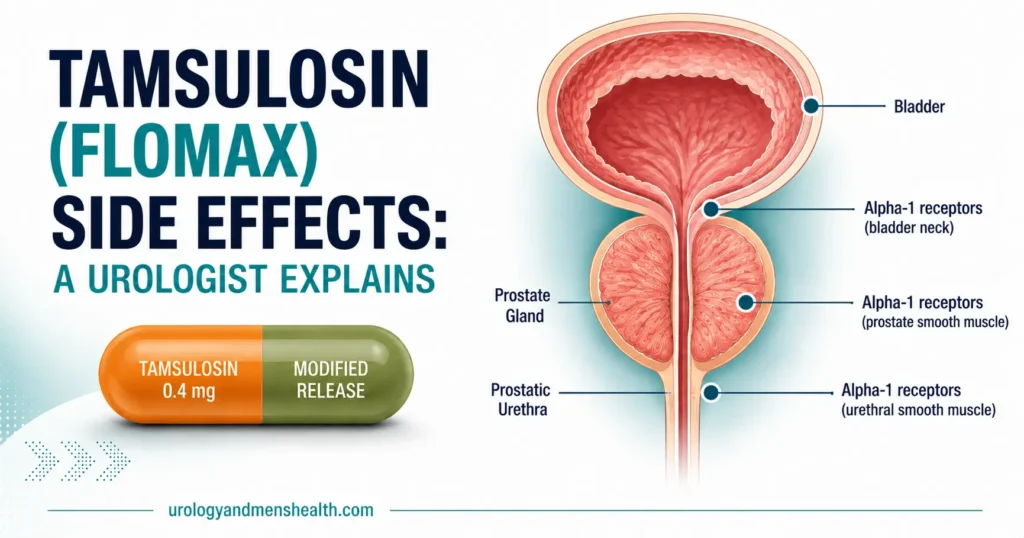
Tamsulosin side effects are something most men only learn about after they have started the medication — usually with significant alarm. Tamsulosin (sold as Flomax in the United States) is one of the most commonly prescribed drugs in urology. If you have been told you have an enlarged prostate (BPH) or a kidney stone, there is a very high chance you have either been given it already or will be soon. It works, it works quickly, and for most men it provides genuine relief from urinary symptoms within days.
The problem is that several side effects — particularly retrograde ejaculation, postural dizziness, and floppy iris syndrome — are rarely mentioned at the prescription stage. Not because anyone is hiding anything, but because the standard consultation is short and the focus is on solving the immediate urinary problem. The result is that men discover these side effects themselves, and a meaningful number stop the medication without telling anyone.
As a urologist who prescribes tamsulosin multiple times a week, I want to give you the complete, honest picture — the common side effects, the rare but serious ones, and the one interaction with eye surgery that every man on tamsulosin must know about before it causes a preventable complication.
Key Takeaways
- Tamsulosin is an alpha-1 adrenergic blocker that relaxes smooth muscle in the prostate and bladder neck — it does not shrink the prostate.
- Retrograde ejaculation (dry orgasm) occurs in roughly 8-18% of men on tamsulosin — semen flows backward into the bladder rather than forward. It is harmless but distressing if unexpected [1].
- Dizziness and postural hypotension affect 5-15% of patients, especially in the first few weeks — stand up slowly and take the capsule after a meal, ideally at bedtime [2].
- Intraoperative floppy iris syndrome (IFIS) is a serious complication during cataract surgery in patients who have ever taken tamsulosin — even years after stopping. Always tell your ophthalmologist [3].
- Tamsulosin does not cause erectile dysfunction — this misconception confuses tamsulosin with finasteride, which acts by a different mechanism.
- For kidney stones, tamsulosin is prescribed as medical expulsive therapy (MET) for 2-4 weeks to help stones pass [6]. It is not needed long-term for stones.
How Tamsulosin Works (And Why Side Effects Make Sense)
Tamsulosin belongs to a class of drugs called alpha-1 adrenergic receptor blockers (alpha blockers). Alpha-1 receptors sit on smooth muscle cells throughout the body, but they are particularly concentrated in three locations: the prostate, the bladder neck, and the iris of the eye.
When tamsulosin blocks these receptors in the prostate and bladder neck, the smooth muscle relaxes, the prostatic urethra opens wider, and urine flows more freely. This is why it helps BPH symptoms — the urethra is being physically squeezed by an enlarged prostate, and tamsulosin releases that squeeze. It is also why it helps kidney stones — the same relaxation occurs in the ureteric smooth muscle, widening the tube and helping the stone pass.
Once you understand that alpha-1 receptors are also present in blood vessels (causing dizziness when blocked), the iris (causing floppy iris syndrome), and the ejaculatory duct (causing retrograde ejaculation), every major side effect makes physiological sense. The drug is not malfunctioning — it is doing its job in places you would prefer it did not.
If you want to check whether your symptoms warrant medication in the first place, our IPSS prostate symptom score calculator gives a structured score within five minutes.
Related Read: Enlarged Prostate (BPH) — When Medication Fails and Surgery Becomes the AnswerThe Common Tamsulosin Side Effects (And How to Manage Them)
1. Retrograde ejaculation — “dry orgasm”
This is the side effect that catches men completely off guard. During orgasm, semen normally exits through the urethra because the bladder neck closes tightly, directing ejaculate forward. Tamsulosin relaxes that bladder neck, and in roughly 8-18% of men, this causes semen to flow backward into the bladder rather than forward out of the penis [1].
The result: you have a normal orgasm with normal sensation, but little or no semen comes out. The semen is later harmlessly excreted when you next urinate (you may notice cloudy urine).
This is medically harmless. It does not damage anything. Orgasm quality and sensation are preserved. However, it is understandably alarming for men who are not warned about it — and it is a significant concern for men actively trying to conceive, since no forward ejaculation means no sperm reaching the partner. If fertility is a priority, ask your urologist about silodosin (which has a higher rate of retrograde ejaculation) versus alfuzosin or doxazosin (which have lower rates) before any prescription is finalized.
Retrograde ejaculation typically reverses completely within 1-2 weeks of stopping tamsulosin.
2. Dizziness and postural hypotension
Because tamsulosin also blocks alpha-1 receptors in blood vessel walls, it can cause a drop in blood pressure — particularly when standing up from a sitting or lying position. This shows up as dizziness, light-headedness, or occasionally fainting (syncope), and affects roughly 5-15% of patients [2].
The risk is highest during the first week of treatment and improves as your body adjusts. Practical strategies that work:
- Take it at bedtime — the peak drug effect occurs while you are lying down, and the blood pressure drop is less noticeable.
- Take it after a meal — food slows absorption, producing a more gradual onset.
- Stand up slowly — sit on the edge of the bed for 30 seconds before standing, especially in the morning.
- Stay hydrated — aim for around 2 liters of water daily (about 68 fl oz / 8 cups). Dehydration amplifies the blood pressure drop.
- Be cautious with alcohol — alcohol dilates blood vessels and compounds the hypotensive effect.
If dizziness is severe or has not improved after 2 weeks, tell your prescriber. A dose reduction or switch to a different alpha blocker (silodosin, alfuzosin) often helps.
3. Nasal congestion (stuffy nose)
Alpha-1 receptors are also present in the nasal blood vessels. Blocking them causes nasal vasodilation — swollen nasal mucosa and a persistently blocked nose. This affects roughly 5-10% of patients and is more a nuisance than a danger [2]. Saline nasal spray and short-course decongestant sprays can help, but most men simply tolerate it as a trade-off for improved urinary flow.
4. Fatigue and weakness
Some men report a general sense of tiredness, particularly in the first few weeks. This is related to the mild blood pressure reduction and usually resolves as the body adapts. If fatigue is persistent and bothersome, it is worth checking whether the tamsulosin is genuinely the cause — fatigue has many other causes in men over 50, including low testosterone, anemia, and sleep apnea. Our low testosterone symptom quiz takes about three minutes and helps separate medication-related fatigue from low T.
Use the Tool: BPH Medication Side Effect Checker — log and track your symptomsThe Serious Side Effect Nobody Mentions: Floppy Iris Syndrome
This is the side effect I most want every tamsulosin user to know about, because it has direct implications for your safety during eye surgery — and many ophthalmologists report that patients frequently forget to mention they are on tamsulosin.
Intraoperative floppy iris syndrome (IFIS) occurs during cataract surgery when the iris (the colored part of your eye) behaves abnormally because tamsulosin has blocked the alpha-1 receptors in its smooth muscle. During surgery, the iris billows, constricts unexpectedly, and may prolapse through the surgical incision — sharply increasing the risk of complications including iris damage, posterior capsule rupture, and vitreous loss [3].
IFIS has been reported in up to 90% of cataract surgery patients who are taking or have previously taken tamsulosin [4]. The point that catches most patients out is that stopping tamsulosin before surgery does not prevent IFIS — the alpha-1 receptor changes in the iris appear to be long-lasting, possibly permanent. Cases have been reported in patients who stopped tamsulosin years before their cataract operation.
The practical advice is straightforward:
- Always tell your ophthalmologist that you take or have ever taken tamsulosin, even if you stopped it years ago.
- An experienced cataract surgeon who knows about the tamsulosin exposure can use specific techniques (iris hooks, intracameral phenylephrine, viscoelastic devices) to manage the floppy iris safely.
- If you are planning cataract surgery and have not yet started tamsulosin, ask your urologist whether tamsulosin can be delayed until after the surgery if your urinary symptoms are tolerable.
What Tamsulosin Does NOT Cause (Common Misconceptions)
Tamsulosin does not cause erectile dysfunction
This is one of the most persistent misconceptions I encounter. Patients frequently conflate tamsulosin with finasteride (Proscar/Propecia) — another BPH medication that acts by a completely different mechanism and does carry a small risk of sexual side effects including reduced libido and erectile difficulties.
Tamsulosin has no significant effect on erections, libido, or testosterone levels. The only sexual side effect is retrograde ejaculation (covered above), which affects ejaculate direction, not erection quality. If you develop ED while taking tamsulosin, the cause is very likely unrelated — age-related vascular changes, diabetes, hypertension, or other medications are far more probable culprits. Our article on ED and heart disease walks through this in more detail, because new ED in a man over 40 is more often a vascular warning than a medication side effect.
Related Read: Finasteride for BPH and Hair Loss — The Trade-Offs a Urologist ExplainsTamsulosin does not shrink the prostate
Another common misunderstanding. Tamsulosin relaxes the smooth muscle around the prostate and bladder neck — it opens the door, but it does not reduce the size of the doorframe. The prostate remains the same size. If you want actual prostate shrinkage (a reduction of 20-30% in volume over 6-12 months), that requires a 5-alpha reductase inhibitor like finasteride or dutasteride, which blocks the conversion of testosterone to DHT — the hormone that drives prostate growth.
This is why urologists often combine tamsulosin with finasteride for large prostates: tamsulosin provides immediate symptom relief while finasteride gradually shrinks the gland. The CombAT trial demonstrated that combination therapy was superior to either drug alone in men with large prostates [5].
Tamsulosin does not increase cancer risk
There is no evidence that tamsulosin increases the risk of prostate cancer or any other malignancy. It is a symptomatic treatment for benign (non-cancerous) prostatic enlargement. If your PSA rises while on tamsulosin, that rise is clinically meaningful and warrants investigation — tamsulosin does not affect PSA levels (unlike finasteride, which halves them).
In My Practice
Retrograde ejaculation is the side effect I spend the most time counseling patients about, because if a man is not warned, he almost invariably stops the medication on his own and never tells anyone. The conversation that works for me is: “On this drug, when you climax, semen will go backward into your bladder rather than out. The orgasm itself feels normal. It is not damaging anything, and it reverses within two weeks if you stop.” When patients hear this in plain terms before the first dose, the discontinuation rate drops sharply. When they discover it themselves, almost half assume something has gone seriously wrong with their body and quietly stop.
The takeaway: if your prescriber did not warn you, that does not mean something has gone wrong — it means the warning was missed.
Tamsulosin for Kidney Stones — A Different Use Case
Beyond BPH, tamsulosin is widely prescribed as medical expulsive therapy (MET) to help kidney stones pass through the ureter. The same smooth muscle relaxation that opens the prostatic urethra also relaxes the ureteric wall, particularly at the vesicoureteric junction (the narrowest point where the ureter enters the bladder).
The 2019 Cochrane review pooling 67 randomized trials concluded that alpha blockers — tamsulosin in particular — increase the spontaneous passage rate of distal ureteric stones, with the largest benefit seen in stones 5-10 mm (about 1/5 to 2/5 inch) located in the lower third of the ureter [6]. The effect on smaller stones (under 5 mm) is more modest, and on upper ureteric or renal stones it is minimal.
For stone expulsion, tamsulosin is prescribed for 2-4 weeks alongside NSAIDs and adequate hydration. If the stone has not passed by 4 weeks (or earlier if complications develop), surgical intervention is warranted. Unlike BPH use, tamsulosin for stones is a short course — there is no need to continue it once the stone has passed. To get a realistic timeline for your specific stone, use our kidney stone passage calculator, which factors in stone size and location.
Related Read: How to Pass a Kidney Stone Fast — What I Tell My PatientsWhen Tamsulosin Stops Working — What Comes Next?
Tamsulosin is effective for mild to moderate BPH symptoms, but it has limits. It does not stop the prostate from continuing to grow, and over time — typically 5-10 years — the prostate may enlarge to the point where medication alone is not enough. Signs that tamsulosin is no longer adequate include:
- Return of urinary symptoms (poor stream, frequency, nocturia) despite good compliance.
- Recurring urinary retention (inability to pass urine).
- Recurrent UTIs caused by incomplete bladder emptying.
- Rising post-void residual volume on ultrasound (typically over 100 mL / 3.4 fl oz).
At this point, the options are: adding finasteride (combination therapy), switching to a different alpha blocker, or progressing to surgical intervention. Per the 2024 American Urological Association BPH guideline, surgical management is recommended once medical therapy has failed and post-void residual, recurrent retention, or bladder stones develop [7]. TURP remains the historical reference standard for BPH surgery, though HoLEP, UroLift, and Aquablation are increasingly available depending on prostate size and patient preference.
When to See a Doctor — Urgently
- Fainting (syncope) after starting tamsulosin — especially if it occurs when standing up. This suggests a significant drop in blood pressure and may require dose adjustment or medication change.
- Complete inability to urinate (acute retention) while on tamsulosin — this is a urological emergency requiring catheterization at the emergency room, regardless of whether you are taking medication. It means the medication alone is not enough.
- Persistent severe dizziness that does not improve after 2 weeks — may indicate excessive blood pressure lowering, especially in combination with other antihypertensives.
- Allergic reaction — rash, swelling of the face or throat, difficulty breathing. Rare but requires immediate emergency attention.
- Priapism (painful prolonged erection) — extremely rare with tamsulosin but reported with alpha blockers as a class. An erection lasting more than 4 hours requires emergency urological intervention to prevent permanent damage.
Weak stream and night-time trips wearing you down? Download Dr. Khalid’s BPH & Enlarged Prostate Guide.
Enter your email below to receive Dr. Khalid’s complete BPH & Enlarged Prostate Guide as a free, printable PDF.
Frequently Asked Questions
Can I take tamsulosin and Viagra (sildenafil) together?
Yes, but with care. Both tamsulosin and sildenafil lower blood pressure, and the combination can cause a larger drop than either drug alone, leading to dizziness or fainting. The 2024 American Urological Association erectile dysfunction guideline advises starting sildenafil at a low dose (25 mg) and separating the timing — take tamsulosin at bedtime and sildenafil at least 4 hours apart. Most men tolerate the combination well once the doses are established. For more on choosing the right ED medication, see our comparison of Viagra, Cialis, and sildenafil.
How long does it take for tamsulosin to work for BPH?
For BPH symptoms, most men notice improvement in urinary flow and frequency within 2-7 days. The full effect may take 2-4 weeks to establish. If you see no improvement after 4 weeks of consistent use, tamsulosin may not be effective for you, and your urologist should consider alternatives. For kidney stone expulsion, the effect on ureteric relaxation begins within 24-48 hours, but the stone itself may take days to weeks to pass. To track your symptoms over time, the IPSS prostate score calculator gives an objective number you can compare across visits.
What happens if I stop tamsulosin suddenly?
For BPH: your urinary symptoms will typically return within 1-3 days as the smooth muscle tone in the prostate and bladder neck reverts to its baseline state. There is no dangerous withdrawal effect, but the return of poor urinary flow and frequency can be uncomfortable. If you want to stop, ask your prescriber rather than stopping abruptly, so they can assess whether an alternative is needed. For kidney stones: if you stop before the stone has passed, you lose the ureteric relaxation benefit that was helping it move. Read more on when BPH medication is no longer enough.
Does tamsulosin affect blood pressure medication?
Yes. If you are already taking antihypertensive medication (particularly other alpha blockers like doxazosin, or calcium channel blockers like amlodipine), adding tamsulosin can cause an additive blood pressure drop. Your primary care doctor or urologist should review your blood pressure medications before starting tamsulosin and may need to adjust doses. Monitor your blood pressure at home for the first 2 weeks after starting to catch any excessive drops. Our guide to blood pressure medication and ED covers the broader interaction picture.
Is tamsulosin safe for long-term use?
Yes. Tamsulosin has been in clinical use for BPH since 1997 and has an extensive long-term safety record. There are no concerns about organ toxicity, cancer risk, or cumulative damage with prolonged use. The main long-term consideration is the floppy iris risk for any future cataract surgery — which means you should tell every ophthalmologist about your tamsulosin history, even decades after stopping it. Many men take tamsulosin continuously for 10-20 years with sustained benefit and no significant adverse effects beyond those present in the first few weeks.
Should I take tamsulosin if I am planning cataract surgery soon?
This is a question to raise with both your urologist and your ophthalmologist before starting tamsulosin. If your urinary symptoms are tolerable and cataract surgery is on the near horizon, it is reasonable to ask whether tamsulosin can be delayed. If your urinary symptoms are severe enough to need medication now, the safer route is to start tamsulosin and notify your eye surgeon, who can plan for floppy iris prevention with iris hooks or intracameral phenylephrine during the operation. Stopping tamsulosin before cataract surgery does not eliminate the floppy iris risk — the receptor changes appear to be long-lasting.
References
- Lepor H. Alpha blockers for the treatment of benign prostatic hyperplasia. Urol Clin North Am. 2016;43(3):311-323. PubMed
- Lepor H. Phase III multicenter placebo-controlled study of tamsulosin in benign prostatic hyperplasia. Urology. 1998;51(6):892-900. PubMed
- Chang DF, Campbell JR. Intraoperative floppy iris syndrome associated with tamsulosin. J Cataract Refract Surg. 2005;31(4):664-673. PubMed
- Bell CM, Hatch WV, Fischer HD, et al. Association between tamsulosin and serious ophthalmic adverse events in older men following cataract surgery. JAMA. 2009;301(19):1991-1996. PubMed
- Roehrborn CG, Siami P, Barkin J, et al. The effects of combination therapy with dutasteride and tamsulosin on clinical outcomes in men with symptomatic benign prostatic hyperplasia: 4-year results from the CombAT study. Eur Urol. 2010;57(1):123-131. PubMed
- Campschroer T, Zhu X, Vernooij RW, Lock MT. Alpha-blockers as medical expulsive therapy for ureteral stones. Cochrane Database Syst Rev. 2018;4(4):CD008509. PubMed
- Sandhu JS, Bixler BR, Dahm P, et al. Management of lower urinary tract symptoms attributed to benign prostatic hyperplasia (BPH): AUA Guideline Amendment 2023. J Urol. 2024;211(1):11-19. AUA Guideline
Dr. Muhammad Khalid
MBBS · FCPS (Urology) · MCPS (General Surgery) · CHPE · CRSM · IMC #539472
Specialist urologist with 11+ years of clinical experience across tertiary teaching hospitals. Trained at Lady Reading Hospital and Khyber Teaching Hospital, Peshawar. Author or co-author of five peer-reviewed international publications, including in Cureus and the World Journal of Surgery. Procedural expertise: URS, PCNL, RIRS, TURP, TURBT, and major open urological surgery. Full profile →
This article is for educational purposes only and does not constitute medical advice. Always consult your physician or urologist for diagnosis and treatment decisions specific to your condition.