
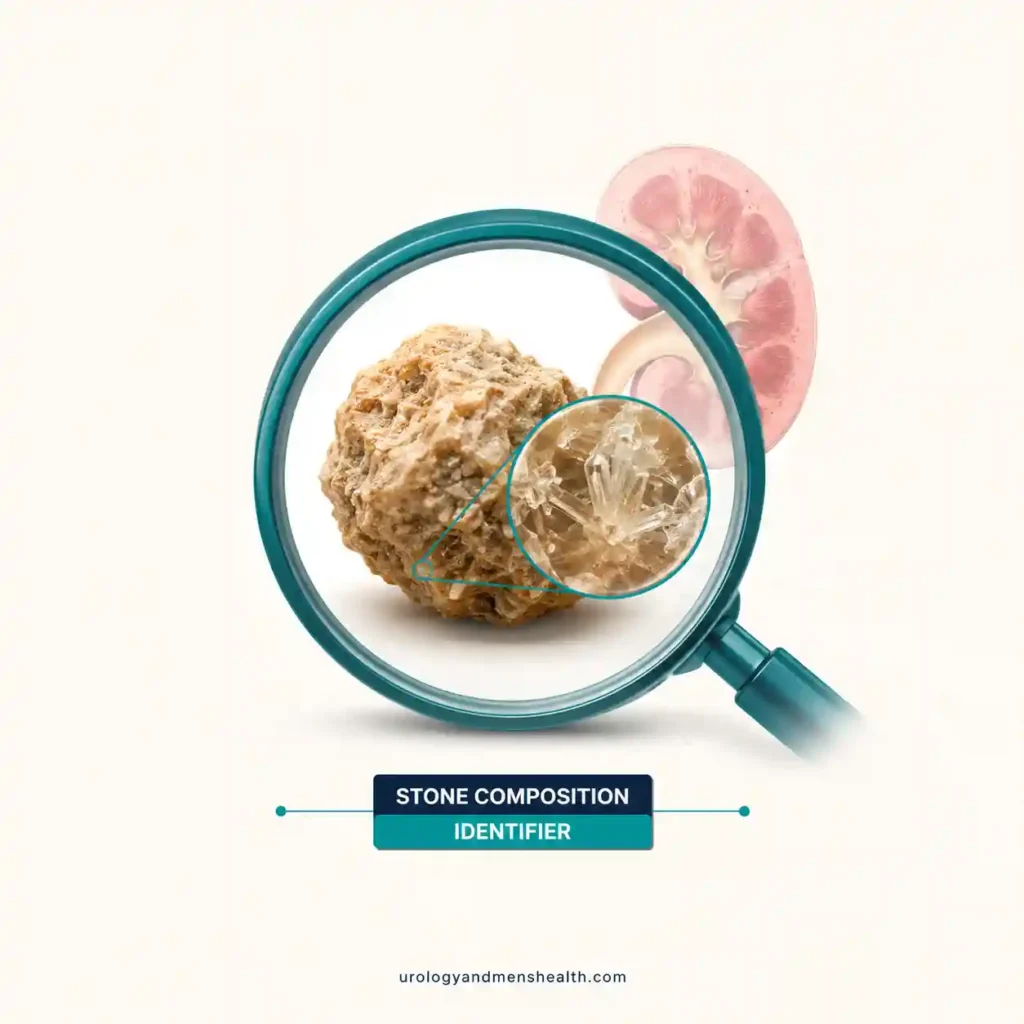
Kidney Stone Composition Identifier
This kidney stone composition identifier estimates your most likely stone type - calcium oxalate, uric acid, struvite, or a rarer one - from your history, imaging clues, and diet. Knowing the type matters because the prevention plans are not just different, they can be opposite. It takes about a minute and ends with a clear next step to bring to your urologist. Start with our kidney stones hub for the full picture.

The Tool
Related Kidney Tools
Full Clinical Guide
In This Guide:
- The only definitive way to know your stone type is lab analysis of a passed or removed stone — this tool estimates the most likely type from your history.
- Calcium oxalate is the most common stone by far, and cutting dietary calcium usually makes it worse, not better.
- Uric acid stones can often be dissolved with medication instead of surgery, because they form in acidic urine.
- Struvite (infection) and cystine stones are less common but more aggressive, and need a specialist — not diet changes alone.
What This Tool Estimates
This kidney stone composition identifier estimates the most likely type of stone you form — calcium oxalate, uric acid, struvite, cystine, or calcium phosphate — from your history, imaging clues, and diet. It is a pattern-based estimate, not a lab test: the only definitive way to confirm composition is infrared spectroscopy or X-ray diffraction on a stone that has been passed or removed [1][4]. That distinction matters, because composition — not just the presence of a stone — decides prevention. Calcium oxalate is the most common type by a wide margin, close to three-quarters of stones in most large series [4]. The rest split between uric acid, struvite, cystine, and calcium phosphate, each with its own driver. If you have ever had a stone analyzed, this tool simply hands you back the type-specific plan; if not, it weighs the strongest clues to point you and your urologist in the right direction. See the full breakdown of kidney stone types.
The Chemistry Behind Each Stone Type
Each stone type forms through a different chemical fault, which is why one prevention plan never fits all. Calcium oxalate precipitates when oxalate from food meets calcium in concentrated urine — like sugar crystallizing out of an over-saturated syrup. Uric acid stones form when urine is persistently acidic (a pH below about 5.5), common with gout, diabetes, and obesity; they are radiolucent, so they hide on a plain X-ray but show on CT [1][5]. Struvite stones appear only when urea-splitting bacteria — most often Proteus — turn the urine alkaline, and they can build into branching staghorn stones [2]. Cystine stones are inherited, leaking cystine into the urine from a young age. Calcium phosphate favors alkaline urine and is often a clue to a parathyroid or kidney-tubule problem. Browse each stone type and its diet in the A-to-Z directory.
How to Read Your Result
Your result names the single most likely type and a confidence level. A calcium-based result (most people) means diet and fluid are your main levers — and, importantly, you should not cut dietary calcium. A uric acid result is the hopeful one: because the problem is acidity, raising urine pH toward 6.0–6.5 with potassium citrate can dissolve a pure uric acid stone over roughly two to six weeks, often avoiding surgery [1][5]. A struvite or cystine result is the flag to involve a specialist early — these recur and do not respond to diet alone [2]. Confidence reflects how strong your clues were: a stone already analyzed in a lab is “High”; a pattern-only estimate is “Moderate.” Treat a moderate-confidence result as a strong hypothesis to confirm, not a verdict.
What to Do Next
Whatever your result, two steps help every stone former. First, drink enough to keep urine pale — the guideline target is a urine output of at least 2.5 liters (around 85 fl oz) a day [1]. Second, the next time you pass a stone, catch it in a strainer and send it for analysis; one lab result ends years of guessing. From there the path forks by type: calcium formers benefit most from a 24-hour urine test to find the exact lever, and our kidney stone diet protocol covers the everyday food choices; uric acid formers should ask about urine alkalinization; struvite and cystine formers need a urologist-led plan that usually combines surgery or high-volume fluids with medication [1][2]. A stone recurrence risk profiler can show how aggressive your prevention needs to be.
If you are unsure about your result, the PDF report this tool generates gives you a ready-made framework to bring to your next appointment.
In My Practice
Over the years, the most common thing I see is not a rare stone — it is a stone that was never analyzed. People arrive after their second or third episode, having had stones removed surgically, with no idea what those stones were made of. The fragment went in the bin instead of to the lab.
A stone you can hold is a free diagnosis. If a stone is ever passed or retrieved, the single most valuable thing you can do is make sure it reaches a laboratory — it turns guesswork into a targeted prevention plan.
References
- American Urological Association. Medical Management of Kidney Stones: AUA Guideline. AUA. Fluid target of at least 2.5 L urine/day; urine pH 6.0 for uric acid and 7.0 for cystine stones.
- European Association of Urology. Urolithiasis Guidelines (Metabolic Evaluation and Recurrence Prevention). EAU / Uroweb. Infection stones form with urease-producing bacteria in alkaline urine; complete surgical removal plus antibiotics.
- Pearle MS, Goldfarb DS, Assimos DG, et al. Medical Management of Kidney Stones: AUA Guideline. J Urol. 2014;192(2):316-324. DOI: 10.1016/j.juro.2014.05.006.
- Stone composition analysis by Fourier-transform infrared spectroscopy (1,520 patients). Sci Rep. 2021. Scientific Reports. Calcium oxalate the predominant component; uric acid linked to low urine pH, infection stones to alkaline urine.
- American Urological Association. Medical Student Curriculum: Kidney Stones. AUA. Uric acid stones are radiolucent on KUB; dissolution by alkalinization over 2-6 weeks.
Frequently Asked Questions
How does this tool know my kidney stone type without a lab test?
It does not know for certain — it estimates. The tool weighs the strongest clues urologists use: whether the stone showed on a plain X-ray, any infection history, your age at onset and family history, and your diet pattern. Each points toward a likely type. The only definitive answer comes from lab analysis of an actual stone. Learn how the different stone types are identified.
Can a uric acid stone really be dissolved without surgery?
Often, yes. Uric acid stones are unusual because they form in acidic urine, so raising urine pH toward 6.0 to 6.5 — usually with potassium citrate — can dissolve a pure uric acid stone over roughly two to six weeks. It does not work for calcium or struvite stones, which is why confirming the type first matters. See what a full metabolic workup involves.
What is a struvite (infection) stone, and why is it serious?
A struvite stone is made of magnesium ammonium phosphate and forms only when urea-splitting bacteria, most often Proteus, make the urine alkaline. These stones can grow quickly into large branching staghorn stones that fill the kidney. They need complete surgical removal plus antibiotics — diet changes alone will not clear them. Check your recurrence risk profile.
How accurate is this tool, and can I rely on it?
This tool gives an educated estimate, not a diagnosis. It is built on AUA and EAU stone guidelines and the same clues urologists use, but it cannot replace lab analysis of an actual stone or a 24-hour urine test. Use it to understand your likely type and to ask sharper questions, then confirm the answer with your urologist. Read more about how stone types differ.
How do I use this result at my doctor’s appointment?
Use the Download My Report button to generate a two-page PDF with your estimated stone type, the reasoning, and a list of questions to ask. Bring it to your primary care doctor or urologist. It gives the conversation a clear starting point and helps you request the right tests — stone analysis or a 24-hour urine collection. You can also profile your recurrence risk first.
Dr. Muhammad Khalid
MBBS · FCPS (Urology) · MCPS (General Surgery) · CHPE · CRSM · IMC #539472
Specialist urologist with 11+ years of clinical experience across tertiary teaching hospitals. Trained at Lady Reading Hospital and Khyber Teaching Hospital, Peshawar. Author or co-author of five peer-reviewed international publications, including in Cureus and the World Journal of Surgery. Procedural expertise: URS, PCNL, RIRS, TURP, TURBT, and major open urological surgery. Full profile →
This article is for educational purposes only and does not constitute medical advice. Always consult your physician or urologist for diagnosis and treatment decisions specific to your condition.