
Sodium Intake Tracker: How Much Salt Did You Eat Today?
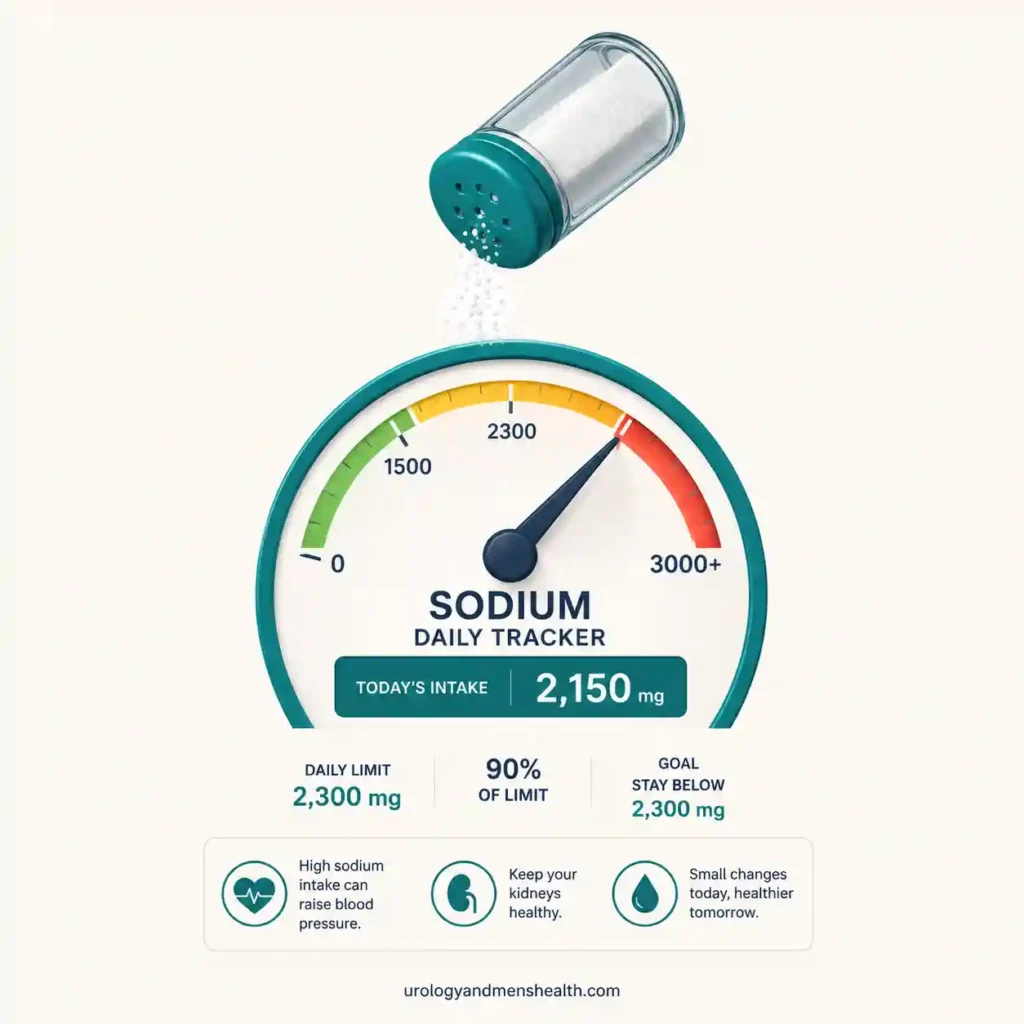
This sodium intake tracker estimates how many milligrams of sodium you ate today from the categories that actually carry it - bread, cured meat, cheese, ready meals, canned goods, snacks, sauces, and the saltshaker. It takes about a minute and gives you a number you can take to an appointment. For the wider picture, start at the blood pressure hub.

The Tool
Related Blood Pressure Tools
Full Clinical Guide
In This Guide:
- Most of your sodium is already in the food before you buy it – over 70% of US dietary sodium comes from packaged and prepared food, not the saltshaker.
- The target is under 2,300 mg a day, or under 1,500 mg if you have high blood pressure, heart failure, or chronic kidney disease.
- Salt does not only raise blood pressure – it pulls calcium into your urine, which is why calcium stone formers are given the same 2,300 mg ceiling.
- One level teaspoon of table salt is the entire daily allowance, about 2,300 mg of sodium.
What This Sodium Intake Tracker Measures
This sodium intake tracker does not weigh your food. It estimates your daily total from the eight categories that carry most of it in a Western diet, using typical mid-range values for each category rather than brand-specific figures. That design is deliberate, because the targets are meaningless unless you know roughly where you stand. The 2025 AHA/ACC hypertension guideline sets a ceiling of under 2,300 mg of sodium a day and describes under 1,500 mg as desirable where appropriate [1]. The American Urological Association independently supports a target of 100 mEq daily – the same 2,300 mg – for people who form calcium stones [3]. Almost nobody is close: the average American takes in around 3,400 mg a day, and more than 70% of it arrives inside packaged and prepared food rather than from the saltshaker [6]. That single fact is why salt sits behind both kidney stones and high blood pressure in the same men.
Why Sodium Raises Pressure and Pulls Calcium Into Urine
Sodium works on two organs at once. In the circulation it holds water, because sodium is the main osmotic particle in the fluid outside your cells – the more you retain, the more water stays in the bloodstream, and the harder your heart pushes against a fuller pipe. Picture a garden hose with the tap opened a quarter turn further: same hose, higher pressure. In the kidney, sodium and calcium are reabsorbed together in the proximal tubule. When you excrete a large sodium load, calcium follows it out into the urine, which is why a high-salt diet raises urinary calcium even in a man eating no extra calcium at all. The EAU urolithiasis guideline therefore advises restricting salt to 3-5 g of sodium chloride a day, roughly 1,200-2,000 mg of sodium [4]. The effect reaches the bladder too: in a Japanese study of 321 adults with high salt intake, the 223 who cut their salt from 10.7 g to 8.0 g a day saw nighttime voids fall from 2.3 to 1.4 a night [5]. If you want to see which specific products carry your load, the hidden sodium calculator breaks it down item by item.
How to Interpret Your Result
The tool sorts your estimate into three bands against the target you selected. On target means your total sits at or below 2,300 mg, or 1,500 mg if you chose the tighter goal. Above target means you are up to one and a half times over. Well above target means more than that. The difference is not academic. A man who logs 1,400 mg and a man who logs 5,000 mg get completely different advice from me in clinic: the first needs nothing more than consistency and a repeat check on a weekend, while the second is someone whose antihypertensive may be being undermined by his diet, and whose urinary calcium will stay high no matter how much water he drinks. The size of the prize is real. In the DASH-Sodium trial of 412 adults, dropping from an intermediate to a low sodium intake lowered systolic blood pressure by a further 4.6 mmHg on a typical American diet, and a low-sodium DASH pattern ran 11.5 mmHg below a high-sodium typical diet in people with hypertension [2]. That is a medication-sized effect from a shopping list.
What to Do With Your Result
Read the subscores before the total. If the “from packaged and prepared food” line is above 70%, the saltshaker is not your problem and putting it away will change nothing – your work is in the bread, the cured meat, the cheese, and the meals you did not cook yourself. If added salt is carrying a quarter or more of your total, that is the fastest single fix available to you. Then set a measurement rather than a feeling: ask for a 24-hour urine collection reporting sodium and calcium if you have formed a stone, and for creatinine, eGFR, and a urine albumin-to-creatinine ratio if your blood pressure is high. If you are already taking a thiazide diuretic, for stones or for pressure, sodium restriction stops being optional – the drug’s calcium-lowering effect depends on it, and a high-salt diet blunts the medication you are already paying for. The blood pressure and kidney damage risk tool puts that combination into numbers.
If you are unsure about your result, the PDF report this tool generates gives you a ready-made framework to bring to your next appointment.
In My Practice
The sentence I hear most often in stone clinic is “I never add salt.” It is usually true, and it is usually irrelevant. When those same men complete a 24-hour urine collection, their sodium excretion routinely comes back well above the 100 mEq target – because their intake was never in the saltshaker to begin with. It was in the sandwich, the cheese, and the three restaurant meals a week nobody thought to mention.
Takeaway: if you have been cutting the saltshaker for years and your urinary calcium has not moved, you have been fixing the wrong 10% of the problem. Ask what your 24-hour urine sodium actually was, and work backwards from that number.
References
- 2025 AHA/ACC/Multisociety Guideline for the Prevention, Detection, Evaluation and Management of High Blood Pressure in Adults. Circulation (AHA/ACC). Source for the under-2,300 mg target, the under-1,500 mg preferred target, and the potassium-based salt substitute recommendation.
- Sacks FM, Svetkey LP, Vollmer WM, et al. Effects on blood pressure of reduced dietary sodium and the DASH diet. N Engl J Med. 2001;344(1):3-10. PubMed. 412 participants; source for the 4.6 mmHg and 11.5 mmHg systolic figures.
- Medical Management of Kidney Stones: AUA Guideline. American Urological Association. Source for the 100 mEq (2,300 mg) daily sodium target in calcium stone formers.
- EAU Guidelines on Urolithiasis: Metabolic Evaluation and Recurrence Prevention. European Association of Urology. Source for restricted salt intake in high urinary sodium excretion.
- Matsuo T, Miyata Y, Sakai H. Effect of salt intake reduction on nocturia in patients with excessive salt intake. Neurourol Urodyn. 2019;38(3):927-933. PubMed. 321 patients; 223 reduced salt from 10.7 to 8.0 g/day with nocturia falling from 2.3 to 1.4.
- Sodium in Your Diet: Use the Nutrition Facts Label and Reduce Your Intake. US Food and Drug Administration. Source for the ~3,400 mg average intake, the over-70% packaged-food share, and 1 teaspoon of salt equalling about 2,300 mg of sodium.
Frequently Asked Questions
How can an estimate based on servings be accurate when sodium varies so much between brands?
It cannot be exact, and it is not meant to be. The tool uses typical mid-range values per category, so your number is an order-of-magnitude estimate: it reliably tells you whether you are near 1,500 mg, near 3,000 mg, or near 6,000 mg. That is enough to decide whether sodium is worth acting on. If you need a true figure, only a 24-hour urine sodium measurement provides one.
Does cutting salt help kidney stones as well as blood pressure?
Yes, and by a different mechanism. Sodium and calcium are reabsorbed together in the kidney, so a high sodium load drags calcium into the urine and raises the concentration that forms calcium stones. Both the AUA and the EAU recommend salt restriction for stone formers for exactly this reason. Fluid volume still matters most, and the hydration calculator sets that target.
I get up two or three times a night to pass urine. Could salt be causing that?
It can contribute. A high sodium load increases the volume of urine your kidneys produce overnight, which is one recognised driver of nocturia alongside prostate enlargement, sleep apnoea, and evening fluid timing. Salt reduction has been shown to lower nighttime voiding in people with high intake. If the nights are broken and you also snore heavily, read how sleep apnoea, blood pressure, and nocturia connect.
How accurate is this tool, and can I rely on it?
This is a screening aid, not a diagnosis, and it does not replace a clinical assessment. The targets it measures you against come from the 2025 AHA/ACC hypertension guideline and the AUA kidney stone guideline, but your intake figure is an estimate built from category averages. Use it to decide whether sodium deserves a conversation with your doctor, not to rule anything in or out.
How do I use this result at my doctor’s appointment?
Press the Download My Report button after you get your result. It produces a two-page PDF holding what you entered, your estimated daily sodium, the interpretation, your next steps, and a list of questions with your own number already filled in. Hand it over at the start of the appointment. It saves several minutes of history-taking and keeps the conversation on decisions rather than recall.
Dr. Muhammad Khalid
MBBS · FCPS (Urology) · MCPS (General Surgery) · CHPE · CRSM · IMC #539472
Specialist urologist with 11+ years of clinical experience across tertiary teaching hospitals. Trained at Lady Reading Hospital and Khyber Teaching Hospital, Peshawar. Author or co-author of five peer-reviewed international publications, including in Cureus and the World Journal of Surgery. Procedural expertise: URS, PCNL, RIRS, TURP, TURBT, and major open urological surgery. Full profile →
This article is for educational purposes only and does not constitute medical advice. Always consult your physician or urologist for diagnosis and treatment decisions specific to your condition.