
Evidence-Based Supplement Matcher for Men
The Evidence-Based Supplement Matcher tells you what the research actually shows about common men's health supplements - for the prostate, testosterone, kidney stones, UTIs, and general health - before you spend a penny. Answer two short questions about your goal and where you are in your work-up, and you'll get an honest, evidence-graded steer plus a printable summary for your doctor. Start with the pillar it belongs to in the Men's Wellness Hub.

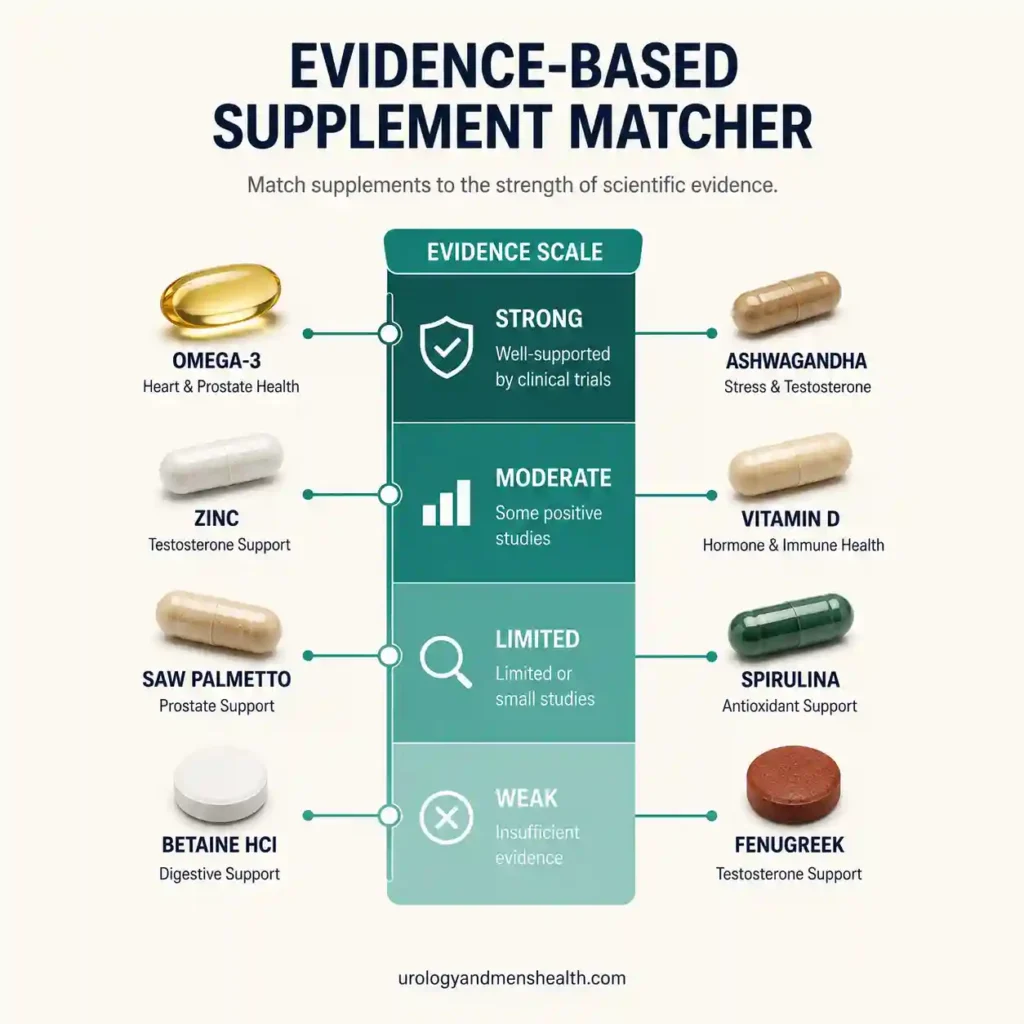
The Tool
Related Wellness Tools
Full Clinical Guide
In This Guide:
- The Evidence-Based Supplement Matcher grades supplements against your goal – most common men’s products do not beat placebo in trials.
- For prostate symptoms, saw palmetto works no better than a dummy pill, even at three times the usual dose.
- Never take selenium or high-dose vitamin E to prevent prostate cancer – the SELECT trial linked them to harm.
- New, one-sided, or bloody urinary symptoms need a doctor, not a supplement – a bottle can delay a diagnosis.
What This Tool Matches You To
The Evidence-Based Supplement Matcher grades what the research actually shows for the men’s health supplements people ask about most – saw palmetto and beta-sitosterol for the prostate, ashwagandha and zinc for testosterone, vitamin C and “kidney support” blends for stones, cranberry for UTIs, and selenium or vitamin E for prostate cancer. Instead of a marketing claim, you get a steer built from Cochrane systematic reviews, the large SELECT and CAMUS trials, and the National Center for Complementary and Integrative Health (NCCIH) [2]. You answer two questions – your goal, and where you are in your work-up – and the tool sorts you into one of three honest verdicts rather than selling you a bottle.
Why “Evidence-Based” Changes the Answer
Most men’s supplements fail the same way. The biology often looks plausible – saw palmetto blocks dihydrotestosterone (DHT, the hormone that drives prostate growth), so in theory it should ease the symptoms you can measure with the IPSS symptom score – yet when it is tested against a dummy pill in rigorous trials, the benefit disappears [1]. Two things explain the gap. First, benign prostate symptoms have a strong placebo response, so uncontrolled “it worked for me” reports are unreliable. Second, the supplement aisle is loosely regulated: “proprietary blends” hide how much of each ingredient you actually get, and the standardized proanthocyanidin (PAC) content – the active fraction in cranberry – varies widely between products. Evidence grading cuts through both by asking one question: did it beat placebo in men like you?
How to Read Your Match
Your match lands in one of three bands. Reassuring means the evidence points away from any pill and toward basics you already control – no supplement has been shown to prevent prostate cancer, so the honest move is diet, weight, activity, and age-appropriate PSA screening. Try With Caution means the evidence is mixed or modest: a supplement is a reasonable add-on if you keep expectations realistic and give it a defined 8-to-12-week trial. See a Doctor First means a supplement is the wrong tool entirely. The same weak stream produces opposite advice depending on your second answer: a man who has already had his PSA and symptom score checked and wants a low-risk add-on gets “save your money on saw palmetto,” while a man with identical symptoms who has never been evaluated gets “find out why you cannot empty first” – because a supplement there mainly delays a diagnosis.
What to Do With Your Match
If your match is Reassuring, put the supplement budget toward the proven levers and book the screening you are due. If it is Try With Caution, choose one product with the dose printed on the label, avoid proprietary blends, and decide up front how you will judge it – a repeat blood test or a symptom score, not a feeling. If it is See a Doctor First, get the evaluation before anything else: for urinary symptoms that means a PSA discussion, a symptom score, and a uroflowmetry or post-void residual (PVR) check; for a man’s recurrent UTIs it means imaging and a flow assessment to find the cause. A few products earn a firm no – do not take selenium or high-dose vitamin E to prevent prostate cancer [3], and calcium-oxalate stone formers should avoid supplemental vitamin C at 1,000 mg a day or more [5]. If low energy is your driver, confirm it with a morning blood test using the Low Testosterone Symptom Quiz before you buy a “booster.”
If you are unsure about your result, the PDF report this tool generates gives you a ready-made framework to bring to your next appointment.
In My Practice
The clearest example I give men is the vitamin C one. I have seen calcium-oxalate stone formers take 1,000 mg (1 g) of vitamin C daily “for immunity,” not realizing the body converts a share of it into oxalate – the very thing their stones are made of. We stop the supplement, keep their fluids up toward 2.5 liters (around 85 fl oz) a day, and their 24-hour urine oxalate quietly settles.
Before any supplement, the useful question is not “could this help?” but “could this be feeding the exact problem I am trying to fix?”
References
- Barry MJ, et al. Effect of increasing doses of saw palmetto extract on lower urinary tract symptoms (CAMUS), JAMA 2011; NIH summary. National Institutes of Health. Saw palmetto no better than placebo, even at 3x the standard dose.
- National Center for Complementary and Integrative Health. Spotlight on Saw Palmetto. NCCIH (NIH). Evidence does not support saw palmetto for BPH or any condition.
- Klein EA, et al. Vitamin E and the risk of prostate cancer (SELECT), JAMA 2011. JAMA. ~35,000 men; vitamin E linked to about a 17% higher prostate cancer risk.
- Williams G, et al. Cranberries for preventing urinary tract infections, Cochrane 2023. Cochrane Database of Systematic Reviews. Benefit in women with recurrent UTIs; not established in men.
- Ferraro PM, et al. Total, dietary, and supplemental vitamin C intake and risk of incident kidney stones. Renal & Urology News (reporting the Health Professionals Follow-up Study). Supplemental vitamin C linked to higher stone risk in men; dietary vitamin C not.
Frequently Asked Questions
Does this tool tell me exactly which supplement to buy?
Not quite – and that is the point. It matches your goal to what the evidence actually supports, which is often “no supplement, do this instead” rather than a brand name. For most men the highest-value move is not a bottle but catching the basics they have missed, which the Men’s Health Screening Checklist walks through step by step.
Are any men’s health supplements actually worth taking?
A few, in the right person. Cranberry with standardized PAC has moderate evidence for recurrent UTIs in women, and correcting a genuine deficiency such as vitamin D is sensible. Most prostate and “testosterone booster” products, though, do not beat placebo in trials. Our review of the top prostate supplements lays out which have real data and which are marketing.
If saw palmetto is harmless, why not just try it?
You can – it is well tolerated – but “harmless” is not the same as “useful.” Rigorous trials show saw palmetto does not relieve prostate symptoms better than placebo, and its main risk is the false reassurance that delays finding a treatable cause. Our saw palmetto evidence review explains what the large trials actually found.
How accurate is this tool, and can I rely on it?
This is an educational screening aid, not a diagnosis. It reflects current evidence from sources like Cochrane reviews and the SELECT and CAMUS trials, but it cannot examine you, read your bloods, or know your full history. Use it to ask sharper questions, and browse the wider Men’s Wellness Hub for context – then let a doctor make the call.
How do I use this result at my doctor’s appointment?
Tap Download My Report to generate a one-page PDF with your goal, your match, and a short list of questions to ask. Bring it, along with a written list of every supplement and dose you take. If stones are your concern, the Hydration Calculator gives you numbers your doctor can act on too.
Dr. Muhammad Khalid
MBBS · FCPS (Urology) · MCPS (General Surgery) · CHPE · CRSM · IMC #539472
Specialist urologist with 11+ years of clinical experience across tertiary teaching hospitals. Trained at Lady Reading Hospital and Khyber Teaching Hospital, Peshawar. Author or co-author of five peer-reviewed international publications, including in Cureus and the World Journal of Surgery. Procedural expertise: URS, PCNL, RIRS, TURP, TURBT, and major open urological surgery. Full profile →
This article is for educational purposes only and does not constitute medical advice. Always consult your physician or urologist for diagnosis and treatment decisions specific to your condition.