
Prostate Volume Calculator: Convert Ultrasound Dimensions to Grams
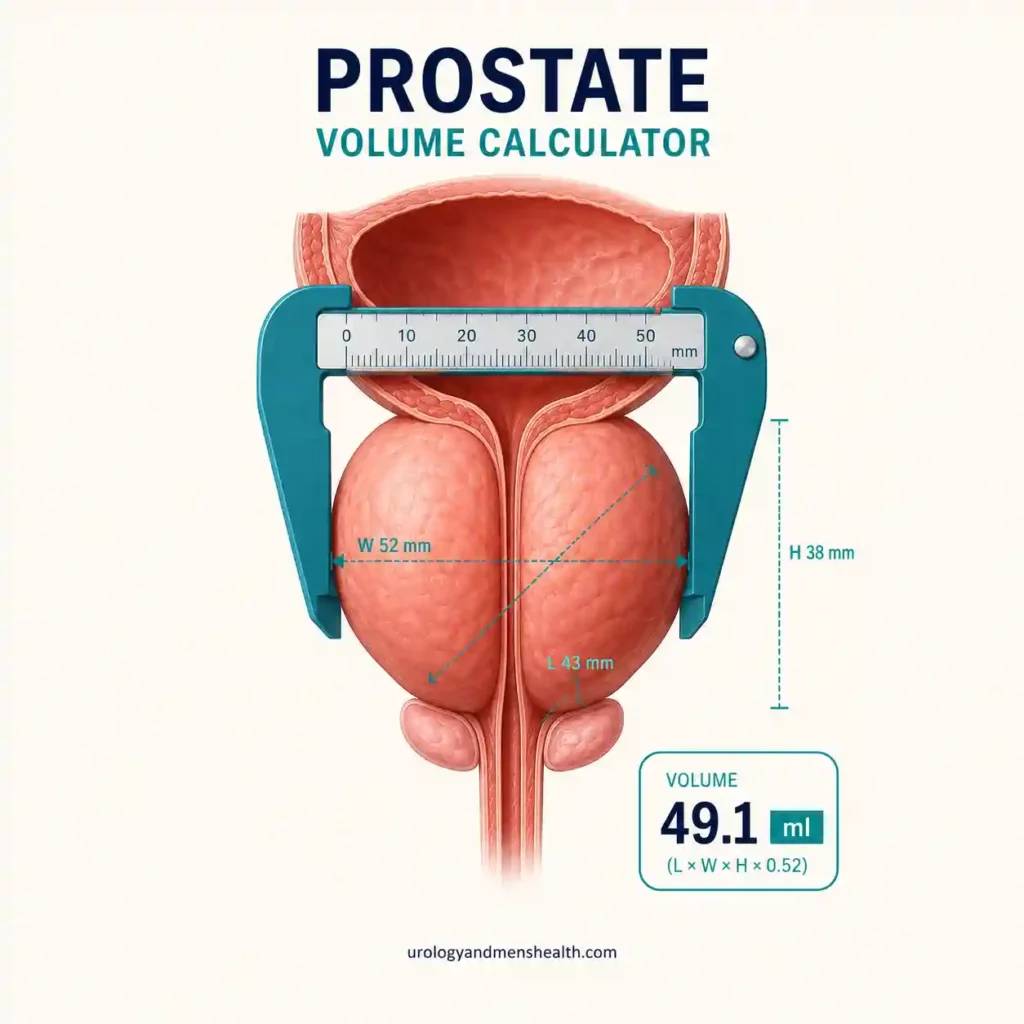
This prostate volume calculator turns the three dimensions on your ultrasound or MRI report into prostate size in grams, using the standard ellipsoid formula. Add your PSA and it also returns your PSA density. Your size largely decides which BPH procedures fit you. Enter your numbers below, then read the full guide for what the result means. More at the prostate health hub.

The Tool
Related Prostate Tools
Full Clinical Guide
In This Guide:
- Volume is length x width x height x 0.52; because the prostate is nearly water-dense, 1 cc is about 1 gram.
- A normal gland is about 20 to 25 grams; above 80 grams is markedly enlarged.
- Size, not symptom severity, decides which BPH procedures fit – the two correlate poorly.
- PSA density (PSA divided by volume) at or above 0.15 ng/mL/cc usually shifts the conversation toward an MRI.
What This Prostate Volume Calculator Measures
This prostate volume calculator uses the prolate ellipsoid formula – length x width x height x 0.52 – to turn the three measurements on your ultrasound or MRI report into a single size in grams. The 0.52 constant is pi/6, the geometry of an ellipsoid, and it is the same method radiology departments and the AUA and EAU guidelines rely on [1]. Because prostate tissue has almost the same density as water, the result is read interchangeably as cubic centimeters (cc), milliliters (mL), or grams. If you also enter your PSA, the tool divides it by the volume to give your PSA density – a number that helps separate a high PSA caused by a large benign gland from one that needs a closer look [4]. For how these two numbers work together, see prostate volume and PSA density explained.
Why the Prostate Grows – and Why Size and Symptoms Disagree
From roughly the age of 40, the inner part of the prostate – the transition zone, the ring of tissue wrapped around the urethra – slowly enlarges. This is benign prostatic hyperplasia, and over the years it can take a walnut-sized gland of about 20 to 25 grams up to the size of a lemon or larger. What matters is not only how much it grows but in which direction. A gland that expands outward can reach a large volume and still let urine pass freely, while a much smaller gland with a median lobe – a button of tissue pushing up into the floor of the bladder – can block the outlet like a ball valve. That is why volume and symptoms line up so poorly, and why your urologist reads the size alongside the shape, the symptom score, and the flow rate.
How to Interpret Your Result
Your number falls into one of three broad bands. Under about 30 grams is a normal-sized gland, where enlargement is an unlikely cause of major symptoms. Between 30 and 80 grams is the common enlarged range, where almost every treatment remains on the table. Above 80 grams is markedly enlarged, where the surgical choices narrow. The difference is real: a man whose report reads 28 grams and a man whose report reads 110 grams are sent down completely different paths, even with identical symptoms – the first toward medication or a urethral lift, the second toward enucleation or simple prostatectomy. If you entered a PSA, also read your PSA density: a value at or above 0.15 ng/mL/cc is the most widely cited threshold above which urologists more often pursue an MRI, though the cutoff varies between about 0.10 and 0.20 depending on the setting [4].
What to Do With Your Result
What your size changes is the menu, not whether anything must be done – many enlarged prostates need no treatment at all. If symptoms are mild, the size is mostly information to file and recheck. If they are bothersome and your gland is in the 30 to 80 gram range, a prostatic urethral lift (UroLift) can be considered when there is no median lobe, while transurethral resection (TURP) and laser enucleation are also options [2][3]. Above roughly 80 grams, holmium laser enucleation (HoLEP), which works regardless of size, and simple prostatectomy move to the front. If a raised PSA density brought you here, the next step is imaging rather than surgery – and the PSA interpreter puts your PSA in age context first. If you are unsure about your result, the PDF report this tool generates gives you a ready-made framework to bring to your next appointment.
In My Practice
When a new patient slides his radiology report across the desk, the first thing I do is read the three dimensions and work the volume myself – because the typed “mildly” or “markedly enlarged” on the page is sometimes calculated differently from one report to the next. Patients are often surprised that a single multiplication settles what the prose left vague.
The three numbers on your report are worth more than the adjective beside them – they convert to one figure that you and your urologist can both act on.
References
- Aydin S, et al. Evaluation of prostate volume in mpMRI: comparison of the recommendations of PI-RADS v2 and PI-RADS v2.1 (ellipsoid formula validation). PubMed Central. Confirms volume = height x width x length x 0.52.
- American Urological Association. Management of Lower Urinary Tract Symptoms Attributed to Benign Prostatic Hyperplasia: AUA Guideline Amendment 2023. Journal of Urology. Source for procedure-by-size recommendations (UroLift 30-80 g without median lobe; enucleation size-independent).
- European Association of Urology. Guidelines on the Management of Non-neurogenic Male LUTS (including benign prostatic obstruction). Uroweb. Second guideline body supporting size-led surgical selection.
- Diagnostic performance of PSA density for detecting clinically significant prostate cancer in the era of MRI: a systematic review and meta-analysis. PubMed Central. Source for the 0.15 ng/mL/cc PSA-density threshold and its 0.10-0.20 range.
Frequently Asked Questions
What is a normal prostate size?
A normal adult prostate is about the size of a walnut, roughly 20 to 25 grams (the same as cc or mL). With age it commonly enlarges: 30 to 50 grams is mildly enlarged, 50 to 80 grams is moderately enlarged, and above 80 grams is markedly enlarged. Size alone, though, says little about symptoms. Score your symptoms with the IPSS questionnaire to see what is actually bothering you.
Are grams and cubic centimeters (cc) the same?
For prostate work, effectively yes. Prostate tissue has a density very close to water, so 1 cubic centimeter (cc) or 1 milliliter (mL) of volume weighs about 1 gram. Your ultrasound or MRI report usually gives volume in cc or mL, while surgeons describe the tissue they remove in grams. The numbers are used interchangeably, and this calculator reports all three at once. See how volume feeds your PSA reading.
How does prostate size affect my surgery options?
Size is the single biggest factor in choosing a BPH procedure. A urethral lift (UroLift) is generally considered for glands of 30 to 80 grams without a median lobe; TURP and laser enucleation also suit this range. Above about 80 grams, holmium laser enucleation (HoLEP) and simple prostatectomy become the stronger options, since a standard TURP on a very large gland takes longer and bleeds more. Compare the procedures side by side.
How accurate is this tool, and can I rely on it?
This calculator applies the prolate ellipsoid formula that radiologists and urologists use worldwide, so the volume it returns matches the method behind your report. It is an estimate, not a measurement – the ellipsoid model tends to slightly underestimate very large glands, and ultrasound and MRI can differ. Treat the result as a reliable working figure to discuss, not a diagnosis. Pair it with your PSA reading for more context.
How do I use this result at my doctor’s appointment?
Use the Download My Report button to generate a two-page PDF with your dimensions, your calculated volume, your PSA density, and a short list of questions to ask. Bring it to your primary care doctor or urologist so the conversation starts from your actual numbers rather than a vague impression of size. It is a conversation starter your clinician can read in seconds. Add your symptom score to round out the picture.
Dr. Muhammad Khalid
MBBS · FCPS (Urology) · MCPS (General Surgery) · CHPE · CRSM · IMC #539472
Specialist urologist with 11+ years of clinical experience across tertiary teaching hospitals. Trained at Lady Reading Hospital and Khyber Teaching Hospital, Peshawar. Author or co-author of five peer-reviewed international publications, including in Cureus and the World Journal of Surgery. Procedural expertise: URS, PCNL, RIRS, TURP, TURBT, and major open urological surgery. Full profile →
This article is for educational purposes only and does not constitute medical advice. Always consult your physician or urologist for diagnosis and treatment decisions specific to your condition.