
BMI & Metabolic Syndrome Calculator for Men
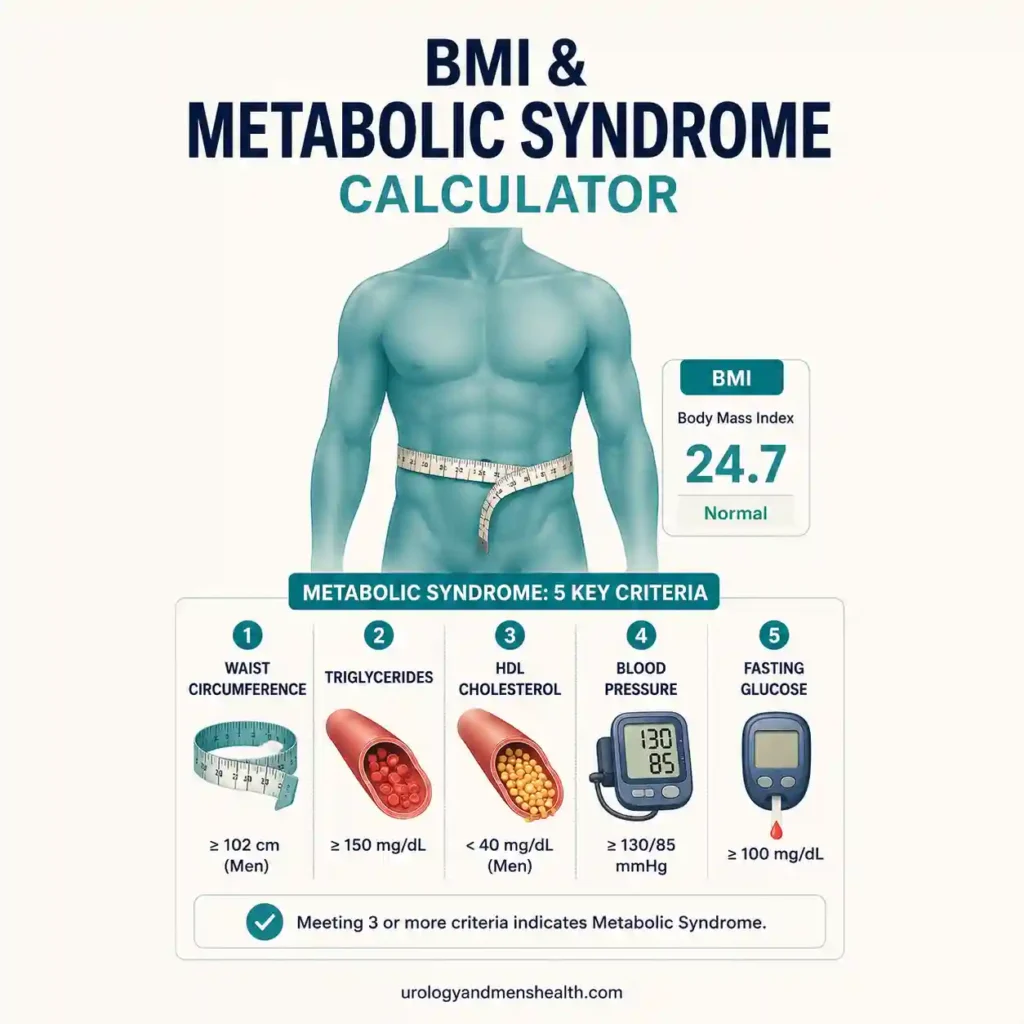
This metabolic syndrome calculator combines your BMI with the five clinical criteria doctors use to flag cardiometabolic risk in men: waist size, triglycerides, HDL cholesterol, blood pressure, and fasting glucose. Enter what you know, and you will see how many criteria you meet, what your BMI category means for your background, and the specific next steps to raise with your doctor. Start from the men's wellness hub for the full picture.

The Tool
Related Wellness Tools
Full Clinical Guide
In This Guide:
- Metabolic syndrome is a cluster of five risk factors; meeting three or more defines it.
- BMI is one signal, not the diagnosis – waist size and lab numbers carry the rest of the picture.
- The full syndrome is tied to roughly double the cardiovascular risk, yet it is highly reversible.
- If you are of South or East Asian background, lower waist and BMI cut-offs apply to you.
What This Tool Measures
This BMI and metabolic syndrome calculator does two jobs at once. First it works out your body mass index (BMI) – your weight in relation to your height. Then it screens for metabolic syndrome using the five criteria set out in the 2009 harmonized definition, a joint statement from the International Diabetes Federation, the American Heart Association, and the National Heart, Lung, and Blood Institute [1]. Those five are a large waist (central obesity), high triglycerides, low HDL cholesterol, raised blood pressure, and a high fasting glucose. Meeting three or more of the five is what defines the syndrome [2]. BMI on its own does not diagnose it – which is why this tool asks for the waist and lab numbers alongside your height and weight.
The Physiology Behind the Score
The thread tying all five criteria together is insulin resistance – when your cells stop responding well to insulin, the hormone that moves sugar out of the blood. Think of insulin as a key that no longer turns smoothly in the lock: the body makes more of it, and the knock-on effects show up as higher blood sugar, higher triglycerides, lower HDL, and rising blood pressure. Visceral fat – the deep fat around the organs, measured indirectly by your waist – is the main driver, which is why a 40 in (102 cm) waist in men, or 35 in (about 90 cm) for men of South or East Asian background, is one of the five criteria [1]. That is also why waist matters more than the number on the scale, and why the ED vascular risk screener often points at the same underlying problem – the arteries feel insulin resistance early.
How to Interpret Your Result
The tool sorts you into one of three bands, and the gap between them is real: a man with a healthy BMI who meets none of the criteria and a man who meets four get completely different advice, even if they weigh the same on paper. Lower risk means your BMI sits below 25 (or 23 if you are of Asian background) and no criteria are flagged – hold steady and recheck. Elevated risk means one or two criteria, or a BMI in the obese range (30 and above, or 27.5 for Asian men) – this is the reversible stage where a 5 to 10 percent weight loss does the heavy lifting. Metabolic syndrome likely means three or more criteria are met, which shifts the conversation toward confirming your numbers and deciding on treatment. The specific thresholds the tool uses – triglycerides 150 mg/dL (1.7 mmol/L), HDL under 40 mg/dL (1.0 mmol/L), blood pressure 130/85 mmHg, fasting glucose 100 mg/dL (5.6 mmol/L) – come straight from the harmonized criteria [1][2].
What to Do With Your Result
What you do next depends on the band, and the split is deliberate. If you are lower risk, the job is monitoring – log your waist, BMI, blood pressure, and a fasting lipid and glucose panel as a baseline, and recheck every one to two years. If you are at elevated risk, the highest-value move is completing the picture (a fasting lipid panel and an HbA1c) and setting a concrete weight target, because obesity alone still warrants lifestyle change even before other criteria appear. If you meet three or more criteria, the decision is no longer lifestyle-versus-nothing – it is whether lifestyle change alone is enough, or whether a statin, a blood-pressure drug, or a glucose-lowering medication should start alongside it. Because metabolic risk, low testosterone, and erectile changes often travel together, the low testosterone symptom quiz is a sensible companion check if your energy or libido has dropped. If you are unsure about your result, the PDF report this tool generates gives you a ready-made framework to bring to your next appointment.
In My Practice
The single most common thing I see men get wrong here is trusting the bathroom scale over the tape measure. Two men can weigh the same and have very different risk – the one carrying it around the middle is the one whose triglycerides and blood pressure are already drifting, because that deep abdominal fat is metabolically active in a way that thigh or hip fat is not.
If you measure only one thing between visits, make it your waist – it moves before the scale tells the full story, and it is the number that best tracks the risk this tool is screening for.
References
- Alberti KGMM, Eckel RH, Grundy SM, et al. Harmonizing the Metabolic Syndrome: A Joint Interim Statement. Circulation. 2009;120(16):1640-1645. The five criteria and ethnicity-specific waist cut-offs.
- Metabolic Syndrome. Endotext, NCBI Bookshelf (NIH). Diagnostic thresholds and population-specific waist criteria.
- Obesity Classification (WHO BMI cut-offs). World Obesity Federation. Overweight 25-29.9, obesity 30 and above.
- WHO Expert Consultation. Appropriate body-mass index for Asian populations. Lancet. 2004;363(9403):157-163. Additional action points at BMI 23 and 27.5 for Asian populations.
- Mottillo S, Filion KB, Genest J, et al. The Metabolic Syndrome and Cardiovascular Risk: A Systematic Review and Meta-Analysis. J Am Coll Cardiol. 2010;56(14):1113-1132. Roughly 2-fold increase in cardiovascular risk.
Frequently Asked Questions
What actually counts as metabolic syndrome?
Is BMI on its own enough, or do I really need the lab numbers?
Why does my South or East Asian background change the cut-offs?
How accurate is this tool, and can I rely on it?
How do I use this result at my doctor’s appointment?
Dr. Muhammad Khalid
MBBS · FCPS (Urology) · MCPS (General Surgery) · CHPE · CRSM · IMC #539472
Specialist urologist with 11+ years of clinical experience across tertiary teaching hospitals. Trained at Lady Reading Hospital and Khyber Teaching Hospital, Peshawar. Author or co-author of five peer-reviewed international publications, including in Cureus and the World Journal of Surgery. Procedural expertise: URS, PCNL, RIRS, TURP, TURBT, and major open urological surgery. Full profile →
This article is for educational purposes only and does not constitute medical advice. Always consult your physician or urologist for diagnosis and treatment decisions specific to your condition.