
Post-Operative Recovery Timeline After Urology Surgery
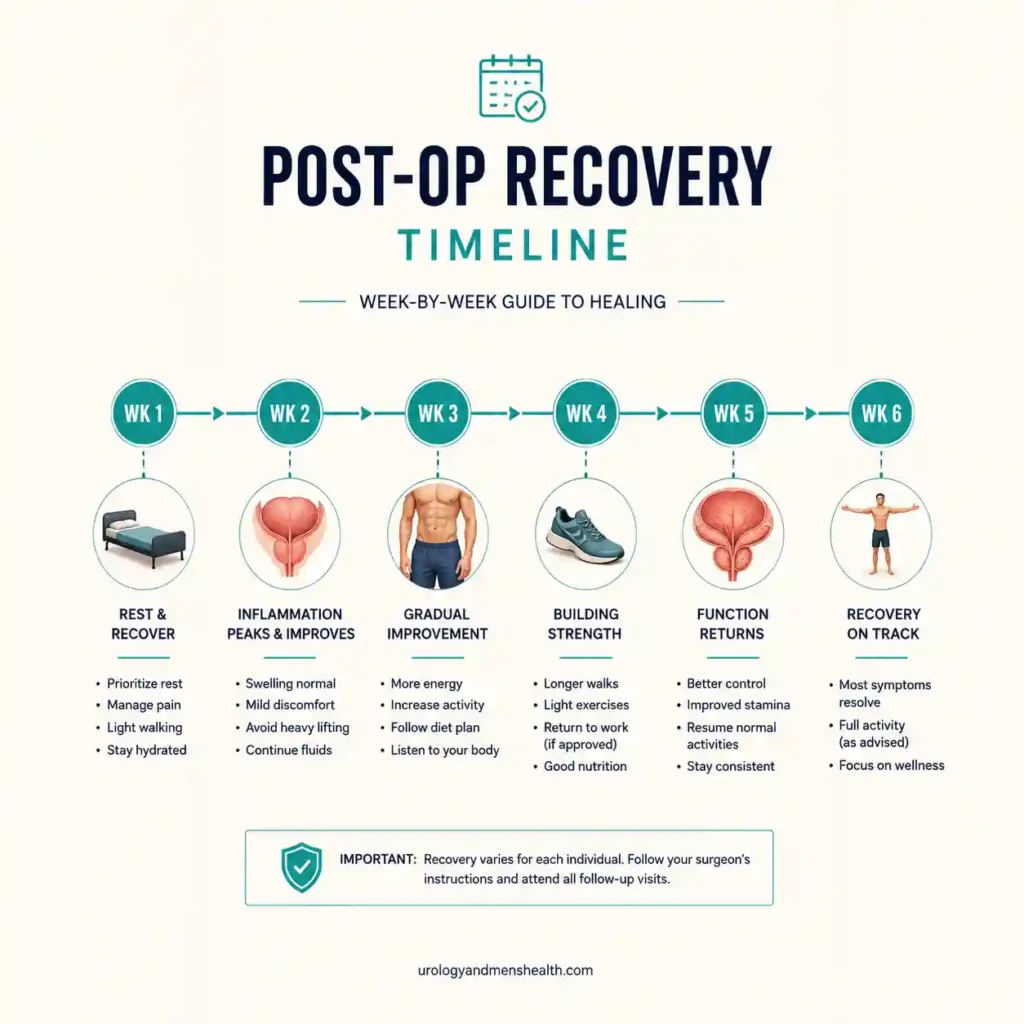
This post-operative recovery timeline tells you whether what you are feeling right now - blood, burning, pain, leaking - is on schedule for the urological operation you had, or running late enough to warrant a call. Pick your procedure, how long it has been, and your main concern. It covers TURP, HoLEP, ureteroscopy, PCNL, TURBT, prostatectomy, and day-case surgery. More recovery guidance sits in the urological surgery and recovery hub.

The Tool
Related Surgery Tools
Full Clinical Guide
In This Guide:
- Almost every worrying post-op symptom – blood, burning, urgency, leaking – is expected healing running on a schedule. What matters is whether it is still fading week on week.
- The classic TURP scare is a bleed in the second or third week, when the healing surface inside the prostate separates. It is on schedule, not a tear.
- Fever, retention, heavy clots, or calf and chest symptoms are never part of the curve. Those go to the emergency room or the on-call team the same day.
- Every operation has one milestone that decides your follow-up: the stent removal date, the 3-month cystoscopy, the first PSA, or the semen test. Know which one is yours.
What This Post-Operative Recovery Timeline Measures
This post-operative recovery timeline does not produce a validated score, and it would be dishonest to pretend otherwise – there is no equivalent of the IPSS for surgical healing. What it does instead is compare three things you can answer accurately – which operation you had, how long ago, and what is bothering you now – against the recovery windows and follow-up milestones published in the AUA and EAU guidelines for each of those procedures [1][2][3]. The output is a routing decision, not a diagnosis: on track, worth a call, or get seen now.
It covers the six operations that generate almost every anxious message I receive: TURP or HoLEP, ureteroscopy with a stent, PCNL, TURBT, radical prostatectomy, and day-case work such as flexible cystoscopy, adult circumcision, and vasectomy.
Why Urological Healing Runs On A Schedule
Every urological operation leaves a raw internal surface inside a system that is continuously washed with urine. A scraped knee scabs over in air and is then left alone; the equivalent surface inside your prostate or ureter is bathed in fluid, brushed by every stent and catheter, and stretched by every void. That is why urological healing announces itself in the urine – and why it announces itself on a timetable.
After a TURP, bleeding usually settles over about three weeks, and the raw prostatic fossa re-lines itself with a surface that separates in the second or third week – which is why a man who has been clear for ten days suddenly passes visible blood and is convinced he has torn something [4][5]. A ureteric stent behaves completely differently, because it is a foreign body: it rubs the bladder trigone and refluxes urine back toward the kidney every time you pass water. In the study that validated the stent symptom questionnaire, 78% of 85 patients reported bothersome urinary symptoms and more than 80% had stent pain interfering with daily activities [6]. After a radical prostatectomy, the sphincter that was previously backed up by the prostate is working alone, which is why leaking is expected early and why the guidelines describe it improving toward baseline over a full twelve months [7].
How To Read Your Result
Two men call me with blood in the urine. One had a TURP eleven days ago; the other had a TURP four months ago. Same symptom, same color, same alarm in the voice – and completely different advice. The first gets a glass of water and a reassuring sentence. The second gets a flexible cystoscopy, because bleeding that far out is no longer healing and usually means a narrowing, a residual chip of tissue, or something in the bladder that was never the prostate’s fault. The tool exists to tell those two men apart.
| Operation | Normal early | Usually settled by | The milestone that matters |
|---|---|---|---|
| TURP or HoLEP | Blood, burning, urgency; a bleed in week 2 to 3 | Bleeding about 3 weeks; storage symptoms ease over the first 1 to 3 months | Retrograde ejaculation follows roughly two thirds of TURPs [1] |
| Ureteroscopy with a stent | Blood, urgency, flank pain on voiding | Within days of stent removal, usually at 1 to 2 weeks | Confirm the removal date – a retained stent encrusts [6] |
| PCNL | Blood, flank ache, real tiredness | 2 to 4 weeks | Fever follows about 1 in 9 and transfusion about 1 in 14 – fever is never routine [2] |
| TURBT | Blood; burning from the chemotherapy instillation | 1 to 2 weeks | First surveillance cystoscopy at 3 to 4 months [3][8] |
| Radical prostatectomy | Leaking after catheter removal | Improves toward baseline by 12 months [7] | The first PSA, and starting pelvic floor training early |
| Day case (cystoscopy, circumcision, vasectomy) | Pink urine, ache, bruising | 48 hours to 2 weeks | Post-vasectomy semen test from 8 weeks [9] |
What To Do With Your Result
On track. Do nothing clever. Keep fluids at roughly 2 to 2.5 liters (around 68 to 85 fl oz) a day unless your team has restricted them, stay off lifting above roughly 5 kg (about 10 lb), and record one word a day: better, same, or worse. Put your next milestone in the calendar today.
Worth a call. A stalled recovery is almost never a new disease. It is one of four things – infection, a device still in place, a residual stone fragment, or scar tissue narrowing the channel – and each has its own quick test. Ask for a urine culture plus a flow test (uroflowmetry) with a post-void residual scan, and ask your team to confirm from the record that every stent and tube is actually out. If you are weighing up a future operation, the day-by-day post-op recovery planner covers the preparation side.
Get seen now. Retention, fever, heavy clots, and calf or chest symptoms are not on any recovery curve. Take your operation note, discharge letter, and medication list, and say early if you are on a blood thinner. If you are unsure about your result, the PDF report this tool generates gives you a ready-made framework to bring to your next appointment.
In My Practice
The most useful question I ask a worried man is not “how bad is it?” but “is it better or worse than three days ago?” A man passing bright blood that is lighter each day is healing. A man passing lighter blood that has been exactly the same shade for three weeks is the one I bring in for a camera. Severity is what frightens people. Direction is what tells me anything.
Before you call, spend two minutes working out your direction of travel. It changes the conversation from “I am worried” to “this has been static for three weeks” – and the second sentence is the one that gets you the right test.
References
- American Urological Association. Management of Lower Urinary Tract Symptoms Attributed to Benign Prostatic Hyperplasia: Surgical Therapy. AUA Guideline. Meta-analysis cited: retrograde ejaculation 65.4% after TURP versus 18.2% after TUIP.
- European Association of Urology. Guidelines on Urolithiasis. EAU Guideline. Review of almost 12,000 patients: PCNL fever 10.8%, transfusion 7%, sepsis 0.5%.
- American Urological Association / Society of Urologic Oncology. Diagnosis and Treatment of Non-Muscle Invasive Bladder Cancer. AUA/SUO Guideline. First surveillance cystoscopy within three to four months.
- Chen JS et al. Secondary hemorrhage after bipolar transurethral resection and vaporization of prostate. Prospective cohort, 316 patients. Defines secondary hemorrhage as bleeding between 48 hours and 30 days after surgery.
- Haematuria and clot retention after transurethral resection of the prostate: a pilot study. PubMed 9839574. Postoperative bleeding usually stops within three weeks of TURP.
- Joshi HB et al. Indwelling ureteral stents: evaluation of symptoms, quality of life and utility. J Urol 2003. PubMed 12576847. 85 patients; 78% bothersome urinary symptoms, more than 80% stent pain affecting daily activities.
- American Urological Association / GURS / SUFU. Incontinence after Prostate Treatment. AUA/GURS/SUFU Guideline. Incontinence is expected short-term and generally improves toward baseline by twelve months.
- European Association of Urology. Non-muscle-invasive Bladder Cancer: Follow-up. EAU Guideline. First cystoscopy three months after TURBT in all TaT1 and CIS patients.
- American Urological Association. Vasectomy Guideline (2026). AUA Guideline. A post-vasectomy semen sample may be submitted as early as eight weeks.
Frequently Asked Questions
Is blood in my urine normal after prostate surgery?
After a TURP or HoLEP, yes – and the pattern matters more than the color. Bleeding usually settles over about three weeks, and a brief return of visible blood in the second or third week is the classic pattern as the healing surface inside the prostate separates. What is not routine: heavy red bleeding with clots, or clots that block your flow. That is an emergency room visit, not a phone call.
How long should a ureteric stent make me feel this bad?
Stents are genuinely miserable, and that is not a sign anything went wrong. In the study that validated the stent symptom questionnaire, 78% of 85 patients reported bothersome urinary symptoms and more than 80% had stent pain affecting daily activities. Symptoms usually fall away within days of removal. If you are still suffering weeks later, the first question is whether the stent was actually removed – track it with my ureteral stent symptom tracker.
When is a fever after urological surgery an emergency?
Treat any temperature above 38C (100.4F) after stone or prostate surgery as urgent, the same day. The urinary tract drains straight into the bloodstream, and fever follows roughly one in nine PCNL procedures. Men delay because they feel otherwise well – that is exactly when it moves fastest. Being unable to pass urine is the other same-day problem; my guide to postoperative urinary retention explains why it happens.
How accurate is this tool, and can I rely on it?
It is a screening aid, not a diagnosis, and it is deliberately not presented as a validated score – no validated instrument exists for surgical recovery timing. It compares your answers against the recovery windows and follow-up milestones published in the AUA and EAU guidelines for each procedure. It cannot examine you or read your operation note. Use it to decide whether to call, never to decide that you do not need to.
How do I use this result at my doctor’s appointment?
Press Download My Report. You get a two-page PDF: page one records which operation you had, how long it has been, and what you reported; page two carries my interpretation, your next steps, and questions written to force a decision rather than reassurance. Hand it over at the start of the appointment. It saves the first five minutes of every consultation.
Dr. Muhammad Khalid
MBBS · FCPS (Urology) · MCPS (General Surgery) · CHPE · CRSM · IMC #539472
Specialist urologist with 11+ years of clinical experience across tertiary teaching hospitals. Trained at Lady Reading Hospital and Khyber Teaching Hospital, Peshawar. Author or co-author of five peer-reviewed international publications, including in Cureus and the World Journal of Surgery. Procedural expertise: URS, PCNL, RIRS, TURP, TURBT, and major open urological surgery. Full profile →
This article is for educational purposes only and does not constitute medical advice. Always consult your physician or urologist for diagnosis and treatment decisions specific to your condition.